Species · Reptiles
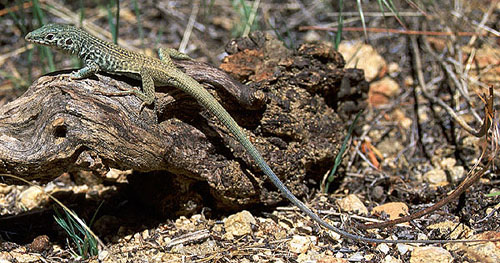
Baja California Whiptail Aspidoscelis labialis
The scientific name of the Baja California Whiptail is Aspidoscelis labialis. It is a species of reptile in the family Teiidae (tegus), order Squamata. The name dates from 1890.
- Scientific name
- Aspidoscelis labialis (Stejneger, 1890)
- Common name
- Baja California Whiptail
- Genus
- Aspidoscelis
- Family
- Teiidae (Tegus)
- Order
- Squamata
- Class
- Reptilia
- Red List category
- VU Vulnerable
- Recorded in
- 1 country
- Name status
- accepted in the Catalogue of Life

Overview
The Baja California whiptail (Aspidoscelis labialis) is a species of teiid lizard endemic to the Baja California Peninsula in Mexico.
Classification of the Baja California Whiptail
| Kingdom | Animalia |
|---|---|
| Phylum | Chordata |
| Subphylum | Vertebrata |
| Infraphylum | Gnathostomata |
| Parvphylum | Osteichthyes |
| Megaclass | Tetrapoda |
| Class | Reptilia (Reptile) |
| Order | Squamata (Snakes) |
| Suborder | Autarchoglossa |
| Family | Teiidae (Tegus) |
| Genus | Aspidoscelis (North American Whiptails) |
| Species | Aspidoscelis labialis (Stejneger, 1890) |
Where the Baja California Whiptail is found
Checklists and occurrence records place Aspidoscelis labialis in 1 country across North America. GBIF holds 596 georeferenced records of it.
Countries
Regions and cities with the most records
Range as the checklists state it
Mexico (Baja California)
A number beside a place is its count of GBIF occurrence records. A place without a number comes from a checklist alone. Records show where a species has been observed or collected, which can include escapes and vagrants.
Common names
English
- Baja California Whiptail
Names in 3 other languages
- Portuguese
- Cauda-de-chicote-da-baixa-california, Cauda-de-chicote-de-baja-california
- Spanish
- Huico de Baja California
- sei
- güico
Synonyms
One other scientific name has been used for this species and is now treated as a synonym of Aspidoscelis labialis.
- Cnemidophorus labialis Stejneger, 1890
Related species
-
 New Mexico WhiptailAspidoscelis neomexicanus
-
 Desert Grassland Whiptail LizardAspidoscelis uniparens
-
 Six-lined RacerunnerAspidoscelis sexlineatus
-
 Western WhiptailAspidoscelis tigris
-
 Texas Spotted WhiptailAspidoscelis gularis
- Little Striped WhiptailAspidoscelis inornatus
-
 Chihuahuan Spotted WhiptailAspidoscelis exsanguis
-
 Plateau Striped WhiptailAspidoscelis velox
Compare
Questions and answers
What is the scientific name of the Baja California Whiptail?
The scientific name of the Baja California Whiptail is Aspidoscelis labialis. Written with its author, the full name is Aspidoscelis labialis (Stejneger, 1890).
Which family does the Baja California Whiptail belong to?
Aspidoscelis labialis belongs to the family Teiidae, in the order Squamata and the class Reptilia.
Where is the Baja California Whiptail found?
Checklists and occurrence records place Aspidoscelis labialis in 1 country: Mexico.
What is the conservation status of the Baja California Whiptail?
The IUCN Red List category recorded for Aspidoscelis labialis is Vulnerable (VU).
Sources
Data
- Catalogue of Life, 2026-10-16 XR cc by
- Global Biodiversity Information Facility CC BY 4.0
- Wikidata CC0
- English Wikipedia CC BY-SA 4.0
- GeoNames CC BY 4.0
- Wikimedia Commons per image; credit shown with each image
- Within the Catalogue of Life, this name comes from The Reptile Database cc by
References
- Stejneger, & Leonhard. (1890). Description of a new lizard from Lower California. Proc. US Natl. Mus. 12: 643-644.
- Van Denburgh, J. (1895). A review of the herpetology of Lower California. Part I - Reptiles. Proc. Cal. Acad. Sci. (2) 5: 77-163.
- Gadow, H. (1906). A contribution to the study of evolution based upon the Mexican species of Cnemidophorus. Proc. Zool. Soc. London 1906: 277-375 (+ Maps).
- Burt, C. E. (1931). A study of the teiid lizards of the genus Cnemidophorus with special reference to their phylogenetic relationships. Bull. US Natl. Mus. 154: 286 Pp.
- Tevis, lloyd, Jr. (1944). Herpetological notes from lower California. Copeia 1944 (1): 6-18.
- Smith, H. M., & Taylor, E. H. (1950). An annotated checklist and key to the reptiles of Mexico exclusive of the snakes. Bull. US Natl. Mus. 199: 1-253.
- Duellman, W. E., & ZWEIFEL, R. G. (1962). A synopsis of the lizards of the sexlineatus group (genus Cnemidophorus). Bull. Amer. Mus. Nat. Hist. 123: 155-210.
- Lowe, Charles H., Jr;Wright, John W.;Norris, Kenneth S. (1966). Analysis of the herpetofauna of Baja California, Mexico IV. The Baja California striped whiptail, Cnemidophorus labialis, with key to the striped - unspotted whiptails of the southwest. Journal of the Arizona Academy of Science 4 (2): 121-127.
- Bostic, D. L. (1971). Herpetofauna of the Pacific Coast of north central Baja California, Mexico, with a description of a new subspecies of Phyllodactylus xanti. Transactions of the San Diego Society of Natural History, 16: 237—263.
- Stebbins, R. C. (1985). A Field Guide to Western Reptiles and Amphibians, 2nd ed. Houghton Mifflin, Boston.
- Maslin, T., & Secoy, D. M. (1986). A checklist of the lizard genus Cnemidophorus (Teiidae). Contr. Zool. Univ. Colorado Mus. 1: 1-60.
- REEDER, T.W.; CHARLES J. COLE AND HERBERT C. DESSAUER. (2002). Phylogenetic Relationships of Whiptail Lizards of the Genus Cnemidophorus (Squamata: Teiidae): A Test of Monophyly, Reevaluation of Karyotypic Evolution, and Review of Hybrid Origins. American Museum Novitates 3365: 1-64.
- Jones, L. L., & Lovich, R. E. (2009). Lizards of the American Southwest. A photographic field guide. Rio Nuevo Publishers, Tucson, AZ, 568 Pp. [Review in Reptilia 86: 84].
- Goldberg, S. R., Bursey, C. R., & Arreola, J. (2012). Aspidoscelis labialis (Baja California whiptail) endoparasites. Herpetological Review 43: 643-644.
- Goldberg, S. R. (2012). Aspidoscelis labialis (Baja California whiptail) reproduction. Herpetological Review 43: 643.
- WALKER, JAMES M. (2022). ASPIDOSCELIS LABIALIS (Baja California Whiptail). BODY SIZE and REPRODUCTION. Herpetological Review 53 (2): 317–319.
- Peralta-García A, Valdez-Villavicencio JH, Fucsko LA, Hollingsworth BD, Johnson JD, Mata-Silva V, Rocha A, DeSantis DL, Porras LW, and Wilson LD. (2023). The herpetofauna of the Baja California Peninsula and its adjacent islands, Mexico: composition, distribution, and conservation status. Amphibian & Reptile Conservation 17(1&2): 57–142.
This species in other databases
Page built on 26 November 2026. See how the catalog is made and all sources and licences.
Cite this page
ScientificNames.org. (2026). Aspidoscelis labialis (Baja California Whiptail). Retrieved November 26, 2026, from https://scientificnames.org/species/aspidoscelis-labialis
“Aspidoscelis labialis (Baja California Whiptail).” ScientificNames.org, 2026, scientificnames.org/species/aspidoscelis-labialis. Accessed 26 Nov. 2026.
ScientificNames.org. “Aspidoscelis labialis (Baja California Whiptail).” Accessed November 26, 2026. https://scientificnames.org/species/aspidoscelis-labialis.
@misc{scientificnames_aspidoscelis_labialis_baja_california_whiptail,
  author = {{ScientificNames.org}},
  title = {Aspidoscelis labialis (Baja California Whiptail)},
  year = {2026},
  url = {https://scientificnames.org/species/aspidoscelis-labialis},
  note = {Accessed 2026-11-26}
}