Species · Reptiles
Marbled Whiptail Aspidoscelis marmoratus
The scientific name of the Marbled Whiptail is Aspidoscelis marmoratus. It is a species of reptile in the family Teiidae (tegus), order Squamata. The name dates from 1852.
- Scientific name
- Aspidoscelis marmoratus (Baird & Girard, 1852)
- Common name
- Marbled Whiptail
- Genus
- Aspidoscelis
- Family
- Teiidae (Tegus)
- Order
- Squamata
- Class
- Reptilia
- Recorded in
- 2 countries
- Name status
- accepted in the Catalogue of Life
Overview
The Marbled Whiptail is a reptile in the family Teiidae, order Squamata, and class Reptilia. It occurs in southern New Mexico and Texas in the United States and in Coahuila, Chihuahua, and Durango in northern Mexico. It can reproduce through facultative parthenogenesis, producing offspring with genome-wide homozygosity.
Written 27 November 2026 from the sources listed below. Each statement was checked against the passage it cites; statements that could not be supported were removed.
Appearance
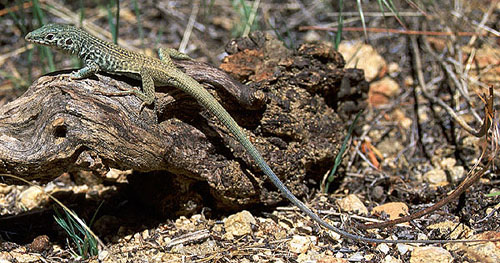
The Marbled Whiptail has a slender body and a long tail. Its overall coloration is grey or black, with four to eight yellow or white stripes and often dark mottling.[1][2]
Its underside is white or pale yellow, and its throat has a peach coloration. Hatchlings resemble adults but have brightly blue-colored tails.[3][4]
Adults measure between 8 and 12 inches in total length.[5]
Habitat
Its preferred habitats include semiarid sandy areas with sparse vegetation and open woodland edges.[6]
Diet
The Marbled Whiptail is insectivorous.[7]
Behaviour
The Marbled Whiptail is active during daylight hours. It is wary, energetic, and fast-moving, and retreats into cover when approached.[8][9]
Reproduction and life cycle
Breeding occurs during spring. A female can lay as many as four eggs between May and August, and females occasionally produce a second clutch in mid-summer.[10][11][12]
Eggs generally hatch in August during the wet season. Egg incubation lasts approximately six to eight weeks.[13][14]
The species can undergo facultative parthenogenesis through a post-meiotic mechanism involving haploid unfertilized oocytes. A small proportion of unfertilized oocytes undergo parthenogenesis and develop normally.[15][16]
Females housed with both conspecific and heterospecific males have produced unfertilized eggs that developed spontaneously. A single clutch can contain offspring originating from both fertilized eggs and parthenogenetic development.[17][18]
The post-meiotic mechanism of facultative parthenogenesis can eliminate all heterozygosity in one generation. Facultative parthenogenesis produces offspring with genome-wide homozygosity.[19][20]
Complete homozygosity associated with facultative parthenogenesis can expose genetic load and is associated with congenital malformations and embryonic mortality.[21]
Classification of the Marbled Whiptail
| Kingdom | Animalia |
|---|---|
| Phylum | Chordata |
| Subphylum | Vertebrata |
| Infraphylum | Gnathostomata |
| Parvphylum | Osteichthyes |
| Megaclass | Tetrapoda |
| Class | Reptilia (Reptile) |
| Order | Squamata (Snakes) |
| Suborder | Autarchoglossa |
| Family | Teiidae (Tegus) |
| Genus | Aspidoscelis (North American Whiptails) |
| Species | Aspidoscelis marmoratus (Baird & Girard, 1852) |
Where the Marbled Whiptail is found
Checklists and occurrence records place Aspidoscelis marmoratus in 2 countries across North America. GBIF holds 6,963 georeferenced records of it.
Countries
Regions and cities with the most records
- Texas, United States 1,646
- New Mexico, United States 1,598
- Las Cruces, United States 684
- Chihuahua, Mexico 561
- Coahuila, Mexico 496
- El Paso, United States 357
- Ciudad Juárez, Mexico 333
- Sunland Park, United States 322
- Horizon City, United States 97
- Manuel Ojinaga, Mexico 57
- Ciudad Delicias, Mexico 42
- Pedro Meoqui, Mexico 42
- Socorro Mission Number 1 Colonia, United States 41
- Torreón, Mexico 39
- Socorro, United States 38
- Francisco I. Madero, Mexico 37
- Durango, Mexico 32
- San Pedro, Mexico 32
- Santa Rosalía de Camargo, Mexico 23
- Ojinaga, Mexico 19
- Carlsbad, United States 16
- Sonora, Mexico 14
- Frontera, Mexico 12
- Monclova, Mexico 12
- Hobbs, United States 11
- Nuevo León, Mexico 11
- San Buenaventura, Mexico 9
- Alamogordo, United States 8
- Castaños, Mexico 8
- Matamoros, Mexico 8
- Lerdo, Mexico 7
- Gómez Palacio, Mexico 6
- Juan Aldama, Mexico 6
- Baja California Sur, Mexico 4
- Chihuahua, Mexico 4
- Victoria de Durango, Mexico 3
Range as the checklists state it
USA (SW New Mexico, Texas)
Middle America
A number beside a place is its count of GBIF occurrence records. A place without a number comes from a checklist alone. Records show where a species has been observed or collected, which can include escapes and vagrants.
Common names
English
- Marbled Whiptail
- Eastern Black-throated Whiptail
- Eastern Marbled Whiptail [reticuloriens]
- Western Marbled Whiptail
- Western Marbled Whiptail [marmorata]
Names in 4 other languages
- Danish
- Marmor-piskehaleteju
- Japanese
- マダラハシリトカゲ
- Portuguese
- Cauda-de-chicote-marmorado
- Spanish
- Huico Marmóreo, Huico de Garganta Negra del Oriente, Huico marmoleado
Synonyms
8 other scientific names have been used for this species and are now treated as synonyms of Aspidoscelis marmoratus.
- Aspidoscelis tigris marmorata (Baird & Girard, 1852)
- Aspidoscelis tigris nigroriens (Hendricks & Dixon, 1986)
- Cnemidophorus marmoratus Baird & Girard, 1852
- Cnemidophorus marmoratus nigroriens Hendricks & Dixon, 1986
- Cnemidophorus marmoratus reticuloriens Hendricks & Dixon, 1986
- Cnemidophorus tigris marmoratus Baird & Girard, 1852
- Cnemidophorus tigris pulcher Williams, Smith & Chrapliwy, 1960
- Cnemidophorus variolosus Cope, 1863
Subspecies and varieties
- Aspidoscelis marmoratus marmoratus (Western Marbled Whiptail) subspecies
- Aspidoscelis marmoratus pulcher (Beautiful Marbled Whiptail) subspecies
- Aspidoscelis marmoratus reticuloriens (Eastern Marbled Whiptail) subspecies
- Aspidoscelis marmoratus variolosus subspecies
Related species
-
 New Mexico WhiptailAspidoscelis neomexicanus
-
 Desert Grassland Whiptail LizardAspidoscelis uniparens
-
 Six-lined RacerunnerAspidoscelis sexlineatus
-
 Western WhiptailAspidoscelis tigris
-
 Texas Spotted WhiptailAspidoscelis gularis
- Little Striped WhiptailAspidoscelis inornatus
-
 Chihuahuan Spotted WhiptailAspidoscelis exsanguis
-
 Plateau Striped WhiptailAspidoscelis velox
Compare
Questions and answers
What is the scientific name of the Marbled Whiptail?
The scientific name of the Marbled Whiptail is Aspidoscelis marmoratus. Written with its author, the full name is Aspidoscelis marmoratus (Baird & Girard, 1852).
Which family does the Marbled Whiptail belong to?
Aspidoscelis marmoratus belongs to the family Teiidae, in the order Squamata and the class Reptilia.
Where is the Marbled Whiptail found?
Checklists and occurrence records place Aspidoscelis marmoratus in 2 countries: United States and Mexico.
What other names does the Marbled Whiptail have?
Aspidoscelis marmoratus is also known in English as Eastern Black-throated Whiptail, Eastern Marbled Whiptail [reticuloriens], Western Marbled Whiptail and Western Marbled Whiptail [marmorata].
What do whiptail lizards eat?
The Marbled Whiptail is insectivorous.[7]
Sources
Passages the profile rests on
- Its overall coloration is grey or black, with four to eight yellow or white stripes and often dark mottling. Source passage: “It is grey or black overall in color with 4 to 8 yellow or white stripes, often with dark mottling, giving it a marbled appearance.” — English Wikipedia
- The species has a slender body and a long tail. Source passage: “They are slender bodied, with long tails.” — English Wikipedia
- Its underside is white or pale yellow, and its throat has a peach coloration. Source passage: “Their underside is white or pale yellow, with a peach coloration on the throat.” — English Wikipedia
- Hatchlings resemble adults but have brightly blue-colored tails. Source passage: “Hatchlings look much like the adults, except they have bright blue colored tails.” — English Wikipedia
- Adults measure between 8 and 12 inches in total length. Source passage: “The marbled whiptail grows from 8 to 12 inches in length.” — English Wikipedia
- Its preferred habitats include semiarid sandy areas with sparse vegetation and open woodland edges. Source passage: “Its preferred habitat is semiarid, sandy areas with sparse vegetation, or the open edges of wooded areas.” — English Wikipedia
- The species is insectivorous. Source passage: “Like most other species of whiptail lizards, the marbled whiptail is diurnal and insectivorous.” — English Wikipedia
- The species is active during daylight hours. Source passage: “Like most other species of whiptail lizards, the marbled whiptail is diurnal and insectivorous.” — English Wikipedia
- It is wary, energetic, and fast-moving, and it retreats into cover when approached. Source passage: “It is wary, energetic, and fast moving, darting for cover if approached.” — English Wikipedia
- Breeding occurs during spring. Source passage: “Breeding takes place in the spring, with up to four eggs laid sometime between the months of May and August, hatch happening usually in August during the wet season.” — English Wikipedia
- A female can lay as many as four eggs between May and August. Source passage: “Breeding takes place in the spring, with up to four eggs laid sometime between the months of May and August, hatch happening usually in August during the wet season.” — English Wikipedia
- Females occasionally produce a second clutch of eggs in mid-summer. Source passage: “A second clutch of eggs is occasionally laid in mid summer.” — English Wikipedia
- Eggs generally hatch in August during the wet season. Source passage: “hatch happening usually in August during the wet season.” — English Wikipedia
- Egg incubation lasts approximately six to eight weeks. Source passage: “The eggs hatch in six to eight weeks.” — English Wikipedia
- The species can undergo facultative parthenogenesis through a post-meiotic mechanism involving haploid unfertilized oocytes. Source passage: “Facultative parthenogenesis can occur in A. marmoratus haploid unfertilized oocytes by a post-meiotic mechanism resulting in genome wide homozygosity.” — English Wikipedia
- A small proportion of unfertilized oocytes undergo parthenogenesis and develop normally. Source passage: “in A. marmoratus a small percentage of unfertilized oocytes undergo parthenogenesis and yet develop normally.” — English Wikipedia
- Females housed with both conspecific and heterospecific males have produced unfertilized eggs that developed spontaneously. Source passage: “Contrary to the widely held belief that females need to be isolated from males to undergo FP, females housed with conspecific and heterospecific males produced unfertilized eggs that underwent spontaneous development.” — pmc.ncbi.nlm.nih.gov
- A single clutch can contain offspring originating from both fertilized eggs and parthenogenetic development. Source passage: “In addition, offspring arising from both fertilized eggs and parthenogenetic development were observed to arise from a single clutch.” — pmc.ncbi.nlm.nih.gov
- Facultative parthenogenesis in this species produces offspring with genome-wide homozygosity. Source passage: “Here, we show that FP occurring in the gonochoristic Aspidoscelis species A. marmoratus and A. arizonae results in genome-wide homozygosity” — pmc.ncbi.nlm.nih.gov
- The post-meiotic mechanism of facultative parthenogenesis can eliminate all heterozygosity in one generation. Source passage: “Strikingly, our data support a mechanism for facultative parthenogenesis that removes all heterozygosity in a single generation.” — pmc.ncbi.nlm.nih.gov
- Complete homozygosity associated with facultative parthenogenesis can expose genetic load and is associated with congenital malformations and embryonic mortality. Source passage: “Complete homozygosity exposes the genetic load and explains the high rate of congenital malformations and embryonic mortality associated with FP in many species.” — pmc.ncbi.nlm.nih.gov
- The species occurs in southern New Mexico and Texas in the United States and in Coahuila, Chihuahua, and Durango in northern Mexico. Source passage: “The marbled whiptail (Aspidoscelis marmoratus) is a species of lizard found in the United States, in southern New Mexico and Texas, and in northern Mexico, in Coahuila, Chihuahua and Durango.” — English Wikipedia
Data
- Catalogue of Life, 2026-10-16 XR cc by
- Global Biodiversity Information Facility CC BY 4.0
- Wikidata CC0
- GeoNames CC BY 4.0
- Within the Catalogue of Life, this name comes from The Reptile Database cc by
References
- Baird, S.F. and Girard,C. (1852). Characteristics of some new reptiles in the Museum of the Smithsonian Institution, part 2. Proc. Acad. Nat. Sci. Philadelphia 6: 125-129.
- Cope, E. D. (1892). A synopsis of the species of the teiid genus Cnemidophorus. Trans. Am. Phil. Soc. (Ser. 2) 17 (1): 27-52 [1893].
- Burger, & Leslie, W. (1950). New, revived, and reallocated names for North American whiptailed lizards, Genus Cnemidophorus. Natural History Miscellanea, Chicago Acad. Sci. (65): 1-9.
- Smith, H. M., & Taylor, E. H. (1950). An annotated checklist and key to the reptiles of Mexico exclusive of the snakes. Bull. US Natl. Mus. 199: 1-253.
- Zweifel, Richard G. (1958). Cnemidophorus tigris variolosus, a revived subspecies of whiptail lizard from Mexico. Southwestern Naturalist 9: 94-101.
- Williams, Kenneth L.;Smith, Hobart M.;Chrapliwy, Pete S. (1960). Turtles and lizards from Northern Mexico. Transactions of the Illinois State Academy of Science 53 (1/2): 36-45.
- Taylor, Harry L. (1968). The occurrence of the teiid lizard Cnemidophorus tigris marmoratus in Arizona. Herpetologica 24 (2): 162-168.
- Burkholder, G.L. & J.M. Walker. (1973). Habitat and Reproduction of the Desert Whiptail Lizard, Cnemidophorus tigris Baird and Girard in Southwestern Idaho at the Northern Part of Its Range. Herpetologica 29 (1): 76-83.
- Vance, & Thomas. (1978). A field key to the whiptail lizards (genus Cnemidophorus) Part I: The whiptails of the United States. Bull. Maryland Herp. Soc. 14 (1): 1-9.
- Maslin, T., & Secoy, D. M. (1986). A checklist of the lizard genus Cnemidophorus (Teiidae). Contr. Zool. Univ. Colorado Mus. 1: 1-60.
- Hendricks, F. S., & Dixon, J. R. (1986). Systematics and biogeography of Cnemidophorus marmoratus (Sauria: Teiidae). Texas Journal of Science 38: 327-402.
- Tanner, W. W. (1987). Lizards and turtles of Western Chihuahua. Great Basin Naturalist. 47: 383-421.
- Conant, R., & Collins, J. T. (1991). A Field Guide to Reptiles and Amphibians of Eastern/Central North America, 3rd ed. Houghton Mifflin (Boston/New York), Xx + 450 P.
- Dessauer, H. C., & Cole, C. J. (1991). Genetics of whiptail lizards (Reptiia: Teiidae: Cnemidophorus) in a hybrid zone in southwestern New Mexico. Copeia 1991 (2): 622-637.
- Price, A. H. (1992). Comparative behavior in lizards of he genus Cnemidophorus (Teiidae), with comments on the evolution of pathenogenesis in reptiles. Copeia 1992 (2): 323-331.
- Bartlett, R. D., & Bartlett, P. (1999). A Field Guide to Texas Reptiles and Amphibians. Gulf Publishing Co., Houston, Texas, 331 Pp.
- Dixon, James R. (2000). Amphibians and reptiles of Texas, second edition. Texas A&M University Press, 421 Pp.
- Taylor, H.L.; Charles J. Cole; Laurence M. Hardy; Herbert C. Dessauer; Carol R. Townsend; James M. Walker; and James E. Cordes. (2001). Natural hybridization between the teiid lizards Cnemidophorus tesselatus (parthenogenetic) and C. tigris marmoratus (bisexual) : assessment of evolutionary alternatives. American Museum Novitates 3345: 1-64.
- REEDER, T.W.; CHARLES J. COLE AND HERBERT C. DESSAUER. (2002). Phylogenetic Relationships of Whiptail Lizards of the Genus Cnemidophorus (Squamata: Teiidae): A Test of Monophyly, Reevaluation of Karyotypic Evolution, and Review of Hybrid Origins. American Museum Novitates 3365: 1-64.
- Mata-Silva, Vicente, Charles R. Bursey and Jerry D. Johnson. (2008). Gut Parasites of Two Syntopic Species of Whiptail Lizards (Aspidoscelis marmorata and Aspidoscelis tesselata) from the Northern Chihuahuan Desert. Boletin de La Sociedad Herpetologica Mexicana 16(1):1-4.
- Jones, L. L., & Lovich, R. E. (2009). Lizards of the American Southwest. A photographic field guide. Rio Nuevo Publishers, Tucson, AZ, 568 Pp. [Review in Reptilia 86: 84].
- COLE, CHARLES J.; LAURENCE M. HARDY, HERBERT C. DESSAUER, HARRY L. TAYLOR, AND CAROL R. TOWNSEND. (2010). Laboratory Hybridization among North American Whiptail Lizards, Including Aspidoscelis inornata arizonae × A. tigris marmorata (Squamata: Teiidae), Ancestors of Unisexual Clones in Nature. American Museum Novitates 3698: 1-43.
- Mata-Silva, Vicente, Aurelio Ramirez-Bautista, and Jerry D. Johnson. (2010). Reproductive Characteristics of Two Syntopic Species of Whiptail Lizards (Aspidoscelis marmorata and Aspidoscelis tesselata) from the Northern Chihuahuan Desert. Southwestern Naturalist 55:125-129.
- Taylor, Harry L.; Charles J. Cole, Glenn J. Manning, James E. Cordes, and James M. Walker. (2012). Comparative Meristic Variability in Whiptail Lizards (Teiidae, Aspidoscelis): Samples of Parthenogenetic A. tesselata Versus Samples of Sexually Reproducing A. sexlineata, A. marmorata, and A. gularis septemvittata. American Museum Novitates (3744): 1-24.
- Acre, M. R., & Daniel J Leavitt, a. C. M. S. (2012). A Patternless Morph of the Marbled Whiptail (Aspidoscelis marmorata; Squamata: Teiidae) in New Mexico. Southwestern Naturalist 57 (2): 206-207.
This species in other databases
Page built on 28 November 2026. See how the catalog is made and all sources and licences.
Cite this page
ScientificNames.org. (2026). Aspidoscelis marmoratus (Marbled Whiptail). Retrieved November 28, 2026, from https://scientificnames.org/species/aspidoscelis-marmoratus
“Aspidoscelis marmoratus (Marbled Whiptail).” ScientificNames.org, 2026, scientificnames.org/species/aspidoscelis-marmoratus. Accessed 28 Nov. 2026.
ScientificNames.org. “Aspidoscelis marmoratus (Marbled Whiptail).” Accessed November 28, 2026. https://scientificnames.org/species/aspidoscelis-marmoratus.
@misc{scientificnames_aspidoscelis_marmoratus_marbled_whiptail,
  author = {{ScientificNames.org}},
  title = {Aspidoscelis marmoratus (Marbled Whiptail)},
  year = {2026},
  url = {https://scientificnames.org/species/aspidoscelis-marmoratus},
  note = {Accessed 2026-11-28}
}