Species · Reptiles
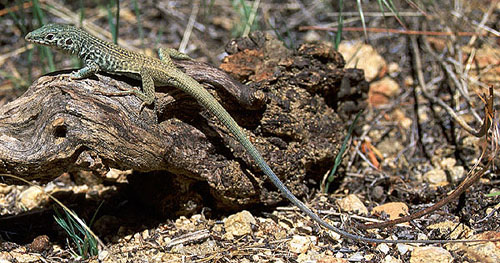
Maslin's Whiptail Aspidoscelis maslini
The scientific name of the Maslin's Whiptail is Aspidoscelis maslini. It is a species of reptile in the family Teiidae (tegus), order Squamata. The name dates from 1969.
- Scientific name
- Aspidoscelis maslini (Fritts, 1969)
- Common name
- Maslin's Whiptail
- Genus
- Aspidoscelis
- Family
- Teiidae (Tegus)
- Order
- Squamata
- Class
- Reptilia
- Red List category
- LC Least Concern
- Recorded in
- 3 countries
- Name status
- accepted in the Catalogue of Life
Overview
Maslin's Whiptail is a lizard belonging to the family Teiidae. It is native to the Mexican states of Campeche and Quintana Roo, the Guatemalan department of Petén, and Belize. It reproduces parthenogenetically and belongs to the Aspidoscelis cozumela species group.
Written 27 November 2026 from the sources listed below. Each statement was checked against the passage it cites; statements that could not be supported were removed.
Appearance
Maslin's Whiptail is a lizard belonging to the family Teiidae.[1]
Similar species
Maslin's Whiptail belongs to the Aspidoscelis cozumela species group.[2]
Reproduction and life cycle
Maslin's Whiptail reproduces by laying eggs. It reproduces parthenogenetically.[3][4]
Classification of the Maslin's Whiptail
| Kingdom | Animalia |
|---|---|
| Phylum | Chordata |
| Subphylum | Vertebrata |
| Infraphylum | Gnathostomata |
| Parvphylum | Osteichthyes |
| Megaclass | Tetrapoda |
| Class | Reptilia (Reptile) |
| Order | Squamata (Snakes) |
| Suborder | Autarchoglossa |
| Family | Teiidae (Tegus) |
| Genus | Aspidoscelis (North American Whiptails) |
| Species | Aspidoscelis maslini (Fritts, 1969) |
Where the Maslin's Whiptail is found
Checklists and occurrence records place Aspidoscelis maslini in 3 countries across North America. GBIF holds 223 georeferenced records of it.
Countries
Regions and cities with the most records
- Quintana Roo, Mexico 107
- Campeche, Mexico 54
- Chetumal, Mexico 14
- Champotón, Mexico 12
- Jalisco, Mexico 8
- Ciudad del Carmen, Mexico 7
- Stann Creek, Belize 5
Range as the checklists state it
S Mexico (coastal Campeche, Quintana Roo), Belize, Guatemala
A number beside a place is its count of GBIF occurrence records. A place without a number comes from a checklist alone. Records show where a species has been observed or collected, which can include escapes and vagrants.
Common names
English
- Maslin's Whiptail
- Maslin’s Whiptail
Names in 2 other languages
- Portuguese
- Cauda-de-chicote-de-maslin
- Spanish
- Huico de Maslin, Huico de la península de Yucatán
Synonyms
One other scientific name has been used for this species and is now treated as a synonym of Aspidoscelis maslini.
- Cnemidophorus cozumelae maslini Fritts, 1969
Related species
-
 New Mexico WhiptailAspidoscelis neomexicanus
-
 Desert Grassland Whiptail LizardAspidoscelis uniparens
-
 Six-lined RacerunnerAspidoscelis sexlineatus
-
 Western WhiptailAspidoscelis tigris
-
 Texas Spotted WhiptailAspidoscelis gularis
- Little Striped WhiptailAspidoscelis inornatus
-
 Chihuahuan Spotted WhiptailAspidoscelis exsanguis
-
 Plateau Striped WhiptailAspidoscelis velox
Compare
Questions and answers
What is the scientific name of the Maslin's Whiptail?
The scientific name of the Maslin's Whiptail is Aspidoscelis maslini. Written with its author, the full name is Aspidoscelis maslini (Fritts, 1969).
Which family does the Maslin's Whiptail belong to?
Aspidoscelis maslini belongs to the family Teiidae, in the order Squamata and the class Reptilia.
Where is the Maslin's Whiptail found?
Checklists and occurrence records place Aspidoscelis maslini in 3 countries: Mexico, Guatemala and Belize.
What is the conservation status of the Maslin's Whiptail?
The IUCN Red List category recorded for Aspidoscelis maslini is Least Concern (LC).
What other names does the Maslin's Whiptail have?
Aspidoscelis maslini is also known in English as Maslin’s Whiptail.
What kind of animal is a whiptail?
Maslin's Whiptail is a lizard belonging to the family Teiidae.[1]
Sources
Passages the profile rests on
- Aspidoscelis maslini is a lizard belonging to the family Teiidae. Source passage: “is a species of lizard in the family Teiidae.” — English Wikipedia
- Aspidoscelis maslini belongs to the Aspidoscelis cozumela species group. Source passage: “Aspidoscelis maslini is a member of the Aspidoscelis cozumela species group.” — English Wikipedia
- Aspidoscelis maslini reproduces by laying eggs. Source passage: “Aspidoscelis maslini is oviparous and parthenogenetic.” — English Wikipedia
- Aspidoscelis maslini reproduces parthenogenetically. Source passage: “Aspidoscelis maslini is oviparous and parthenogenetic.” — English Wikipedia
Data
- Catalogue of Life, 2026-10-16 XR cc by
- Global Biodiversity Information Facility CC BY 4.0
- Wikidata CC0
- GeoNames CC BY 4.0
- Within the Catalogue of Life, this name comes from The Reptile Database cc by
References
- Gadow, H. (1906). A contribution to the study of evolution based upon the Mexican species of Cnemidophorus. Proc. Zool. Soc. London 1906: 277-375 (+ Maps).
- Stuart, L. C. (1935). A contribution to a knowledge of the herpetology of a portion of the savanna region of Central Peten, Guatemala. University of Michigan Museum of Zoology Miscellaneous Publications 29: 1-56.
- Smith, H. M., & Taylor, E. H. (1950). An annotated checklist and key to the reptiles of Mexico exclusive of the snakes. Bull. US Natl. Mus. 199: 1-253.
- McCoy, C. J., & Maslin, T. P. (1962). A review of the teiid lizard Cnemidophorus cozumelus and the recognition of a new race, Cnemidophorus cozumelus rodecki. Copeia 1962 (3): 620-627.
- Fritts, T. H. (1969). The systematics of the parthenogenetic lizards ot the Cnemidophorus cozumelae complex. Copeia 1969 (3): 519-535.
- Maslin, T., & Secoy, D. M. (1986). A checklist of the lizard genus Cnemidophorus (Teiidae). Contr. Zool. Univ. Colorado Mus. 1: 1-60.
- McCOY, C. J., CENSKY, E. J., & VAN DE VENDER, R. R. (1986). Distribution records for amphibians and reptiles in Belize, Central America. Herpetological Review 17:28-29.
- Taylor, H. L., & Cooley, C. R. (1995). Patterns of meristic variation among parthenogenetic Teiid lizards (Genus Cnemidophorus) of the Yucatan Peninsula and their progenitor species, C. angusticeps and C. deppei. Journal of Herpetology 29 (4): 583-592.
- Campbell, J. A. (1998). Amphibians and reptiles of northern Guatemala, the Yucatán, and Belize. Norman: University of Oklahoma Press, Xiii + 380 Pp.
- Köhler, G. (2000). Reptilien und Amphibien Mittelamerikas, Bd 1: Krokodile, Schildkröten, Echsen. Herpeton Verlag, Offenbach, 158 Pp.
- Lee, J. C. (2000). A field guide to the amphibians and reptiles of the Maya world. Cornell University Press, Ithaca,.
- REEDER, T.W.; CHARLES J. COLE AND HERBERT C. DESSAUER. (2002). Phylogenetic Relationships of Whiptail Lizards of the Genus Cnemidophorus (Squamata: Teiidae): A Test of Monophyly, Reevaluation of Karyotypic Evolution, and Review of Hybrid Origins. American Museum Novitates 3365: 1-64.
- Manríquez-Morán, N.L.; Villagrán-Santa Cruz, M. & Méndez-de la Cruz, F.R. (2005). Reproductive biology of the parthenogenetic lizard, Aspidocelis cozumelae. Herpetologica 61 (4): 435-439.
- TAYLOR, HARRY L.; JAMES M. WALKER; JAMES E. CORDES AND GLENN J. MANNING. (2005). Application of the Evolutionary Species Concept to Parthenogenetic Entities: Comparison of Postformational Divergence in Two Clones of Aspidoscelis tesselata and between Aspidoscelis cozumela and Aspidoscelis maslini (Squamata: Teiidae. Journal of Herpetology 39 (2): 266-277.
- Cordes, James E. and James M. Walker. (2006). Evolutionary and Systematic Implications of Skin Histocompatibility Among Parthenogenetic Teiid Lizards: Three Color Pattern Classes of Aspidoscelis dixoni and One of Aspidoscelis tesselata. Copeia, 2006 (1):14-26.
- Köhler, G. (2008). Reptiles of Central America. 2nd Ed. Herpeton-Verlag, 400 Pp.
- Beolens, B., & Michael Watkins, a. M. G. (2011). The Eponym Dictionary of Reptiles. Johns Hopkins University Press, Baltimore, USA.
- Manríquez-Morán, Norma L., Fausto R. Méndez-de la Cruz, and Robert W. Murphy. (2014). Genetic Variation and Origin of Parthenogenesis in the Aspidoscelis cozumela Complex: Evidence from Mitochondrial Genes. Zoological Science 31, No. 1: 14-19.
- Taylor, Harry L.; Charles J. Cole, and Christopher R. Cooley. (2014). Origins and Evolution in the Aspidoscelis cozumela Complex of Parthenogenetic Teiid Lizards: Morphological and Karyotypic Evidence and Paradoxes. Journal of Herpetology Sep 2014, Vol. 48, No. 3: 343-354.
- Charruau, Pierre; Aníbal H. Díaz de la Vega Pérez, and Fausto R. Méndez de la Cruz. (2015). Reptiles of Banco Chinchorro: Updated List, Life History Data, and Conservation [Quintana Roo, Mexico]. Southwestern Naturalist 60(4):299-312.
- Hernandez-Gallegos, Oswaldo; Ana Esthela Lopez-Moreno, Fausto R. Mendez-de la Cruz, James M. Walker. (2018). Home range of the parthenogenetic lizard Aspidoscelis maslini (FRITTS, 1969), on a beach strand. Herpetozoa 31 (1/2): 83 - 86.
- Aguilar-López JL, Luría-Manzano R, Pineda E, & Canseco-Márquez L. (2021). Selva Zoque, Mexico: an important Mesoamerican tropical region for reptile species diversity and conservation. ZooKeys 1054: 127-153.
- Badillo-Saldaña, L. M., Pineda, E., & Ramírez-Bautista, A. (2024). From tropical forest to agroecosystems: changes in functional and species diversity of lizards in Mexican Caribbean. Agroforest Syst (2024).
This species in other databases
Page built on 27 November 2026. See how the catalog is made and all sources and licences.
Cite this page
ScientificNames.org. (2026). Aspidoscelis maslini (Maslin's Whiptail). Retrieved November 27, 2026, from https://scientificnames.org/species/aspidoscelis-maslini
“Aspidoscelis maslini (Maslin's Whiptail).” ScientificNames.org, 2026, scientificnames.org/species/aspidoscelis-maslini. Accessed 27 Nov. 2026.
ScientificNames.org. “Aspidoscelis maslini (Maslin's Whiptail).” Accessed November 27, 2026. https://scientificnames.org/species/aspidoscelis-maslini.
@misc{scientificnames_aspidoscelis_maslini_maslins_whiptail,
  author = {{ScientificNames.org}},
  title = {Aspidoscelis maslini (Maslin's Whiptail)},
  year = {2026},
  url = {https://scientificnames.org/species/aspidoscelis-maslini},
  note = {Accessed 2026-11-27}
}