Species · Reptiles
Colorado Checkered Whiptail Aspidoscelis neotesselatus
The scientific name of the Colorado Checkered Whiptail is Aspidoscelis neotesselatus. It is a species of reptile in the family Teiidae (tegus), order Squamata. The name dates from 1997.
- Scientific name
- Aspidoscelis neotesselatus (Walker, Cordes & Taylor, 1997)
- Common name
- Colorado Checkered Whiptail
- Genus
- Aspidoscelis
- Family
- Teiidae (Tegus)
- Order
- Squamata
- Class
- Reptilia
- Red List category
- NT Near Threatened
- Recorded in
- 1 country
- Name status
- accepted in the Catalogue of Life

Overview
The Colorado Checkered Whiptail is a teiid lizard in the family Teiidae, order Squamata, and class Reptilia. The species is endemic to southeastern Colorado in the United States and occurs near and within the Arkansas River drainage. The species consists entirely of females and reproduces asexually through parthenogenesis.
Written 27 November 2026 from the sources listed below. Each statement was checked against the passage it cites; statements that could not be supported were removed.
Similar species
The Colorado Checkered Whiptail is difficult to distinguish from the common checkered whiptail (Aspidoscelis tesselatus).[1]
Appearance
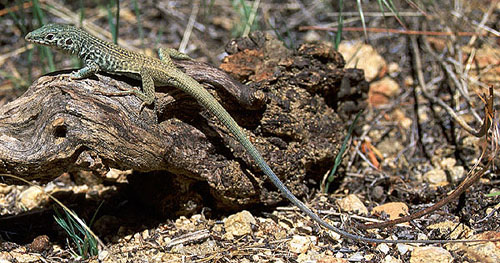
The species has granular scales, a light-colored body, and dark checkering, lines, and bars. Hatchlings and young individuals have a yellow body and bright blue tail.[2][3]
Adults average 4.2 inches in snout-to-vent length. The tail is generally longer than the body.[4][5]
Habitat
Individuals are often found in or around juniper bushes. The species also occurs in canyons and beneath trees and shrubs.[6][7]
Individuals are sometimes found basking on rocks.[8]
Behaviour
The species tends to avoid exposed open areas. Individuals are extremely fast and agile and primarily defend themselves by fleeing.[9][10][11]
Individuals can shed their tails when caught or grabbed.[12]
Reproduction and life cycle
The species consists entirely of females and reproduces asexually through parthenogenesis. Individuals possess three chromosome sets rather than two, and offspring are genetically identical to their mothers.[13][14][15][16]
The effect of clutch size on follicle size was statistically significant but not linear. Females with two-follicle clutches had larger average follicles than females with one-follicle clutches, while females with three-follicle clutches had smaller average follicles than females with two-follicle clutches.[17][18][19]
Larger females produced larger follicles regardless of clutch size. Corticosterone and innate immune function, measured through bacterial killing ability, did not affect the relationship between follicle size and clutch size.[20][21][22]
Oxidative stress explained variability in the relationship between follicle size and clutch size. Oxidative stress was more elevated in females producing larger clutches and larger follicles.[23][24]
Classification of the Colorado Checkered Whiptail
| Kingdom | Animalia |
|---|---|
| Phylum | Chordata |
| Subphylum | Vertebrata |
| Infraphylum | Gnathostomata |
| Parvphylum | Osteichthyes |
| Megaclass | Tetrapoda |
| Class | Reptilia (Reptile) |
| Order | Squamata (Snakes) |
| Suborder | Autarchoglossa |
| Family | Teiidae (Tegus) |
| Genus | Aspidoscelis (North American Whiptails) |
| Species | Aspidoscelis neotesselatus (Walker, Cordes & Taylor, 1997) |
Where the Colorado Checkered Whiptail is found
Checklists and occurrence records place Aspidoscelis neotesselatus in 1 country. GBIF holds 1,294 georeferenced records of it.
Countries
Regions and cities with the most records
- Colorado, United States 662
- Pueblo West, United States 285
- Pueblo, United States 278
- Cañon City, United States 197
- Fountain, United States 32
- Englewood, United States 30
- Lakewood, United States 29
- Washington, United States 27
- Security-Widefield, United States 26
- Colorado Springs, United States 25
- Greenwood Village, United States 25
- Moses Lake, United States 25
- Arvada, United States 21
- Broomfield, United States 21
- Commerce City, United States 21
- Northglenn, United States 21
- Sherrelwood, United States 21
- Thornton, United States 21
- Westminster, United States 21
- Wheat Ridge, United States 21
- Denver, United States 20
- Aurora, United States 19
- Littleton, United States 16
- Columbine, United States 13
- Highlands Ranch, United States 13
- Ken Caryl, United States 13
- Dakota Ridge, United States 12
- Centennial, United States 10
- Texas, United States 4
Range as the checklists state it
USA (SE Colorado, Pueblo County; introduced to Washington, Grant county).
A number beside a place is its count of GBIF occurrence records. A place without a number comes from a checklist alone. Records show where a species has been observed or collected, which can include escapes and vagrants.
Common names
English
- Colorado Checkered Whiptail
- Triploid Checkered Whiptail
Names in 1 other language
- Portuguese
- Cauda-de-chicote-xadrez-do-colorado, Cauda-de-chicote-xadrez-triploide
Synonyms
One other scientific name has been used for this species and is now treated as a synonym of Aspidoscelis neotesselatus.
- Cnemidophorus neotesselatus Walker, Cordes & Taylor, 1997
Related species
-
 New Mexico WhiptailAspidoscelis neomexicanus
-
 Desert Grassland Whiptail LizardAspidoscelis uniparens
-
 Six-lined RacerunnerAspidoscelis sexlineatus
-
 Western WhiptailAspidoscelis tigris
-
 Texas Spotted WhiptailAspidoscelis gularis
- Little Striped WhiptailAspidoscelis inornatus
-
 Chihuahuan Spotted WhiptailAspidoscelis exsanguis
-
 Plateau Striped WhiptailAspidoscelis velox
Compare
Questions and answers
What is the scientific name of the Colorado Checkered Whiptail?
The scientific name of the Colorado Checkered Whiptail is Aspidoscelis neotesselatus. Written with its author, the full name is Aspidoscelis neotesselatus (Walker, Cordes & Taylor, 1997).
Which family does the Colorado Checkered Whiptail belong to?
Aspidoscelis neotesselatus belongs to the family Teiidae, in the order Squamata and the class Reptilia.
Where is the Colorado Checkered Whiptail found?
Checklists and occurrence records place Aspidoscelis neotesselatus in 1 country: United States.
What is the conservation status of the Colorado Checkered Whiptail?
The IUCN Red List category recorded for Aspidoscelis neotesselatus is Near Threatened (NT).
What other names does the Colorado Checkered Whiptail have?
Aspidoscelis neotesselatus is also known in English as Triploid Checkered Whiptail.
What lizards are native to Colorado?
The Colorado Checkered Whiptail is a lizard endemic to southeastern Colorado in the United States.[25][26]
Are whiptails all female?
The Colorado Checkered Whiptail consists entirely of females. It reproduces asexually through parthenogenesis, producing offspring genetically identical to their mothers.[13][14][16]
What are some interesting facts about the whiptail lizard?
The Colorado Checkered Whiptail has three chromosome sets rather than two and reproduces through parthenogenesis. Its offspring are genetically identical to their mothers, and individuals can shed their tails when caught or grabbed.[12][14][15][16]
Sources
Passages the profile rests on
- The species is difficult to distinguish from the common checkered whiptail (Aspidoscelis tesselatus). Source passage: “This species of lizard can be nearly impossible to discern from the common checkered whiptail (Aspidoscelis tesselatus)” — English Wikipedia
- The species has granular scales, a light-colored body, and dark checkering, lines, and bars. Source passage: “They have granular scales with a light colored body and dark checkering, lines, and bars.” — English Wikipedia
- Hatchlings and young individuals have a yellow body and bright blue tail. Source passage: “Hatchlings and young have brighter colors, with a bright blue tail and yellow body.” — English Wikipedia
- Adults average 4.2 inches in snout-to-vent length. Source passage: “They average a length of 4.2 inches snout to vent” — English Wikipedia
- The species generally has a tail longer than its body. Source passage: “with a tail generally longer than the body.” — English Wikipedia
- Individuals are often found in or around juniper bushes. Source passage: “Often found in or around Juniper bushes” — English Wikipedia
- The species occurs in canyons and beneath trees and shrubs. Source passage: “canyons, under trees and shrubs” — English Wikipedia
- Individuals are sometimes found basking on rocks. Source passage: “or basking on a rock.” — English Wikipedia
- The species tends to avoid exposed open areas. Source passage: “They tend to avoid being out in the open.” — English Wikipedia
- Individuals primarily defend themselves by fleeing. Source passage: “The main defense of these lizards is to flee.” — English Wikipedia
- Individuals are described as extremely fast and agile. Source passage: “They are incredibly fast and agile.” — English Wikipedia
- Individuals can shed their tails when caught or grabbed. Source passage: “They can also drop their tail if caught or grabbed.” — English Wikipedia
- The species consists entirely of females. Source passage: “This species of whiptail lizard is entirely female” — English Wikipedia
- The species reproduces asexually through parthenogenesis. Source passage: “reproduces asexually through a process known as parthenogenesis.” — English Wikipedia
- Individuals possess three chromosome sets rather than two. Source passage: “In this species they posses three chromosome sets rather than two” — English Wikipedia
- Offspring are genetically identical to their mothers. Source passage: “The offspring are genetically identical to the mother” — English Wikipedia
- The effect of clutch size on follicle size was statistically significant but not linear. Source passage: “We found the effect of clutch size on follicle size was significant, but not linear.” — digitalcommons.unl.edu
- Females with two-follicle clutches had larger average follicles than females with one-follicle clutches. Source passage: “follicle size was on average larger in females with clutches of two follicles when compared to clutches of one follicle” — digitalcommons.unl.edu
- Females with three-follicle clutches had smaller average follicles than females with two-follicle clutches. Source passage: “but smaller in females with clutches of three when compared to clutches of two.” — digitalcommons.unl.edu
- Larger females produced larger follicles regardless of clutch size. Source passage: “In addition, females that were larger produced larger follicles regardless of clutch size.” — digitalcommons.unl.edu
- Corticosterone did not affect the relationship between follicle size and clutch size. Source passage: “Neither CORT nor BKA affected the relationship between follicle size and clutch size.” — digitalcommons.unl.edu
- Innate immune function, measured through bacterial killing ability, did not affect the relationship between follicle size and clutch size. Source passage: “Neither CORT nor BKA affected the relationship between follicle size and clutch size.” — digitalcommons.unl.edu
- Oxidative stress explained variability in the relationship between follicle size and clutch size. Source passage: “However, ROMs did explain variability in this relationship” — digitalcommons.unl.edu
- Oxidative stress was more elevated in females producing larger clutches and larger follicles. Source passage: “oxidative stress was more elevated in females that produced larger clutches and larger follicles.” — digitalcommons.unl.edu
- The species is endemic to southeastern Colorado in the United States. Source passage: “these lizards are endemic to Southeastern Colorado.” — English Wikipedia
- The species is classified as a teiid lizard. Source passage: “is a species of teiid lizard found in Colorado in the United States.” — English Wikipedia
- The species occurs near and within the Arkansas River drainage in southeastern Colorado. Source passage: “The Colorado Checkered Whiptail can only be found near and in the Arkansas river drainage located in SE Colorado.” — English Wikipedia
Data
- Catalogue of Life, 2026-10-16 XR cc by
- Global Biodiversity Information Facility CC BY 4.0
- Wikidata CC0
- GeoNames CC BY 4.0
- Wikimedia Commons per image; credit shown with each image
- Within the Catalogue of Life, this name comes from The Reptile Database cc by
References
- Walker, James M., James E. Cordes and Harry L. Taylor. (1997). Parthenogenetic Cnemidophorus tesselatus complex (Sauria: Teiidae): A neotype for diploid C. tesselatus (Say, 1823), redescription of the taxon, and description of a new triploid species. Herpetologica 53 (2): 233-259.
- Crother, B. I. (2000). Scientific and standard English names of amphibians and reptiles of North America north of Mexico, with comments regarding confidence in our understanding. Herpetological Circular 29: 1-82.
- REEDER, T.W.; CHARLES J. COLE AND HERBERT C. DESSAUER. (2002). Phylogenetic Relationships of Whiptail Lizards of the Genus Cnemidophorus (Squamata: Teiidae): A Test of Monophyly, Reevaluation of Karyotypic Evolution, and Review of Hybrid Origins. American Museum Novitates 3365: 1-64.
- Cordes, James E. and James M. Walker. (2006). Evolutionary and Systematic Implications of Skin Histocompatibility Among Parthenogenetic Teiid Lizards: Three Color Pattern Classes of Aspidoscelis dixoni and One of Aspidoscelis tesselata. Copeia, 2006 (1):14-26.
- Taylor, Harry L.; Rondeau, Renee J.; Sovell, John. (2006). Alternative ontogenetic pathways to color pattern class b in a newly discovered population of parthenogenetic Aspidoscelis neotesselata (Squamata: Teiidae). Herpetological Review 37 (1): 40-44.
- Jones, L. L., & Lovich, R. E. (2009). Lizards of the American Southwest. A photographic field guide. Rio Nuevo Publishers, Tucson, AZ, 568 Pp. [Review in Reptilia 86: 84].
- Collins, J.T. and T. W. Taggart. (2009). Standard Common and Current Scientific Names for North American Amphibians, Turtles, Reptiles, and Crocodilians, Sixth Edition. Center for North American Herpetology, 48 Pp.
- Weaver, Robert E.; Andy P. O’Connor, Joshua L. Wallace, Jeffrey M. King, and James M. Walker. (2011). Discovery of the Parthenogenetic Colorado Checkered Whiptail, Aspidoscelis neotesselata (Squamata: Teiidae), In Washington State. Northwestern Naturalist 92 (3): 233-236. 2011.
- Taylor-Young, M. (2011). The Guide to Colorado Reptiles and Amphibians. Fulcrum Publishing, Golden, Colorado, 169 Pp.
- Walker, J. M. (2012). Aspidoscelis neotesselata (Colorado checkered whiptail) fragmented habitat. Herpetological Review 43: 478-479.
- Crother, B. I. (ed.). (2012). Standard Common and Current Scientific Names for North American Amphibians, Turtles, Reptiles, and Crocodilians, Seventh Edition. Herpetological Circular 39: 1-92.
- WALKER, JAMES M.; HARRY L. TAYLOR, GLENN J. MANNING, JAMES E. CORDES, CHAD E. MONTGOMERY, LAUREN J. LIVO, STEVE KEEFER, AND CHARLES LOEFFLER. (2012). MICHELLE’S LIZARD: IDENTITY, RELATIONSHIPS, AND ECOLOGICAL STATUS OF AN ARRAY OF PARTHENOGENETIC LIZARDS (GENUS ASPIDOSCELIS: SQUAMATA: TEIIDAE) IN COLORADO, USA. Herp. Cons. Biol. 7 (2): 227–248.
- Pyron, R. Alexander; Frank T. Burbrink. (2013). Early origin of viviparity and multiple reversions to oviparity in squamate reptiles. Ecology Letters 17 (1): 13–21 (Published Online 2013, in Print 2014), DOI: 10.1111/Ele.12168.
- Taylor, Harry L., Lauren J. Livo, Daniel J. Martin, William R. Maynard, April Estep, Rick Clawges, Dick Roth, Joey Kellner and Tina Jackson. (2015). New northern distribution records for pattern classes A, B, and D of Aspidoscelis neotesselata (Colorado checkered whiptail) in Colorado, and biogeographic sources of northern colonists. Herpetological Review 46 (3): 312-319.
- Taylor, Harry L.; James M. Walker, Charles J. Cole, and Herbert C. Dessauer. (2015). Morphological Divergence and Genetic Variation in the Triploid Parthenogenetic Teiid Lizard, Aspidoscelis neotesselata. Journal of Herpetology Sep 2015, Vol. 49, No. 3: 491-501.
- Taylor, Harry L., Wilmes, Anthony J., Garey, Laura K., Montgomery, Chad E., Livo, Lauren J. and Walker, James M. (2016). Rare color-pattern misfits in indigenous arrays of parthenogenetic Aspidoscelis neotesselata (Colorado Checkered Whiptail). Herpetological Review 47 (4): 561-568.
- Tucker, Derek B.; Guarino R. Colli, Lilian G. Giugliano, S. Blair Hedges, Catriona R. Hendry, Emily Moriarty Lemmon, Alan R. Lemmon, Jack W. Sites Jr., R. Alexander Pyron. (2016). Methodological congruence in phylogenomic analyses with morphological support for teiid lizards (Sauria: Teiidae). Molecular Phylogenetics and Evolution 103: 75-84.
- Aubry, Lise M.; Douglas Eifler, Kaera Utsumi, and Susannah S. French. (2019). Demographic Assessment of the Triploid Parthenogenetic Lizard Aspidoscelis neotesselatus at the Northern Edge of its Range. Herp. Conserv. Biology 14 (2):
- Bezy, Robert L. (2020). John William Wright— Recollections of Juan Siempre Correcto. Sonoran Herpetologist 33 (3): 83-92.
- WARFEL, TIMOTHY; JOSHUA WARFEL & HUNTER JOHNSON. (2021). Geographic distribution: ASPIDOSCELIS NEOTESSELATUS (Colorado Checkered Whiptail). USA: COLORADO. Herpetological Review 52 (1): 83–84.
- LIVO, L.J.; H. L. TAYLOR & T. L. WILCOX. (2022). Tests of Hypotheses Regarding Sources of Color-pattern Classes A and B in an Expanding Array of Aspidoscelis neotesselatus (Colorado Checkered Whiptail) in Metropolitan Denver, Colorado, USA. Herpetological Review 53 (3): 385–392.
- Taylor, H. L., & Livio, L. J. (2023). Origins of Multiple Color-pattern Classes in an Array of Parthenogenetic Aspidoscelis neotesselatus (Colorado Checkered Whiptail) and Ecological Implications. Herpetological Review 54 (2): 17–26.
- Pilliod, D., Jeffries, M., Arkle, R. and Olson, D. (2024). Climate Futures for Lizards and Snakes in Western North America May Result in New Species Management Issues. Ecol Evol, 14: E70379.
- Walker, J. M., Livo, L. J., & Cordes, J. E. (2025). Reevaluation of the Status of Whiptails (Aspidoscelis sp. ) Based on Museum Specimens Collected by Benjamin H. Banta (1963–1965). Herpetological Conservation and Biology, 20(1), 43-56.
This species in other databases
Page built on 28 November 2026. See how the catalog is made and all sources and licences.
Cite this page
ScientificNames.org. (2026). Aspidoscelis neotesselatus (Colorado Checkered Whiptail). Retrieved November 28, 2026, from https://scientificnames.org/species/aspidoscelis-neotesselatus
“Aspidoscelis neotesselatus (Colorado Checkered Whiptail).” ScientificNames.org, 2026, scientificnames.org/species/aspidoscelis-neotesselatus. Accessed 28 Nov. 2026.
ScientificNames.org. “Aspidoscelis neotesselatus (Colorado Checkered Whiptail).” Accessed November 28, 2026. https://scientificnames.org/species/aspidoscelis-neotesselatus.
@misc{scientificnames_aspidoscelis_neotesselatus_colorado_checkered_whiptail,
  author = {{ScientificNames.org}},
  title = {Aspidoscelis neotesselatus (Colorado Checkered Whiptail)},
  year = {2026},
  url = {https://scientificnames.org/species/aspidoscelis-neotesselatus},
  note = {Accessed 2026-11-28}
}