Species · Reptiles
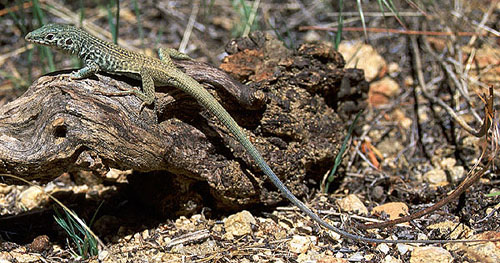
Sack’s Spotted Whiptail Aspidoscelis sackii
The scientific name of the Sack’s Spotted Whiptail is Aspidoscelis sackii. It is a species of reptile in the family Teiidae (tegus), order Squamata. The name dates from 1834.
- Scientific name
- Aspidoscelis sackii (Wiegmann, 1834)
- Common name
- Sack’s Spotted Whiptail
- Genus
- Aspidoscelis
- Family
- Teiidae (Tegus)
- Order
- Squamata
- Class
- Reptilia
- Red List category
- LC Least Concern
- Recorded in
- 4 countries
- Name status
- accepted in the Catalogue of Life
Overview
Aspidoscelis sackii, known commonly as Sack's spotted whiptail, is a species of lizard in the family Teiidae. The species is endemic to Mexico. There are three recognized subspecies.
Classification of the Sack’s Spotted Whiptail
| Kingdom | Animalia |
|---|---|
| Phylum | Chordata |
| Subphylum | Vertebrata |
| Infraphylum | Gnathostomata |
| Parvphylum | Osteichthyes |
| Megaclass | Tetrapoda |
| Class | Reptilia (Reptile) |
| Order | Squamata (Snakes) |
| Suborder | Autarchoglossa |
| Family | Teiidae (Tegus) |
| Genus | Aspidoscelis (North American Whiptails) |
| Species | Aspidoscelis sackii (Wiegmann, 1834) |
Where the Sack’s Spotted Whiptail is found
Checklists and occurrence records place Aspidoscelis sackii in 4 countries across North America. GBIF holds 3,059 georeferenced records of it.
Countries
Regions and cities with the most records
- Oaxaca, Mexico 477
- Morelos, Mexico 358
- Puebla, Mexico 263
- Xochitepec, Mexico 233
- Emiliano Zapata, Mexico 230
- Temixco, Mexico 230
- Guerrero, Mexico 229
- Tres de Mayo, Mexico 221
- Jiutepec, Mexico 215
- Xoxocotla, Mexico 189
- Cuernavaca, Mexico 185
- Santa Rosa Treinta, Mexico 179
- Zacatepec de Hidalgo, Mexico 172
- Yautepec, Mexico 149
- Puente de Ixtla, Mexico 143
- San Antonio de la Cal, Mexico 129
- Oaxaca, Mexico 121
- Michoacán, Mexico 118
- Santa Cruz Xoxocotlán, Mexico 118
- Tlaquiltenango, Mexico 112
- Jojutla, Mexico 105
- Santa María Atzompa, Mexico 91
- Chihuahua, Mexico 83
- Nayarit, Mexico 81
- Jalisco, Mexico 79
- Altepexi, Mexico 77
- Chilpancingo, Mexico 72
- Zumpango del Río, Mexico 72
- Sinaloa, Mexico 69
- Ajalpan, Mexico 67
- Tixtla de Guerrero, Mexico 65
- Zinacatepec, Mexico 64
- Tamaulipas, Mexico 61
- Cuautla, Mexico 60
- Sonora, Mexico 60
- Tehuacán, Mexico 57
Range as the checklists state it
Mexico (Michoacán, Morelos, Guerrero, Puebla, Chiapas, Oaxaca, México [HR 31: 184], Tamaulipas)
A number beside a place is its count of GBIF occurrence records. A place without a number comes from a checklist alone. Records show where a species has been observed or collected, which can include escapes and vagrants.
Common names
English
- Sack’s Spotted Whiptail
- Giant Spotted Whiptail [gigas]
- Sack's Giant Whiptail Lizard
- Sack's Spotted Whiptail
Names in 3 other languages
- Portuguese
- Cauda-de-chicote-manchado-de-sack
- Russian
- Пятнистая ящерица-бегун
- Spanish
- Campeche, Cuiji Moteado Gigante [gigas], Huico manchado
Synonyms
9 other scientific names have been used for this species and are now treated as synonyms of Aspidoscelis sackii.
- Cnemidophorus bocourti Boulenger, 1885
- Cnemidophorus gigas Davis & Smith, 1952
- Cnemidophorus mexicanus balsas Gadow, 1906
- Cnemidophorus mexicanus typica Gadow, 1906
- Cnemidophorus sackiecki
- Cnemidophorus sackii Wiegmann, 1834
- Cnemidophorus communis australis Gadow, 1906 ambiguous synonym
- Cnemidophorus costatus Cope, 1878 ambiguous synonym
- Cnemidophorus mexicanus Peters, 1870 ambiguous synonym
Subspecies and varieties
- Aspidoscelis sackii bocourti subspecies
- Aspidoscelis sackii gigas (Cuiji Moteado Gigante) subspecies
- Aspidoscelis sackii sackii (Sack's Spotted Whiptail) subspecies
Related species
-
 New Mexico WhiptailAspidoscelis neomexicanus
-
 Desert Grassland Whiptail LizardAspidoscelis uniparens
-
 Six-lined RacerunnerAspidoscelis sexlineatus
-
 Western WhiptailAspidoscelis tigris
-
 Texas Spotted WhiptailAspidoscelis gularis
- Little Striped WhiptailAspidoscelis inornatus
-
 Chihuahuan Spotted WhiptailAspidoscelis exsanguis
-
 Plateau Striped WhiptailAspidoscelis velox
Compare
Questions and answers
What is the scientific name of the Sack’s Spotted Whiptail?
The scientific name of the Sack’s Spotted Whiptail is Aspidoscelis sackii. Written with its author, the full name is Aspidoscelis sackii (Wiegmann, 1834).
Which family does the Sack’s Spotted Whiptail belong to?
Aspidoscelis sackii belongs to the family Teiidae, in the order Squamata and the class Reptilia.
Where is the Sack’s Spotted Whiptail found?
Checklists and occurrence records place Aspidoscelis sackii in 4 countries: Mexico, United States, Guatemala and Belize.
What is the conservation status of the Sack’s Spotted Whiptail?
The IUCN Red List category recorded for Aspidoscelis sackii is Least Concern (LC).
What other names does the Sack’s Spotted Whiptail have?
Aspidoscelis sackii is also known in English as Giant Spotted Whiptail [gigas], Sack's Giant Whiptail Lizard and Sack's Spotted Whiptail.
Sources
Data
- Catalogue of Life, 2026-10-16 XR cc by
- Global Biodiversity Information Facility CC BY 4.0
- Wikidata CC0
- English Wikipedia CC BY-SA 4.0
- GeoNames CC BY 4.0
- Within the Catalogue of Life, this name comes from The Reptile Database cc by
References
- Wiegmann, A. F. A. (1834). Herpetologia Mexicana, seu descriptio amphibiorum novae hispaniae , quae itineribus comitis de Sack, Ferdinandi Deppe et Chr. Guil. Schiede im Museum Zoologicum Berolinense Pervenerunt. Pars prima, saurorum species. Berlin, Lüderitz, Iv + 54 Pp.
- Cope, E. D. (1862). Synopsis of the species of Holcosus and Ameiva, with diagnoses of new West Indian and South American Colubridae. Proc. Acad. Nat. Sci. Philadelphia 14: 60-82.
- Peters, WILHELM C. H. (1869). Eine Mittheilung über neue Gattungen und Arten von Eidechsen. Monatsber. Königl. Preuss. Akad. Wissensch. Berlin, 1869: 57-66.
- Bocourt, M. E. (1873). In: A. Duméril, M. F. Bocourt, and F. Mocquard, (1870-1909), Etudes sur les reptiles, p. i-xiv; In Recherches Zoologiques pour servir a l’Histoire de Ia Faune de l’Amérique Centrale et du Mexique. Mission Scientifique au Mexique et dans l’Amérique Centrale, Recherches zoologiques. Part 2, sect. 1. Imprimerie Impériale, Paris, Livr. 2-15, Pp. 33-860.
- Cope, E. D. (1878). Tenth contribution to the herpetology of Tropical America. Proc. Amer. Philos. Soc. 17: 85-98 [1877].
- Günther, A. C. L. G. (1885). Reptilia and Batrachia. Biologia Centrali-Américana. Taylor, & Francis, London, 326 Pp. [Published in Parts from 1885-1902; Reprint by the SSAR 1987].
- Boulenger, G. A. (1885). Catalogue of the lizards in the British Museum (Natural History). Vol. 2, Second edition. London, Xiii+497 Pp.
- Gadow, H. (1906). A contribution to the study of evolution based upon the Mexican species of Cnemidophorus. Proc. Zool. Soc. London 1906: 277-375 (+ Maps).
- Burt, Charles E. (1931). The status of the spotted race-runner, Cnemidophorus sexlineatus gularis (Baird and Girard). Proc. Biol. Soc. Washington 44: 73-78.
- Taylor, Edward H. (1936). Notes on the Herpetological fauna of the Mexican state of Sinaloa. Univ. Kansas Sci. Bull. 24 (20): 505-537.
- Schmidt, Karl P.;Stuart, L. C. (1941). The herpetological fauna of the Salama Basin, Baja Verapaz, Guatemala. Zoological Series of Field Museum of Natural History 24 (21): 233-247.
- Smith, Hobart M. (1946). Rev. Soc. Mex. Hist. Nat. 7: 69.
- Smith, H. M. (1949). Miscellaneous notes on Mexican lizards. J. Washington Acad. Sci. 39: 34-43.
- Davis, W. B., & Smith, H. M. (1952). A new whiptailed lizard (Genus Cnemidophorus) from Mexico. Herpetologica 8: 97-100.
- Mertens, R. (1952). Die Amphibien und Reptilien von El Salvador. Abh. Senckenb. Naturf. Ges. (Frankfurt) (No. 487): 120 Pp.
- Lowe, Charles H., Jr. (1955). A new species of whiptailed lizard (Genus Cnemidophorus) from the Colorado Plateau of Arizona, New Mexico, Colorado, and Utah. Breviora (47): 1-7.
- Martin, Plul S. (1958). A biogeography of reptiles and amphibians in the Gomez Farias Region, Tamaulipas, Mexico. Miscellaneous Publications, Museum of Zoology, University of Michigan (101): 1-102 + 7 Plates.
- Zweifel, Richard G. (1959). Variation in and distribution of lizards of western Mexico related to Cnemidophorus sacki. Bull. Amer. Mus. Nat. Hist. 117 (2): 57-116.
- Duellman, W. E. (1960). A new subspecies of lizard, Cnemidophorus sacki, from Michoacan, México. Univ. Kansas Publ. Mus. Nat. Hist. 10: 587-598.
- Zweifel, Richard G. (1961). Relationship of two whiptail lizards (genus Cnemidophorus) in western Mexico. Copeia 1961 (1): 98-103.
- Duellman, W. E., & ZWEIFEL, R. G. (1962). A synopsis of the lizards of the sexlineatus group (genus Cnemidophorus). Bull. Amer. Mus. Nat. Hist. 123: 155-210.
- McCoy, Clarence J.;Richmond, Neil D. (1965). Herpetological Type-specimens in Carnegie Museum. [type catalogue]. Annals of the Carnegie Museum 38: 233-264 [1966].
- Maslin, T., & Secoy, D. M. (1986). A checklist of the lizard genus Cnemidophorus (Teiidae). Contr. Zool. Univ. Colorado Mus. 1: 1-60.
- Castro-Franco, Rubén, & María Guasalupe Bustos-Zagal. (1994). List of reptiles of Morelos, Mexico, and their distribution in relation to vegetation types. Southwestern Naturalist 39 (2): 171-175.
- REEDER, T.W.; CHARLES J. COLE AND HERBERT C. DESSAUER. (2002). Phylogenetic Relationships of Whiptail Lizards of the Genus Cnemidophorus (Squamata: Teiidae): A Test of Monophyly, Reevaluation of Karyotypic Evolution, and Review of Hybrid Origins. American Museum Novitates 3365: 1-64.
This species in other databases
Page built on 27 November 2026. See how the catalog is made and all sources and licences.
Cite this page
ScientificNames.org. (2026). Aspidoscelis sackii (Sack’s Spotted Whiptail). Retrieved November 27, 2026, from https://scientificnames.org/species/aspidoscelis-sackii
“Aspidoscelis sackii (Sack’s Spotted Whiptail).” ScientificNames.org, 2026, scientificnames.org/species/aspidoscelis-sackii. Accessed 27 Nov. 2026.
ScientificNames.org. “Aspidoscelis sackii (Sack’s Spotted Whiptail).” Accessed November 27, 2026. https://scientificnames.org/species/aspidoscelis-sackii.
@misc{scientificnames_aspidoscelis_sackii_sacks_spotted_whiptail,
  author = {{ScientificNames.org}},
  title = {Aspidoscelis sackii (Sack’s Spotted Whiptail)},
  year = {2026},
  url = {https://scientificnames.org/species/aspidoscelis-sackii},
  note = {Accessed 2026-11-27}
}