Species · Reptiles
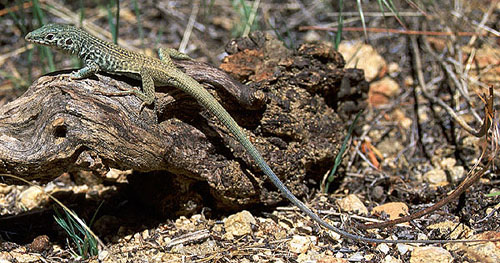
Sonoran Spotted Whiptail Aspidoscelis sonorae
The scientific name of the Sonoran Spotted Whiptail is Aspidoscelis sonorae. It is a species of reptile in the family Teiidae (tegus), order Squamata. The name dates from 1964.
- Scientific name
- Aspidoscelis sonorae (Lowe & Wright, 1964)
- Common name
- Sonoran Spotted Whiptail
- Genus
- Aspidoscelis
- Family
- Teiidae (Tegus)
- Order
- Squamata
- Class
- Reptilia
- Red List category
- LC Least Concern
- Recorded in
- 2 countries
- Name status
- accepted in the Catalogue of Life

Overview
The Sonoran spotted whiptail (Aspidoscelis sonorae) is a parthenogenic species of teiid lizard found in Arizona and New Mexico in the United States, and Mexico.
Classification of the Sonoran Spotted Whiptail
| Kingdom | Animalia |
|---|---|
| Phylum | Chordata |
| Subphylum | Vertebrata |
| Infraphylum | Gnathostomata |
| Parvphylum | Osteichthyes |
| Megaclass | Tetrapoda |
| Class | Reptilia (Reptile) |
| Order | Squamata (Snakes) |
| Suborder | Autarchoglossa |
| Family | Teiidae (Tegus) |
| Genus | Aspidoscelis (North American Whiptails) |
| Species | Aspidoscelis sonorae (Lowe & Wright, 1964) |
Where the Sonoran Spotted Whiptail is found
Checklists and occurrence records place Aspidoscelis sonorae in 2 countries across North America. GBIF holds 8,266 georeferenced records of it.
Countries
Regions and cities with the most records
- Arizona, United States 5,086
- Sonora, Mexico 958
- Casas Adobes, United States 802
- Flowing Wells, United States 785
- Catalina Foothills, United States 682
- Tucson, United States 600
- Oro Valley, United States 585
- Tanque Verde, United States 573
- Sierra Vista, United States 505
- Green Valley, United States 483
- Drexel Heights, United States 477
- New Mexico, United States 440
- California, United States 347
- Rio Rico, United States 336
- Irvine, United States 313
- Lake Forest, United States 306
- Laguna Hills, United States 304
- Laguna Woods, United States 304
- Mission Viejo, United States 299
- Aliso Viejo, United States 297
- Tustin, United States 294
- North Tustin, United States 292
- Laguna Beach, United States 283
- Santa Ana, United States 266
- Costa Mesa, United States 265
- Newport Beach, United States 254
- Orange, United States 223
- Laguna Niguel, United States 222
- Nogales, United States 210
- Fountain Valley, United States 204
- Rancho Santa Margarita, United States 190
- Garden Grove, United States 179
- Ladera Ranch, United States 170
- Nogales, Mexico 163
- Huntington Beach, United States 148
- Westminster, United States 123
Range as the checklists state it
USA (SE Arizona, SW New Mexico, S California),
A number beside a place is its count of GBIF occurrence records. A place without a number comes from a checklist alone. Records show where a species has been observed or collected, which can include escapes and vagrants.
Common names
English
- Sonoran Spotted Whiptail
- Gila Spotted Whiptail
- Gila Spotted Whiptail [flagellicaudus]
Names in 4 other languages
- Portuguese
- Cauda-de-chicote-manchado-de-sonora, Rabo-de-chicote-manchado-de-sonora
- Russian
- Сонорская хлыстохвостая ящерица
- Spanish
- Huico Manchado de Sonora
- sei
- huico
Synonyms
3 other scientific names have been used for this species and are now treated as synonyms of Aspidoscelis sonorae.
- Aspidoscelis flagellicauda (Lowe & Wright, 1964)
- Cnemidophorus flagellicaudus Lowe & Wright, 1964
- Cnemidophorus sonorae Lowe & Wright, 1964
Related species
-
 New Mexico WhiptailAspidoscelis neomexicanus
-
 Desert Grassland Whiptail LizardAspidoscelis uniparens
-
 Six-lined RacerunnerAspidoscelis sexlineatus
-
 Western WhiptailAspidoscelis tigris
-
 Texas Spotted WhiptailAspidoscelis gularis
- Little Striped WhiptailAspidoscelis inornatus
-
 Chihuahuan Spotted WhiptailAspidoscelis exsanguis
-
 Plateau Striped WhiptailAspidoscelis velox
Compare
Questions and answers
What is the scientific name of the Sonoran Spotted Whiptail?
The scientific name of the Sonoran Spotted Whiptail is Aspidoscelis sonorae. Written with its author, the full name is Aspidoscelis sonorae (Lowe & Wright, 1964).
Which family does the Sonoran Spotted Whiptail belong to?
Aspidoscelis sonorae belongs to the family Teiidae, in the order Squamata and the class Reptilia.
Where is the Sonoran Spotted Whiptail found?
Checklists and occurrence records place Aspidoscelis sonorae in 2 countries: United States and Mexico.
What is the conservation status of the Sonoran Spotted Whiptail?
The IUCN Red List category recorded for Aspidoscelis sonorae is Least Concern (LC).
What other names does the Sonoran Spotted Whiptail have?
Aspidoscelis sonorae is also known in English as Gila Spotted Whiptail and Gila Spotted Whiptail [flagellicaudus].
Sources
Data
- Catalogue of Life, 2026-10-16 XR cc by
- Global Biodiversity Information Facility CC BY 4.0
- Wikidata CC0
- English Wikipedia CC BY-SA 4.0
- GeoNames CC BY 4.0
- Wikimedia Commons per image; credit shown with each image
- Within the Catalogue of Life, this name comes from The Reptile Database cc by
References
- Lowe, Charles H. & Wright, John W. (1964). Species of the Cnemidophorus exsanguis subgroup of whiptail lizards. Journal of the Arizona Academy of Science 3 (2): 78-80.
- Lowe, Charles H.;Wright, John W.;Cole, Charles J.;Bezy, Robert L. (1970). Natural hybridization between the teiid lizards Cnemidophorus sonorae (Parthenogenetic) and Cnemidophorus tigris (Bisexual). Systematic Zoology 19 (2): 114-127.
- Cuéllar, O., & Kluge, A. G. (1972). Natural parthenogenesis in the gekkonid lizard Lepidodactylus lugubris. Journal of Genetics 61 (1): 14-26.
- Lucchino, Ronald V. (1973). Biochemical Comparison of Two Sibling Species: Cnemidophorus exsanguis and Cnemidophorus sonorae (Sauria: Teiidae). Journal of Herpetology 7 (4): 379-380.
- Mitchell, J. C. (1979). Ecology of southeastern Arizona whiptail lizards (Cnemidophorus: Teiidae): population densities, resource partitioning, and niche overlap. Canadian Journal of Zoology 57 (7): 1487-1499.
- Dessauer, H. C., & Cole, C. J. (1984). INFLUENCE OF GENE DOSAGE ON ELECTROPHORETIC PHENOTYPES OF PROTEINS FROM LIZARDS OF THE GENUS CNEMIDOPHORUS. Camp. Biochem. Physiol. 77B (1): 181-189.
- Stebbins, R. C. (1985). A Field Guide to Western Reptiles and Amphibians, 2nd ed. Houghton Mifflin, Boston.
- Maslin, T., & Secoy, D. M. (1986). A checklist of the lizard genus Cnemidophorus (Teiidae). Contr. Zool. Univ. Colorado Mus. 1: 1-60.
- Degenhardt, William G.; C. W. Painter, and A. H. Price. (1996). Amphibians and reptiles of New Mexico. Univ. New Mexico Press, 431 Pp.
- Hardy, Laurence M. and Charles J. Cole. (1998). Morphology of a Sterile, Tetraploid, Hybrid Whiptail Lizard (Squamata: Teiidae: Cnemidophorus). American Museum Novitates 3228: 16 Pp.
- Crother, B. I. (2000). Scientific and standard English names of amphibians and reptiles of North America north of Mexico, with comments regarding confidence in our understanding. Herpetological Circular 29: 1-82.
- Bezy, R. L. (2002). Pseudocopulation in the Gila Spotted Whiptail, Cnemidophorus flagellicaudus. Sonoran Herpetologist 15 (8):90-91.
- REEDER, T.W.; CHARLES J. COLE AND HERBERT C. DESSAUER. (2002). Phylogenetic Relationships of Whiptail Lizards of the Genus Cnemidophorus (Squamata: Teiidae): A Test of Monophyly, Reevaluation of Karyotypic Evolution, and Review of Hybrid Origins. American Museum Novitates 3365: 1-64.
- Lemos-Espinal, Julio A., David Chiszar, and Hobart M. Smith. (2004). Selected Records of 2003 Lizards from Chihuahua and Sonora, Mexico. Bull. Chicago Herp. Soc. 39 (9): 164-168.
- Taylor, Harry L. (2006). A male hybrid from Aspidoscelis sonorae (Parthenogenetic) and A. burti stictogramma (bisexual): Squamata, Teiidae. Herpetological Review 37 (2): 154-157.
- Cordes, James E. and James M. Walker. (2006). Evolutionary and Systematic Implications of Skin Histocompatibility Among Parthenogenetic Teiid Lizards: Three Color Pattern Classes of Aspidoscelis dixoni and One of Aspidoscelis tesselata. Copeia, 2006 (1):14-26.
- Jones, L. L., & Lovich, R. E. (2009). Lizards of the American Southwest. A photographic field guide. Rio Nuevo Publishers, Tucson, AZ, 568 Pp. [Review in Reptilia 86: 84].
- Collins, J.T. and T. W. Taggart. (2009). Standard Common and Current Scientific Names for North American Amphibians, Turtles, Reptiles, and Crocodilians, Sixth Edition. Center for North American Herpetology, 48 Pp.
- FLESCH, AARON D.; DON E. SWANN, DALE S. TURNER, AND BRIAN F. POWELL. (2010). HERPETOFAUNA OF THE RINCON MOUNTAINS, ARIZONA. Southwestern Naturalist 55(2):240–253.
- Crother, B. I. (ed.). (2012). Standard Common and Current Scientific Names for North American Amphibians, Turtles, Reptiles, and Crocodilians, Seventh Edition. Herpetological Circular 39: 1-92.
- Skubowius, & Bernd. (2012). Echsen, Schildkröten, Amphibien und Spinnentiere – die vielfältige Welt der „creeping crawlers“ in Arizona. Draco 13 (50): 70-78.
- Werning, & Heiko. (2012). Die Reptilien und Amphibien des Südwestens. Draco 13 (50): 18-60.
- Bezy, Robert L. and Charles J. Cole. (2014). Amphibians and Reptiles of the Madrean Archipelago of Arizona and New Mexico. American Museum Novitates (3810): 1-24.
- Lemos-Espinal, Julio A. (ed.). (2015). Amphibians and Reptiles of the US - Mexico Border States / Anfibios y Reptiles de los Estados de la Frontera México - Estados Unidos. Texas A&M University Press, College Station, Texas. X + 614 Pp.; ISBN 978-1-62349-306-6.
- Tucker, Derek B.; Guarino R. Colli, Lilian G. Giugliano, S. Blair Hedges, Catriona R. Hendry, Emily Moriarty Lemmon, Alan R. Lemmon, Jack W. Sites Jr., R. Alexander Pyron. (2016). Methodological congruence in phylogenomic analyses with morphological support for teiid lizards (Sauria: Teiidae). Molecular Phylogenetics and Evolution 103: 75-84.
This species in other databases
Page built on 26 November 2026. See how the catalog is made and all sources and licences.
Cite this page
ScientificNames.org. (2026). Aspidoscelis sonorae (Sonoran Spotted Whiptail). Retrieved November 26, 2026, from https://scientificnames.org/species/aspidoscelis-sonorae
“Aspidoscelis sonorae (Sonoran Spotted Whiptail).” ScientificNames.org, 2026, scientificnames.org/species/aspidoscelis-sonorae. Accessed 26 Nov. 2026.
ScientificNames.org. “Aspidoscelis sonorae (Sonoran Spotted Whiptail).” Accessed November 26, 2026. https://scientificnames.org/species/aspidoscelis-sonorae.
@misc{scientificnames_aspidoscelis_sonorae_sonoran_spotted_whiptail,
  author = {{ScientificNames.org}},
  title = {Aspidoscelis sonorae (Sonoran Spotted Whiptail)},
  year = {2026},
  url = {https://scientificnames.org/species/aspidoscelis-sonorae},
  note = {Accessed 2026-11-26}
}