Species · Reptiles
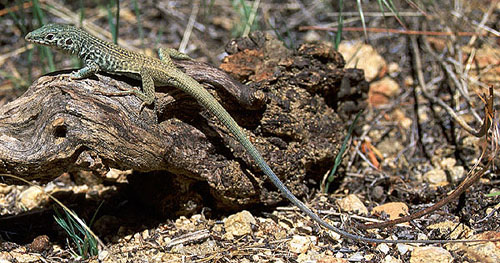
Giant Spotted Whiptail Aspidoscelis stictogrammus
The scientific name of the Giant Spotted Whiptail is Aspidoscelis stictogrammus. It is a species of reptile in the family Teiidae (tegus), order Squamata. The name dates from 1950.
- Scientific name
- Aspidoscelis stictogrammus (Burger, 1950)
- Common name
- Giant Spotted Whiptail
- Genus
- Aspidoscelis
- Family
- Teiidae (Tegus)
- Order
- Squamata
- Class
- Reptilia
- Recorded in
- 2 countries
- Name status
- accepted in the Catalogue of Life
Classification of the Giant Spotted Whiptail
| Kingdom | Animalia |
|---|---|
| Phylum | Chordata |
| Subphylum | Vertebrata |
| Infraphylum | Gnathostomata |
| Parvphylum | Osteichthyes |
| Megaclass | Tetrapoda |
| Class | Reptilia (Reptile) |
| Order | Squamata (Snakes) |
| Suborder | Autarchoglossa |
| Family | Teiidae (Tegus) |
| Genus | Aspidoscelis (North American Whiptails) |
| Species | Aspidoscelis stictogrammus (Burger, 1950) |
Where the Giant Spotted Whiptail is found
Checklists and occurrence records place Aspidoscelis stictogrammus in 2 countries across North America. GBIF holds 654 georeferenced records of it.
Countries
Regions and cities with the most records
- Arizona, United States 262
- Oro Valley, United States 120
- Sonora, Mexico 98
- Catalina Foothills, United States 93
- Casas Adobes, United States 87
- Flowing Wells, United States 77
- Tucson, United States 72
- Tanque Verde, United States 60
- Drexel Heights, United States 35
- Rio Rico, United States 18
- Nogales, United States 16
- Nogales, Mexico 14
- Sahuarita, United States 7
- Chihuahua, Mexico 5
- Empalme, Mexico 5
- Green Valley, United States 5
- Heroica Guaymas, Mexico 5
- New Mexico, United States 4
- Sierra Vista, United States 4
- Hermosillo, Mexico 3
Range as the checklists state it
USA (C Arizona, New Mexico), Mexico (southward through Sonora and probably N Sinaloa, and the northern parts of Chihuahua)
A number beside a place is its count of GBIF occurrence records. A place without a number comes from a checklist alone. Records show where a species has been observed or collected, which can include escapes and vagrants.
Common names
English
- Giant Spotted Whiptail
Names in 2 other languages
- Portuguese
- Cauda-de-chicote-manchado-gigante
- Spanish
- Huico Manchado Gigante
Synonyms
3 other scientific names have been used for this species and are now treated as synonyms of Aspidoscelis stictogrammus.
- Aspidoscelis burti stictogrammus (Burger, 1950)
- Cnemidophorus burti stictogrammus Burger, 1950
- Cnemidophorus sackii stictogrammus Burger, 1950
Related species
-
 New Mexico WhiptailAspidoscelis neomexicanus
-
 Desert Grassland Whiptail LizardAspidoscelis uniparens
-
 Six-lined RacerunnerAspidoscelis sexlineatus
-
 Western WhiptailAspidoscelis tigris
-
 Texas Spotted WhiptailAspidoscelis gularis
- Little Striped WhiptailAspidoscelis inornatus
-
 Chihuahuan Spotted WhiptailAspidoscelis exsanguis
-
 Plateau Striped WhiptailAspidoscelis velox
Compare
Questions and answers
What is the scientific name of the Giant Spotted Whiptail?
The scientific name of the Giant Spotted Whiptail is Aspidoscelis stictogrammus. Written with its author, the full name is Aspidoscelis stictogrammus (Burger, 1950).
Which family does the Giant Spotted Whiptail belong to?
Aspidoscelis stictogrammus belongs to the family Teiidae, in the order Squamata and the class Reptilia.
Where is the Giant Spotted Whiptail found?
Checklists and occurrence records place Aspidoscelis stictogrammus in 2 countries: United States and Mexico.
Sources
Data
- Catalogue of Life, 2026-10-16 XR cc by
- Global Biodiversity Information Facility CC BY 4.0
- Wikidata CC0
- GeoNames CC BY 4.0
- Within the Catalogue of Life, this name comes from The Reptile Database cc by
References
- Taylor, & Edward Harrison. (1938). Notes on the herpetological fauna of the Mexican state of Sonora. Univ. Kansas Sci. Bull. 24 (19): 475-503 [1936].
- Smith, Hobart M. (1946). Handbook of Lizards: Lizards of the United States and of Canada. Comstock, Ithaca, NY, Xxii + 557 Pp.
- Burger, & Leslie, W. (1950). New, revived, and reallocated names for North American whiptailed lizards, Genus Cnemidophorus. Natural History Miscellanea, Chicago Acad. Sci. (65): 1-9.
- Duellman, William E. & Lowe, Charles H., Jr. (1953). A new lizard of the genus Cnemidophorus from Arizona. Natural History Miscellanea, Chicago Acad. Sci. (120): 1-8.
- Maslin, & Paul, T. (1959). The nature of amphibian and reptilian species. Journal of the Arizona Academy of Science 1 (1): 8-17.
- Duellman, W. E., & ZWEIFEL, R. G. (1962). A synopsis of the lizards of the sexlineatus group (genus Cnemidophorus). Bull. Amer. Mus. Nat. Hist. 123: 155-210.
- Stebbins, R. C. (1985). A Field Guide to Western Reptiles and Amphibians, 2nd ed. Houghton Mifflin, Boston.
- Maslin, T., & Secoy, D. M. (1986). A checklist of the lizard genus Cnemidophorus (Teiidae). Contr. Zool. Univ. Colorado Mus. 1: 1-60.
- Goldberg, S. R. (1987). Larval Cestodes (Mesocestoides sp.) in the Giant Spotted Whiptail, Cnemidophorus burti stictogrammus. Journal of Herpetology 21 (4): 337.
- Wright, J. W. (1993). Evolution of the lizards of the genus Cnemidophorus. In: Wright,J.W. & Vitt,L.J. (eds.) Biology of Whiptail lizards (genus Cnemidophorus), pp. 27-81. Oklahoma Mus. Nat. Hist., Norman.
- Degenhardt, William G.; C. W. Painter, and A. H. Price. (1996). Amphibians and reptiles of New Mexico. Univ. New Mexico Press, 431 Pp.
- Hardy, Laurence M. and Charles J. Cole. (1998). Morphology of a Sterile, Tetraploid, Hybrid Whiptail Lizard (Squamata: Teiidae: Cnemidophorus). American Museum Novitates 3228: 16 Pp.
- Crother, B. I. (2000). Scientific and standard English names of amphibians and reptiles of North America north of Mexico, with comments regarding confidence in our understanding. Herpetological Circular 29: 1-82.
- REEDER, T.W.; CHARLES J. COLE AND HERBERT C. DESSAUER. (2002). Phylogenetic Relationships of Whiptail Lizards of the Genus Cnemidophorus (Squamata: Teiidae): A Test of Monophyly, Reevaluation of Karyotypic Evolution, and Review of Hybrid Origins. American Museum Novitates 3365: 1-64.
- Turner, D. S. (2007). Amphibians and reptiles of Sonoita Creek State Natural Area, Arizona. Sonoran Herpetologist 20 (4):38-42.
- Collins, J.T. and T. W. Taggart. (2009). Standard Common and Current Scientific Names for North American Amphibians, Turtles, Reptiles, and Crocodilians, Sixth Edition. Center for North American Herpetology, 48 Pp.
- Crother, B. I. (ed.). (2012). Standard Common and Current Scientific Names for North American Amphibians, Turtles, Reptiles, and Crocodilians, Seventh Edition. Herpetological Circular 39: 1-92.
- Lemos-Espinal, Julio A. (ed.). (2015). Amphibians and Reptiles of the US - Mexico Border States / Anfibios y Reptiles de los Estados de la Frontera México - Estados Unidos. Texas A&M University Press, College Station, Texas. X + 614 Pp.; ISBN 978-1-62349-306-6.
- Tucker, Derek B.; Guarino R. Colli, Lilian G. Giugliano, S. Blair Hedges, Catriona R. Hendry, Emily Moriarty Lemmon, Alan R. Lemmon, Jack W. Sites Jr., R. Alexander Pyron. (2016). Methodological congruence in phylogenomic analyses with morphological support for teiid lizards (Sauria: Teiidae). Molecular Phylogenetics and Evolution 103: 75-84.
- Lemos-Espinal JA, Smith GR, & Rorabaugh JC. (2019). A conservation checklist of the amphibians and reptiles of Sonora, Mexico, with updated species lists. ZooKeys 829: 131-160.
- Lemos-Espinal JA, & Smith GR. (2020). A checklist of the amphibians and reptiles of Sinaloa, Mexico with a conservation status summary and comparisons with neighboring states. ZooKeys 931: 85-114.
- Bezy, Robert L. (2020). John William Wright— Recollections of Juan Siempre Correcto. Sonoran Herpetologist 33 (3): 83-92.
- Barley, Anthony J.; Tod W. Reeder, Adrián Nieto-Montes de Oca, Charles J. Cole, Robert C. Thomson. (2021). A new diploid parthenogenetic whiptail lizard from Sonora, Mexico is the ‘missing link’ in the evolutionary transition to polyploidy. American Naturalist 198 (2): 295-309.
- Turner, D. S., Van Devender, T. R., Hale, S. F., Zach, R., Martínez, R., Van Devender, R. W., ... & Paholski, C. (2022). Amphibians and reptiles of Rancho Las Playitas area, Sonora, Mexico. Sonoran Herpetologist, 35, 50-59.
- Pilliod, D., Jeffries, M., Arkle, R. and Olson, D. (2024). Climate Futures for Lizards and Snakes in Western North America May Result in New Species Management Issues. Ecol Evol, 14: E70379.
This species in other databases
Page built on 27 November 2026. See how the catalog is made and all sources and licences.
Cite this page
ScientificNames.org. (2026). Aspidoscelis stictogrammus (Giant Spotted Whiptail). Retrieved November 27, 2026, from https://scientificnames.org/species/aspidoscelis-stictogrammus
“Aspidoscelis stictogrammus (Giant Spotted Whiptail).” ScientificNames.org, 2026, scientificnames.org/species/aspidoscelis-stictogrammus. Accessed 27 Nov. 2026.
ScientificNames.org. “Aspidoscelis stictogrammus (Giant Spotted Whiptail).” Accessed November 27, 2026. https://scientificnames.org/species/aspidoscelis-stictogrammus.
@misc{scientificnames_aspidoscelis_stictogrammus_giant_spotted_whiptail,
  author = {{ScientificNames.org}},
  title = {Aspidoscelis stictogrammus (Giant Spotted Whiptail)},
  year = {2026},
  url = {https://scientificnames.org/species/aspidoscelis-stictogrammus},
  note = {Accessed 2026-11-27}
}