Species · Mammals · Extinct
Hispaniolan Edible Rat Brotomys voratus
The scientific name of the Hispaniolan Edible Rat is Brotomys voratus. It is an extinct species of mammal in the family Echimyidae (coypu), order Rodentia. The name dates from 1916.
- Scientific name
- Brotomys voratus Miller, 1916
- Common name
- Hispaniolan Edible Rat
- Genus
- Brotomys
- Family
- Echimyidae (Coypu)
- Order
- Rodentia
- Class
- Mammalia
- Red List category
- EX Extinct
- Name status
- accepted in the Catalogue of Life
Overview
The Hispaniolan Edible Rat (Brotomys voratus Miller, 1916) was an extinct rodent in the family Echimyidae, order Rodentia, class Mammalia. It was endemic to Hispaniola in the Caribbean, within the territories of present-day Dominican Republic and Haiti. It was the only species classified in the genus Brotomys.
Written 26 November 2026 from the sources listed below. Each statement was checked against the passage it cites; statements that could not be supported were removed.
Conservation
The Hispaniolan Edible Rat is extinct. Introduced Old World rats are considered the primary driver of its extinction rather than human hunting.[1][2]
A Brotomys mandible was radiocarbon dated to 340 ± 60 years BP, corresponding to approximately 1550–1670 AD. This demonstrates that the species survived the Spanish conquest of Hispaniola.[3][4]
Uses
The species was historically valued as food by the caciques and chiefs of Hispaniola. Historical accounts report that people who had eaten it praised its meat as better than other meats discussed in the account.[5][6]
Appearance
Historical accounts attributed a pale gray coat to the species. Descriptions of the mohuy attributed to Brotomys report denser and coarser hair than that of the hutia.[7][8]
Historical descriptions report that the animal's hair stood erect and pointed.[9]
Habitat
Its natural habitat consisted of subtropical or tropical moist lowland forests.[10]
Classification of the Hispaniolan Edible Rat
| Kingdom | Animalia |
|---|---|
| Phylum | Chordata |
| Subphylum | Vertebrata |
| Infraphylum | Gnathostomata |
| Parvphylum | Osteichthyes |
| Megaclass | Tetrapoda |
| Class | Mammalia (Mammal) |
| Subclass | Theria |
| Infraclass | Eutheria |
| Order | Rodentia (Rodent) |
| Suborder | Hystricomorpha |
| Infraorder | Hystricognathi (Hystricognath Rodents) |
| Family | Echimyidae (Coypu) |
| Subfamily | Heteropsomyinae |
| Genus | Brotomys |
| Species | Brotomys voratus Miller, 1916 |
Where the Hispaniolan Edible Rat is found
Checklists place Brotomys voratus in North America.
Range as the checklists state it
Caribbean
A number beside a place is its count of GBIF occurrence records. A place without a number comes from a checklist alone. Records show where a species has been observed or collected, which can include escapes and vagrants.
Common names
English
- Hispaniolan Edible Rat
Names in 5 other languages
- Czech
- koro dominikánský
- Finnish
- hispaniolanherkkurotta
- German
- Dominikanische Stachelratte, Hispaniola-Stachelratte
- Japanese
- ヒスパニオラホラアナネズミ
- Polish
- hispaniolek jadalny
Related species
- Haitian Edible RatBrotomys contractus
-
 NutriaMyocastor coypus
-
 Red-crested Tree-ratSantamartamys rufodorsalis
-
 Desmarest's HutiaCapromys pilorides
-
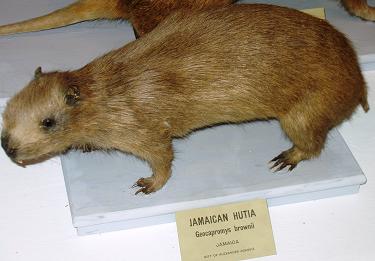 Jamaican ConeyGeocapromys brownii
-
 Hispaniolan HutiaPlagiodontia aedium
-
 Armored RatHoplomys gymnurus
-
 Bahamian HutiaGeocapromys ingrahami
Compare
Questions and answers
What is the scientific name of the Hispaniolan Edible Rat?
The scientific name of the Hispaniolan Edible Rat is Brotomys voratus. Written with its author, the full name is Brotomys voratus Miller, 1916.
Which family does the Hispaniolan Edible Rat belong to?
Brotomys voratus belongs to the family Echimyidae, in the order Rodentia and the class Mammalia.
What is the conservation status of the Hispaniolan Edible Rat?
The IUCN Red List category recorded for Brotomys voratus is Extinct (EX).
Sources
Passages the profile rests on
- Brotomys voratus is an extinct rodent species. Source passage: “The Hispaniolan edible rat (Brotomys voratus) is a recently extinct species of rodent in the family Echimyidae.” — English Wikipedia
- Introduced Old World rats are considered the primary driver of the species' extinction rather than human hunting. Source passage: “the species is thought to have been primarily driven to extinction by introduced Old World rats rather than human hunting.” — English Wikipedia
- A Brotomys mandible was radiocarbon dated to 340 ± 60 years BP, corresponding to approximately 1550–1670 AD. Source passage: “A mandible of Brotomys was carbon dated to 340 ± 60 years BP (1550-1670 AD),” — English Wikipedia
- The dated mandible demonstrates that the species survived the Spanish conquest of Hispaniola. Source passage: “proving it survived the Spanish conquest of Hispaniola.” — English Wikipedia
- The species was historically valued as food by the caciques and chiefs of Hispaniola. Source passage: “This was the food most valued and esteemed by the caciques and chiefs of this island;” — English Wikipedia
- Historical accounts report that people who had eaten the animal praised its meat as better than other meats discussed in the account. Source passage: “who praise this meat as better than all the others we have spoken about.” — English Wikipedia
- Historical accounts attributed to the species describe its coat as pale gray. Source passage: “its color is paler and likewise gray.” — English Wikipedia
- Historical descriptions of the mohuy attributed to Brotomys report denser and coarser hair than that of the hutia. Source passage: “the hair was denser and coarser (or more stiff),” — English Wikipedia
- Historical descriptions report that the animal's hair stood erect and pointed. Source passage: “very pointed and standing erect or straight above.” — English Wikipedia
- Its natural habitat consisted of subtropical or tropical moist lowland forests. Source passage: “Its natural habitat was subtropical or tropical moist lowland forests.” — English Wikipedia
Data
- Catalogue of Life, 2026-10-16 XR cc by
- Wikidata CC0
- Within the Catalogue of Life, this name comes from The Integrated Taxonomic Information System cc0
References
- Smithson Misc. Coll. vol.66 12 p.7 where the name was published
- Wilson, Don E., and DeeAnn M. Reeder, eds. (1993). Mammal Species of the World: A Taxonomic and Geographic Reference, 2nd Ed., 3rd Printing.
- Woods, Charles A., and C. William Kilpatrick / Wilson, Don E., and DeeAnn M. Reeder, eds. (2005). Infraorder Hystricognathi Brandt, 1855. Mammal Species of the World: A Taxonomic and Geographic Reference, 3rd Ed., Vol. 2.
- Upham, Nathan S. (2017). Past and present of insular Caribbean mammals: understanding Holocene extinctions to inform modern biodiversity conservation. Journal of Mammalogy, Vol. 98, No. 4.
This species in other databases
Page built on 27 November 2026. See how the catalog is made and all sources and licences.
Cite this page
ScientificNames.org. (2026). Brotomys voratus (Hispaniolan Edible Rat). Retrieved November 27, 2026, from https://scientificnames.org/species/brotomys-voratus
“Brotomys voratus (Hispaniolan Edible Rat).” ScientificNames.org, 2026, scientificnames.org/species/brotomys-voratus. Accessed 27 Nov. 2026.
ScientificNames.org. “Brotomys voratus (Hispaniolan Edible Rat).” Accessed November 27, 2026. https://scientificnames.org/species/brotomys-voratus.
@misc{scientificnames_brotomys_voratus_hispaniolan_edible_rat,
  author = {{ScientificNames.org}},
  title = {Brotomys voratus (Hispaniolan Edible Rat)},
  year = {2026},
  url = {https://scientificnames.org/species/brotomys-voratus},
  note = {Accessed 2026-11-27}
}