Species · Reptiles
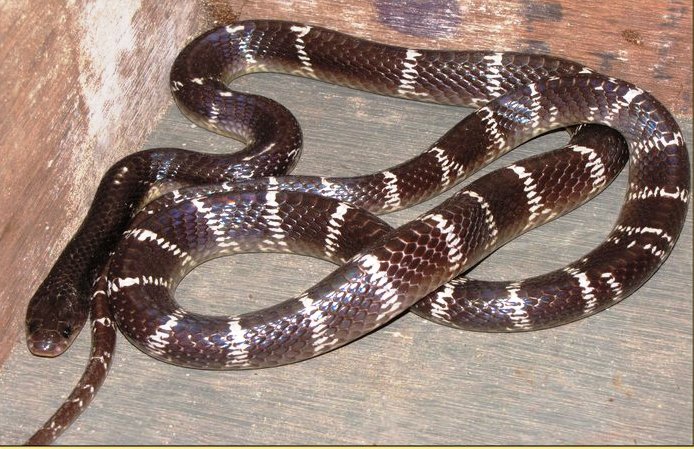
Blue Krait Bungarus candidus
The scientific name of the Blue Krait is Bungarus candidus. It is a species of reptile in the family Elapidae (cobras), order Squamata. The name dates from 1758.
- Scientific name
- Bungarus candidus (Linnaeus, 1758)
- Common name
- Blue Krait
- Genus
- Bungarus
- Family
- Elapidae (Cobras)
- Order
- Squamata
- Class
- Reptilia
- Red List category
- LC Least Concern
- Recorded in
- 9 countries
- Name status
- accepted in the Catalogue of Life

Overview
Bungarus candidus, commonly known as the Malayan krait or blue krait, is an extremely venomous species of snake. The blue krait is a member of the genus Bungarus and the family Elapidae.
Classification of the Blue Krait
| Kingdom | Animalia |
|---|---|
| Phylum | Chordata |
| Subphylum | Vertebrata |
| Infraphylum | Gnathostomata |
| Parvphylum | Osteichthyes |
| Megaclass | Tetrapoda |
| Class | Reptilia (Reptile) |
| Order | Squamata (Snakes) |
| Suborder | Serpentes (Snakes) |
| Infraorder | Alethinophidia |
| Family | Elapidae (Cobras) |
| Genus | Bungarus (Deathpickers) |
| Species | Bungarus candidus (Linnaeus, 1758) |
Where the Blue Krait is found
Checklists and occurrence records place Bungarus candidus in 9 countries across Asia. GBIF holds 878 georeferenced records of it.
Countries
Regions and cities with the most records
- Cibinong, Indonesia 60
- Citeureup, Indonesia 59
- Bogor, Indonesia 49
- Ciampea, Indonesia 45
- Sawangan, Indonesia 39
- Dong Nai, Vietnam 38
- Parung, Indonesia 38
- Nakhon Ratchasima, Thailand 36
- Caringin, Indonesia 34
- Depok, Indonesia 34
- Bali, Indonesia 24
- Bandung, Indonesia 24
- Lampung, Indonesia 20
- Pameungpeuk, Indonesia 20
- Cileungsir, Indonesia 18
- Banjaran, Indonesia 17
- Cimahi, Indonesia 17
- Margahayukencana, Indonesia 17
- Krabi, Thailand 16
- Lembang, Indonesia 16
- Padalarang, Indonesia 16
- Soreang, Indonesia 16
- Banten, Indonesia 15
- South Tangerang, Indonesia 15
- Thành Phố Bà Rịa, Vietnam 15
- Jakarta, Indonesia 14
- Pamulang, Indonesia 14
- Phú Mỹ, Vietnam 14
- Ubud, Indonesia 14
- Yala, Thailand 14
- Bandar Lampung, Indonesia 13
- Cileunyi, Indonesia 13
- Kedah, Malaysia 13
- Yogyakarta, Indonesia 13
- Ciputat, Indonesia 12
- Denpasar, Indonesia 12
Range as the checklists state it
Cambodia, Laos (Vientiane, Champasak, Salavan),
A number beside a place is its count of GBIF occurrence records. A place without a number comes from a checklist alone. Records show where a species has been observed or collected, which can include escapes and vagrants.
Common names
English
- Blue Krait
- Malayan Krait
Names in 2 other languages
- Chinese
- 马来环蛇
- German
- Blauer Krait
Synonyms
5 other scientific names have been used for this species and are now treated as synonyms of Bungarus candidus.
- Aspidoclonion semifasciatum Wagler, 1828
- Bungarus candidus var. semifasciata Werner, 1900
- Bungarus javanicus Kopstein, 1932
- Coluber candidus Linnaeus, 1758
- Bungarus semifasciatus Boie, 1827 ambiguous synonym
Related species
-
 Common KraitBungarus caeruleus
-
 Banded KraitBungarus fasciatus
-
 Many-banded KraitBungarus multicinctus
-
 Red-headed KraitBungarus flaviceps
-
 Sind KraitBungarus sindanus
-
 Greater Black KraitBungarus niger
-
 Ceylon KraitBungarus ceylonicus
-
 Suzhen’s KraitBungarus suzhenae
Compare
Questions and answers
What is the scientific name of the Blue Krait?
The scientific name of the Blue Krait is Bungarus candidus. Written with its author, the full name is Bungarus candidus (Linnaeus, 1758).
Which family does the Blue Krait belong to?
Bungarus candidus belongs to the family Elapidae, in the order Squamata and the class Reptilia.
Where is the Blue Krait found?
Checklists and occurrence records place Bungarus candidus in 9 countries, including Indonesia, Thailand, Vietnam, India, Malaysia and Cambodia.
What is the conservation status of the Blue Krait?
The IUCN Red List category recorded for Bungarus candidus is Least Concern (LC).
What other names does the Blue Krait have?
Bungarus candidus is also known in English as Malayan Krait.
Sources
Data
- Catalogue of Life, 2026-10-16 XR cc by
- Global Biodiversity Information Facility CC BY 4.0
- Wikidata CC0
- English Wikipedia CC BY-SA 4.0
- GeoNames CC BY 4.0
- Wikimedia Commons per image; credit shown with each image
- Within the Catalogue of Life, this name comes from The Reptile Database cc by
References
- Linné, C. [= Linnaeus, C.]. (1758). Systema naturæ per regna tria naturæ, secundum classes, ordines, genera, species, cum characteribus, differentiis, synonymis, locis. Tomus I. Editio decima, reformata. Laurentii Salvii, Holmiæ. 10th Edition: 824 Pp.
- Wagler, J. (1828). Descriptiones et icones amphibiorum. Vol. 1. J. G. Cotttae, Stuttgartiae, Monachii et Tubingiae, I-Xii Pp.
- Müller, F. (1887). Fünfter Nachtrag zum Katalog der herpetologischen Sammlung des Basler Museums. Verh. Naturf. Ges. Basel 8: 249-296.
- Boulenger, G. A. (1896). Catalogue of the snakes in the British Museum, Vol. 3. London (Taylor & Francis), Xiv + 727 Pp.
- Wall, F. (1904). The Food of the Common Krait (Bungarus candidus). J. Bombay Nat. Hist. Soc. 15: 706.
- Wall, F. (1905). Notes on Snakes collected in Cannanore from 5th November 1903 to 5th August 1904. J. Bombay Nat. Hist. Soc. 16: 292.
- Wall, F. (1906). The poisonous snakes of India and how to recognize them, Part I. J. Bombay Nat. Hist. Soc. 17: 51-72 [Correction on P. 995].
- Wall, F. (1907). Notes on Snakes collected in Fyzabad. J. Bombay Nat. Hist. Soc. 18: 101-129.
- Wall, F. (1908). A popular treatise of the common Indian snakes. Part VIII. J. Bombay Nat. Hist. Soc. 18: 711-735.
- Smith, M. A. (1914). Occurence of Krait (Bungarus candidus) and the small-spotted coral snake (Calliophis maculiceps) in Siam; a new colour variety of the latter. J. Nat. Hist. Soc. Siam 1: 123-125.
- Kopstein, F. (1932). Bungarus javanicus, eine neue Giftschlange von Java. Treubia 14: 73-89.
- Sworder, G. H. (1933). Notes on some reptiles from the Malay Peninsula. Bull. Raffles Mus. No 8: 101-105.
- Kopstein, F. (1936). Herpetologische notizen XV. Ueber Bungarus javanicus Kopst. Treubia 15 (3):265-266.
- Kopstein, F. (1936). Über Bungarus javanicus Kopst. Treubia 15: 265-266.
- Smith, M. A. (1943). The Fauna of British India, Ceylon and Burma, Including the Whole of the Indo-Chinese Sub-Region. Reptilia and Amphibia. 3 (Serpentes). Taylor and Francis, London. 583 Pp.
- Taylor, E. H. (1965). The serpents of Thailand and adjacent waters. Univ. Kansas Sci. Bull. 45 (9): 609-1096.
- Kuch, U. & W. Schneyder. (1991). Erfahrungen bei der Terrarienhaltung von vier Arten nahrungs - spezialisierter Giftnattern der Gattung Bungarus Daudin, 1803, Teil 1 - Bungarus candidus (Linnaeus, 1758). Sauria 13 (4): 7-14.
- Slowinski J, B. (1994). A phylogenetic analysis of Bungarus (Elapidae) based on morphological characters. Journal of Herpetology 28 (4): 440-446.
- David, P., & Vogel, G. (1996). The snakes of Sumatra. An annotated checklist and key with natural history notes. Bücher Kreth, Frankfurt/M.
- Kuch, U. (1996). Erfolgreiche Terrarienhaltung eines Java-Kraits, Bungarus javanicus KOPSTEIN 1932. Elaphe 4 (2): 10-12.
- Manthey, U., & Grossmann, W. (1997). Amphibien & Reptilien Südostasiens. Natur Und Tier Verlag (Münster), 512 Pp. (ISBN 3-931587-12-6).
- Cox, Merel J.; Van Dijk, Peter Paul; Jarujin Nabhitabhata & Thirakhupt,Kumthorn. (1998). A Photographic Guide to Snakes and Other Reptiles of Peninsular Malaysia, Singapore and Thailand. Ralph Curtis Publishing, 144 Pp.
- Tillack, F. & W. Grossmann. (1998). Erstnachweis eines schwarzen Kraits (Gattung Bungarus Daudin, 1803) auf Bali, Indonesien (Reptilia: Serpentes: Elapidae). Sauria 20 (3): 11-14.
- Chan-ard,T.; Grossmann,W.; Gumprecht,A. & Schulz,K. D. (1999). Amphibians and reptiles of peninsular Malaysia and Thailand - an illustrated checklist [bilingual English and German]. Bushmaster Publications, Würselen, Gemany, 240 Pp. [Book Review in Russ. J Herp. 7: 87].
- Grossmann, W., & Schäfer, C. (2000). Eine Blindwühle der Gattung lchthyophis FITZlNGER, 1826 als Beute des Malayen-Kraits Bungarus candidus (LlNNAEUS, 1758). Sauria 22 (3): 45-46.
This species in other databases
Page built on 24 November 2026. See how the catalog is made and all sources and licences.
Cite this page
ScientificNames.org. (2026). Bungarus candidus (Blue Krait). Retrieved November 24, 2026, from https://scientificnames.org/species/bungarus-candidus
“Bungarus candidus (Blue Krait).” ScientificNames.org, 2026, scientificnames.org/species/bungarus-candidus. Accessed 24 Nov. 2026.
ScientificNames.org. “Bungarus candidus (Blue Krait).” Accessed November 24, 2026. https://scientificnames.org/species/bungarus-candidus.
@misc{scientificnames_bungarus_candidus_blue_krait,
  author = {{ScientificNames.org}},
  title = {Bungarus candidus (Blue Krait)},
  year = {2026},
  url = {https://scientificnames.org/species/bungarus-candidus},
  note = {Accessed 2026-11-24}
}