Species · Reptiles
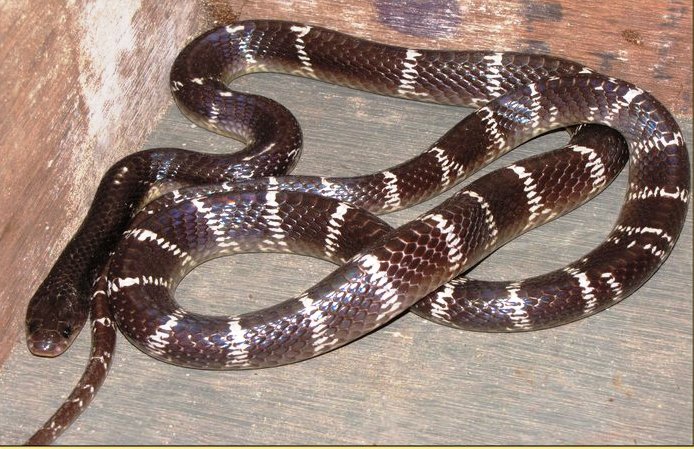
Ceylon Krait Bungarus ceylonicus
The scientific name of the Ceylon Krait is Bungarus ceylonicus. It is a species of reptile in the family Elapidae (cobras), order Squamata. The name dates from 1864.

Overview
Bungarus ceylonicus, the Ceylon krait or Sri Lankan krait, is a species of venomous elapid snake which is endemic to the island Sri Lanka, locally known as මුදු කරවලා (mudu karawalaa).
Classification of the Ceylon Krait
| Kingdom | Animalia |
|---|---|
| Phylum | Chordata |
| Subphylum | Vertebrata |
| Infraphylum | Gnathostomata |
| Parvphylum | Osteichthyes |
| Megaclass | Tetrapoda |
| Class | Reptilia (Reptile) |
| Order | Squamata (Snakes) |
| Suborder | Serpentes (Snakes) |
| Infraorder | Alethinophidia |
| Family | Elapidae (Cobras) |
| Genus | Bungarus (Deathpickers) |
| Species | Bungarus ceylonicus Günther, 1864 |
Where the Ceylon Krait is found
Checklists and occurrence records place Bungarus ceylonicus in 1 country across Asia. GBIF holds 102 georeferenced records of it.
Countries
Regions and cities with the most records
Range as the checklists state it
Sri Lanka
A number beside a place is its count of GBIF occurrence records. A place without a number comes from a checklist alone. Records show where a species has been observed or collected, which can include escapes and vagrants.
Common names
English
- Ceylon Krait
- Common Krait
- Montane Ceylon Krait [karavala]
- Sri Lankan Krait
Names in 5 other languages
- Chinese
- 斯里蘭卡環蛇
- Czech
- Bungar cejlonský
- Italian
- Bungaro dello Sri Lanka, Bungaro di Ceylon, Bungaro di Sri Lanka, Krait dello Sri Lanka, Krait di Ceylon, Krait di Sri Lanka
- Russian
- Цейлонский крайт
- Sinhala
- මුදු කරවලා
Subspecies and varieties
- Bungarus ceylonicus ceylonicus subspecies
- Bungarus ceylonicus karavala subspecies
Related species
-
 Common KraitBungarus caeruleus
-
 Banded KraitBungarus fasciatus
-
 Many-banded KraitBungarus multicinctus
-
 Blue KraitBungarus candidus
-
 Red-headed KraitBungarus flaviceps
-
 Sind KraitBungarus sindanus
-
 Greater Black KraitBungarus niger
-
 Suzhen’s KraitBungarus suzhenae
Compare
Questions and answers
What is the scientific name of the Ceylon Krait?
The scientific name of the Ceylon Krait is Bungarus ceylonicus. Written with its author, the full name is Bungarus ceylonicus Günther, 1864.
Which family does the Ceylon Krait belong to?
Bungarus ceylonicus belongs to the family Elapidae, in the order Squamata and the class Reptilia.
Where is the Ceylon Krait found?
Checklists and occurrence records place Bungarus ceylonicus in 1 country: Sri Lanka.
What is the conservation status of the Ceylon Krait?
The IUCN Red List category recorded for Bungarus ceylonicus is Near Threatened (NT).
What other names does the Ceylon Krait have?
Bungarus ceylonicus is also known in English as Common Krait, Montane Ceylon Krait [karavala] and Sri Lankan Krait.
Sources
Data
- Catalogue of Life, 2026-10-16 XR cc by
- Global Biodiversity Information Facility CC BY 4.0
- Wikidata CC0
- English Wikipedia CC BY-SA 4.0
- GeoNames CC BY 4.0
- Wikimedia Commons per image; credit shown with each image
- Within the Catalogue of Life, this name comes from The Reptile Database cc by
References
- Günther, A. (1864). The Reptiles of British India. London (Taylor & Francis), Xxvii + 452 Pp.
- Müller, F. (1887). Fünfter Nachtrag zum Katalog der herpetologischen Sammlung des Basler Museums. Verh. Naturf. Ges. Basel 8: 249-296.
- Boulenger, George A. (1890). The Fauna of British India, Including Ceylon and Burma. Reptilia and Batrachia. Taylor & Francis, London, Xviii, 541 Pp.
- Boulenger, G. A. (1896). Catalogue of the snakes in the British Museum, Vol. 3. London (Taylor & Francis), Xiv + 727 Pp.
- Willey, A. (1906). Terrestrial Colubridae of Ceylon. Spolia Zeylanica 3 (11): 227-234.
- Wall, F. (1906). The poisonous snakes of India and how to recognize them, Part I. J. Bombay Nat. Hist. Soc. 17: 51-72 [Correction on P. 995].
- Wall, F. (1908). A popular treatise of the common Indian snakes. Part VIII. J. Bombay Nat. Hist. Soc. 18: 711-735.
- Wall, F. (1908). The poisonous terrestrial snakes of our British Indian dominions and how to recognise them, 2nd ed. Bombay, Bombay Natural History Society, 68 Pp.
- Smith, M. A. (1943). The Fauna of British India, Ceylon and Burma, Including the Whole of the Indo-Chinese Sub-Region. Reptilia and Amphibia. 3 (Serpentes). Taylor and Francis, London. 583 Pp.
- Taylor, Edward H. (1953). Report on a collection of Ceylonese serpents. Univ. Kansas Sci. Bull. 35 (14): 1615-1624.
- Deraniyagala. PAUL E. PIERIS. (1955). A colored atlas of some vertebrates from Ceylon. Vol. 3. Serpentoid Reptilia. Colombo, Xix + 121 Pp.
- Slowinski J, B. (1994). A phylogenetic analysis of Bungarus (Elapidae) based on morphological characters. Journal of Herpetology 28 (4): 440-446.
- Kandamby, & DharmaSri. (1997). Herpetological types reposed in the National Museum Colombo, Sri Lanka. Lyriocephalus 3 (1): 31-33.
- de Silva, A. (1998). Snakes of Sri Lanka: a checklist and an annotated bibliography. Dept. Wildlife Conservation/ GEF /UNDP/ FAO, Colombo.
- Das, I., & De Silva, A. (2005). Photographic guide to snakes and other reptiles of Sri Lanka. New Holland Publishers, 144 Pp.
- Janzen, P.; Klaas, P. & Ziesmann, S. (2007). Sri Lankas Schlangenfauna. Draco 7 (30): 56-64.
- Karunarathna, Suranjan D. M. S. and A. A. Thasun Amarasinghe. (2011). A PRELIMINARY SURVEY OF THE REPTILE FAUNA IN NILGALA FOREST AND ITS VICINITY, MONARAGALA DISTRICT, SRI LANKA. Taprobanica 3 (2): 69-76.
- Botejue, W. Madhava S.; Jayantha Wattavidanage. (2012). Herpetofaunal diversity and distribution in Kalugala proposed forest reserve, Western province of Sri Lanka. Amphibian & Reptile Conservation 5 (2): 65-80(e38).
- Pyron, R. Alexander; H.K. Dushantha Kandambi, Catriona R. Hendry, Vishan Pushpamal, Frank T. Burbrink, Ruchira Somaweera. (2013). Genus-level phylogeny of snakes reveals the origins of species richness in Sri Lanka. Molecular Phylogenetics and Evolution 66 (3): 969-978.
- Wallach, Van; Kenneth L. Williams, Jeff Boundy. (2014). Snakes of the World: A Catalogue of Living and Extinct Species. [type catalogue]. Taylor and Francis, CRC Press, 1237 Pp.
- Jayaneththi, & Hareschandra Bandula. (2015). Vertebrate fauna of Morankanda-Mukalana secondary forest patch in Sri Lanka: A checklist reported from 2004-2008 survey. Ruhuna Journal of Science 6: 21- 41.
- Samarawickrama, V.A.M.P.K.; H.I.G.C. Kumara, D.R.N.S. Samarawickrama. (2019). Diversity of Reptiles in the Eastern and Southern parts of the Sinharaja Rain Forest. Journal of Tropical Forestry and Environment.
- Silva, A., de Alwis, T., Wijesekara, S., & Somaweera, R. (2023). Minimising misidentification of common medically important snakes of Sri Lanka in the hospital setting. Revised Version: 17.07.2023 Published: 25.07.2023.
- Massimo Capalbo. (2024). The World’s Most Dangerous Snakes - Volume I: From the fast-lightning Black Mamba to the insidious Hook-nosed Sea Snake, through the formidable Coastal Taipan. Privately Published, 252 Pp.
- Somaweera, R., Pirro, S., & Pyron, R. A. (2025). The Complete Genome Sequences of 26 Species of Sri Lankan Snakes. Biodiversity Genomes.
This species in other databases
Page built on 24 November 2026. See how the catalog is made and all sources and licences.
Cite this page
ScientificNames.org. (2026). Bungarus ceylonicus (Ceylon Krait). Retrieved November 24, 2026, from https://scientificnames.org/species/bungarus-ceylonicus
“Bungarus ceylonicus (Ceylon Krait).” ScientificNames.org, 2026, scientificnames.org/species/bungarus-ceylonicus. Accessed 24 Nov. 2026.
ScientificNames.org. “Bungarus ceylonicus (Ceylon Krait).” Accessed November 24, 2026. https://scientificnames.org/species/bungarus-ceylonicus.
@misc{scientificnames_bungarus_ceylonicus_ceylon_krait,
  author = {{ScientificNames.org}},
  title = {Bungarus ceylonicus (Ceylon Krait)},
  year = {2026},
  url = {https://scientificnames.org/species/bungarus-ceylonicus},
  note = {Accessed 2026-11-24}
}