Species · Reptiles
Many-banded Krait Bungarus multicinctus
The scientific name of the Many-banded Krait is Bungarus multicinctus. It is a species of reptile in the family Elapidae (cobras), order Squamata. The name dates from 1861.
- Scientific name
- Bungarus multicinctus Blyth, 1861
- Common name
- Many-banded Krait
- Genus
- Bungarus
- Family
- Elapidae (Cobras)
- Order
- Squamata
- Class
- Reptilia
- Red List category
- VU Vulnerable
- Recorded in
- 9 countries
- Name status
- accepted in the Catalogue of Life

Overview
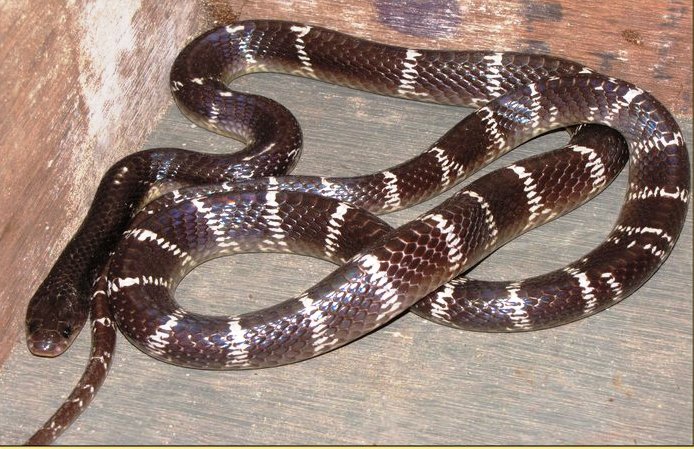
The many-banded krait (Bungarus multicinctus), also known as the Taiwanese krait or the Chinese krait, is an extremely venomous species of elapid snake found in much of central and southern China and Southeast Asia. The species was first described by the scientist Edward Blyth in 1861. Averaging 1 to 1.5 m (3.5 to 5 ft) in length, it is a black or bluish-black snake with many white bands across its body.
Classification of the Many-banded Krait
| Kingdom | Animalia |
|---|---|
| Phylum | Chordata |
| Subphylum | Vertebrata |
| Infraphylum | Gnathostomata |
| Parvphylum | Osteichthyes |
| Megaclass | Tetrapoda |
| Class | Reptilia (Reptile) |
| Order | Squamata (Snakes) |
| Suborder | Serpentes (Snakes) |
| Infraorder | Alethinophidia |
| Family | Elapidae (Cobras) |
| Genus | Bungarus (Deathpickers) |
| Species | Bungarus multicinctus Blyth, 1861 |
Where the Many-banded Krait is found
Checklists and occurrence records place Bungarus multicinctus in 9 countries across Asia. GBIF holds 4,438 georeferenced records of it.
Countries
Regions and cities with the most records
- Taiwan, Taiwan 1,667
- Tai Po, Hong Kong 441
- Shap Pat Heung, Hong Kong 439
- Tsing Yi Town, Hong Kong 437
- Yuen Long San Hui, Hong Kong 436
- Tsuen Wan, Hong Kong 434
- Kwai Chung, Hong Kong 430
- Yuen Long, Hong Kong 428
- Yuen Long Kau Hui, Hong Kong 427
- Fanling, Hong Kong 423
- Ping Shan, Hong Kong 416
- Mei Foo, Hong Kong 408
- Tin Shui Wai, Hong Kong 405
- Sha Tin, Hong Kong 402
- Shenzhen City Centre, China 402
- Banqiao, Taiwan 393
- Shenzhen, China 393
- New Taipei City, Taiwan 391
- Sha Tin Wai, Hong Kong 391
- Siu Lek Yuen, Hong Kong 383
- Wong Tai Sin, Hong Kong 382
- Nam Cheong, Hong Kong 377
- Taipei, Taiwan 376
- Sham Shui Po, Hong Kong 374
- Mong Kok, Hong Kong 369
- Kowloon City, Hong Kong 359
- Victoria, Hong Kong 358
- Guangdong, China 352
- Ma On Shan, Hong Kong 351
- Pok Fu Lam, Hong Kong 346
- Wan Chai, Hong Kong 338
- Neihu, Taiwan 337
- Hong Kong, Hong Kong 334
- Tuen Mun, Hong Kong 327
- Sau Mau Ping, Hong Kong 317
- Shulin, Taiwan 316
Range as the checklists state it
Taiwan, S China (incl. Hong Kong, Hainan),
A number beside a place is its count of GBIF occurrence records. A place without a number comes from a checklist alone. Records show where a species has been observed or collected, which can include escapes and vagrants.
Common names
English
- Many-banded Krait
Names in 12 other languages
- Burmese
- သံကွင်းစွပ်, သံကွင်းစွပ်မြွေ
- Chinese
- 銀環蛇, 银环蛇, 雨傘節
- Danish
- Smalbåndet Krait
- French
- Bongare rayé
- German
- Chinesischer Krait, Vielbindenbungar, Vielgebänderter Krait
- Italian
- Bungaro di Taiwan, Bungaro multifasciato, Krait di Taiwan, Krait multifasciato
- Japanese
- アマガサヘビ, タイワンアマガサ
- Russian
- Южнокитайский многополосый крайт
- Spanish
- Krait de muchas bandas
- Thai
- งูทับสมิงคลาลายถี่
- Vietnamese
- Ran cap nia bac
- yue
- 银脚带(銀腳帶)
Synonyms
3 other scientific names have been used for this species and are now treated as synonyms of Bungarus multicinctus.
- Bungarus candidus multicinctus Bourret, 1936
- Bungarus candidus var. multicinctus Boulenger, 1896: 369
- Bungarus semifasciatus Günther, 1858 ambiguous synonym
Subspecies and varieties
- Bungarus multicinctus multicinctus subspecies
Related species
-
 Common KraitBungarus caeruleus
-
 Banded KraitBungarus fasciatus
-
 Blue KraitBungarus candidus
-
 Red-headed KraitBungarus flaviceps
-
 Sind KraitBungarus sindanus
-
 Greater Black KraitBungarus niger
-
 Ceylon KraitBungarus ceylonicus
-
 Suzhen’s KraitBungarus suzhenae
Compare
Questions and answers
What is the scientific name of the Many-banded Krait?
The scientific name of the Many-banded Krait is Bungarus multicinctus. Written with its author, the full name is Bungarus multicinctus Blyth, 1861.
Which family does the Many-banded Krait belong to?
Bungarus multicinctus belongs to the family Elapidae, in the order Squamata and the class Reptilia.
Where is the Many-banded Krait found?
Checklists and occurrence records place Bungarus multicinctus in 9 countries, including Taiwan, China, Hong Kong, Vietnam, Myanmar and Macao.
What is the conservation status of the Many-banded Krait?
The IUCN Red List category recorded for Bungarus multicinctus is Vulnerable (VU).
Sources
Data
- Catalogue of Life, 2026-10-16 XR cc by
- Global Biodiversity Information Facility CC BY 4.0
- Wikidata CC0
- English Wikipedia CC BY-SA 4.0
- GeoNames CC BY 4.0
- Wikimedia Commons per image; credit shown with each image
- Within the Catalogue of Life, this name comes from The Reptile Database cc by
References
- Günther, A. (1858). Catalogue of Colubrine snakes of the British Museum. London, I - XVI, 1 - 281.
- Blyth, E. (1861). Proceedings of the Society. Report of the Curator. J. Asiatic Soc. Bengal Xxix [1860]: 87-115.
- Günther, A. (1864). The Reptiles of British India. London (Taylor & Francis), Xxvii + 452 Pp.
- Günther, A. (1888). On a collection of reptiles from China. Ann. Mag. Nat. Hist. (6) 1: 165-172.
- Boulenger, George A. (1890). The Fauna of British India, Including Ceylon and Burma. Reptilia and Batrachia. Taylor & Francis, London, Xviii, 541 Pp.
- Boulenger, G. A. (1896). Catalogue of the snakes in the British Museum, Vol. 3. London (Taylor & Francis), Xiv + 727 Pp.
- Stejneger, LEONHARD H. (1907). Herpetology of Japan and adjacent territory. Bull. US Natl. Mus. 58: Xx, 1-577.
- Wall, F. (1908). A popular treatise of the common Indian snakes. Part VIII. J. Bombay Nat. Hist. Soc. 18: 711-735.
- Wall, F. (1908). The poisonous terrestrial snakes of our British Indian dominions and how to recognise them, 2nd ed. Bombay, Bombay Natural History Society, 68 Pp.
- Stejneger, L. (1910). The batrachians and reptiles of Formosa. Proc. US Natl. Mus. 38: 91-114.
- Barbour, & Thomas. (1912). Some Chinese Vertebrates: Amphibia and Reptilia. Memoirs of the Museum of Comparative Zoölogy 40 (4): 125-136.
- Pope, C. H. (1928). Four new snakes and a new lizard from South China. American Museum Novitates 325: 1-4.
- Smith, M. A. (1943). The Fauna of British India, Ceylon and Burma, Including the Whole of the Indo-Chinese Sub-Region. Reptilia and Amphibia. 3 (Serpentes). Taylor and Francis, London. 583 Pp.
- Glass, Bryan P. (1946). A collection of reptiles from Hunan and Anhwei provinces, China. Copeia 1946 (4): 249-252.
- Gotch, A. F. (1986). Reptiles - Their Latin Names Explained. Blandford Press, 176 Pp.
- Dowling, H.G., & Jenner, J.V. (1988). Snakes of Burma: checklist of reported species and bibliography. Smithsonian Herp. Inf. Serv. (76): 19 Pp.
- Kuch, U., & Schneyer, W. (1992). Erfahrungen bei der Terrarienhaltung von vier Arten nahrungsspezialisierter Giftnattern der Gattung Bungarus DAUDIN 1803 Teil II Bungarus multicinctus BLYTH 1861. Sauria 14 (1): 25-32.
- Zhao, E., & Adler, K. (1993). Herpetology of China. SSAR, Oxford/Ohio, 1-522.
- Chan-ard,T.; Grossmann,W.; Gumprecht,A. & Schulz,K. D. (1999). Amphibians and reptiles of peninsular Malaysia and Thailand - an illustrated checklist [bilingual English and German]. Bushmaster Publications, Würselen, Gemany, 240 Pp. [Book Review in Russ. J Herp. 7: 87].
- Lazell, J. D. (2002). The herpetofauna of Shek Kwu Chau, South Chinese Sea, with descriptions of two new colubrid snakes. Mem. Hong Kong Nat. Hist. Soc. 25: 82 Pp.
- Ziegler, T. (2002). Die Amphibien und Reptilien eines Tieflandfeuchtwald-Schutzgebietes in Vietnam. Natur Und Tier Verlag (Münster), 342 Pp.
- Orlov, N.; Ananjeva, A.; Ryabov, S. & Rao, D.-Q. (2003). Die Giftschlangen Südchinas. Reptilia (Münster) 8 (44): 30-36.
- Leviton, Alan E.; Guinevere O.U. Wogan; Michelle S. Koo; George R. Zug; Rhonda S. Lucas and Jens V. Vindum. (2003). The Dangerously Venomous Snakes of Myanmar Illustrated Checklist with Keys. Proc. Cal. Acad. Sci. 54 (24): 407–462.
- Orlov, N.; Ananjeva, A.; Ryabov, S. & Rao, D.-Q. (2003). Venomous snakes in Southern China. Reptilia (GB) (31): 22-29.
- Sokolov, A. Y. (2005). ON THE MORPHOFUNCTIONAL PECULIARITIES OF THE JAW APPARATUS OF OPHIOPHAGOUS ELAPID SNAKES AND ON THE SOME STAGES IN EVOLUTION OF ELAPIDAE. Herpetologia Petropolitana [SEH Meeting 2003], Ananjeva N.&O.Tsinenko (Eds.): 171 – 173.
This species in other databases
Page built on 24 November 2026. See how the catalog is made and all sources and licences.
Cite this page
ScientificNames.org. (2026). Bungarus multicinctus (Many-banded Krait). Retrieved November 24, 2026, from https://scientificnames.org/species/bungarus-multicinctus
“Bungarus multicinctus (Many-banded Krait).” ScientificNames.org, 2026, scientificnames.org/species/bungarus-multicinctus. Accessed 24 Nov. 2026.
ScientificNames.org. “Bungarus multicinctus (Many-banded Krait).” Accessed November 24, 2026. https://scientificnames.org/species/bungarus-multicinctus.
@misc{scientificnames_bungarus_multicinctus_many_banded_krait,
  author = {{ScientificNames.org}},
  title = {Bungarus multicinctus (Many-banded Krait)},
  year = {2026},
  url = {https://scientificnames.org/species/bungarus-multicinctus},
  note = {Accessed 2026-11-24}
}