Species · Reptiles
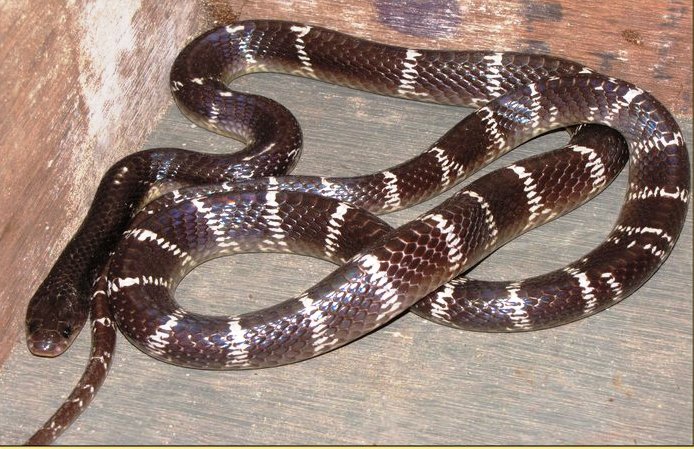
Sind Krait Bungarus sindanus
The scientific name of the Sind Krait is Bungarus sindanus. It is a species of reptile in the family Elapidae (cobras), order Squamata. The name dates from 1897.
- Scientific name
- Bungarus sindanus Boulenger, 1897
- Common name
- Sind Krait
- Genus
- Bungarus
- Family
- Elapidae (Cobras)
- Order
- Squamata
- Class
- Reptilia
- Red List category
- LC Least Concern
- Recorded in
- 2 countries
- Name status
- accepted in the Catalogue of Life

Overview
Bungarus sindanus, the Sind krait, is a species of krait, a highly venomous elapid snake found in Bangladesh, northwestern India, Afghanistan, and Pakistan. It can be confused with the common krait.
Classification of the Sind Krait
| Kingdom | Animalia |
|---|---|
| Phylum | Chordata |
| Subphylum | Vertebrata |
| Infraphylum | Gnathostomata |
| Parvphylum | Osteichthyes |
| Megaclass | Tetrapoda |
| Class | Reptilia (Reptile) |
| Order | Squamata (Snakes) |
| Suborder | Serpentes (Snakes) |
| Infraorder | Alethinophidia |
| Family | Elapidae (Cobras) |
| Genus | Bungarus (Deathpickers) |
| Species | Bungarus sindanus Boulenger, 1897 |
Where the Sind Krait is found
Checklists and occurrence records place Bungarus sindanus in 2 countries. GBIF holds 62 georeferenced records of it.
Countries
Regions and cities with the most records
- Maharashtra, India 9
- Khadki, India 6
- Kharakvasla, India 6
- Pimpri, India 6
- Pimpri-Chinchwad, India 6
- Pune, India 6
- Ballari, India 5
- Karnataka, India 5
- Punjab, Pakistan 3
Range as the checklists state it
SE Pakistan, NW India (Rajasthan, Maharashtra, Gujarat, Punjab)
A number beside a place is its count of GBIF occurrence records. A place without a number comes from a checklist alone. Records show where a species has been observed or collected, which can include escapes and vagrants.
Common names
English
- Sind Krait
Synonyms
4 other scientific names have been used for this species and are now treated as synonyms of Bungarus sindanus.
- Bungarus caeruleus sindanus Boulenger, 1897
- Bungarus sindanus razai Khan, 1985
- Bungarus sindanus sindanus Boulenger, 1897
- Bungarus walli Wall, 1907 ambiguous synonym
Related species
-
 Common KraitBungarus caeruleus
-
 Banded KraitBungarus fasciatus
-
 Many-banded KraitBungarus multicinctus
-
 Blue KraitBungarus candidus
-
 Red-headed KraitBungarus flaviceps
-
 Greater Black KraitBungarus niger
-
 Ceylon KraitBungarus ceylonicus
-
 Suzhen’s KraitBungarus suzhenae
Compare
Questions and answers
What is the scientific name of the Sind Krait?
The scientific name of the Sind Krait is Bungarus sindanus. Written with its author, the full name is Bungarus sindanus Boulenger, 1897.
Which family does the Sind Krait belong to?
Bungarus sindanus belongs to the family Elapidae, in the order Squamata and the class Reptilia.
Where is the Sind Krait found?
Checklists and occurrence records place Bungarus sindanus in 2 countries: India and Pakistan.
What is the conservation status of the Sind Krait?
The IUCN Red List category recorded for Bungarus sindanus is Least Concern (LC).
Sources
Data
- Catalogue of Life, 2026-10-16 XR cc by
- Global Biodiversity Information Facility CC BY 4.0
- Wikidata CC0
- English Wikipedia CC BY-SA 4.0
- GeoNames CC BY 4.0
- Wikimedia Commons per image; credit shown with each image
- Within the Catalogue of Life, this name comes from The Reptile Database cc by
References
- Boulenger, G. A. (1897). A new krait from Sind (Bungarus sindanus). J. Bombay Nat. Hist. Soc. 11: 73-74.
- Wall, F. (1906). The poisonous snakes of India and how to recognize them, Part I. J. Bombay Nat. Hist. Soc. 17: 51-72 [Correction on P. 995].
- Wall, F. (1907). A new krait from Oudh (Bungarus walli). J. Bombay Nat. Hist. Soc. 17: 608-611.
- Wall, F. (1907). Notes on Snakes collected in Fyzabad. J. Bombay Nat. Hist. Soc. 18: 101-129.
- Wall, F. (1908). A popular treatise of the common Indian snakes. Part VIII. J. Bombay Nat. Hist. Soc. 18: 711-735.
- Cholmondeley, E. C. (1908). Kraits in Indore. J. Bombay Nat. Hist. Soc. 18: 921-924.
- Wall, F. (1908). The poisonous terrestrial snakes of our British Indian dominions and how to recognise them, 2nd ed. Bombay, Bombay Natural History Society, 68 Pp.
- Wall, F. (1909). Remarks on some little known Indian Ophidia. Records of the Indian Museum 3 (2): 145-150.
- Wall, F. (1911). Remarks on a snake collection in the Quetta museum. J. Bombay Nat. Hist. Soc. 20: 1033-1042.
- Wall, F. (1913). On the Common (Bungarus caeruleus) and Sind Kraits (Bungarus sindanus). J. Bombay Nat. Hist. Soc. 22: 401.
- Pitman, C. R. S. (1913). Kraits in the Dera Ismail Khan District. J. Bombay Nat. Hist. Soc. 22: 636.
- Smith, M. A. (1943). The Fauna of British India, Ceylon and Burma, Including the Whole of the Indo-Chinese Sub-Region. Reptilia and Amphibia. 3 (Serpentes). Taylor and Francis, London. 583 Pp.
- Kral, B. (1969). Notes on the herpetofauna of certain provinces of Afghanistan. Zoologiske Listy 18, 55-66.
- Khan, M. S. (1985). Taxonomic notes on Bungarus caeruleus (Schneider) and Bungarus sindanus Boulenger. The Snake 17: 71-78.
- Khan, M. S. (1986). A noteworthy collection of Amphibians and reptiles from North- Western Punjab, Pakistan. The Snake 18: 118-125.
- Das, I., & Chaturvedi, N. (1998). Catalogue of the herpetological types in the collection of the Bombay Natural History Society. Hamadryad 23 (2): 150-156.
- Vyas, & Raju. (1998). Unusual marking pattern in krait Bungarus sindanus. Cobra 32: 34-35.
- Whitaker, & Romulus and Ashok Captain. (2004). Snakes of India. Draco Books, 500 Pp., Reprinted 2007.
- Kuch, & Ulrich. (2004). Bungarus sindanus Boulenger, 1897, an addition to the venomous snake fauna of Afghanistan. Herpetozoa 16 (3/4):171-173.
- Sharma, R. C. (2004). Handbook Indian Snakes. AKHIL BOOKS, New Delhi, 292 Pp.
- Roemer, K., & Mahyar-Roemer, M. (2006). Haltung, Nachzucht und Toxin des Indischen Kraits, Bungarus caeruleus (SCHNEIDER 1801). Elaphe 14 (1): 26-32.
- Vyas, & Raju. (2007). Present conservation scenario of reptile fauna in Gujarat State, India. Indian Forester, Oct 2007: 1381-1394.
- Baig, KJ, Masroor, R., and Arshad, M. (2008). Biodiversity and ecology of the herpetofauna of Cholistan Desert, Pakistan. Russ. J. Herpetol. 15 (3): 193-205.
- Lenz, & Norbert. (2012). Von Schmetterlingen und Donnerdrachen - Natur und Kultur in Bhutan. Karlsruher Naturhefte 4, Naturkundemuseum Karlsruhe, 124 Pp.
- Kästle, W., Rai, K., & Schleich, H. H. (2013). FIELD GUIDE to Amphibians and Reptiles of Nepal. ARCO-Nepal E.V., 625 Pp.
This species in other databases
Page built on 24 November 2026. See how the catalog is made and all sources and licences.
Cite this page
ScientificNames.org. (2026). Bungarus sindanus (Sind Krait). Retrieved November 24, 2026, from https://scientificnames.org/species/bungarus-sindanus
“Bungarus sindanus (Sind Krait).” ScientificNames.org, 2026, scientificnames.org/species/bungarus-sindanus. Accessed 24 Nov. 2026.
ScientificNames.org. “Bungarus sindanus (Sind Krait).” Accessed November 24, 2026. https://scientificnames.org/species/bungarus-sindanus.
@misc{scientificnames_bungarus_sindanus_sind_krait,
  author = {{ScientificNames.org}},
  title = {Bungarus sindanus (Sind Krait)},
  year = {2026},
  url = {https://scientificnames.org/species/bungarus-sindanus},
  note = {Accessed 2026-11-24}
}