Species · Reptiles
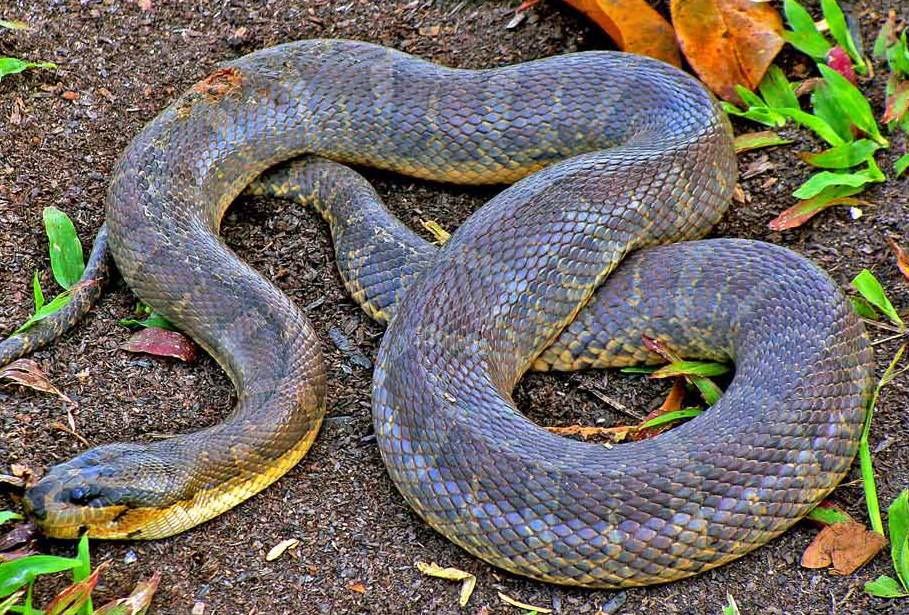
Southeast Asian Bockadam Cerberus schneiderii
The scientific name of the Southeast Asian Bockadam is Cerberus schneiderii. It is a species of reptile in the family Homalopsidae (mud snakes), order Squamata. The name dates from 1837.
- Scientific name
- Cerberus schneiderii (Schlegel, 1837)
- Common name
- Southeast Asian Bockadam
- Genus
- Cerberus
- Family
- Homalopsidae (Mud Snakes)
- Order
- Squamata
- Class
- Reptilia
- Recorded in
- 8 countries
- Name status
- accepted in the Catalogue of Life

Overview
Wikidata describes Cerberus schneiderii as “species of reptile”.
Classification of the Southeast Asian Bockadam
| Kingdom | Animalia |
|---|---|
| Phylum | Chordata |
| Subphylum | Vertebrata |
| Infraphylum | Gnathostomata |
| Parvphylum | Osteichthyes |
| Megaclass | Tetrapoda |
| Class | Reptilia (Reptile) |
| Order | Squamata (Snakes) |
| Suborder | Serpentes (Snakes) |
| Infraorder | Alethinophidia |
| Family | Homalopsidae (Mud Snakes) |
| Genus | Cerberus (Dog-faced Water Snakes) |
| Species | Cerberus schneiderii (Schlegel, 1837) |
Where the Southeast Asian Bockadam is found
Checklists and occurrence records place Cerberus schneiderii in 8 countries across Asia. GBIF holds 1,855 georeferenced records of it.
Countries
- Cambodia 11
- India 12
- Indonesia 350
- Malaysia 96
- Philippines 596
- Singapore 507
- Thailand 241
- Vietnam 42
Regions and cities with the most records
- Ang Mo Kio New Town, Singapore 475
- Novena, Singapore 475
- Yio Chu Kang, Singapore 475
- Sengkang New Town, Singapore 472
- Bukit Timah, Singapore 469
- Yishun New Town, Singapore 468
- Queenstown Estate, Singapore 467
- Sungai Simpang, Singapore 467
- Kampung Pasir Gudang Baru, Malaysia 465
- Sembawang Estate, Singapore 465
- Masai, Malaysia 463
- Woodlands, Singapore 462
- Bandar Seri Alam, Malaysia 460
- Matilda Estate, Singapore 440
- Pasir Gudang, Malaysia 440
- Punggol, Singapore 435
- Eunos, Singapore 433
- MacPherson, Singapore 433
- Singapore, Singapore 432
- Marine Parade, Singapore 431
- Kampong Pasir Ris, Singapore 430
- Bedok New Town, Singapore 429
- Ulu Bedok, Singapore 429
- Kampong Loyang, Singapore 428
- Taman Scientex, Malaysia 398
- Pengerang, Malaysia 394
- Anak Bukit, Singapore 88
- Bukit Panjang New Town, Singapore 81
- Marsiling, Singapore 79
- Teck Whye, Singapore 78
- Choa Chu Kang New Town, Singapore 77
- Yew Tee, Singapore 76
- Johor Bahru, Malaysia 75
- Keat Hong Village, Singapore 75
- Taman Permas Jaya, Malaysia 75
- Boon Lay, Singapore 74
1 more country has a few records outside this range
These countries hold a few records of Cerberus schneiderii but lie outside the range the checklists give for it. Such records are often zoo or garden specimens, museum material or vagrants, so the species is not counted as occurring there.
Range as the checklists state it
coastal areas of Thailand, Malaysia, Gulf of Thailand, Cambodia, S Vietnam, Indonesia (Ambon, Waingapu, Sumba Island, Sumatra, Java, Bali, Komodo, Natuna islands, Sulawesi, Borneo etc.), Philippines (Jagoliaou I., Bohol Province, Palawan, Luzon, Cebu, Dinagat Island, Negros, Catanduanes), Singapore
A number beside a place is its count of GBIF occurrence records. A place without a number comes from a checklist alone. Records show where a species has been observed or collected, which can include escapes and vagrants.
Common names
English
- Southeast Asian Bockadam
- Dog-faced Water Snake
- South East Asian Dog-faced Water Snake
Names in 7 other languages
- Chinese
- 東南亞波加丹蛇
- Danish
- Sydøstasiatisk Hundehovedsnog
- German
- Hundskopf-Wassertrugnatter
- Indonesian
- Ular Kadut
- Italian
- Serpente acquatico dal muso canino, Serpente acquatico di Schneider
- Spanish
- Serpiente Acuática Cara de Perro
- Thai
- งูปากกว้างน้ำเค็ม
Synonyms
9 other scientific names have been used for this species and are now treated as synonyms of Cerberus schneiderii.
- Cerberus acutus Gray, 1849
- Cerberus boaeformis
- Cerberus rhynchops , Ross and Gonzales, 1992
- Cerberus russelii Cuvier, 1828
- Elaps boaeformis Schneider, 1801
- Homalopsis molurus
- Homalopsis schneideri Schlegel, 1837
- Hurria schneideriana Daudin, 1803
- Python boaeformis
Related species
-
 South Asian BockadamCerberus rynchops
- Lake Buhi BockadamCerberus microlepis
- Australian BockadamCerberus australis
- Palau BockadamCerberus dunsoni
-
 Tentacled SnakeErpeton tentaculatum
-
 Puff-faced Water SnakeHomalopsis buccata
-
 Boie’s Mud SnakeHypsiscopus plumbeus
-
 Rainbow Water SnakeEnhydris enhydris
Compare
Questions and answers
What is the scientific name of the Southeast Asian Bockadam?
The scientific name of the Southeast Asian Bockadam is Cerberus schneiderii. Written with its author, the full name is Cerberus schneiderii (Schlegel, 1837).
Which family does the Southeast Asian Bockadam belong to?
Cerberus schneiderii belongs to the family Homalopsidae, in the order Squamata and the class Reptilia.
Where is the Southeast Asian Bockadam found?
Checklists and occurrence records place Cerberus schneiderii in 8 countries, including Philippines, Singapore, Indonesia, Thailand, Malaysia and Vietnam.
What other names does the Southeast Asian Bockadam have?
Cerberus schneiderii is also known in English as Dog-faced Water Snake and South East Asian Dog-faced Water Snake.
Sources
Data
- Catalogue of Life, 2026-10-16 XR cc by
- Global Biodiversity Information Facility CC BY 4.0
- Wikidata CC0
- GeoNames CC BY 4.0
- Wikimedia Commons per image; credit shown with each image
- Within the Catalogue of Life, this name comes from The Reptile Database cc by
References
- Murphy, John C.;Voris, Harold K.;Karns, Daryl R. (2012). The dog-faced water snakes, a revision of the genus Cerberus Cuvier, (Squamata, Serpentes, Homalopsidae), with the description of a new species. Zootaxa, 3484, 1–34. https://doi.org/10.5281/zenodo.282377 Link where the name was published
- Schneider, J. G. (1799). Historiae Amphibiorum narturalis et literariae. Fasciculus primus, continens Ranas. Calamitas, Bufones, Salamandras et Hydros. Frommanni, Jena, 266 S.
- Schneider, & JOHANN GOTTLOB. (1801). Historiae Amphibiorum naturalis et literariae. Fasciculus secundus continens Crocodilos, Scincos, Chamaesauras, Boas. Pseudoboas, Elapes, Angues. Amphisbaenas et Caecilias. Frommanni, Jena. 374 Pp.
- Shaw, G. (1802). General Zoology, or Systematic Natural History. Vol.3, part 2. G. Kearsley, Thomas Davison, London: 313-615.
- Daudin, F. M. (1802). Histoire Naturelle, Générale et Particulière des Reptiles, Vol. 4. F. Dufart, Paris, 397 Pp.
- Daudin, F. M. (1803). Histoire Naturelle, Générale et Particulière des Reptiles. vol. 7. Paris: Dufart, 436 Pp. [Publication Date Fide Harper 1940].
- Merrem, B. (1820). Versuch eines Systems der Amphibien I (Tentamen Systematis Amphibiorum). J. C. Kriegeri, Marburg, 191 Pp.
- Cuvier, G. J. L. N. F. D. (1829). Le Regne Animal Distribué, d’apres son Organisation, pur servir de base à l’Histoire naturelle des Animaux et d’introduction à l’Anatomie Comparé. Nouvelle Edition [second edition]. Vol. 2. Les Reptiles. Déterville, Paris, I-Xvi, 1-406.
- Schlegel, H. (1837). Essai sur la physionomie des serpens. Partie Descriptive. La Haye (J. Kips, J. HZ. Et W. P. Van Stockum), 606 S. + Xvi.
- Duméril, A. M. C., Bibron, G. & DUMÉRIL, A. H. A.,. (1854). Erpétologie générale ou histoire naturelle complète des reptiles. Tome septième. Deuxième partie, comprenant l’histoire des serpents venimeux. Paris, Librairie Encyclopédique de Roret: I-Xii + 781-1536.
- Günther, A. (1864). The Reptiles of British India. London (Taylor & Francis), Xxvii + 452 Pp.
- Müller, F. (1880). Erster Nachtrag zum Katalog der herpetologischen Sammlung des Basler Museums. Verh. Naturf. Ges. Basel 7: 120-165.
- Boulenger, George A. (1890). The Fauna of British India, Including Ceylon and Burma. Reptilia and Batrachia. Taylor & Francis, London, Xviii, 541 Pp.
- Boulenger, G. A. (1894). On the herpetological fauna of Palawan and Balabac. Ann. Mag. Nat. Hist. (6) 14: 81-90.
- Boulenger, G. A. (1896). Catalogue of the snakes in the British Museum, Vol. 3. London (Taylor & Francis), Xiv + 727 Pp.
- Boulenger, G. A. (1897). List of the reptiles and batrachians collected by Mr. Alfred Everett in Lombok, Flores, Sumba and Saru, with descriptions of new species. Ann. Mag. Nat. Hist. (6) 19: 503-509.
- Wall, F. (1905). Notes on Snakes collected in Cannanore from 5th November 1903 to 5th August 1904. J. Bombay Nat. Hist. Soc. 16: 292.
- Stejneger, LEONHARD H. (1907). Herpetology of Japan and adjacent territory. Bull. US Natl. Mus. 58: Xx, 1-577.
- Stejneger, L. (1910). The batrachians and reptiles of Formosa. Proc. US Natl. Mus. 38: 91-114.
- Wall, & FRANK. (1921). Ophidia Taprobanica or the Snakes of Ceylon. Colombo Mus. (H. R. Cottle, Govt. Printer), Colombo. Xxii, 581 Pages.
- Mertens, R. (1930). Die Amphibien und Reptilien der Inseln Bali, Lombok, Sumbawa und Flores. Senck. Naturf. Gesell., Frankfurt Am Main, Abhandl. 42(3): 117-344.
- Smith, M. A. (1943). The Fauna of British India, Ceylon and Burma, Including the Whole of the Indo-Chinese Sub-Region. Reptilia and Amphibia. 3 (Serpentes). Taylor and Francis, London. 583 Pp.
- Bergman, R. A. M. (1955). L’anatomie de Cerberus rhynchops. Arch. Neerl. Zool. 11:113-126.
- Taylor, E. H. (1965). The serpents of Thailand and adjacent waters. Univ. Kansas Sci. Bull. 45 (9): 609-1096.
- Hendrickson, J. R. (1966). Observations on the fauna of Pulau Tioman and Pulau Tulai. 5. The Reptiles. Bull. Nat. Mus. Singapore 34: 53-71.
This species in other databases
Page built on 28 November 2026. See how the catalog is made and all sources and licences.
Cite this page
ScientificNames.org. (2026). Cerberus schneiderii (Southeast Asian Bockadam). Retrieved November 28, 2026, from https://scientificnames.org/species/cerberus-schneiderii
“Cerberus schneiderii (Southeast Asian Bockadam).” ScientificNames.org, 2026, scientificnames.org/species/cerberus-schneiderii. Accessed 28 Nov. 2026.
ScientificNames.org. “Cerberus schneiderii (Southeast Asian Bockadam).” Accessed November 28, 2026. https://scientificnames.org/species/cerberus-schneiderii.
@misc{scientificnames_cerberus_schneiderii_southeast_asian_bockadam,
  author = {{ScientificNames.org}},
  title = {Cerberus schneiderii (Southeast Asian Bockadam)},
  year = {2026},
  url = {https://scientificnames.org/species/cerberus-schneiderii},
  note = {Accessed 2026-11-28}
}