Species · Spiders and other arachnids
African Long-legged Sac Spider Cheiracanthium africanum
The scientific name of the African Long-legged Sac Spider is Cheiracanthium africanum. It is a species of arachnid in the family Cheiracanthiidae (long-legged sac spiders), order Araneae. The name dates from 1921.
- Scientific name
- Cheiracanthium africanum Lessert, 1921
- Common name
- African Long-legged Sac Spider
- Genus
- Cheiracanthium
- Family
- Cheiracanthiidae (Long-legged Sac Spiders)
- Order
- Araneae
- Class
- Arachnida
- Recorded in
- 13 countries
- Name status
- accepted in the Catalogue of Life
Overview
Cheiracanthium africanum inhabits plants and constructs silk retreats inside rolled-up leaves.
Written 27 November 2026 from the sources listed below. Each statement was checked against the passage it cites; statements that could not be supported were removed.
Habitat
The African Long-legged Sac Spider is a free-living spider that inhabits plants. It constructs silk retreats inside rolled-up leaves.[1][2]
The species has been collected in gardens, grasslands and cultivated crops.[3][4][5]
Conservation
The African Long-legged Sac Spider is classified as Least Concern. It has been sampled from more than 20 protected areas.[6][7]
Classification of the African Long-legged Sac Spider
| Kingdom | Animalia |
|---|---|
| Phylum | Arthropoda |
| Subphylum | Chelicerata |
| Class | Arachnida (Arachnid) |
| Order | Araneae (Spider) |
| Family | Cheiracanthiidae (Long-legged Sac Spiders) |
| Genus | Cheiracanthium (Longlegged Sac Spiders) |
| Species | Cheiracanthium africanum Lessert, 1921 |
Where the African Long-legged Sac Spider is found
Checklists and occurrence records place Cheiracanthium africanum in 13 countries across Africa. GBIF holds 147 georeferenced records of it.
Countries
- Botswana 5
- Cabo Verde 4
- Democratic Republic of the Congo 4
- Ivory Coast 5
- Kenya 2
- Madagascar 8
- Namibia 4
- Reunion 5
- Senegal 1
- South Africa 28
- Tanzania 7
- Uganda 6
- Zimbabwe 68
Regions and cities with the most records
- Entebbe, Uganda 5
- Kajansi, Uganda 5
- Kasanje, Uganda 5
- Katabi, Uganda 5
- North-West, Botswana 5
- Ribeira Grande, Cabo Verde 4
- Antsiranana, Madagascar 3
- Eastern Cape, South Africa 3
- Harare, Zimbabwe 3
- Harare, Zimbabwe 3
- Harare Western Suburbs, Zimbabwe 3
- Mpumalanga, South Africa 3
- Western Cape, South Africa 3
Range as the checklists state it
Africa, Madagascar, Réunion
Réunion
Senegal
Kenya
A number beside a place is its count of GBIF occurrence records. A place without a number comes from a checklist alone. Records show where a species has been observed or collected, which can include escapes and vagrants.
Common names
English
- African Long-legged Sac Spider
Synonyms
4 other scientific names have been used for this species and are now treated as synonyms of Cheiracanthium africanum.
- Cheiracanthium franganilloi Caporiacco, 1949
- Cheiracanthium nigropalpatum Schmidt & Jocqué, 1983
- Cheiracanthium tenuipes Roewer, 1961
- Chiracanthium africanum Lessert, 1921
Related species
-
 Agrarian Sac SpiderCheiracanthium inclusum
-
 Northern Yellow Sac SpiderCheiracanthium mildei
-
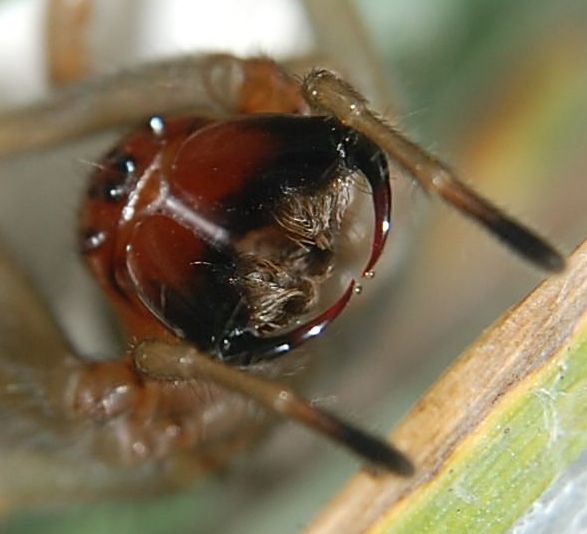 European Yellow Sac SpiderCheiracanthium punctorium
-
 Common House Sac SpiderCheiracanthium furculatum
-
 Two-Clawed Hunting SpiderCheiracanthium erraticum
-
 Cheiracanthium taiwanicum
- Cheiracanthium annulipes
-
 Cheiracanthium eutittha
Compare
Questions and answers
What is the scientific name of the African Long-legged Sac Spider?
The scientific name of the African Long-legged Sac Spider is Cheiracanthium africanum. Written with its author, the full name is Cheiracanthium africanum Lessert, 1921.
Which family does the African Long-legged Sac Spider belong to?
Cheiracanthium africanum belongs to the family Cheiracanthiidae, in the order Araneae and the class Arachnida.
Where is the African Long-legged Sac Spider found?
Checklists and occurrence records place Cheiracanthium africanum in 13 countries, including Zimbabwe, South Africa, Madagascar, Tanzania, Uganda and Botswana.
Sources
Passages the profile rests on
- The species is a free-living spider that inhabits plants. Source passage: “This species is a free-living plant dweller” — English Wikipedia
- The species constructs silk retreats inside rolled-up leaves. Source passage: “constructs silk retreats in rolled-up leaves.” — English Wikipedia
- The species has been collected in gardens. Source passage: “including gardens, grasslands, cultivated crops, shrubs, trees and from under stones.” — English Wikipedia
- The species has been collected in grasslands. Source passage: “including gardens, grasslands, cultivated crops, shrubs, trees and from under stones.” — English Wikipedia
- The species has been collected in cultivated crops. Source passage: “including gardens, grasslands, cultivated crops, shrubs, trees and from under stones.” — English Wikipedia
- Cheiracanthium africanum is classified as Least Concern. Source passage: “it is listed as Least Concern.” — English Wikipedia
- The species has been sampled from more than 20 protected areas. Source passage: “It has been sampled from more than 20 protected areas.” — English Wikipedia
Data
- Catalogue of Life, 2026-10-16 XR cc by
- Global Biodiversity Information Facility CC BY 4.0
- Wikidata CC0
- GeoNames CC BY 4.0
- Within the Catalogue of Life, this name comes from The World Spider Catalog cc by
References
- Lessert, R. de (1921). Araignées du Kilimandjaro et du Merou (suite). 4. Clubionidae. Revue Suisse de Zoologie 28: 381-442. where the name was published
This species in other databases
Page built on 29 November 2026. See how the catalog is made and all sources and licences.
Cite this page
ScientificNames.org. (2026). Cheiracanthium africanum (African Long-legged Sac Spider). Retrieved November 29, 2026, from https://scientificnames.org/species/cheiracanthium-africanum
“Cheiracanthium africanum (African Long-legged Sac Spider).” ScientificNames.org, 2026, scientificnames.org/species/cheiracanthium-africanum. Accessed 29 Nov. 2026.
ScientificNames.org. “Cheiracanthium africanum (African Long-legged Sac Spider).” Accessed November 29, 2026. https://scientificnames.org/species/cheiracanthium-africanum.
@misc{scientificnames_cheiracanthium_africanum_african_long_legged_sac_spider,
  author = {{ScientificNames.org}},
  title = {Cheiracanthium africanum (African Long-legged Sac Spider)},
  year = {2026},
  url = {https://scientificnames.org/species/cheiracanthium-africanum},
  note = {Accessed 2026-11-29}
}