Species · Spiders and other arachnids
Agrarian Sac Spider Cheiracanthium inclusum
The scientific name of the Agrarian Sac Spider is Cheiracanthium inclusum. It is a species of arachnid in the family Cheiracanthiidae (long-legged sac spiders), order Araneae. The name dates from 1847.
- Scientific name
- Cheiracanthium inclusum (Hentz, 1847)
- Common name
- Agrarian Sac Spider
- Genus
- Cheiracanthium
- Family
- Cheiracanthiidae (Long-legged Sac Spiders)
- Order
- Araneae
- Class
- Arachnida
- Recorded in
- 16 countries
- Name status
- accepted in the Catalogue of Life

Overview
Cheiracanthium inclusum inhabits forests, gardens, trees, shrubs, agricultural areas, and human homes. It has a pale yellow-beige body with dark brown markings and often an orange-brown stripe along the upper centre of its abdomen.
Written 26 November 2026 from the sources listed below. Each statement was checked against the passage it cites; statements that could not be supported were removed.
Appearance
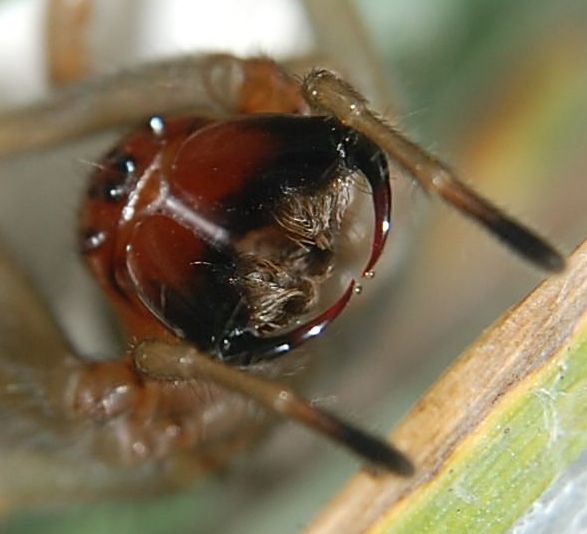
The Agrarian Sac Spider has a pale yellow-beige body with dark brown markings on its palps, chelicerae, and tarsal tips. Its abdomen often has an orange-brown stripe running along its upper centre.[1][2]
It has eight similarly sized eyes arranged in two parallel horizontal rows. Its body consists of two segments: a cephalothorax and an abdomen.[3][4]
Female body length ranges from 5 to 9 mm, and leg span can reach 2.5 cm. Males have narrower bodies and larger leg spans than females.[5][6][7]
Habitat
The species inhabits foliage in forests and gardens and commonly occurs in trees and shrubs. It also occupies forest floors, fruit orchards, agricultural areas, and shrubs surrounding open fields.[8][9][10]
It can inhabit human homes. It constructs silk tube-like retreats beneath ground debris and inside human-made structures, and may shelter beneath leaf litter, stones, and boards.[11][12][13]
Indoor retreats may occur in corners of walls and ceilings.[14]
Diet
The Agrarian Sac Spider actively hunts insects and other spiders rather than capturing prey in webs. Its prey includes leafhoppers, fleahoppers, fruit flies, and cotton plant bugs.[15][16]
It also consumes eggs of lepidopteran insects and other spiders, including Anyphaena pacifica and Theridion melanurum. The species consumes nectar while foraging.[17][18][19]
Behaviour
The species is nocturnal and feeds and mates at night. During daylight hours, it retreats into small silk nests and builds a new silk nest each day in under ten minutes.[20][21][22]
It disperses between trees and shrubs using wind-carried silk threads and can travel through the air by ballooning on a silk thread. It also uses silk strings to travel vertically and catch airborne prey.[23][24][25]
Juveniles sometimes leave their silk retreats during winter to forage.[26]
Reproduction and life cycle
Females generally mate only once and produce their first egg mass approximately 14 days after mating. They usually produce two egg masses, although the number can range from one to five.[27][28][29]
Egg masses generally contain 17–85 eggs, with reports of up to 112 eggs. Females generally lay eggs during June and July in silk tubes approximately 2 cm long.[30][31][32]
Females remain with their eggs and juveniles for approximately 17 days. Males reach sexual maturity at an average age of 119 days and females at an average age of 134 days.[33][34][35]
Conservation
The species has no special conservation status.[36]
Uses
The species provides agricultural pest control in vineyards, apple orchards, and cotton fields.[37]
Similar species
Cheiracanthium mildei is closely related to Cheiracanthium inclusum and resembles it in appearance and natural history.[38]
Classification of the Agrarian Sac Spider
| Kingdom | Animalia |
|---|---|
| Phylum | Arthropoda |
| Subphylum | Chelicerata |
| Class | Arachnida (Arachnid) |
| Order | Araneae (Spider) |
| Family | Cheiracanthiidae (Long-legged Sac Spiders) |
| Genus | Cheiracanthium (Longlegged Sac Spiders) |
| Species | Cheiracanthium inclusum (Hentz, 1847) |
Origin of the name. Etymology. Latin, to include
Where the Agrarian Sac Spider is found
Checklists and occurrence records place Cheiracanthium inclusum in 16 countries across North America and South America. GBIF holds 1,060 georeferenced records of it.
Countries
- Argentina 92
- Brazil 516
- Canada 7
- Colombia 3
- Costa Rica 4
- Cuba 4
- Dominican Republic 4
- French Guiana 4
- Guyana
- Mexico 27
- Panama
- Peru 1
- Saint Martin 3
- United States 379
- Uruguay 15
- Venezuela 1
Regions and cities with the most records
- Ceará, Brazil 73
- California, United States 64
- Texas, United States 63
- Maracanaú, Brazil 51
- Eusébio, Brazil 42
- Itaitinga, Brazil 40
- São Paulo, Brazil 35
- New Mexico, United States 32
- Paraíba, Brazil 32
- Rio Grande do Sul, Brazil 31
- Alagoa Grande, Brazil 30
- Fortaleza, Brazil 30
- Guará, Brazil 29
- Maranguape, Brazil 29
- Núcleo Bandeirante, Brazil 27
- Pacatuba, Brazil 26
- Setor Complementar de Indústria e Abastecimento, Brazil 26
- Buenos Aires, Argentina 25
- Guaiúba, Brazil 24
- Águas Claras, Brazil 24
- Indiana, United States 22
- Colorado, United States 21
- Cruzeiro, Brazil 21
- East Chicago, United States 21
- Gary, United States 21
- Griffith, United States 21
- Hobart, United States 21
- Merrillville, United States 21
- Portage, United States 21
- Brasília, Brazil 20
- Entre Rios, Argentina 20
- Itapoã, Brazil 20
- Lago Sul, Brazil 20
- Plano Piloto, Brazil 20
- Caucaia, Brazil 19
- Highland, United States 19
2 more countries have a few records outside this range
These countries hold a few records of Cheiracanthium inclusum but lie outside the range the checklists give for it. Such records are often zoo or garden specimens, museum material or vagrants, so the species is not counted as occurring there.
Range as the checklists state it
North America, Central America, Caribbean, South America. Introduced to Réunion
Mexico, Panama, Cuba
Venezuela, Guyana
Costa Rica
A number beside a place is its count of GBIF occurrence records. A place without a number comes from a checklist alone. Records show where a species has been observed or collected, which can include escapes and vagrants.
Common names
English
- Agrarian Sac Spider
- American Yellow Sac Spider
- Yellow Sac Spider
Names in 3 other languages
- Czech
- zápřednice skrytá
- Portuguese
- Aranha-corredora-noturna
- Spanish
- Araña amarilla de saco patinegra
Synonyms
27 other scientific names have been used for this species and are now treated as synonyms of Cheiracanthium inclusum.
- Cheiracanthium brachyapophysis (Caporiacco, 1955)
- Cheiracanthium candidum Mello-Leitão, 1941
- Cheiracanthium debile O. Pickard-Cambridge, 1897
- Cheiracanthium edentulum L. Koch, 1866
- Cheiracanthium ferum O. Pickard-Cambridge, 1897
- Cheiracanthium frontalis (Banks, 1909)
- Cheiracanthium gracilipes Mello-Leitão, 1917
- Cheiracanthium haplogyna (Mello-Leitão, 1945)
- Cheiracanthium keyserlingii Becker, 1878
- Cheiracanthium lanipes L. Koch, 1866
- Cheiracanthium leitaoi Roewer, 1951
- Cheiracanthium mandibulare (Mello-Leitão, 1942)
- Cheiracanthium melloi Roewer, 1951
- Cheiracanthium popayanse Strand, 1915
- Cheiracanthium ragazzii Boeris, 1889
- Cheiracanthium seminerme (Caporiacco, 1947)
- Cheiracanthium subflavum (Blackwall, 1862)
- Cheiracanthium viride Emerton, 1890
- Chiracanthium inclusum
- Chiracanthops mandibularis Mello-Leitão, 1942
- Clubiona inclusa Hentz, 1847
- Clubiona melanostoma Holmberg, 1876
- Clubiona subflava Blackwall, 1862
- Eutichurus frontalis Banks, 1909
- Matidia haplogyna Mello-Leitão, 1945
- Radulphius brachyapophysis Caporiacco, 1955
- Radulphius seminermis Caporiacco, 1947
Related species
-
 Northern Yellow Sac SpiderCheiracanthium mildei
-
 European Yellow Sac SpiderCheiracanthium punctorium
-
 Common House Sac SpiderCheiracanthium furculatum
-
 Two-Clawed Hunting SpiderCheiracanthium erraticum
-
 Cheiracanthium taiwanicum
- Cheiracanthium annulipes
- African Long-legged Sac SpiderCheiracanthium africanum
-
 Cheiracanthium eutittha
Compare
Questions and answers
What is the scientific name of the Agrarian Sac Spider?
The scientific name of the Agrarian Sac Spider is Cheiracanthium inclusum. Written with its author, the full name is Cheiracanthium inclusum (Hentz, 1847).
Which family does the Agrarian Sac Spider belong to?
Cheiracanthium inclusum belongs to the family Cheiracanthiidae, in the order Araneae and the class Arachnida.
Where is the Agrarian Sac Spider found?
Checklists and occurrence records place Cheiracanthium inclusum in 16 countries, including Brazil, United States, Argentina, Mexico, Uruguay and Canada.
What other names does the Agrarian Sac Spider have?
Cheiracanthium inclusum is also known in English as American Yellow Sac Spider and Yellow Sac Spider.
How venomous is a sac spider?
The Agrarian Sac Spider's venomous bite generally causes localized swelling rather than necrosis. Symptoms usually resolve within 7–10 days. Females may bite more frequently than wandering males.[39][40][41]
What do sac spiders eat?
The Agrarian Sac Spider actively hunts leafhoppers, fleahoppers, fruit flies, cotton plant bugs, and other spiders. It also consumes eggs of lepidopteran insects and nectar while foraging.[15][16][17][18][19]
Sources
Passages the profile rests on
- The spider has a pale yellow-beige body with dark brown markings on its palps, chelicerae, and tarsal tips. Source passage: “It is a pale yellow-beige colour with dark brown markings on its palps, chelicerae (jaws) and on the ends of its tarsi (feet).” — English Wikipedia
- Its abdomen often has an orange-brown stripe running along its upper centre. Source passage: “There is also often an orange-brown stripe running down the top-centre of its abdomen.” — English Wikipedia
- The species has eight similarly sized eyes arranged in two parallel horizontal rows. Source passage: “C. inclusum has 8 similarly sized eyes, distributed in 2 parallel horizontal rows.” — English Wikipedia
- The species has two body segments, consisting of a cephalothorax and an abdomen. Source passage: “Like all spiders, C. inclusum has two body segments: a cephalothorax (fused head and thorax) and an abdomen.” — English Wikipedia
- Female body length ranges from 5 to 9 mm. Source passage: “In females, the body measures between 5 and 9 mm” — English Wikipedia
- Its leg span can reach 2.5 cm. Source passage: “The leg span however can be up to 1 inch (2.5 cm)” — English Wikipedia
- Males have narrower bodies and larger leg spans than females. Source passage: “Males tend to have a narrower body and a larger leg span than females.” — English Wikipedia
- The species inhabits foliage in forests and gardens. Source passage: “It is often found living in the foliage of forests and gardens” — English Wikipedia
- The species commonly occurs in trees and shrubs. Source passage: “They are most often found in trees and shrubs” — English Wikipedia
- The species occupies forest floors, fruit orchards, agricultural areas, and shrubs surrounding open fields. Source passage: “This species occupies a wide variety of habitats, including trees, forest floors, fruit orchards and other agricultural areas, and shrubs surrounding open fields” — animaldiversity.org
- The species can inhabit human homes. Source passage: “but also can inhabit human homes.” — English Wikipedia
- The species constructs silk tube-like retreats beneath ground debris and inside human-made structures. Source passage: “Yellow sac spiders form silk tube-like sacs under ground debris and within man-made structures” — animaldiversity.org
- The species can shelter beneath leaf litter, stones, and boards. Source passage: “Sac spiders can be found walking about on foliage; under leaf litter, stones, and boards;” — extension.psu.edu
- Indoor retreats may occur in corners of walls and ceilings. Source passage: “and in the corners of walls and ceilings within homes.” — extension.psu.edu
- The species actively hunts insects and other spiders rather than capturing prey in webs. Source passage: “C. inclusum do not make webs to catch prey; instead, they are active predators, feeding on a variety of arthropods such as insects and other spiders.” — English Wikipedia
- The species preys on leafhoppers, fleahoppers, fruit flies, and cotton plant bugs. Source passage: “Yellow sac spiders prey upon anthropods such as leafhoppers ( Erythroneura variabilis ), fleahoppers ( Pseudomatoscelis seriatus ), fruit flies ( Drosophila sp)and cotton plant bugs ( Creontiades signatus )” — animaldiversity.org
- The species also consumes eggs of lepidopteran insects. Source passage: “as well as eggs of lepidopterans such as Helicoverpa zea and Plutella xylostella .” — animaldiversity.org
- The species preys on other spiders, including Anyphaena pacifica and Theridion melanurum. Source passage: “They have also been known to prey on other spiders including Anyphaena pacifica and Theridion melanurum .” — animaldiversity.org
- The species consumes nectar while foraging. Source passage: “Aside from their predatory diet, these spiders consume nectar as they forage.” — animaldiversity.org
- The species is nocturnal and feeds and mates at night. Source passage: “Being nocturnal, C. inclusum feed and mate at night.” — English Wikipedia
- The species retreats into small silk nests during daylight hours. Source passage: “During the day, they retreat in small silk nests similar to those used for reproduction.” — English Wikipedia
- The species builds a new silk nest each day in under ten minutes. Source passage: “A new nest, which may be completely closed, open on one side, or open on both sides, is built every day in under 10 minutes.” — English Wikipedia
- The species disperses between trees and shrubs using wind-carried silk threads. Source passage: “They do this by excreting a long silk thread that gets carried by the wind and sticks to a nearby structure” — English Wikipedia
- The species can disperse through the air by ballooning on a silk thread. Source passage: “Alternatively, the spider may stay attached to the thread and balloon through the air.” — English Wikipedia
- The species uses silk strings to travel vertically and catch airborne prey. Source passage: “These spiders can travel vertically attached to a silk string, which they use in order to both catch airborne prey” — English Wikipedia
- Juveniles sometimes leave their silk retreats during winter to forage. Source passage: “Juveniles tend to say in the egg sac during the winter but do venture out in order to feed.” — animaldiversity.org
- Females generally mate only once. Source passage: “Females of C. inclusum mate only once” — English Wikipedia
- Females produce their first egg mass approximately 14 days after mating. Source passage: “produce their first egg mass about 14 days after mating.” — English Wikipedia
- Females usually produce two egg masses, although the number can range from one to five. Source passage: “Two sets of eggs are usually produced, but this can range anywhere from 1 to 5.” — English Wikipedia
- Egg masses generally contain 17–85 eggs, with reports of up to 112 eggs. Source passage: “Egg masses generally contain 17 to 85 eggs, although as many as 112 eggs have been reported in a single egg mass.” — English Wikipedia
- Females generally lay eggs during June and July. Source passage: “Egg laying generally occurs during the months of June and July” — English Wikipedia
- Females lay their eggs in silk tubes approximately 2 cm long. Source passage: “females lay their eggs in small (2 cm) silk tubes” — English Wikipedia
- Females remain with their eggs and juveniles for approximately 17 days. Source passage: “Females stay with the eggs and juvenile spiders for about 17 days” — English Wikipedia
- Males reach sexual maturity at an average age of 119 days. Source passage: “Males tend to become sexually mature earlier (119 days on average)” — English Wikipedia
- Females reach sexual maturity at an average age of 134 days. Source passage: “than females (134 days on average)” — English Wikipedia
- The species has no special conservation status. Source passage: “This species currently has no special conservation status.” — animaldiversity.org
- The species provides agricultural pest control in vineyards, apple orchards, and cotton fields. Source passage: “Yellow sac spiders are secondary consumers and are valuable anti-pest predators in agricultural ecosystems, particularly in vineyards, apple orchards and cotton fields.” — animaldiversity.org
- Cheiracanthium mildei is closely related to C. inclusum and resembles it in appearance and natural history. Source passage: “C. inclusum is closely related to Cheiracanthium mildei, an introduced species native to Europe which is similar in appearance and natural history” — English Wikipedia
- The species' venomous bite generally causes localized swelling rather than necrosis. Source passage: “Despite common beliefs of necrosis, Cheiracanthium bites cause only localized swelling.” — English Wikipedia
- Symptoms of a bite usually resolve within 7–10 days. Source passage: “Symptoms usually resolve within 7–10 days.” — English Wikipedia
- Females may bite more frequently than wandering males. Source passage: “the spider rarely bites (with females biting more often than wandering males)” — English Wikipedia
Data
- Catalogue of Life, 2026-10-16 XR cc by
- Global Biodiversity Information Facility CC BY 4.0
- Wikidata CC0
- GeoNames CC BY 4.0
- Wikimedia Commons per image; credit shown with each image
- iNaturalist per image; credit shown with each image
- Within the Catalogue of Life, this name comes from The World Spider Catalog cc by
References
- Hentz, N. M. (1847). Descriptions and figures of the araneides of the United States. Boston Journal of Natural History 5(4): 443-479, pl. 23-24, 30-31. where the name was published
This species in other databases
Page built on 28 November 2026. See how the catalog is made and all sources and licences.
Cite this page
ScientificNames.org. (2026). Cheiracanthium inclusum (Agrarian Sac Spider). Retrieved November 28, 2026, from https://scientificnames.org/species/cheiracanthium-inclusum
“Cheiracanthium inclusum (Agrarian Sac Spider).” ScientificNames.org, 2026, scientificnames.org/species/cheiracanthium-inclusum. Accessed 28 Nov. 2026.
ScientificNames.org. “Cheiracanthium inclusum (Agrarian Sac Spider).” Accessed November 28, 2026. https://scientificnames.org/species/cheiracanthium-inclusum.
@misc{scientificnames_cheiracanthium_inclusum_agrarian_sac_spider,
  author = {{ScientificNames.org}},
  title = {Cheiracanthium inclusum (Agrarian Sac Spider)},
  year = {2026},
  url = {https://scientificnames.org/species/cheiracanthium-inclusum},
  note = {Accessed 2026-11-28}
}