Species · Spiders and other arachnids
Common House Sac Spider Cheiracanthium furculatum
The scientific name of the Common House Sac Spider is Cheiracanthium furculatum. It is a species of arachnid in the family Cheiracanthiidae (long-legged sac spiders), order Araneae. The name dates from 1879.
- Scientific name
- Cheiracanthium furculatum Karsch, 1879
- Common name
- Common House Sac Spider
- Genus
- Cheiracanthium
- Family
- Cheiracanthiidae (Long-legged Sac Spiders)
- Order
- Araneae
- Class
- Arachnida
- Recorded in
- 22 countries
- Name status
- accepted in the Catalogue of Life

Overview
Cheiracanthium furculatum is native to Africa, occurs widely across Africa, Madagascar and the Comoro Islands, and has been introduced to Belgium. It has a cream-yellow body, dark chelicerae and eye region, and constructs sac-shaped retreats in vegetation.
Written 26 November 2026 from the sources listed below. Each statement was checked against the passage it cites; statements that could not be supported were removed.
Behaviour
The Common House Sac Spider constructs sac-shaped retreats in vegetation, especially inside rolled-up leaves. These retreats are used for resting, mating, breeding and hibernating.[1][2]
It is an aggressive predator that kills encountered prey but does not necessarily consume every animal it kills.[3]
Individuals can survive prolonged periods at low temperatures. They can bite humans when threatened.[4][5]
Conservation
The species is classified as Least Concern because of its extensive geographical range. It has been sampled from more than 20 protected areas.[6][7]
Uses
The species can be beneficial in vineyards because of its predatory activity.[8]
Similar species
The epigyne of Cheiracanthium ilicis resembles that of Cheiracanthium furculatum.[9]
Appearance
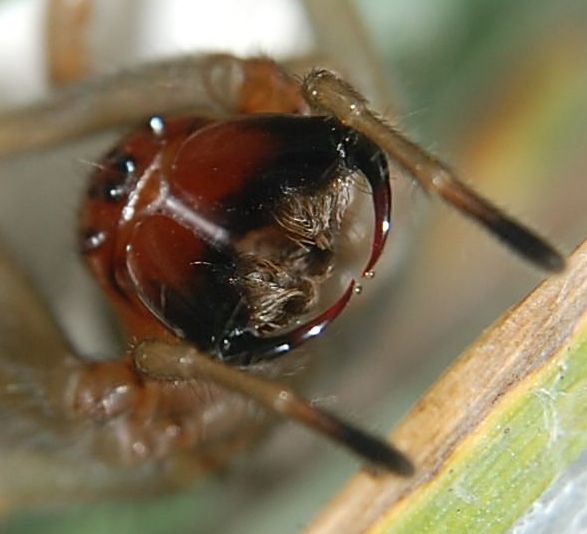
The species has a cream-yellow body with blackish-brown chelicerae and an eye region of the same dark coloration.[10]
Habitat
The species occurs in vegetation, houses, gardens, grasslands, cultivated crops, shrubs and trees. It has been sampled in every South African biome except the Succulent Karoo.[11][12]
In South Africa, it occurs in all nine provinces and has been recorded at elevations between 3 and 1,752 metres above sea level. It is particularly abundant among spiders found in houses in Gauteng and Free State provinces of South Africa.[13][14][15]
Diet
Individual spiders can kill up to 29.3 citrus mites per day in citrus orchards.[16]
Classification of the Common House Sac Spider
| Kingdom | Animalia |
|---|---|
| Phylum | Arthropoda |
| Subphylum | Chelicerata |
| Class | Arachnida (Arachnid) |
| Order | Araneae (Spider) |
| Family | Cheiracanthiidae (Long-legged Sac Spiders) |
| Genus | Cheiracanthium (Longlegged Sac Spiders) |
| Species | Cheiracanthium furculatum Karsch, 1879 |
Where the Common House Sac Spider is found
Checklists and occurrence records place Cheiracanthium furculatum in 22 countries across Africa. GBIF holds 555 georeferenced records of it.
Countries
- Botswana 11
- Burundi 5
- Cabo Verde 21
- Cameroon 12
- Chad 4
- Comoros 3
- Democratic Republic of the Congo 58
- Ethiopia 7
- Ivory Coast 8
- Kenya 26
- Madagascar 1
- Mali 3
- Mozambique 8
- Namibia 16
- Nigeria 4
- Rwanda 11
- Senegal 3
- South Africa 181
- Tanzania 37
- Uganda 5
- Zambia 5
- Zimbabwe 126
Regions and cities with the most records
- Free State, South Africa 45
- Bloemfontein, South Africa 44
- Gauteng, South Africa 44
- Bagale, South Africa 25
- Kakamega, Kenya 22
- Kakamega County, Kenya 22
- Randburg, South Africa 20
- Krugersdorp, South Africa 19
- Randfontein, South Africa 19
- Roodepoort, South Africa 19
- Centurion, South Africa 17
- Pretoria, South Africa 17
- Arusha, Tanzania 14
- Mara, Tanzania 14
- KwaZulu-Natal, South Africa 13
- Mpumalanga, South Africa 11
- Western Cape, South Africa 10
- Eastern Cape, South Africa 9
- Worcester, South Africa 8
- Central, Botswana 7
- Gatumba, Burundi 7
- Harare, Zimbabwe 7
- Harare, Zimbabwe 7
- Haut-Katanga, Democratic Republic of the Congo 7
- Serowe, Botswana 7
- Uvira, Democratic Republic of the Congo 7
- Harare Western Suburbs, Zimbabwe 6
- Ituri, Democratic Republic of the Congo 6
- Limpopo, South Africa 6
- Bouaké, Ivory Coast 5
- Lubumbashi, Democratic Republic of the Congo 5
- Tongaat, South Africa 5
- Vallée du Bandama District, Ivory Coast 5
- Équateur, Democratic Republic of the Congo 5
- Adamaoua, Cameroon 4
- Bukavu, Democratic Republic of the Congo 4
Range as the checklists state it
Cape Verde, Africa, Madagascar, Comoros
Ethiopia, East, Southern Africa
West Africa, Namibia
Southern Africa
A number beside a place is its count of GBIF occurrence records. A place without a number comes from a checklist alone. Records show where a species has been observed or collected, which can include escapes and vagrants.
Common names
English
- Common House Sac Spider
- Common Long-legged Sac Spider
- Yellow Sac Spider
Names in 3 other languages
- Afrikaans
- Huissakspinnekop
- Dutch
- Gehaakte spoorspin
- German
- Gabel-Dornfinger
Synonyms
9 other scientific names have been used for this species and are now treated as synonyms of Cheiracanthium furculatum.
- Cheiracanthium abyssinicum Strand, 1906
- Cheiracanthium castum Lawrence, 1927
- Cheiracanthium geniculosum Simon, 1886
- Cheiracanthium hoggi Lessert, 1921
- Cheiracanthium kiwunum Strand, 1916
- Cheiracanthium lawrencei Roewer, 1951
- Cheiracanthium melanostomellum Roewer, 1951
- Cheiracanthium melanostomellum caboverdense Schmidt & Piepho, 1994
- Cheiracanthium mohasicum Strand, 1916
Related species
-
 Agrarian Sac SpiderCheiracanthium inclusum
-
 Northern Yellow Sac SpiderCheiracanthium mildei
-
 European Yellow Sac SpiderCheiracanthium punctorium
-
 Two-Clawed Hunting SpiderCheiracanthium erraticum
-
 Cheiracanthium taiwanicum
- Cheiracanthium annulipes
- African Long-legged Sac SpiderCheiracanthium africanum
-
 Cheiracanthium eutittha
Compare
Questions and answers
What is the scientific name of the Common House Sac Spider?
The scientific name of the Common House Sac Spider is Cheiracanthium furculatum. Written with its author, the full name is Cheiracanthium furculatum Karsch, 1879.
Which family does the Common House Sac Spider belong to?
Cheiracanthium furculatum belongs to the family Cheiracanthiidae, in the order Araneae and the class Arachnida.
Where is the Common House Sac Spider found?
Checklists and occurrence records place Cheiracanthium furculatum in 22 countries, including South Africa, Zimbabwe, Democratic Republic of the Congo, Tanzania, Kenya and Cabo Verde.
What other names does the Common House Sac Spider have?
Cheiracanthium furculatum is also known in English as Common Long-legged Sac Spider and Yellow Sac Spider.
How poisonous is a yellow sac spider?
The species produces cytotoxic venom that affects tissue surrounding bite sites. Bites can cause lesions reaching 10 centimetres in diameter.[17][18]
Sources
Passages the profile rests on
- The species constructs sac-shaped retreats in vegetation, especially inside rolled-up leaves. Source passage: “It constructs sac-like retreats in vegetation, particularly in rolled-up leaves.” — English Wikipedia
- The species constructs resting, mating, breeding and hibernating retreats. Source passage: “Four types of retreats are constructed: resting, mating, breeding, and hibernating.” — English Wikipedia
- The species is an aggressive predator that kills encountered prey but does not necessarily consume every animal it kills. Source passage: “C. furculatum is an aggressive predator that kills prey it encounters, though it may not always feed on them.” — English Wikipedia
- Individuals can survive prolonged periods at low temperatures. Source passage: “They can survive long periods at low temperatures” — English Wikipedia
- The species can bite humans when threatened. Source passage: “C. furculatum is frequently found in houses and can bite when threatened.” — English Wikipedia
- The species is classified as Least Concern because of its extensive geographical range. Source passage: “Due to its wide geographical range, the species is listed as Least Concern.” — English Wikipedia
- The species has been sampled from more than 20 protected areas. Source passage: “It has been sampled from more than 20 protected areas.” — English Wikipedia
- The species can be beneficial in vineyards because of its predatory activity. Source passage: “While beneficial in vineyards, these spiders can become trapped in table grape containers during export.” — English Wikipedia
- The epigyne of Cheiracanthium ilicis resembles that of Cheiracanthium furculatum. Source passage: “In the case of the epigyne, it resembles those of Cheiracanthium furculatum and Cheiracanthium inclusum,” — pmc.ncbi.nlm.nih.gov
- The species has a cream-yellow body with blackish-brown chelicerae and an eye region of the same dark coloration. Source passage: “The species displays characteristic cream-yellow body coloration with blackish-brown chelicerae and eye region typical of Cheiracanthium.” — English Wikipedia
- The species has been sampled in every South African biome except the Succulent Karoo. Source passage: “This very common species has been sampled from all biomes except Succulent Karoo.” — English Wikipedia
- The species occurs in vegetation, houses, gardens, grasslands, cultivated crops, shrubs and trees. Source passage: “It occurs in vegetation, houses, gardens, grasslands, cultivated crops, shrubs, and trees.” — English Wikipedia
- In South Africa, the species occurs in all nine provinces. Source passage: “In South Africa, it occurs in all nine provinces in more than 10 protected areas, at elevations from 3-1752 m above sea level.” — English Wikipedia
- In South Africa, the species has been recorded at elevations between 3 and 1,752 metres above sea level. Source passage: “at elevations from 3-1752 m above sea level.” — English Wikipedia
- The species is particularly abundant among spiders found in houses in Gauteng and Free State provinces of South Africa. Source passage: “It is the most abundant spider species found in houses in Gauteng and Free State provinces.” — English Wikipedia
- Individual spiders can kill up to 29.3 citrus mites per day in citrus orchards. Source passage: “individuals can kill up to 29.3 citrus mites per spider per day.” — English Wikipedia
- The species produces cytotoxic venom that affects tissue surrounding bite sites. Source passage: “It produces cytotoxic venom affecting tissue around bite sites” — English Wikipedia
- Bites from the species can cause lesions reaching 10 centimetres in diameter. Source passage: “potentially causing lesions up to 10 cm in diameter.” — English Wikipedia
- Cheiracanthium furculatum is native to Africa and has also been introduced to Belgium. Source passage: “It is an African endemic that has been introduced to Belgium.” — English Wikipedia
- The species occurs widely across Africa, Madagascar and the Comoro Islands. Source passage: “C. furculatum is widely found throughout Africa, Madagascar and Comoro Islands.” — English Wikipedia
Data
- Catalogue of Life, 2026-10-16 XR cc by
- Global Biodiversity Information Facility CC BY 4.0
- Wikidata CC0
- GeoNames CC BY 4.0
- Wikimedia Commons per image; credit shown with each image
- Within the Catalogue of Life, this name comes from The World Spider Catalog cc by
References
- Karsch, F. (1879a). West-afrikanische Arachniden, gesammelt von Herrn Stabsarzt Dr. Falkenstein. Zeitschrift für die Gesammten Naturwissenschaften 52: 329-373. where the name was published
This species in other databases
Page built on 29 November 2026. See how the catalog is made and all sources and licences.
Cite this page
ScientificNames.org. (2026). Cheiracanthium furculatum (Common House Sac Spider). Retrieved November 29, 2026, from https://scientificnames.org/species/cheiracanthium-furculatum
“Cheiracanthium furculatum (Common House Sac Spider).” ScientificNames.org, 2026, scientificnames.org/species/cheiracanthium-furculatum. Accessed 29 Nov. 2026.
ScientificNames.org. “Cheiracanthium furculatum (Common House Sac Spider).” Accessed November 29, 2026. https://scientificnames.org/species/cheiracanthium-furculatum.
@misc{scientificnames_cheiracanthium_furculatum_common_house_sac_spider,
  author = {{ScientificNames.org}},
  title = {Cheiracanthium furculatum (Common House Sac Spider)},
  year = {2026},
  url = {https://scientificnames.org/species/cheiracanthium-furculatum},
  note = {Accessed 2026-11-29}
}