Species · Birds
Purple Sunbird Cinnyris asiaticus
The scientific name of the Purple Sunbird is Cinnyris asiaticus. It is a species of bird in the family Nectariniidae (sunbird), order Passeriformes. The name dates from 1790.
- Scientific name
- Cinnyris asiaticus (Latham, 1790)
- Common name
- Purple Sunbird
- Genus
- Cinnyris
- Family
- Nectariniidae (Sunbird)
- Order
- Passeriformes
- Class
- Aves
- Red List category
- LC Least Concern
- Recorded in
- 20 countries
- Name status
- accepted in the Catalogue of Life

Overview
Cinnyris asiaticus occurs from West Asia through the Indian subcontinent into Southeast Asia and parts of the Arabian Peninsula. It measures less than 10 cm in length, and breeding males have glossy metallic bluish to purplish-black plumage.
Written 26 November 2026 from the sources listed below. Each statement was checked against the passage it cites; statements that could not be supported were removed.
Appearance
Non-breeding males may have a black central streak across their yellow underparts. Their collar feathers show a maroon sheen mainly during the breeding season.[1][2]
Females have olive-brown upperparts and yellowish underparts, with a pale supercilium extending beyond the eye and a darkish eye stripe. Both sexes have white tips on their outer tail feathers.[3][4][5]
Its tongue has brush-tipped tubular structures that assist with nectar feeding.[6]
Habitat
The Purple Sunbird occurs in thin forests and gardens, including gardens in densely urbanized areas.[7]
Diet
The Purple Sunbird feeds mainly on nectar and also consumes insects and fruits. Insects are particularly important when adults are feeding young.[8][9]
Its diet includes small berries, including those of Salvadora persica, and cultivated grapes. It sometimes catches insects by flycatching.[10][11]
Behaviour
The species has a fast, direct flight. Although capable of hovering while feeding on nectar, individuals usually perch when foraging at flowers and flick their wings while feeding.[12][13][14]
Individuals are commonly observed in pairs or small groups, although groups of up to 40–50 individuals have occasionally been recorded. The species is highly vocal and joins groups that mob owls and other predators.[15][16][17]
The Purple Sunbird acts as an important pollinator of Butea monosperma, Acacia, Woodfordia and Dendrophthoe. Individuals sometimes obtain nectar by cutting flowers such as Hamelia patens at their bases.[18][19]
Reproduction and life cycle
The primary breeding season in northern India occurs from April to June, before the monsoons. In Sri Lanka, it occurs from January to June.[20][21]
The nest is a pouch constructed from cobwebs, thin vegetation strips, lichens and bark. The female builds almost the entire nest, a process that takes approximately five to ten days.[22][23][24]
The species usually lays two eggs, which the female alone incubates. The eggs hatch after 15–17 days of incubation.[25][26][27]
Males help feed the chicks, although females make more feeding trips as the chicks grow older. During courtship, males raise their heads, fan their tails, flutter with partly open wings and sing before females.[28][29]
Similar species
The species was previously classified in the genus Nectarinia under the name Nectarinia asiatica.[30]
Classification of the Purple Sunbird
| Kingdom | Animalia |
|---|---|
| Phylum | Chordata |
| Subphylum | Vertebrata |
| Infraphylum | Gnathostomata |
| Parvphylum | Osteichthyes |
| Megaclass | Tetrapoda |
| Class | Aves (Bird) |
| Order | Passeriformes (Passerine) |
| Family | Nectariniidae (Sunbird) |
| Genus | Cinnyris (Typical Sunbirds) |
| Species | Cinnyris asiaticus (Latham, 1790) |
Where the Purple Sunbird is found
Checklists and occurrence records place Cinnyris asiaticus in 20 countries across Asia. GBIF holds 703,415 georeferenced records of it.
Countries
- Afghanistan 5
- Bangladesh 6,690
- Bhutan 137
- Cambodia 2,428
- China 290
- Hong Kong 59
- India 623,469
- Iran 1,809
- Kuwait 83
- Laos 89
- Myanmar 1,030
- Nepal 4,365
- Oman 4,545
- Pakistan 3,901
- Qatar 88
- Saudi Arabia 4
- Sri Lanka 8,990
- Thailand 9,837
- United Arab Emirates 35,417
- Vietnam 179
Regions and cities with the most records
- Maharashtra, India 96,951
- Karnataka, India 95,623
- Tamil Nadu, India 95,225
- Gujarat, India 53,370
- Bengaluru, India 39,475
- Madhya Pradesh, India 36,889
- Kerala, India 28,878
- Pune, India 28,768
- Rajasthan, India 28,239
- Khadki, India 27,867
- Electronic City Phase I, India 27,810
- koppana Agrahara, India 27,729
- Kharakvasla, India 27,173
- Yelahanka, India 27,079
- Pimpri, India 26,569
- Pimpri-Chinchwad, India 26,554
- Hebbagodi, India 26,218
- Bommasandra Industrial Area, India 25,392
- Telangana, India 24,484
- Rijokri, India 23,933
- West Bengal, India 23,762
- Sultan Pur, India 23,399
- Saiyad-ul-ajaib, India 23,368
- Neb Sarai, India 23,151
- Kusum Pur, India 22,945
- Malakpur Kohi Rangpur, India 22,831
- Chhatarpur, India 22,744
- Aya Nagar, India 21,893
- Delhi Cantonment, India 21,642
- New Delhi, India 21,453
- Samālka, India 21,314
- Jigani, India 21,218
- Kāpas Herd, India 21,216
- Tighri, India 21,145
- Deoli, India 21,072
- Pul Pehlad, India 20,848
1 more country has a few records outside this range
These countries hold a few records of Cinnyris asiaticus but lie outside the range the checklists give for it. Such records are often zoo or garden specimens, museum material or vagrants, so the species is not counted as occurring there.
Range as the checklists state it
Europe & Northern Asia (excluding China)
Southern Asia
A number beside a place is its count of GBIF occurrence records. A place without a number comes from a checklist alone. Records show where a species has been observed or collected, which can include escapes and vagrants.
Common names
English
- Purple Sunbird
Names in 37 other languages
- Arabic
- تمير أرجوان
- Bengali
- নীলটুনি
- Catalan
- Suimanga Porpra, suimanga metàl·lic
- Chinese
- 紫太陽鳥, 紫色花蜜鸟, 紫花蜜鳥, 紫花蜜鸟
- Croatian
- purpurni medosas
- Czech
- strdimil fialový
- Danish
- Purpursolfugl
- Dutch
- Purperhoningzuiger
- Esperanto
- purpura nektarinio
- Finnish
- purppuramedestäjä
- French
- Souimanga asiatique
- German
- Purpurnektarvogel
- Gujarati
- જાંબલી શક્કરખોરો
- Hebrew
- צופית סגולה
- Hindi
- बैंगनी शक्करखोरा
- Hungarian
- bíbor nektármadár
- Irish
- Grianóg chorcra
- Italian
- Nettarinia purpurea, Nettarinia viola
- Japanese
- ムラサキタイヨウチョウ
- Kannada
- ನೇರಳೆ ಸೂರಕ್ಕಿ
- Khmer
- ចាបកន្លង់ខៀវ
- Latvian
- purpura nektārputns
- Lithuanian
- azijinė spalvingoji nektarina
- Malayalam
- കറുപ്പൻ തേൻകിളി
- Marathi
- जांभळा सूर्यपक्षी
- Persian
- شهدخوار
- Polish
- nektarnik stalowy
- Portuguese
- beija-flor-púrpura, nectarínia-asiática
- Russian
- Атласная нектарница, Пурпуровая нектарница
- Serbian
- Ljubičasta sunčica, Љубичаста сунчица
- Slovak
- nektárovka ligotavá
- Spanish
- Suimanga asiático
- Swedish
- purpursolfågel
- Tamil
- ஊதா தேன்சிட்டு, ஊதாத் தேன்சிட்டு, கருஞ்சிவப்பு
- Thai
- นกกินปลีดำม่วง
- Turkish
- Mor Nektarkuşu
- Ukrainian
- Ма́ріка пурпурова, маріка пурпурова
Synonyms
3 other scientific names have been used for this species and are now treated as synonyms of Cinnyris asiaticus.
- Certhia asiatica Latham, J, 1790
- Certhia chloroptera Forster, JR, 1795
- Nectarinia asiatica (Latham, 1790)
Subspecies and varieties
- Cinnyris asiaticus asiaticus (Purple Sunbird) subspecies
- Cinnyris asiaticus brevirostris subspecies
- Cinnyris asiaticus intermedius subspecies
Related species
-
 Palestine SunbirdCinnyris osea
-
 Garden SunbirdCinnyris jugularis
-
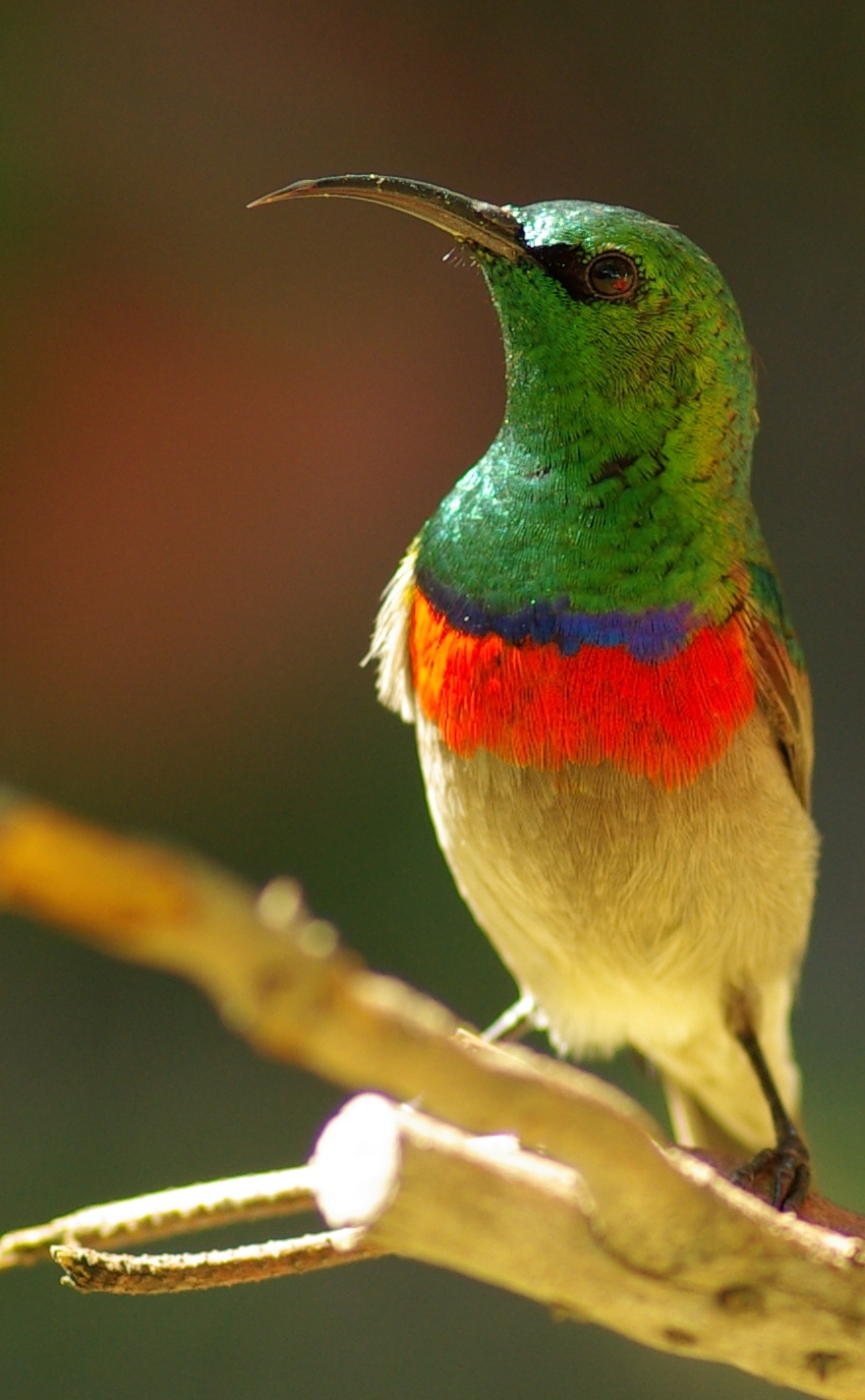 Southern Double-collared SunbirdCinnyris chalybeus
-
 Variable SunbirdCinnyris venustus
-
 Purple-banded SunbirdCinnyris bifasciatus
-
 Souimanga SunbirdCinnyris sovimanga
-
 White-bellied SunbirdCinnyris talatala
-
 Beautiful SunbirdCinnyris pulchellus
Compare
Questions and answers
What is the scientific name of the Purple Sunbird?
The scientific name of the Purple Sunbird is Cinnyris asiaticus. Written with its author, the full name is Cinnyris asiaticus (Latham, 1790).
Which family does the Purple Sunbird belong to?
Cinnyris asiaticus belongs to the family Nectariniidae, in the order Passeriformes and the class Aves.
Where is the Purple Sunbird found?
Checklists and occurrence records place Cinnyris asiaticus in 20 countries, including India, United Arab Emirates, Thailand, Sri Lanka, Bangladesh and Oman.
What is the conservation status of the Purple Sunbird?
The IUCN Red List category recorded for Cinnyris asiaticus is Least Concern (LC).
What to feed a purple sunbird?
The Purple Sunbird feeds mainly on nectar and also consumes insects and fruits, including small berries and cultivated grapes.[8][10]
What does the purple sunbird eat?
It feeds mainly on nectar, as well as insects and fruits. Its diet includes small berries, including those of Salvadora persica, and cultivated grapes.[8][10]
Where do purple sunbirds live?
They occur from West Asia through the Indian subcontinent into Southeast Asia and parts of the Arabian Peninsula. They inhabit thin forests and gardens, including gardens in densely urbanized areas.[7][31][32]
Is a sunbird an herbivore?
The Purple Sunbird is not exclusively herbivorous because its diet includes insects as well as nectar and fruits.[8]
Sources
Passages the profile rests on
- Non-breeding males may have a black central streak across yellow underparts. Source passage: “non-breeding males may show a central streak of black on yellow underparts.” — English Wikipedia
- The collar feathers show a maroon sheen mainly during the breeding season. Source passage: “The maroon shine on the feathers of the collar around the neck is visible mainly during the breeding seasons.” — English Wikipedia
- Females have olive-brown upperparts and yellowish underparts. Source passage: “Females are olive brown above with a yellowish underside.” — English Wikipedia
- Females have a pale supercilium extending beyond the eye and a darkish eye stripe. Source passage: “There is a pale supercilium beyond the eye. There is a darkish eye stripe.” — English Wikipedia
- Both sexes have white tips on their outer tail feathers. Source passage: “The outer tail feathers are tipped in white both in the male and female.” — English Wikipedia
- Its tongue has brush-tipped tubular structures that assist with nectar feeding. Source passage: “brush-tipped tubular tongues that aid in nectar feeding.” — English Wikipedia
- The species occurs in thin forests and gardens, including gardens in densely urbanized areas. Source passage: “They are found in thin forest and garden land, including those in dense urban areas.” — English Wikipedia
- The species feeds mainly on nectar and also consumes insects and fruits. Source passage: “They feed mainly on nectar but also take fruits and insects.” — English Wikipedia
- Insects are particularly important in the diet when adults are feeding young. Source passage: “It feeds mainly on nectar and insects, especially when feeding young.” — English Wikipedia
- The species consumes small berries, including those of Salvadora persica, as well as cultivated grapes. Source passage: “They are known to feed on small berries such as those of Salvadora persica and cultivated grapes.” — English Wikipedia
- The species sometimes catches insects by flycatching. Source passage: “Insects are sometimes caught by flycatching.” — English Wikipedia
- The species has a fast, direct flight. Source passage: “It has a fast and direct flight” — English Wikipedia
- Although capable of hovering while feeding on nectar, individuals usually perch when foraging at flowers. Source passage: “They rarely hover at flowers and usually perch to forage for nectar.” — English Wikipedia
- Individuals flick their wings while feeding. Source passage: “While feeding they flick their wings.” — English Wikipedia
- The species is highly vocal and joins groups that mob owls and other predators. Source passage: “These birds are very vociferous and will call and will join to mob owls or other predators.” — English Wikipedia
- Individuals are commonly observed in pairs or small groups. Source passage: “They are seen in pairs or small groups” — English Wikipedia
- Groups of up to 40–50 individuals have occasionally been recorded. Source passage: “Groups of as many as 40 to 50 individuals have sometimes been noted.” — English Wikipedia
- The species acts as an important pollinator of Butea monosperma, Acacia, Woodfordia and Dendrophthoe. Source passage: “They are important pollinators of some plant species such as Butea monosperma, Acacia, Woodfordia and Dendrophthoe.” — English Wikipedia
- Individuals sometimes obtain nectar by cutting flowers such as Hamelia patens at their bases. Source passage: “but they sometimes steal nectar by slitting flowers such as Hamelia patens at the base.” — English Wikipedia
- The primary breeding season in northern India occurs from April to June, before the monsoons. Source passage: “The primary breeding season is before the Monsoons, April to June in northern India” — English Wikipedia
- The primary breeding season in Sri Lanka occurs from January to June. Source passage: “and January to June in Sri Lanka.” — English Wikipedia
- The nest is a pouch constructed from cobwebs, thin vegetation strips, lichens and bark. Source passage: “The nest is a pouch made of cobwebs, thin strips of vegetation, lichens and bark.” — English Wikipedia
- The female builds almost the entire nest. Source passage: “The nest is built almost entirely by the female.” — English Wikipedia
- Nest construction takes approximately five to ten days. Source passage: “About five to ten days may be taken in the building of the nest.” — English Wikipedia
- The species usually lays two eggs. Source passage: “Two eggs are usually laid.” — English Wikipedia
- The female alone incubates the eggs. Source passage: “Only the female incubates the eggs” — English Wikipedia
- The eggs hatch after 15–17 days of incubation. Source passage: “which hatch after 15 to 17 days.” — English Wikipedia
- Males help feed the chicks, although females make more feeding trips as the chicks grow older. Source passage: “Males assist in feeding the chicks although females involve themselves to a greater extent, making more trips as the chicks get older.” — English Wikipedia
- During courtship, males raise their heads, fan their tails, flutter with partly open wings and sing before females. Source passage: “In courtship displays the male raises his head, fans his tail and flutters with partly open wings that expose the pectoral tufts and sings before the female.” — English Wikipedia
- The species was previously classified in the genus Nectarinia under the name Nectarinia asiatica. Source passage: “was previously placed in the genus Nectarinia and listed as N. asiatica following Sibley and Monroe (1990, 1993).” — datazone.birdlife.org
- The species occurs from West Asia through the Indian subcontinent into Southeast Asia. Source passage: “The species is distributed widely from West Asia through the Indian subcontinent and into Southeast Asia.” — English Wikipedia
- The species also occurs in parts of the Arabian Peninsula. Source passage: “It occurs in parts of the Arabian peninsula and South and Southeast Asia.” — English Wikipedia
Data
- Catalogue of Life, 2026-10-16 XR cc by
- Global Biodiversity Information Facility CC BY 4.0
- Wikidata CC0
- GeoNames CC BY 4.0
- Wikimedia Commons per image; credit shown with each image
- Within the Catalogue of Life, this name comes from The Integrated Taxonomic Information System cc0
References
- del Hoyo, Josep, Andrew Elliot, and David Christie, eds. (2008). Handbook of the Birds of the World. Vol. 13. Penduline-Tits to Shrikes.
This species in other databases
Page built on 29 November 2026. See how the catalog is made and all sources and licences.
Cite this page
ScientificNames.org. (2026). Cinnyris asiaticus (Purple Sunbird). Retrieved November 29, 2026, from https://scientificnames.org/species/cinnyris-asiaticus
“Cinnyris asiaticus (Purple Sunbird).” ScientificNames.org, 2026, scientificnames.org/species/cinnyris-asiaticus. Accessed 29 Nov. 2026.
ScientificNames.org. “Cinnyris asiaticus (Purple Sunbird).” Accessed November 29, 2026. https://scientificnames.org/species/cinnyris-asiaticus.
@misc{scientificnames_cinnyris_asiaticus_purple_sunbird,
  author = {{ScientificNames.org}},
  title = {Cinnyris asiaticus (Purple Sunbird)},
  year = {2026},
  url = {https://scientificnames.org/species/cinnyris-asiaticus},
  note = {Accessed 2026-11-29}
}