Species · Birds
Palestine Sunbird Cinnyris osea
The scientific name of the Palestine Sunbird is Cinnyris osea. It is a species of bird in the family Nectariniidae (sunbird), order Passeriformes. The name dates from 1856.
- Scientific name
- Cinnyris osea Bonaparte, 1856
- Common name
- Palestine Sunbird
- Genus
- Cinnyris
- Family
- Nectariniidae (Sunbird)
- Order
- Passeriformes
- Class
- Aves
- Red List category
- LC Least Concern
- Recorded in
- 9 countries
- Name status
- accepted in the Catalogue of Life

Overview
Cinnyris osea inhabits dry woodland, scrub, wadis, savannas, orchards and gardens. Breeding males have glossy dark plumage and distinctive orange tufts on the sides of their breasts.
Written 26 November 2026 from the sources listed below. Each statement was checked against the passage it cites; statements that could not be supported were removed.
Appearance
Breeding males have predominantly dark plumage that appears glossy blue or green in bright light. Orange tufts on the sides of their breasts are difficult to see except at close range.[1][2]
Females and juveniles have grey-brown upperparts and pale underparts. Non-breeding males resemble females and juveniles but may retain some dark feathers.[3][4]
The species has a relatively long, black bill that curves downwards.[5]
The Palestine Sunbird measures between 8 and 12 cm in length, with a wingspan of 14 to 16 cm. Males have an average body mass of 7.6 g, while females weigh approximately 6.8 g.[6][7][8][9]
Habitat
The Palestine Sunbird inhabits dry woodland, scrub, wadis and savannas. It also uses orchards and gardens as habitats and occurs in areas with high temperatures and dry climates.[10][11][12][13][14][15]
The species occurs from sea level to elevations of 3,200 m. It is common in towns in some parts of its range.[16][17]
The Middle Eastern subspecies breeds in Israel, Palestine and Jordan. Its breeding range extends south through western Saudi Arabia to Yemen and Oman.[18][19]
The species has colonized the Sinai Peninsula in Egypt in recent decades and has been observed breeding in Lebanon. It regularly spends the winter in Lebanon and Syria.[20][21][22]
The African subspecies occurs locally in Sudan, north-west Uganda, the Central African Republic, north-east Democratic Republic of Congo and northern Cameroon.[23]
Diet
The Palestine Sunbird feeds mainly on insects and nectar. It has a long, brush-tipped tongue for extracting nectar from flowers.[24][25]
Behaviour
The Palestine Sunbird produces a high-pitched, fast, jingling song. It also gives a harsh alarm call.[26][27]
Reproduction and life cycle
The Palestine Sunbird builds a purse-shaped nest suspended from a branch in a tree or bush. The nest measures approximately 18 cm in length and 8 cm across its base.[28][29]
Nest construction materials include leaves, grass and other plant material, bound together with hair and spider webs. The nest interior is lined with wool and feathers.[30][31][32]
Clutches contain between one and three eggs. The eggs are smooth and glossy and vary in colour, often being white or grey with faint markings near their broader ends.[33][34][35]
The eggs are incubated for 13 to 14 days. Nestlings are downy and have orange-red mouths, and young birds fledge between 14 and 21 days after hatching.[36][37][38]
Conservation
The species has experienced a continuing decline in the number of mature individuals and in the area, extent or quality of its habitat.[39][40]
Conservation sites have been identified throughout the species' entire range. The species occurs in at least one protected area.[41][42]
Uses
The Palestinian Authority adopted the Palestine Sunbird as its national bird in 2015.[43]
Classification of the Palestine Sunbird
| Kingdom | Animalia |
|---|---|
| Phylum | Chordata |
| Subphylum | Vertebrata |
| Infraphylum | Gnathostomata |
| Parvphylum | Osteichthyes |
| Megaclass | Tetrapoda |
| Class | Aves (Bird) |
| Order | Passeriformes (Passerine) |
| Family | Nectariniidae (Sunbird) |
| Genus | Cinnyris (Typical Sunbirds) |
| Species | Cinnyris osea Bonaparte, 1856 |
Where the Palestine Sunbird is found
Checklists and occurrence records place Cinnyris osea in 9 countries. GBIF holds 119,725 georeferenced records of it.
Countries
- Israel 103,557
- Jordan 2,894
- Lebanon 573
- Oman 1,320
- Palestinian Territory 9,097
- Saudi Arabia 2,103
- Syria 8
- Turkey 49
- Yemen 124
Regions and cities with the most records
- Southern District, Israel 28,202
- Mevasseret Tsiyyon, Israel 26,979
- Qiryat HaYovel, Israel 24,135
- Battir, Palestinian Territory 22,732
- Bayt Jālā, Palestinian Territory 22,247
- Jerusalem, Israel 22,221
- ‘Aţārūt, Palestinian Territory 22,121
- Bethlehem, Palestinian Territory 21,906
- Ramallah, Palestinian Territory 21,841
- Al ‘Ayzarīyah, Palestinian Territory 21,573
- Shu‘fāţ, Palestinian Territory 21,571
- Bet Shemesh, Israel 21,233
- Al Bīrah, Palestinian Territory 21,141
- Shoham, Israel 21,087
- Bayt Ḩanīnā, Palestinian Territory 20,963
- Yehud-Monosson, Israel 20,553
- Ma‘ale Adummim, Palestinian Territory 20,473
- Surif City, Palestinian Territory 20,433
- Lod, Israel 20,404
- Ar Rām wa Ḑāḩiyat al Barīd, Palestinian Territory 20,373
- Central District, Israel 19,936
- Yehud Monosson, Israel 19,865
- Be’er Ya‘aqov, Israel 19,392
- Jerusalem, Israel 19,303
- Or Yehuda, Israel 19,238
- Ramla, Israel 19,083
- El‘ad, Israel 19,061
- Petaẖ Tiqva, Israel 18,535
- Giv'at Shmuel, Israel 18,214
- Bnei Brak, Israel 17,798
- Ganei Tikva, Israel 17,679
- Kiryat Ono, Israel 17,656
- Ramat Gan, Israel 17,559
- Hod HaSharon, Israel 17,399
- Rosh Ha‘Ayin, Israel 17,361
- Givatayim, Israel 17,337
5 more countries have a few records outside this range
These countries hold a few records of Cinnyris osea but lie outside the range the checklists give for it. Such records are often zoo or garden specimens, museum material or vagrants, so the species is not counted as occurring there.
A number beside a place is its count of GBIF occurrence records. A place without a number comes from a checklist alone. Records show where a species has been observed or collected, which can include escapes and vagrants.
Common names
English
- Palestine Sunbird
- Northern Orange-tufted Sunbird
- PASU
Names in 35 other languages
- Arabic
- تمير فلسطين, عصفور الشمس الفلسطيني
- Bulgarian
- Израелска нектарница
- Catalan
- Suimanga palestina, suimanga de Palestina
- Chinese
- 巴勒斯坦花蜜鳥, 阿拉伯橙簇花蜜鸟
- Croatian
- jerihonski medosas
- Czech
- strdimil palestinský
- Danish
- Palæstina-solfugl, Palæstinasolfugl
- Dutch
- Palestijnse Honingzuiger
- Esperanto
- palestina nektarinio
- Estonian
- araabia nektarilind
- Finnish
- isopurppuramedestäjä
- French
- Souimanga de Palestine, Souimanga de Paléstine
- German
- Jerichonektarvogel
- Hebrew
- צופית בוהקת
- Hungarian
- jerikói nektármadár
- Icelandic
- Þornsóli
- Irish
- Grianóg Phailistíneach
- Italian
- Nettarinia della Palestina
- Japanese
- キタキフサタイヨウチョウ
- Latvian
- Palestīnas nektārputns
- Lithuanian
- palestininė spalvingoji nektarina
- Northern Sami
- Palestinamiehtaborri
- Norwegian
- palestinasolfugl
- Polish
- nektarnik palestyński
- Portuguese
- beija-flor-da-palestina, nectarínia-da-palestina
- Russian
- Палестинская нектарница
- Serbian
- Palestinska sunčica
- Slovak
- nektárovka križiacka
- Slovenian
- palestinski medoses
- Spanish
- Suimanga palestino
- Swedish
- palestinasolfågel
- Turkish
- Filistin Nektarkuşu
- Ukrainian
- маріка палестинська
- Welsh
- Aderyn haul oren dan adain y Gogledd
- pnb
- فلسطین رس پنچھی
Synonyms
2 other scientific names have been used for this species and are now treated as synonyms of Cinnyris osea.
- Nectarina osea Bonaparte, CLJL, 1856
- Nectarinia osea (Bonaparte, 1856)
Subspecies and varieties
- Cinnyris osea decorsei subspecies
- Cinnyris osea osea subspecies
Related species
-
 Purple SunbirdCinnyris asiaticus
-
 Garden SunbirdCinnyris jugularis
-
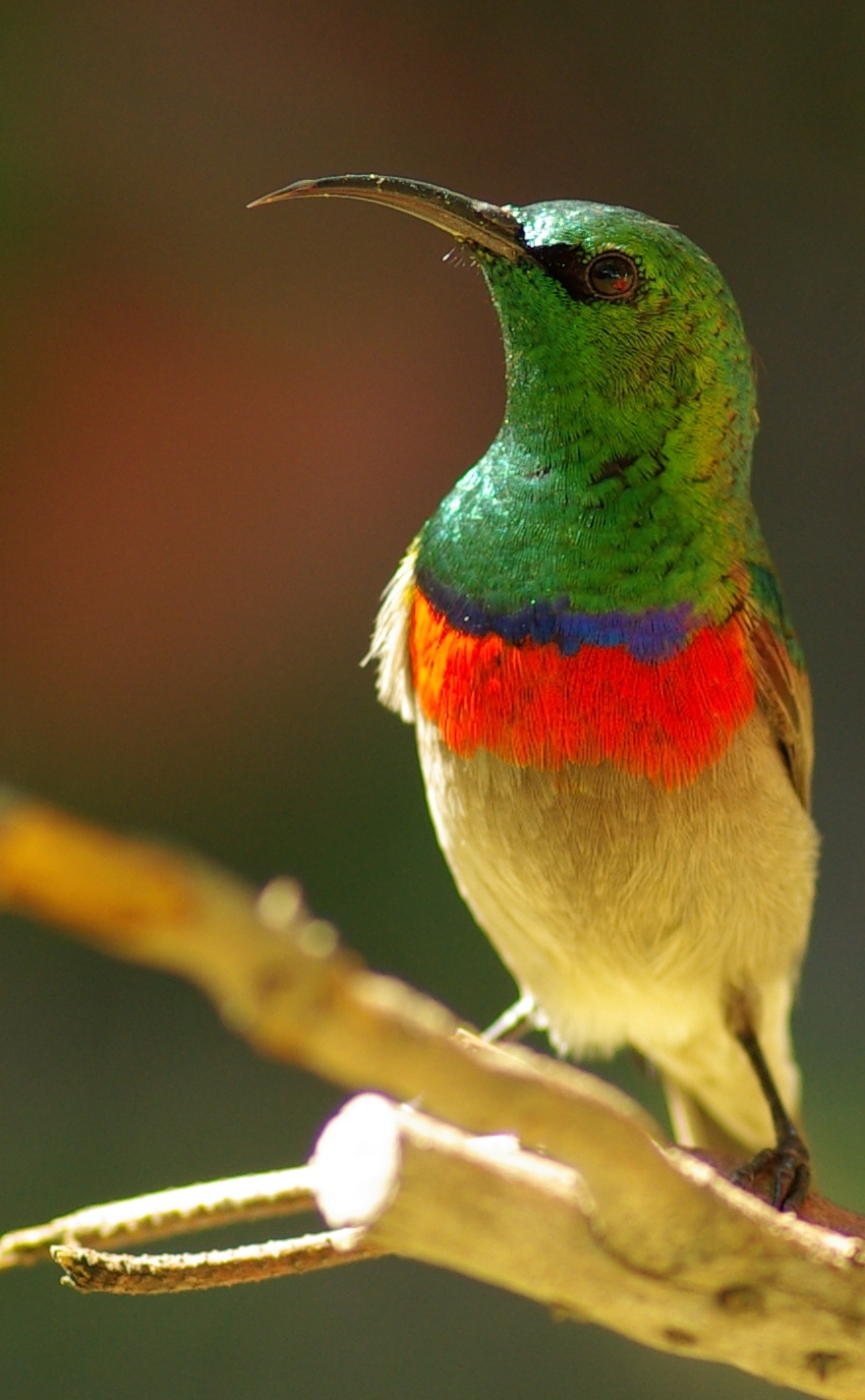 Southern Double-collared SunbirdCinnyris chalybeus
-
 Variable SunbirdCinnyris venustus
-
 Purple-banded SunbirdCinnyris bifasciatus
-
 Souimanga SunbirdCinnyris sovimanga
-
 White-bellied SunbirdCinnyris talatala
-
 Beautiful SunbirdCinnyris pulchellus
Compare
Questions and answers
What is the scientific name of the Palestine Sunbird?
The scientific name of the Palestine Sunbird is Cinnyris osea. Written with its author, the full name is Cinnyris osea Bonaparte, 1856.
Which family does the Palestine Sunbird belong to?
Cinnyris osea belongs to the family Nectariniidae, in the order Passeriformes and the class Aves.
Where is the Palestine Sunbird found?
Checklists and occurrence records place Cinnyris osea in 9 countries, including Israel, Palestinian Territory, Jordan, Saudi Arabia, Oman and Lebanon.
What is the conservation status of the Palestine Sunbird?
The IUCN Red List category recorded for Cinnyris osea is Least Concern (LC).
What other names does the Palestine Sunbird have?
Cinnyris osea is also known in English as Northern Orange-tufted Sunbird and PASU.
What is the national bird of Palestine?
The Palestine Sunbird is the national bird adopted by the Palestinian Authority in 2015.[43]
What does a sunbird eat?
The Palestine Sunbird feeds mainly on insects and nectar.[24]
How long do sunbirds sit on eggs?
The eggs of the Palestine Sunbird are incubated for 13 to 14 days.[36]
Sources
Passages the profile rests on
- Breeding males have predominantly dark plumage that appears glossy blue or green in bright light. Source passage: “The plumage of breeding males is mostly dark but appears glossy blue or green in the light.” — English Wikipedia
- Breeding males have orange tufts on the sides of their breasts that are difficult to see except at close range. Source passage: “There are orange tufts at the sides of the breast which are hard to see except at close range.” — English Wikipedia
- Females and juveniles have grey-brown upperparts and pale underparts. Source passage: “Females and juveniles are grey-brown above with pale underparts.” — English Wikipedia
- Non-breeding males resemble females and juveniles but may retain some dark feathers. Source passage: “Non-breeding males are similar but may retain some dark feathers.” — English Wikipedia
- The species has a relatively long, black bill that curves downwards. Source passage: “The bill is fairly long, black and curves downwards.” — English Wikipedia
- The species measures between 8 and 12 cm in length. Source passage: “The Palestine sunbird is 8 to 12 cm long” — English Wikipedia
- Its wingspan ranges from 14 to 16 cm. Source passage: “with a wingspan of 14 to 16 cm.” — English Wikipedia
- Males have an average body mass of 7.6 g. Source passage: “Males have an average weight of 7.6 g” — English Wikipedia
- Females weigh approximately 6.8 g. Source passage: “females weigh around 6.8 g.” — English Wikipedia
- The species inhabits dry woodland. Source passage: “It inhabits dry woodland, scrub, wadis, savannas, orchards and gardens.” — English Wikipedia
- The species occurs in scrub habitats. Source passage: “It inhabits dry woodland, scrub, wadis, savannas, orchards and gardens.” — English Wikipedia
- The species inhabits wadis. Source passage: “It inhabits dry woodland, scrub, wadis, savannas, orchards and gardens.” — English Wikipedia
- The species occurs in savannas. Source passage: “It inhabits dry woodland, scrub, wadis, savannas, orchards and gardens.” — English Wikipedia
- The species uses orchards and gardens as habitats. Source passage: “It inhabits dry woodland, scrub, wadis, savannas, orchards and gardens.” — English Wikipedia
- The species occurs in areas with high temperatures and dry climates. Source passage: “It occurs in areas with high temperatures and dry climate” — English Wikipedia
- The species occurs from sea level to elevations of 3,200 m. Source passage: “from sea level up to an altitude of 3200 m.” — English Wikipedia
- The species is common in towns in some parts of its range. Source passage: “It is common in towns in some areas.” — English Wikipedia
- The Middle Eastern subspecies breeds in Israel, Palestine and Jordan. Source passage: “breeds from Israel, Palestine and Jordan in the north,” — English Wikipedia
- The Middle Eastern subspecies' breeding range extends south through western Saudi Arabia to Yemen and Oman. Source passage: “down through western Saudi Arabia to Yemen and Oman in the south.” — English Wikipedia
- The species has colonized the Sinai Peninsula in Egypt in recent decades. Source passage: “In recent decades it has colonized the Sinai Peninsula in Egypt.” — English Wikipedia
- The species has been observed breeding in Lebanon. Source passage: “It has been observed breeding in Lebanon” — English Wikipedia
- The species regularly spends the winter in Lebanon and Syria. Source passage: “and regularly winters in both Lebanon and Syria.” — English Wikipedia
- The African subspecies occurs locally in Sudan, north-west Uganda, the Central African Republic, north-east Democratic Republic of Congo and northern Cameroon. Source passage: “The African subspecies C. o. decorsei is found very locally in parts of Sudan, north-west Uganda, the Central African Republic, north-east Democratic Republic of Congo and northern Cameroon.” — English Wikipedia
- The species feeds mainly on insects and nectar. Source passage: “The diet consists mainly of insects and nectar.” — English Wikipedia
- The species has a long, brush-tipped tongue for extracting nectar from flowers. Source passage: “The tongue is long and brush-tipped to extract nectar from flowers.” — English Wikipedia
- The species produces a high-pitched, fast, jingling song. Source passage: “It has a high, fast, jingling song” — English Wikipedia
- The species gives a harsh alarm call. Source passage: “and various calls including a harsh alarm call.” — English Wikipedia
- The species builds a purse-shaped nest suspended from a branch in a tree or bush. Source passage: “The purse-like nest hangs from a branch in a tree or bush.” — English Wikipedia
- The nest measures approximately 18 cm in length and 8 cm across its base. Source passage: “It is 18 cm long and 8 cm wide at the base.” — English Wikipedia
- Nest construction materials include leaves, grass and other plant material. Source passage: “It is made of leaves, grass and other plant material” — English Wikipedia
- The nest's plant materials are bound together with hair and spider webs. Source passage: “which is bound together with hair and spider webs” — English Wikipedia
- The nest interior is lined with wool and feathers. Source passage: “and lined with wool and feathers.” — English Wikipedia
- Clutches contain between one and three eggs. Source passage: “One to three smooth, glossy eggs are laid.” — English Wikipedia
- The eggs are smooth and glossy and vary in colour. Source passage: “One to three smooth, glossy eggs are laid. These are somewhat variable in colour;” — English Wikipedia
- The eggs are often white or grey with faint markings near their broader ends. Source passage: “often white or grey with faint markings at the broader end.” — English Wikipedia
- The eggs are incubated for 13 to 14 days. Source passage: “They are incubated for 13 to 14 days.” — English Wikipedia
- Nestlings are downy and have orange-red mouths. Source passage: “The young are downy with an orange-red mouth” — English Wikipedia
- Young birds fledge between 14 and 21 days after hatching. Source passage: “and fledge after 14 to 21 days.” — English Wikipedia
- The species has experienced a continuing decline in the number of mature individuals. Source passage: “Continuing decline of mature individuals” — iucnredlist.org
- The species has experienced a continuing decline in the area, extent or quality of its habitat. Source passage: “Continuing decline in area, extent and/or quality of habitat” — iucnredlist.org
- Conservation sites have been identified throughout the species' entire range. Source passage: “Conservation sites identified : Yes, over entire range” — iucnredlist.org
- The species occurs in at least one protected area. Source passage: “Occurs in at least one protected area : Yes” — iucnredlist.org
- The Palestinian Authority adopted the species as its national bird in 2015. Source passage: “In 2015 the Palestinian Authority adopted the species as a national bird” — English Wikipedia
Data
- Catalogue of Life, 2026-10-16 XR cc by
- Global Biodiversity Information Facility CC BY 4.0
- Wikidata CC0
- GeoNames CC BY 4.0
- Wikimedia Commons per image; credit shown with each image
- Within the Catalogue of Life, this name comes from The Integrated Taxonomic Information System cc0
This species in other databases
Page built on 26 November 2026. See how the catalog is made and all sources and licences.
Cite this page
ScientificNames.org. (2026). Cinnyris osea (Palestine Sunbird). Retrieved November 26, 2026, from https://scientificnames.org/species/cinnyris-osea
“Cinnyris osea (Palestine Sunbird).” ScientificNames.org, 2026, scientificnames.org/species/cinnyris-osea. Accessed 26 Nov. 2026.
ScientificNames.org. “Cinnyris osea (Palestine Sunbird).” Accessed November 26, 2026. https://scientificnames.org/species/cinnyris-osea.
@misc{scientificnames_cinnyris_osea_palestine_sunbird,
  author = {{ScientificNames.org}},
  title = {Cinnyris osea (Palestine Sunbird)},
  year = {2026},
  url = {https://scientificnames.org/species/cinnyris-osea},
  note = {Accessed 2026-11-26}
}