Species · Birds
Variable Sunbird Cinnyris venustus
The scientific name of the Variable Sunbird is Cinnyris venustus. It is a species of bird in the family Nectariniidae (sunbird), order Passeriformes. The name dates from 1799.
- Scientific name
- Cinnyris venustus (Shaw, 1799)
- Common name
- Variable Sunbird
- Genus
- Cinnyris
- Family
- Nectariniidae (Sunbird)
- Order
- Passeriformes
- Class
- Aves
- Red List category
- LC Least Concern
- Recorded in
- 33 countries
- Name status
- accepted in the Catalogue of Life

Overview
Cinnyris venustus inhabits open woodland and cultivated areas. Adult males have glossy green heads, throats and napes, a maroon breast band and usually a yellow belly.
Written 26 November 2026 from the sources listed below. Each statement was checked against the passage it cites; statements that could not be supported were removed.
Appearance
Adult males have glossy green heads, throats and napes, together with a maroon breast band. Their bellies are yellow in most subspecies, but orange or white in some.[1][2]
Females have grey-brown upperparts, yellowish underparts and a conspicuous pale supercilium. Eclipse males resemble females but retain some green coloration, particularly on the throat.[3][4]
The Variable Sunbird measures approximately 10 cm in length. It has a medium-length, thin, downward-curving bill and a brush-tipped tubular tongue.[5][6]
Habitat
The Variable Sunbird inhabits open woodland and cultivated areas.[7]
Diet
The Variable Sunbird feeds largely on nectar and also consumes insects, particularly when feeding young.[8]
Behaviour
Sunbirds generally have fast, direct flight using their short wings. Most sunbird species can obtain nectar while hovering, although they usually perch to feed.[9][10]
The Variable Sunbird produces a clear, repeated tew call.[11]
Reproduction and life cycle
The Variable Sunbird is a resident breeding species in equatorial Africa. It lays two eggs in a suspended nest situated in a tree.[12][13]
Conservation
The Variable Sunbird was assessed for the IUCN Red List in 2018.[14]
Classification of the Variable Sunbird
| Kingdom | Animalia |
|---|---|
| Phylum | Chordata |
| Subphylum | Vertebrata |
| Infraphylum | Gnathostomata |
| Parvphylum | Osteichthyes |
| Megaclass | Tetrapoda |
| Class | Aves (Bird) |
| Order | Passeriformes (Passerine) |
| Family | Nectariniidae (Sunbird) |
| Genus | Cinnyris (Typical Sunbirds) |
| Species | Cinnyris venustus (Shaw, 1799) |
Where the Variable Sunbird is found
Checklists and occurrence records place Cinnyris venustus in 33 countries. GBIF holds 88,272 georeferenced records of it.
Countries
- Angola 541
- Benin 251
- Burundi 74
- Cameroon 169
- Chad 18
- Democratic Republic of the Congo 616
- Eritrea 82
- Ethiopia 3,281
- Gabon 22
- Gambia 3,774
- Ghana 304
- Guinea 400
- Guinea-Bissau 319
- Ivory Coast 88
- Kenya 29,278
- Liberia 205
- Malawi 2,242
- Mali 25
- Mozambique 1,033
- Namibia 15
- Nigeria 7,922
- Republic of the Congo 10
- Rwanda 5,601
- Senegal 1,260
- Sierra Leone 344
- Somalia 166
- South Africa 13
- South Sudan 23
- Tanzania 11,945
- Togo 312
- Uganda 4,233
- Zambia 4,615
- Zimbabwe 9,091
Regions and cities with the most records
- Nairobi, Kenya 12,597
- Imara Daima Estate, Kenya 12,376
- Nairobi County, Kenya 11,207
- Ongata Rongai, Kenya 10,907
- Kikuyu, Kenya 9,948
- Ngong, Kenya 9,756
- Karuri, Kenya 9,711
- Kiambu, Kenya 8,682
- Kiserian, Kenya 7,036
- Arusha, Tanzania 6,726
- Mlolongo, Kenya 4,930
- Githunguri, Kenya 4,719
- Nakuru County, Kenya 4,135
- Manicaland, Zimbabwe 4,024
- Harare, Zimbabwe 3,966
- Harare, Zimbabwe 3,793
- Plateau State, Nigeria 3,244
- Arusha, Tanzania 3,040
- Ruiru, Kenya 2,961
- Githunguri, Kenya 2,960
- Western, Gambia 2,913
- Bukuru, Nigeria 2,697
- Busumbala, Gambia 2,665
- Limuru, Kenya 2,585
- Machipanda, Mozambique 2,573
- Sinchu Alagi, Gambia 2,511
- Naivasha, Kenya 2,484
- Usa River, Tanzania 2,444
- Kunkujang, Gambia 2,421
- Kiambu County, Kenya 2,420
- Kigali, Rwanda 2,398
- Abuko, Gambia 2,386
- Welingara, Gambia 2,382
- Ndera, Rwanda 2,367
- Faji Kunda, Gambia 2,361
- Brikama, Gambia 2,343
2 more countries have a few records outside this range
These countries hold a few records of Cinnyris venustus but lie outside the range the checklists give for it. Such records are often zoo or garden specimens, museum material or vagrants, so the species is not counted as occurring there.
A number beside a place is its count of GBIF occurrence records. A place without a number comes from a checklist alone. Records show where a species has been observed or collected, which can include escapes and vagrants.
Common names
English
- Variable Sunbird
- VASU
- Variable Or Yellow-bellied Sunbird
- Yellow-bellied Sunbird
Names in 25 other languages
- Afrikaans
- Geelpenssuikerbekkie
- Chinese
- 易變花蜜鳥, 杂色花蜜鸟
- Croatian
- purpurnogrli medosas
- Czech
- strdimil proměnlivý
- Danish
- Savannesolfugl
- Dutch
- Ornaathoningzuiger
- Esperanto
- flavaventra nektarinio
- Finnish
- keltavatsamedestäjä
- French
- Souimanga à ventre jaune
- German
- Ziernektarvogel
- Hungarian
- karcsú nektármadár
- Italian
- Nettarinia variabile, Nettarinia ventregiallo africana
- Japanese
- カワリタイヨウチョウ
- Lithuanian
- paprastoji spalvingoji nektarina
- Norwegian
- venussolfugl
- Norwegian Bokmål
- Gulbuksolfugl
- Polish
- nektarnik fioletowy
- Portuguese
- Suimanga-de-barriga-amarela, beija-flor-de-barriga-amarela, nectarínia-de-barriga-amarela
- Russian
- Разноцветная нектарница
- Serbian
- Raznobojna sunčica
- Slovak
- nektárovka ozdobná
- Spanish
- Suimanga variable
- Swedish
- variabel solfågel
- Turkish
- Değişken Nektarkuşu
- Ukrainian
- маріка різнобарвна
Synonyms
4 other scientific names have been used for this species and are now treated as synonyms of Cinnyris venustus.
- Certhia venusta Shaw, G, 1799
- Eucinnyris leucogaster
- Nectarinia venusta (Shaw, 1799)
- Nectarinia venusta venusta Shaw, G, 1799
Subspecies and varieties
- Cinnyris venustus albiventris (White-bellied Variable Sunbird) subspecies
- Cinnyris venustus falkensteini (Yellow-belly Sunbird) subspecies
- Cinnyris venustus fazoqlensis subspecies
- Cinnyris venustus igneiventris (Orange-chested Sunbird) subspecies
- Cinnyris venustus venustus subspecies
Related species
-
 Palestine SunbirdCinnyris osea
-
 Purple SunbirdCinnyris asiaticus
-
 Garden SunbirdCinnyris jugularis
-
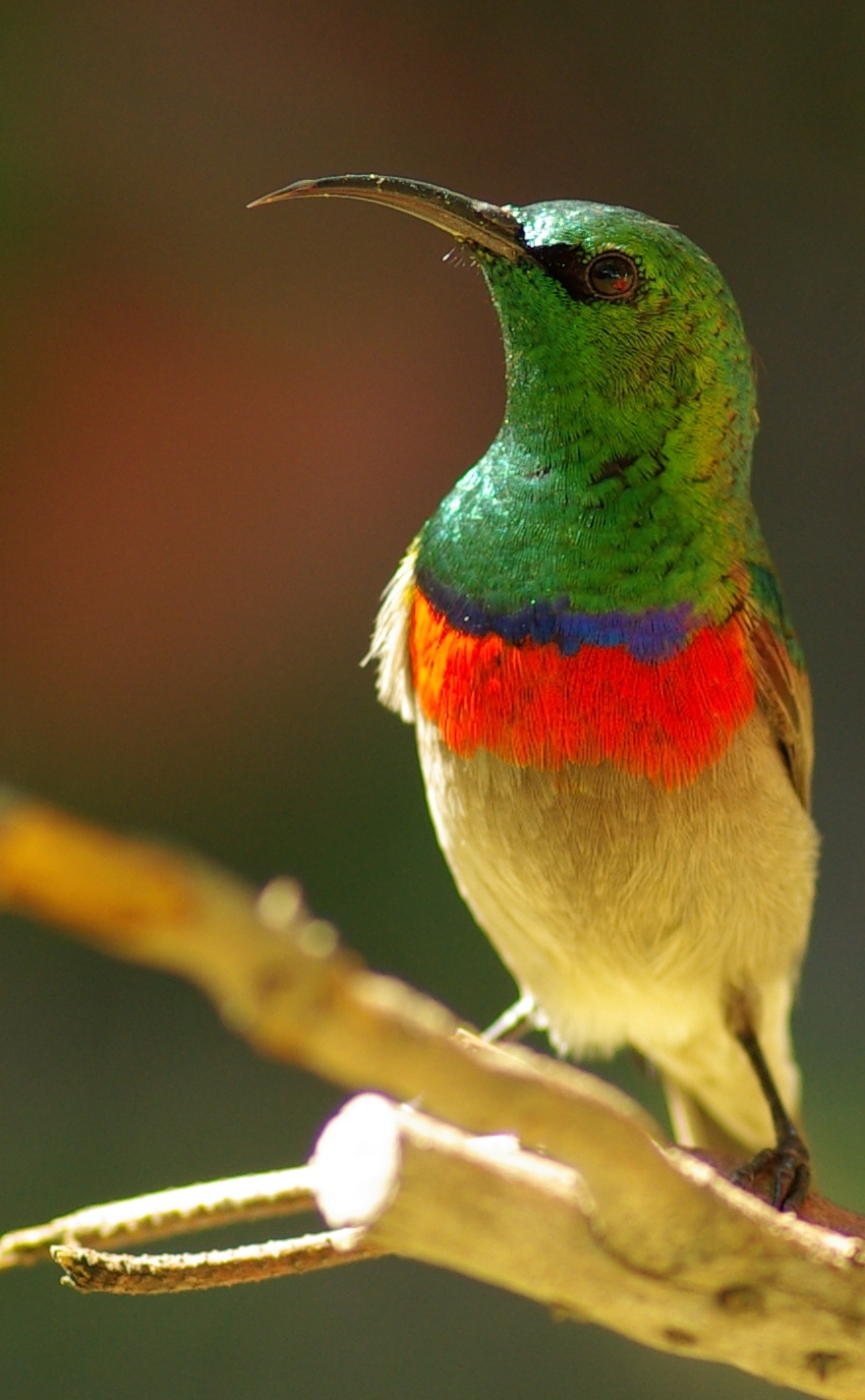 Southern Double-collared SunbirdCinnyris chalybeus
-
 Purple-banded SunbirdCinnyris bifasciatus
-
 Souimanga SunbirdCinnyris sovimanga
-
 White-bellied SunbirdCinnyris talatala
-
 Beautiful SunbirdCinnyris pulchellus
Compare
Questions and answers
What is the scientific name of the Variable Sunbird?
The scientific name of the Variable Sunbird is Cinnyris venustus. Written with its author, the full name is Cinnyris venustus (Shaw, 1799).
Which family does the Variable Sunbird belong to?
Cinnyris venustus belongs to the family Nectariniidae, in the order Passeriformes and the class Aves.
Where is the Variable Sunbird found?
Checklists and occurrence records place Cinnyris venustus in 33 countries, including Kenya, Tanzania, Zimbabwe, Nigeria, Rwanda and Zambia.
What is the conservation status of the Variable Sunbird?
The IUCN Red List category recorded for Cinnyris venustus is Least Concern (LC).
What other names does the Variable Sunbird have?
Cinnyris venustus is also known in English as VASU, Variable Or Yellow-bellied Sunbird and Yellow-bellied Sunbird.
What is a variable sunbird?
The Variable Sunbird (Cinnyris venustus) is a bird in the family Nectariniidae. It inhabits open woodland and cultivated areas.[7]
What do sunbirds eat?
The Variable Sunbird feeds largely on nectar and also consumes insects, particularly when feeding young.[8]
Sources
Passages the profile rests on
- Adult males have glossy green heads, throats and napes, together with a maroon breast band. Source passage: “The adult male has a glossy green head, throat and nape, and a maroon breast band.” — English Wikipedia
- The male's belly is yellow in most subspecies, but orange or white in some. Source passage: “In most subspecies, the belly of the male is yellow, but in a few it is orange or white.” — English Wikipedia
- Females have grey-brown upperparts, yellowish underparts and a conspicuous pale supercilium. Source passage: “The female has grey-brown upperparts and yellowish underparts, and an obvious pale supercilium.” — English Wikipedia
- Eclipse males resemble females but retain some green coloration, particularly on the throat. Source passage: “The eclipse male is like the female, but shows some green, especially on the throat.” — English Wikipedia
- The variable sunbird measures approximately 10 cm in length. Source passage: “Variable sunbirds are small, only 10 cm long.” — English Wikipedia
- The species has medium-length, thin, downward-curving bills and brush-tipped tubular tongues. Source passage: “They have medium-length thin down-curved bills and brush-tipped tubular tongues, both adaptations to their nectar feeding.” — English Wikipedia
- The species inhabits open woodland and cultivated areas. Source passage: “This species is found in open woodland and cultivation.” — English Wikipedia
- The species feeds largely on nectar and also consumes insects, particularly when feeding young. Source passage: “The sunbirds are a group of small Old World passerine birds which feed largely on nectar, although they will also take insects, especially when feeding young.” — English Wikipedia
- Sunbirds generally have fast, direct flight using their short wings. Source passage: “Flight is fast and direct on their short wings.” — English Wikipedia
- Most sunbird species can obtain nectar while hovering, although they usually perch to feed. Source passage: “Most species can take nectar by hovering like a hummingbird, but usually perch to feed most of the time.” — English Wikipedia
- The species produces a clear, repeated tew call. Source passage: “The call is a clear tew-tew-tew-tew-tew.” — English Wikipedia
- The variable sunbird is a resident breeding species in equatorial Africa. Source passage: “The variable sunbird is a fairly common resident breeder in equatorial Africa.” — English Wikipedia
- The species lays two eggs in a suspended nest situated in a tree. Source passage: “Two eggs are laid in a suspended nest in a tree.” — English Wikipedia
- The species was assessed for the IUCN Red List in 2018. Source passage: “Variable Sunbird Cinnyris venustus has most recently been assessed for The IUCN Red List of Threatened Species in 2018.” — iucnredlist.org
Data
- Catalogue of Life, 2026-10-16 XR cc by
- Global Biodiversity Information Facility CC BY 4.0
- Wikidata CC0
- GeoNames CC BY 4.0
- Wikimedia Commons per image; credit shown with each image
- Within the Catalogue of Life, this name comes from The Integrated Taxonomic Information System cc0
This species in other databases
Page built on 27 November 2026. See how the catalog is made and all sources and licences.
Cite this page
ScientificNames.org. (2026). Cinnyris venustus (Variable Sunbird). Retrieved November 27, 2026, from https://scientificnames.org/species/cinnyris-venustus
“Cinnyris venustus (Variable Sunbird).” ScientificNames.org, 2026, scientificnames.org/species/cinnyris-venustus. Accessed 27 Nov. 2026.
ScientificNames.org. “Cinnyris venustus (Variable Sunbird).” Accessed November 27, 2026. https://scientificnames.org/species/cinnyris-venustus.
@misc{scientificnames_cinnyris_venustus_variable_sunbird,
  author = {{ScientificNames.org}},
  title = {Cinnyris venustus (Variable Sunbird)},
  year = {2026},
  url = {https://scientificnames.org/species/cinnyris-venustus},
  note = {Accessed 2026-11-27}
}