Species · Birds
Southern Double-collared Sunbird Cinnyris chalybeus
The scientific name of the Southern Double-collared Sunbird is Cinnyris chalybeus. It is a species of bird in the family Nectariniidae (sunbird), order Passeriformes. The name dates from 1766.
- Scientific name
- Cinnyris chalybeus (Linnaeus, 1766)
- Common name
- Southern Double-collared Sunbird
- Genus
- Cinnyris
- Family
- Nectariniidae (Sunbird)
- Order
- Passeriformes
- Class
- Aves
- Red List category
- LC Least Concern
- Recorded in
- 10 countries
- Name status
- accepted in the Catalogue of Life
Overview
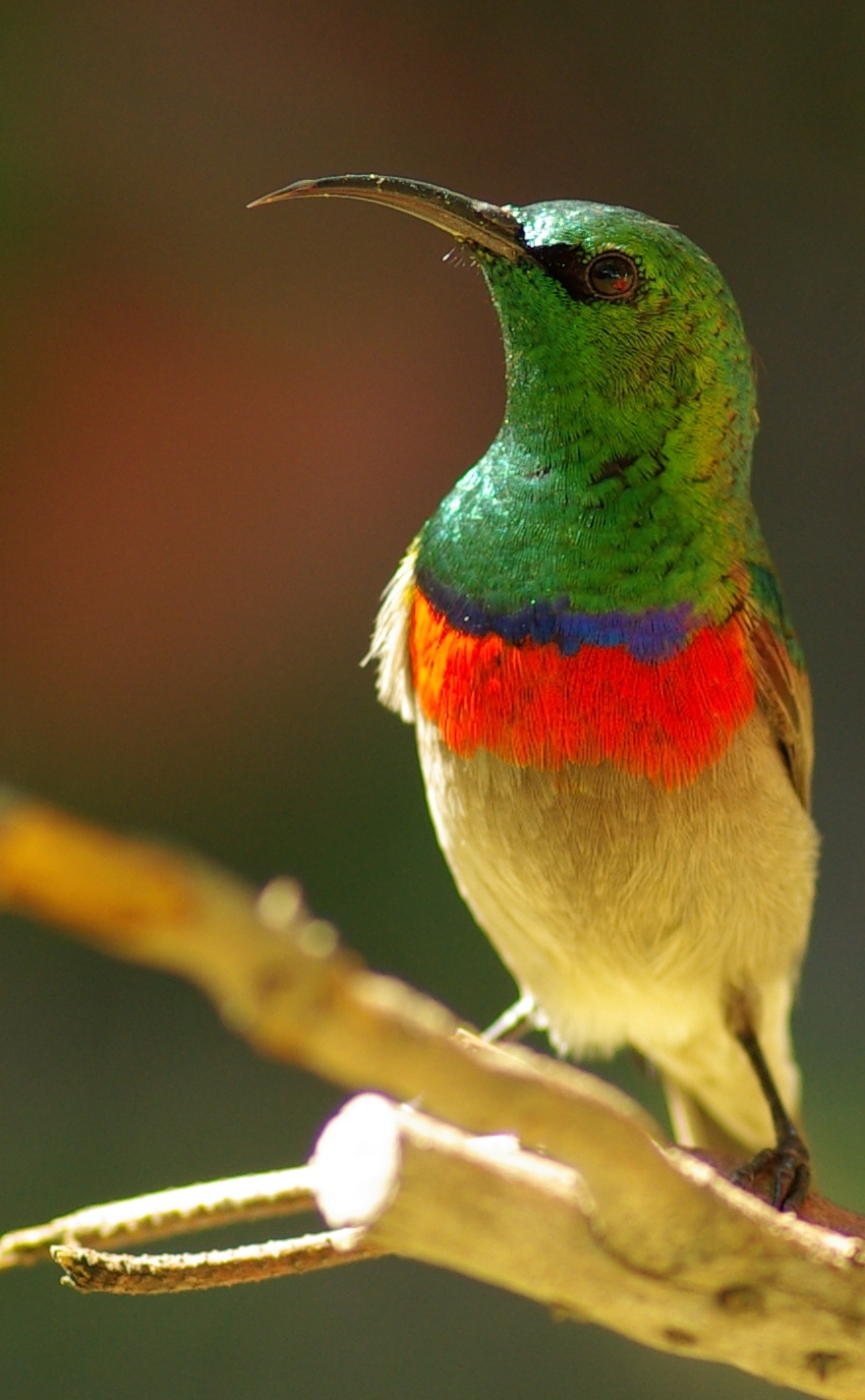
Cinnyris chalybeus commonly inhabits gardens, fynbos, forests and coastal scrub. Adult males are marked by glossy metallic green plumage and a brilliant red chest band separated from the green breast by a narrow metallic blue band.
Written 26 November 2026 from the sources listed below. Each statement was checked against the passage it cites; statements that could not be supported were removed.
Appearance
The Southern Double-collared Sunbird measures 12 cm in length. It has a long, decurved bill, black bill, legs and feet, and dark brown eyes.[1][2][3]
Adult males have glossy metallic green plumage on the head, throat, upper breast and back. A brilliant red chest band is separated from the green breast by a narrow metallic blue band, while the remaining underparts are whitish.[4][5][6]
Male birds display yellow feather tufts on their shoulders.[7]
Females have brown upperparts and yellowish-grey underparts. Their underparts are greyer than those of female orange-breasted sunbirds and darker than those of female dusky sunbirds.[8][9][10]
Juveniles resemble adult females.[11]
Habitat
The Southern Double-collared Sunbird commonly inhabits gardens, fynbos, forests and coastal scrub.[12]
Diet
The Southern Double-collared Sunbird feeds mainly on flower nectar and also consumes some fruit.[13][14]
It eats insects and spiders, particularly when feeding its young.[15]
Behaviour
The Southern Double-collared Sunbird is usually observed alone or in small groups. Its flight is fast and direct, using short wings.[16][17]
It can obtain nectar while hovering but usually feeds while perched.[18]
Its call is a hard-sounding chee-chee. Its song consists of high-pitched tinkling notes that change in pitch and tempo and lasts for at least 3–5 seconds.[19][20][21]
Reproduction and life cycle
The Southern Double-collared Sunbird breeds in southern Africa. Its breeding season extends from April to December, depending on the region.[22][23]
It constructs closed, oval nests from grass, lichen and other plant material bound with spider webs. The nest has a side entrance that sometimes includes a porch.[24][25]
The nest lining consists of wool, plant down and feathers.[26]
Similar species
Male Southern Double-collared Sunbirds can be distinguished from male greater double-collared sunbirds by their smaller size, narrower red chest band and shorter bill.[27]
Classification of the Southern Double-collared Sunbird
| Kingdom | Animalia |
|---|---|
| Phylum | Chordata |
| Subphylum | Vertebrata |
| Infraphylum | Gnathostomata |
| Parvphylum | Osteichthyes |
| Megaclass | Tetrapoda |
| Class | Aves (Bird) |
| Order | Passeriformes (Passerine) |
| Family | Nectariniidae (Sunbird) |
| Genus | Cinnyris (Typical Sunbirds) |
| Species | Cinnyris chalybeus (Linnaeus, 1766) |
Where the Southern Double-collared Sunbird is found
Checklists and occurrence records place Cinnyris chalybeus in 10 countries across Africa. GBIF holds 139,630 georeferenced records of it.
Countries
- Angola 43
- Eswatini 134
- Lesotho 21
- Malawi 7
- Mozambique 5
- Namibia 79
- South Africa 139,196
- Tanzania 17
- Zambia 3
- Zimbabwe 125
Regions and cities with the most records
- Western Cape, South Africa 93,824
- Retreat, South Africa 25,390
- Rondebosch, South Africa 25,041
- Muizenberg, South Africa 24,890
- Cape Town, South Africa 23,133
- Eastern Cape, South Africa 13,589
- Kuils River, South Africa 10,047
- Kraaifontein, South Africa 7,666
- Durbanville, South Africa 6,714
- Somerset West, South Africa 6,685
- KwaZulu-Natal, South Africa 6,298
- Stellenbosch, South Africa 5,331
- Grabouw, South Africa 4,000
- Mpumalanga, South Africa 3,879
- George, South Africa 3,626
- Hermanus, South Africa 3,512
- Gqeberha, South Africa 2,855
- Limpopo, South Africa 2,778
- Saldanha, South Africa 2,704
- Atlantis, South Africa 2,677
- Motherwell, South Africa 2,649
- Vredenburg, South Africa 2,611
- Plettenberg Bay, South Africa 2,421
- Northern Cape, South Africa 2,391
- Knysna, South Africa 2,339
- Mpophomeni, South Africa 2,096
- Howick, South Africa 1,974
- Mossel Bay, South Africa 1,937
- Gansbaai, South Africa 1,936
- Pietermaritzburg, South Africa 1,759
- Paarl, South Africa 1,745
- Despatch, South Africa 1,692
- Groot-Brakrivier, South Africa 1,524
- Gonubie, South Africa 1,515
- Wellington, South Africa 1,328
- Ashton, South Africa 1,291
Range as the checklists state it
Africa
A number beside a place is its count of GBIF occurrence records. A place without a number comes from a checklist alone. Records show where a species has been observed or collected, which can include escapes and vagrants.
Common names
English
- Southern Double-collared Sunbird
- SDCS
Names in 24 other languages
- Afrikaans
- Kleinrooibandsuikerbekkie, klein-rooibandsuikerbekkie
- Catalan
- suimanga de doble collar
- Chinese
- 南方雙領花蜜鳥, 小双领花蜜鸟
- Croatian
- južnoafrički medosas
- Czech
- strdimil dvoupruhý
- Danish
- Sydlig Halsbåndsolfugl
- Dutch
- Kleine Kraaghoningzuiger
- Esperanto
- kaba nektarinio
- Finnish
- kapinpensasmedestäjä
- French
- Petit Nectarin à double collier, Souimanga chalybé, Souimanga chalybée
- German
- Halsbandnektarvogel, Kapnektarvogel
- Hungarian
- kékszalagos nektármadár
- Italian
- Nettarinia duecollari meridionale, Nettarinia piccola dal doppio collare
- Japanese
- ミナミゴシキタイヨウチョウ
- Lithuanian
- pietinė spalvingoji nektarina
- Norwegian
- kappsolfugl
- Polish
- nektarnik czerwonopręgi
- Portuguese
- beija-flor-de-banda-fina, nectarínia-de-dupla-coleira-austral
- Russian
- Синегалстучная нектарница, Южная нектарница
- Slovak
- nektárovka golierikatá
- Spanish
- Suimanga acerado
- Swedish
- kapsolfågel
- Turkish
- Güneyli Çift Kuşaklı Nektarkuşu
- Ukrainian
- маріка південна
Synonyms
4 other scientific names have been used for this species and are now treated as synonyms of Cinnyris chalybeus.
- Certhia chalybea Linnaeus, C, 1766
- Certhia collaris Pallas, PS, 1764
- Microcinnyris chalybeus
- Nectarinia chalybea (Linnaeus, 1766)
Subspecies and varieties
- Cinnyris chalybeus chalybeus (Fynbos Southern Double-Collared Sunbird) subspecies
- Cinnyris chalybeus subalaris (Broad Lesser Doublecollar Sunbird) subspecies
Related species
-
 Palestine SunbirdCinnyris osea
-
 Purple SunbirdCinnyris asiaticus
-
 Garden SunbirdCinnyris jugularis
-
 Variable SunbirdCinnyris venustus
-
 Purple-banded SunbirdCinnyris bifasciatus
-
 Souimanga SunbirdCinnyris sovimanga
-
 White-bellied SunbirdCinnyris talatala
-
 Beautiful SunbirdCinnyris pulchellus
Compare
Questions and answers
What is the scientific name of the Southern Double-collared Sunbird?
The scientific name of the Southern Double-collared Sunbird is Cinnyris chalybeus. Written with its author, the full name is Cinnyris chalybeus (Linnaeus, 1766).
Which family does the Southern Double-collared Sunbird belong to?
Cinnyris chalybeus belongs to the family Nectariniidae, in the order Passeriformes and the class Aves.
Where is the Southern Double-collared Sunbird found?
Checklists and occurrence records place Cinnyris chalybeus in 10 countries, including South Africa, Eswatini, Zimbabwe, Namibia, Angola and Lesotho.
What is the conservation status of the Southern Double-collared Sunbird?
The IUCN Red List category recorded for Cinnyris chalybeus is Least Concern (LC).
What other names does the Southern Double-collared Sunbird have?
Cinnyris chalybeus is also known in English as SDCS.
What do sunbirds eat?
The Southern Double-collared Sunbird feeds mainly on flower nectar. It also consumes some fruit, insects and spiders, particularly when feeding its young.[13][14][15]
Sources
Passages the profile rests on
- The southern double-collared sunbird measures 12 cm in length. Source passage: “The southern double-collared sunbird is 12 cm long.” — English Wikipedia
- The species has a long, decurved bill and black bill, legs and feet. Source passage: “As with other sunbirds the bill is long and decurved. The bill, legs and feet are black.” — English Wikipedia
- The species has dark brown eyes. Source passage: “The eye is dark brown.” — English Wikipedia
- Adult males have glossy metallic green plumage on the head, throat, upper breast and back. Source passage: “The adult male has a glossy, metallic green head, throat, upper breast and back.” — English Wikipedia
- Adult males have a brilliant red chest band separated from the green breast by a narrow metallic blue band. Source passage: “It has a brilliant red band across the chest, separated from the green breast by a narrow metallic blue band.” — English Wikipedia
- The adult male has whitish plumage on the remaining underparts. Source passage: “The rest of the underparts are whitish.” — English Wikipedia
- Male birds display yellow feather tufts on their shoulders. Source passage: “When displaying, yellow feather tufts can be seen on the shoulders.” — English Wikipedia
- Females have brown upperparts and yellowish-grey underparts. Source passage: “The female southern double-collared sunbird has brown upperparts and yellowish-grey underparts.” — English Wikipedia
- The female has greyer underparts than the female orange-breasted sunbird. Source passage: “The female is greyer below than the female orange-breasted sunbird” — English Wikipedia
- The female has darker underparts than the female dusky sunbird. Source passage: “and darker below than the female dusky sunbird.” — English Wikipedia
- Juveniles resemble adult females. Source passage: “The juvenile resembles the female.” — English Wikipedia
- The species commonly inhabits gardens, fynbos, forests and coastal scrub. Source passage: “This sunbird is common in gardens, fynbos, forests and coastal scrub.” — English Wikipedia
- The species feeds mainly on flower nectar. Source passage: “It lives mainly on nectar from flowers” — English Wikipedia
- The species also consumes some fruit. Source passage: “but takes some fruit” — English Wikipedia
- The species eats insects and spiders, particularly when feeding its young. Source passage: “especially when feeding young, insects and spiders.” — English Wikipedia
- The species is usually observed alone or in small groups. Source passage: “The southern double-collared sunbird is usually seen singly or in small groups.” — English Wikipedia
- Its flight is fast and direct, using short wings. Source passage: “Its flight is fast and direct on short wings.” — English Wikipedia
- The species can obtain nectar while hovering but usually feeds while perched. Source passage: “It can take nectar by hovering like a hummingbird, but usually perches to feed most of the time.” — English Wikipedia
- Its call is a hard-sounding chee-chee. Source passage: “The call is a hard chee-chee” — English Wikipedia
- Its song consists of high-pitched tinkling notes that change in pitch and tempo. Source passage: “the song is high pitched jumble of tinkling notes, rising and falling in pitch and tempo” — English Wikipedia
- Its song lasts for at least 3–5 seconds. Source passage: “for 3–5 seconds or more.” — English Wikipedia
- The species breeds in southern Africa. Source passage: “is a small passerine bird which breeds in southern Africa.” — English Wikipedia
- The breeding season extends from April to December, depending on the region. Source passage: “The southern double-collared sunbird breeds from April to December, depending on region.” — English Wikipedia
- The species constructs closed, oval nests from grass, lichen and other plant material bound with spider webs. Source passage: “The closed oval nest is constructed from grass, lichen and other plant material, bound together with spider webs.” — English Wikipedia
- Its nest has a side entrance that sometimes includes a porch. Source passage: “It has a side entrance which sometimes has a porch” — English Wikipedia
- The nest lining consists of wool, plant down and feathers. Source passage: “and is lined with wool, plant down and feathers.” — English Wikipedia
- Male southern double-collared sunbirds can be distinguished from male greater double-collared sunbirds by their smaller size, narrower red chest band and shorter bill. Source passage: “The male can be distinguished from the similar greater double-collared sunbird by its smaller size, narrower red chest band and shorter bill.” — English Wikipedia
Data
- Catalogue of Life, 2026-10-16 XR cc by
- Global Biodiversity Information Facility CC BY 4.0
- Wikidata CC0
- GeoNames CC BY 4.0
- Wikimedia Commons per image; credit shown with each image
- Within the Catalogue of Life, this name comes from The Integrated Taxonomic Information System cc0
References
- del Hoyo, Josep, Andrew Elliot, and David Christie, eds. (2008). Handbook of the Birds of the World. Vol. 13. Penduline-Tits to Shrikes.
This species in other databases
Page built on 27 November 2026. See how the catalog is made and all sources and licences.
Cite this page
ScientificNames.org. (2026). Cinnyris chalybeus (Southern Double-collared Sunbird). Retrieved November 27, 2026, from https://scientificnames.org/species/cinnyris-chalybeus
“Cinnyris chalybeus (Southern Double-collared Sunbird).” ScientificNames.org, 2026, scientificnames.org/species/cinnyris-chalybeus. Accessed 27 Nov. 2026.
ScientificNames.org. “Cinnyris chalybeus (Southern Double-collared Sunbird).” Accessed November 27, 2026. https://scientificnames.org/species/cinnyris-chalybeus.
@misc{scientificnames_cinnyris_chalybeus_southern_double_collared_sunbird,
  author = {{ScientificNames.org}},
  title = {Cinnyris chalybeus (Southern Double-collared Sunbird)},
  year = {2026},
  url = {https://scientificnames.org/species/cinnyris-chalybeus},
  note = {Accessed 2026-11-27}
}