Species · Birds
Garden Sunbird Cinnyris jugularis
The scientific name of the Garden Sunbird is Cinnyris jugularis. It is a species of bird in the family Nectariniidae (sunbird), order Passeriformes. The name dates from 1766.
- Scientific name
- Cinnyris jugularis (Linnaeus, 1766)
- Common name
- Garden Sunbird
- Genus
- Cinnyris
- Family
- Nectariniidae (Sunbird)
- Order
- Passeriformes
- Class
- Aves
- Red List category
- LC Least Concern
- Recorded in
- 19 countries
- Name status
- accepted in the Catalogue of Life

Overview
Cinnyris jugularis occurs on Philippine islands except the Palawan island group. It has olive-green plumage on its wings and back, a bright yellow chest, and a long, downward-curved bill.
Written 26 November 2026 from the sources listed below. Each statement was checked against the passage it cites; statements that could not be supported were removed.
Appearance
The Garden Sunbird has olive-green plumage on its wings and back and a bright yellow chest. Its bill is long and curves downward.[1][2]
Adult males have olive upperparts, black wing feathers edged in green, and a black tail with white tips. They have dark, iridescent coloration around the eyes, neck, chin, throat, and breast, together with yellow pectoral tufts.[3][4]
The male's lower body is dark yellow and may have a brown band around the gorget. Its iris is dark brown, and its bill and legs are black.[5][6]
Non-breeding males often retain glossy black coloration only along the central throat stripe.[7]
Females have greenish-olive upperparts and a pale-yellowish stripe above the eyes. Their wing feathers have yellowish borders, and their tails have black and white markings.[8][9]
Female birds have deep-yellow underparts that are slightly lighter on the undertail feathers. Juveniles resemble females but are generally paler and browner.[10][11]
The bird measures 10–11.4 cm in length. Males weigh between 6.7 and 11.9 g, while females weigh between 6 and 10 g.[12][13][14]
Habitat
The Garden Sunbird inhabits forests, shrublands, grasslands, and artificial habitats. It occurs in forest edges, parks, and gardens and is common in fairly densely populated areas.[15][16][17]
Diet
The Garden Sunbird feeds primarily on nectar. It also consumes insects and spiders, particularly when feeding chicks.[18][19]
The species uses its curved bill to obtain nectar and capture insects.[20]
Behaviour
The Garden Sunbird has adapted well to human environments and builds nests in human settlements.[21][22]
Sunbirds generally perch to feed most of the time, although most species can obtain nectar while hovering.[23]
Reproduction and life cycle
The female constructs the nest from grass, cotton, moss, lichens, leaf fragments, vegetable fibers, and spider webs. She lines it with bark or feathers.[24][25]
The nest is a hanging oval pouch with a sheltered side entrance. It often has a dangling beard-like structure.[26][27]
Females lay eggs during May and June.[28]
Conservation
The Garden Sunbird is classified as Least Concern on the IUCN Red List. It is common throughout its wide range.[29][30]
Similar species
The Palawan sunbird occupies the Palawan archipelago, where the Garden Sunbird is absent.[31]
Classification of the Garden Sunbird
| Kingdom | Animalia |
|---|---|
| Phylum | Chordata |
| Subphylum | Vertebrata |
| Infraphylum | Gnathostomata |
| Parvphylum | Osteichthyes |
| Megaclass | Tetrapoda |
| Class | Aves (Bird) |
| Order | Passeriformes (Passerine) |
| Family | Nectariniidae (Sunbird) |
| Genus | Cinnyris (Typical Sunbirds) |
| Species | Cinnyris jugularis (Linnaeus, 1766) |
Where the Garden Sunbird is found
Checklists and occurrence records place Cinnyris jugularis in 19 countries across Oceania. GBIF holds 314,697 georeferenced records of it.
Countries
- Australia 97,261
- Brunei 263
- Cambodia 7,716
- China 1,819
- Fiji 4
- Hong Kong 192
- India 9,865
- Indonesia 26,657
- Laos 1,339
- Macao 3
- Malaysia 17,626
- Myanmar 1,532
- Papua New Guinea 2,471
- Philippines 31,669
- Singapore 41,341
- Solomon Islands 1,235
- Taiwan 18
- Thailand 69,882
- Vietnam 3,804
Regions and cities with the most records
- Queensland, Australia 91,710
- Ang Mo Kio New Town, Singapore 41,237
- Yio Chu Kang, Singapore 41,235
- Novena, Singapore 41,123
- Yishun New Town, Singapore 40,737
- Sungai Simpang, Singapore 40,555
- Sembawang Estate, Singapore 39,932
- Sengkang New Town, Singapore 39,924
- Bukit Timah, Singapore 39,635
- Queenstown Estate, Singapore 39,499
- Singapore, Singapore 38,084
- Woodlands, Singapore 37,227
- Matilda Estate, Singapore 37,163
- Anak Bukit, Singapore 37,117
- MacPherson, Singapore 36,474
- Eunos, Singapore 36,295
- Bukit Panjang New Town, Singapore 36,271
- Teck Whye, Singapore 35,935
- Choa Chu Kang New Town, Singapore 35,843
- Yew Tee, Singapore 35,618
- Keat Hong Village, Singapore 34,743
- Punggol, Singapore 34,583
- Jurong East, Singapore 34,523
- Jurong West, Singapore 33,959
- Marsiling, Singapore 33,820
- Jurong Town, Singapore 33,792
- Marine Parade, Singapore 33,524
- Ulu Bedok, Singapore 33,208
- Kampong Pasir Ris, Singapore 33,003
- Bedok New Town, Singapore 32,195
- Boon Lay, Singapore 29,675
- Kampung Pasir Gudang Baru, Malaysia 28,327
- Kampong Loyang, Singapore 26,994
- Johor Bahru, Malaysia 26,723
- Pasir Gudang, Malaysia 26,307
- Cairns, Australia 22,013
A number beside a place is its count of GBIF occurrence records. A place without a number comes from a checklist alone. Records show where a species has been observed or collected, which can include escapes and vagrants.
Common names
English
- Garden Sunbird
- Olive-backed Sunbird
- Philippine Olive-backed Sunbird
- Philippine Yellow-bellied Sunbird
Names in 32 other languages
- Catalan
- suimanga de dors olivaci
- Cebuano
- tamsi
- Chinese
- 菲律宾花蜜鸟, 菲律賓花蜜鳥, 黃腹花蜜鳥, 黄腹花蜜鸟
- Croatian
- blistavoprsi medosas
- Czech
- strdimil olivovohřbetý
- Danish
- Olivenrygget Solfugl
- Dutch
- Filipijnse Honingzuiger, Olijfrughoningzuiger, Staalborsthoningzuiger
- Esperanto
- ĝardena nektarinio
- Finnish
- filippiinienoliivimedestäjä, oliivimedestäjä
- French
- Souimanga à dos vert
- German
- Grünrücken-Nektarvogel, Grünrückennektarvogel
- Hungarian
- ausztrál nektármadár
- Indonesian
- Burung madu sriganti, Burung-madu sriganti
- Italian
- Nettarinia dorsoliva, Nettarinia dorsoliva delle Filippine, Nettarinia ventregiallo delle Filippine
- Japanese
- キバラタイヨウチョウ
- Lithuanian
- žalsvanugarė spalvingoji nektarina
- Malay
- Burung Kelicap Bukit
- Norwegian
- olivenryggsolfugl
- Persian
- شهدخوار پشتزیتونی
- Polish
- nektarnik ciemnogardły
- Portuguese
- beija-flor-de-dorso-verde, nectarínia-de-dorso-oliváceo, nectarínia-dos-jardins
- Russian
- Желтобрюхая нектарница, Желтогорлая нектарница, Синегрудая нектарница
- Serbian
- Sunčica maslinastih leđa
- Slovak
- nektárovka zelenochrbtá
- Spanish
- Suimanga dorsioliva
- Swedish
- Olivryggig solfågel, trädgårdssolfågel
- Thai
- นกกินปลีฟิลิปปินส์, นกกินปลีอกเหลือง
- Turkish
- Zeytuni Sırtlı Nektarkuşu
- Ukrainian
- маріка жовточерева
- Vietnamese
- Hút mật họng tím
- Welsh
- Aderyn haul cefn melynwyrdd
- pnb
- زیتونی مگر رس پنچھی
Synonyms
One other scientific name has been used for this species and is now treated as a synonym of Cinnyris jugularis.
- Nectarinia jugularis (Linnaeus, 1766)
Subspecies and varieties
- Cinnyris jugularis andamanicus subspecies
- Cinnyris jugularis aurora (Palawan Sunbird) subspecies
- Cinnyris jugularis buruensis subspecies
- Cinnyris jugularis clementiae (South Moluccan Sunbird) subspecies
- Cinnyris jugularis flammaxillaris subspecies
- Cinnyris jugularis flavigastra subspecies
- Cinnyris jugularis frenatus (Sahul Sunbird) subspecies
- Cinnyris jugularis idenburgi (Rand's Sunbird) subspecies
- Cinnyris jugularis infrenatus (Tukangbesi Sunbird) subspecies
- Cinnyris jugularis jugularis subspecies
- Cinnyris jugularis keiensis subspecies
- Cinnyris jugularis klossi subspecies
- Cinnyris jugularis obscurior subspecies
- Cinnyris jugularis ornatus (Ornate Sunbird) subspecies
- Cinnyris jugularis plateni subspecies
- Cinnyris jugularis polyclystus subspecies
- Cinnyris jugularis proselius subspecies
- Cinnyris jugularis rhizophorae (Cream-bellied Sunbird) subspecies
- Cinnyris jugularis robustirostris subspecies
- Cinnyris jugularis teysmanni (Flores Sea Sunbird) subspecies
- Cinnyris jugularis woodi subspecies
Related species
-
 Palestine SunbirdCinnyris osea
-
 Purple SunbirdCinnyris asiaticus
-
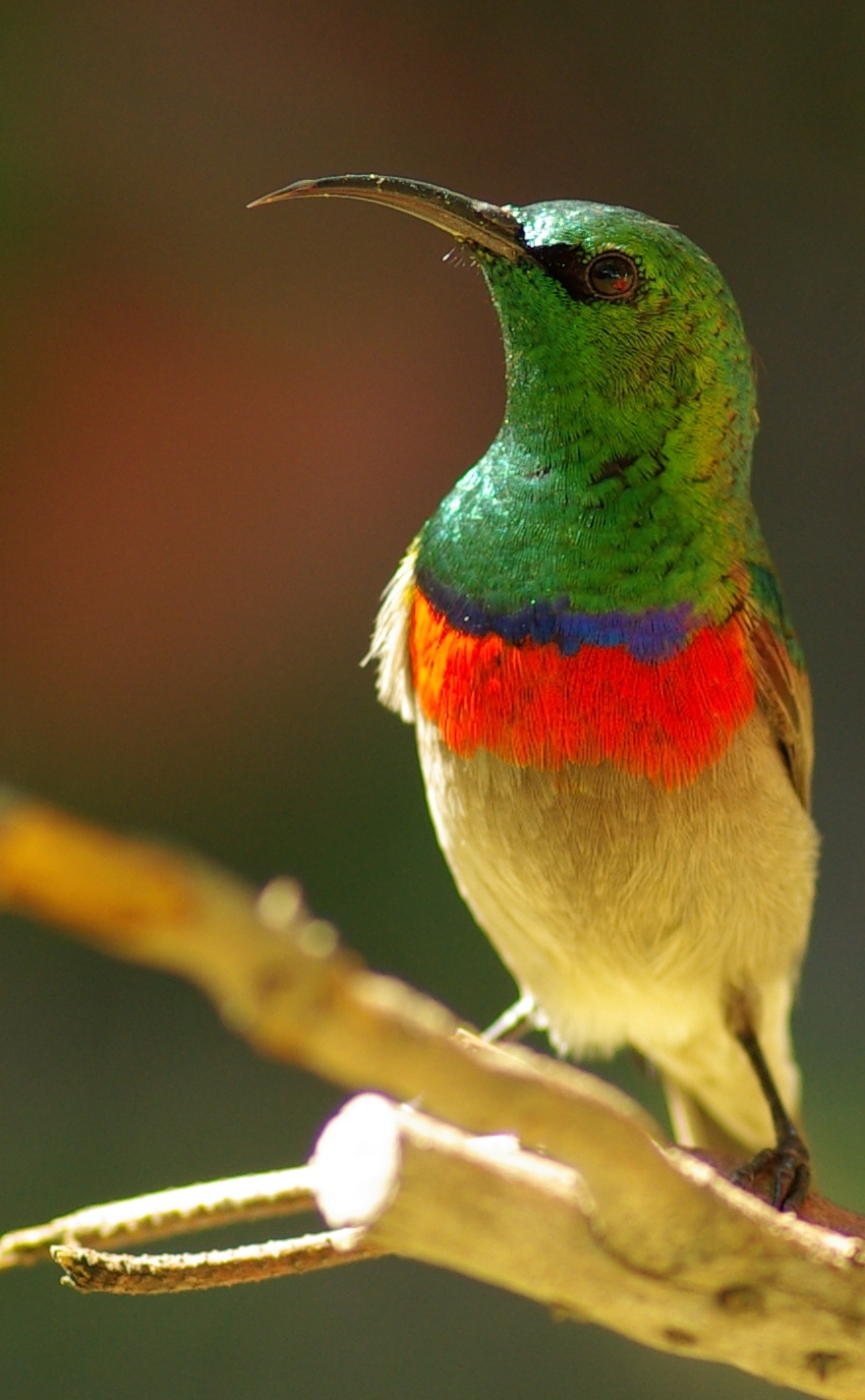 Southern Double-collared SunbirdCinnyris chalybeus
-
 Variable SunbirdCinnyris venustus
-
 Purple-banded SunbirdCinnyris bifasciatus
-
 Souimanga SunbirdCinnyris sovimanga
-
 White-bellied SunbirdCinnyris talatala
-
 Beautiful SunbirdCinnyris pulchellus
Compare
Questions and answers
What is the scientific name of the Garden Sunbird?
The scientific name of the Garden Sunbird is Cinnyris jugularis. Written with its author, the full name is Cinnyris jugularis (Linnaeus, 1766).
Which family does the Garden Sunbird belong to?
Cinnyris jugularis belongs to the family Nectariniidae, in the order Passeriformes and the class Aves.
Where is the Garden Sunbird found?
Checklists and occurrence records place Cinnyris jugularis in 19 countries, including Australia, Thailand, Singapore, Philippines, Indonesia and Malaysia.
What is the conservation status of the Garden Sunbird?
The IUCN Red List category recorded for Cinnyris jugularis is Least Concern (LC).
What other names does the Garden Sunbird have?
Cinnyris jugularis is also known in English as Olive-backed Sunbird, Philippine Olive-backed Sunbird and Philippine Yellow-bellied Sunbird.
What is the scientific name for the garden sunbird?
The scientific name of the Garden Sunbird is Cinnyris jugularis.[32][33]
Sources
Passages the profile rests on
- The bird has olive-green plumage on its wings and back and a bright yellow chest. Source passage: “It is a small, brightly coloured bird with olive-green plumage on the wings and back with a bright yellow chest.” — English Wikipedia
- The bird has a long, downward-curved bill. Source passage: “It has a long downward-curved bill” — English Wikipedia
- Adult males have olive upperparts, black wing feathers edged in green, and a black tail with white tips. Source passage: “The male in its nominate (jugularis) form displays an olive hue on its upper body, featuring black wing feathers with green edges and a black tail adorned with white tips.” — English Wikipedia
- Adult males have dark, iridescent coloration around the eyes, neck, chin, throat, and breast, together with yellow pectoral tufts. Source passage: “The areas around its eyes (lores), neck, chin, throat, and breast are dark and iridescent, accompanied by yellow pectoral tufts.” — English Wikipedia
- The male's lower body is dark yellow and may have a brown band around the gorget. Source passage: “The lower portion of the bird is dark yellow, sometimes with a brown band encircling the gorget area.” — English Wikipedia
- The male has a dark brown iris and black bill and legs. Source passage: “The iris is dark brown, while its bill and legs are black.” — English Wikipedia
- Non-breeding males often retain glossy black coloration only along the central throat stripe. Source passage: “Non-breeding males often have the glossy black coloration limited to the central throat stripe” — English Wikipedia
- Females have greenish-olive upperparts and a pale-yellowish stripe above the eyes. Source passage: “the female exhibits an upper body of greenish olive, featuring a pale-yellowish stripe above the eyes” — English Wikipedia
- Female wing feathers have yellowish borders, and their tails have black and white markings. Source passage: “yellowish borders on its wing feathers, a tail with black and white markings” — English Wikipedia
- Female birds have deep-yellow underparts that are slightly lighter on the undertail feathers. Source passage: “a deep yellow color on the lower portion of its body, slightly lighter on the undertail feathers.” — English Wikipedia
- Juveniles resemble females but are generally paler and browner. Source passage: “Juvenile birds resemble the female but tend to be paler and browner in appearance.” — English Wikipedia
- The bird measures 10–11.4 cm in length. Source passage: “The garden sunbird is 10–11.4 cm (3.9–4.5 in) in size” — English Wikipedia
- Male birds weigh between 6.7 and 11.9 g. Source passage: “males weigh 6.7–11.9 g (0.24–0.42 oz)” — English Wikipedia
- Female birds weigh between 6 and 10 g. Source passage: “females 6–10 g (0.21–0.35 oz).” — English Wikipedia
- The species inhabits forests, shrublands, grasslands, and artificial habitats. Source passage: “It inhabits forests, shrublands, grasslands and artificial habitats.” — English Wikipedia
- The species occurs in forest edges, parks, and gardens. Source passage: “Tiny and active sunbird of forest edges, parks, and gardens.” — ebird.org
- The species is common in fairly densely populated areas. Source passage: “is common in fairly densely populated areas” — English Wikipedia
- The species feeds primarily on nectar. Source passage: “It is primarily nectarivorous” — English Wikipedia
- The species also consumes insects and spiders, particularly when feeding chicks. Source passage: “but will take insects and spiders, particularly when feeding chicks.” — English Wikipedia
- The species uses its curved bill to obtain nectar and capture insects. Source passage: “it uses for taking nectar and capturing insects.” — English Wikipedia
- The species has adapted well to human environments. Source passage: “The garden sunbird has adapted well to human environments” — English Wikipedia
- The species builds nests in human settlements. Source passage: “where it builds nests in human settlements.” — English Wikipedia
- Sunbirds generally perch to feed most of the time, although most species can obtain nectar while hovering. Source passage: “Most species can take nectar by hovering, but usually perch to feed most of the time.” — English Wikipedia
- The female constructs the nest from grass, cotton, moss, lichens, leaf fragments, vegetable fibers, and spider webs. Source passage: “The female garden sunbird builds the nest using grass, cotton, moss, lichens, leaf fragments, vegetable fibers, and spider webs” — English Wikipedia
- The female lines the nest with bark or feathers. Source passage: “lined with bark or feathers.” — English Wikipedia
- The nest is a hanging oval pouch with a sheltered side entrance. Source passage: “The nest has the form of a hanging oval pouch with a sheltered side opening” — English Wikipedia
- The nest often has a dangling beard-like structure. Source passage: “often featuring a dangling "beard."” — English Wikipedia
- Females lay eggs during May and June. Source passage: “She lays eggs in May and June.” — English Wikipedia
- The species is classified as Least Concern on the IUCN Red List. Source passage: “The garden sunbird has been classified as Least Concern on the IUCN Red List” — English Wikipedia
- The species is common throughout its wide range. Source passage: “as it is common throughout its wide range.” — English Wikipedia
- The Palawan sunbird occupies the Palawan archipelago, where the garden sunbird is absent. Source passage: “except on the Palawan archipelago which is occupied by the similar Palawan sunbird.” — English Wikipedia
- The species was originally described by Carl Linnaeus in 1766 under the binomial name Certhia jugularis. Source passage: “Linnaeus included a brief description, coined the binomial name Certhia jugularis” — English Wikipedia
- The species is currently placed in the genus Cinnyris, which was established in 1816. Source passage: “The garden sunbird is now one of 64 species placed in the genus Cinnyris that was introduced by the French naturalist Georges Cuvier in 1816.” — English Wikipedia
- The subspecies C. j. obscurior occurs in northern Luzon and the Babuyan Islands. Source passage: “C. j. obscurior Ogilvie-Grant, 1894 – north Luzon and Babuyan Islands in northern Philippines” — English Wikipedia
- The nominate subspecies C. j. jugularis occurs in the central and southern Luzon group, Mindoro, the Visayas, and the Mindanao group. Source passage: “C. j. jugularis (Linnaeus, 1766) – central, south Luzon group, Mindoro, Visayas and Mindanao group (north to south Philippines)” — English Wikipedia
- The subspecies C. j. woodi occurs in the Sulu Archipelago. Source passage: “C. j. woodi (Mearns, 1909) – Sulu Archipelago in southern Philippines” — English Wikipedia
- Three subspecies are currently recognised. Source passage: “Three subspecies are now recognised:” — English Wikipedia
Data
- Catalogue of Life, 2026-10-16 XR cc by
- Global Biodiversity Information Facility CC BY 4.0
- Wikidata CC0
- GeoNames CC BY 4.0
- Wikimedia Commons per image; credit shown with each image
- Within the Catalogue of Life, this name comes from The Integrated Taxonomic Information System cc0
This species in other databases
Page built on 27 November 2026. See how the catalog is made and all sources and licences.
Cite this page
ScientificNames.org. (2026). Cinnyris jugularis (Garden Sunbird). Retrieved November 27, 2026, from https://scientificnames.org/species/cinnyris-jugularis
“Cinnyris jugularis (Garden Sunbird).” ScientificNames.org, 2026, scientificnames.org/species/cinnyris-jugularis. Accessed 27 Nov. 2026.
ScientificNames.org. “Cinnyris jugularis (Garden Sunbird).” Accessed November 27, 2026. https://scientificnames.org/species/cinnyris-jugularis.
@misc{scientificnames_cinnyris_jugularis_garden_sunbird,
  author = {{ScientificNames.org}},
  title = {Cinnyris jugularis (Garden Sunbird)},
  year = {2026},
  url = {https://scientificnames.org/species/cinnyris-jugularis},
  note = {Accessed 2026-11-27}
}