Species · Flowering plants
Ecuadorian Squash Cucurbita ecuadorensis
The scientific name of the Ecuadorian Squash is Cucurbita ecuadorensis. It is a species of flowering plant in the family Cucurbitaceae (gourd family), order Cucurbitales.
- Scientific name
- Cucurbita ecuadorensis Cutler & Whitaker
- Common name
- Ecuadorian Squash
- Genus
- Cucurbita
- Family
- Cucurbitaceae (Gourd Family)
- Order
- Cucurbitales
- Class
- Magnoliopsida
- Red List category
- VU Vulnerable
- Recorded in
- 1 country
- Name status
- accepted in the Catalogue of Life

Overview
Cucurbita ecuadorensis is a creeping vine resistant to many diseases affecting cultivated Cucurbita species.
Written 26 November 2026 from the sources listed below. Each statement was checked against the passage it cites; statements that could not be supported were removed.
Appearance
Ecuadorian squash grows as a creeping vine.[1]
Habitat
Ecuadorian squash grows wild in Ecuador. It has been recorded only in the western Ecuadorian provinces of Guayas and Manabí.[2][3]
Reproduction and life cycle
There is evidence suggesting that Ecuadorian squash was domesticated in Ecuador approximately 10,000 years ago.[4]
Conservation
Ecuadorian squash is classified as vulnerable on the IUCN Red List. It occurs in Machalilla National Park, where it is protected.[5][6]
Uses
Ecuadorian squash was likely domesticated for its seeds and is no longer cultivated.[7][8]
Classification of the Ecuadorian Squash
| Kingdom | Plantae |
|---|---|
| Subkingdom | Pteridobiotina |
| Phylum | Tracheophyta |
| Class | Magnoliopsida |
| Order | Cucurbitales |
| Family | Cucurbitaceae (Gourd Family) |
| Tribe | Cucurbiteae |
| Genus | Cucurbita (Gourd) |
| Species | Cucurbita ecuadorensis Cutler & Whitaker |
Where the Ecuadorian Squash is found
Checklists and occurrence records place Cucurbita ecuadorensis in 1 country across South America. GBIF holds 74 georeferenced records of it.
Countries
Regions and cities with the most records
- Guayas, Ecuador 19
- Manabí, Ecuador 8
- Bahía de Caráquez, Ecuador 3
- Los Ríos, Ecuador 3
- Morona-Santiago Province, Ecuador 3
1 more country has a few records outside this range
These countries hold a few records of Cucurbita ecuadorensis but lie outside the range the checklists give for it. Such records are often zoo or garden specimens, museum material or vagrants, so the species is not counted as occurring there.
Range as the checklists state it
Ecuador
A number beside a place is its count of GBIF occurrence records. A place without a number comes from a checklist alone. Records show where a species has been observed or collected, which can include escapes and vagrants.
Common names
English
- Ecuadorian Squash
Names in 3 other languages
- Arabic
- قرع أكوادوري
- Spanish
- Calabaza ecuatoriana, Chía, Mate Chino
- Thai
- ฟักทองเอกวาดอร์
Related species
-
 ZucchiniCucurbita pepo
-
 PumpkinCucurbita maxima
-
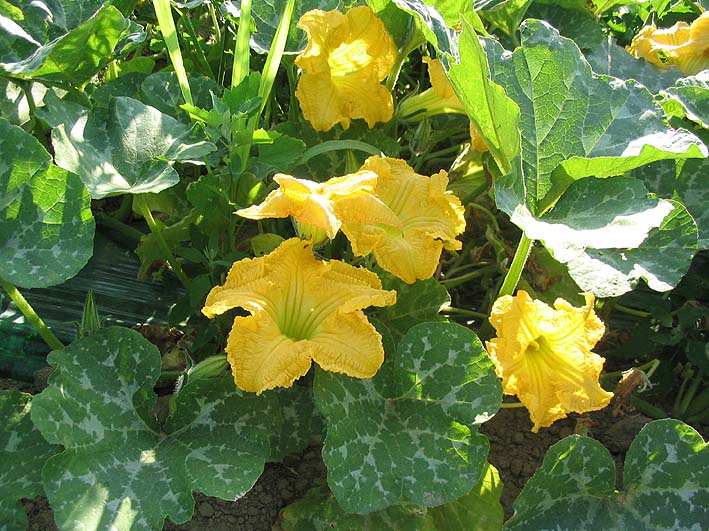 Butternut SquashCucurbita moschata
-
 Fig-leaf GourdCucurbita ficifolia
- Cushaw PumpkinCucurbita argyrosperma
-
 Buffalo GourdCucurbita foetidissima
-
 Coyote-melonCucurbita palmata
-
 Finger-leaf GourdCucurbita digitata
Compare
Questions and answers
What is the scientific name of the Ecuadorian Squash?
The scientific name of the Ecuadorian Squash is Cucurbita ecuadorensis. Written with its author, the full name is Cucurbita ecuadorensis Cutler & Whitaker.
Which family does the Ecuadorian Squash belong to?
Cucurbita ecuadorensis belongs to the family Cucurbitaceae, in the order Cucurbitales and the class Magnoliopsida.
Where is the Ecuadorian Squash found?
Checklists and occurrence records place Cucurbita ecuadorensis in 1 country: Ecuador.
What is the conservation status of the Ecuadorian Squash?
The IUCN Red List category recorded for Cucurbita ecuadorensis is Vulnerable (VU).
Sources
Passages the profile rests on
- Cucurbita ecuadorensis grows as a creeping vine. Source passage: “it is a creeping vine” — English Wikipedia
- Cucurbita ecuadorensis has been recorded only in the western Ecuadorian provinces of Guayas and Manabí. Source passage: “It has been found only in the western provinces of Guayas and Manabí.” — English Wikipedia
- The species grows wild in Ecuador. Source passage: “described in 1965 as growing wild in Ecuador.” — English Wikipedia
- There is evidence suggesting that Cucurbita ecuadorensis was domesticated in Ecuador approximately 10,000 years ago. Source passage: “There is evidence that it was domesticated in Ecuador around 10,000 years ago” — English Wikipedia
- Cucurbita ecuadorensis is classified as vulnerable on the IUCN Red List. Source passage: “Cucurbita ecuadorensis is listed on the IUCN Red List as vulnerable” — English Wikipedia
- The species occurs in Machalilla National Park, where it is protected. Source passage: “is found protected in the Machalilla National Park.” — English Wikipedia
- The species was likely domesticated for its seeds. Source passage: “likely for its seeds” — English Wikipedia
- Cucurbita ecuadorensis is no longer cultivated. Source passage: “it is no longer cultivated.” — English Wikipedia
Data
- Catalogue of Life, 2026-10-16 XR cc by
- Global Biodiversity Information Facility CC BY 4.0
- Wikidata CC0
- GeoNames CC BY 4.0
- Wikimedia Commons per image; credit shown with each image
- Within the Catalogue of Life, this name comes from Synonymic Checklists of the Vascular Plants of the World cc by
References
- Cutler, & Whitaker. (1969). Ann. Missouri Bot. Gard. 55: 392 (1969). where the name was published
This species in other databases
- Catalogue of Life 329Y8
- Wikidata Q15533382
- iNaturalist 191132
- World Flora Online wfo-0000629060
- GRIN 12587
Page built on 28 November 2026. See how the catalog is made and all sources and licences.
Cite this page
ScientificNames.org. (2026). Cucurbita ecuadorensis (Ecuadorian Squash). Retrieved November 28, 2026, from https://scientificnames.org/species/cucurbita-ecuadorensis
“Cucurbita ecuadorensis (Ecuadorian Squash).” ScientificNames.org, 2026, scientificnames.org/species/cucurbita-ecuadorensis. Accessed 28 Nov. 2026.
ScientificNames.org. “Cucurbita ecuadorensis (Ecuadorian Squash).” Accessed November 28, 2026. https://scientificnames.org/species/cucurbita-ecuadorensis.
@misc{scientificnames_cucurbita_ecuadorensis_ecuadorian_squash,
  author = {{ScientificNames.org}},
  title = {Cucurbita ecuadorensis (Ecuadorian Squash)},
  year = {2026},
  url = {https://scientificnames.org/species/cucurbita-ecuadorensis},
  note = {Accessed 2026-11-28}
}