Species · Fishes
Black Musselcracker Cymatoceps nasutus
The scientific name of the Black Musselcracker is Cymatoceps nasutus. It is a species of fish in the family Sparidae (porgies), order Perciformes. The name dates from 1861.
- Scientific name
- Cymatoceps nasutus (Castelnau, 1861)
- Common name
- Black Musselcracker
- Genus
- Cymatoceps
- Family
- Sparidae (Porgies)
- Order
- Perciformes
- Class
- Teleostei
- Red List category
- VU Vulnerable
- Environment
- brackish, marine
- Recorded in
- 2 countries
- Name status
- accepted in the Catalogue of Life

Overview
Black Musselcracker is the sole member of the genus Cymatoceps. The species is endemic to South Africa, where its range extends from northern KwaZulu-Natal to False Bay. Adults have a dull dark grey body with a bright white chin and belly, and large individuals develop a fleshy snout projection and a hump before the eyes.
Written 26 November 2026 from the sources listed below. Each statement was checked against the passage it cites; statements that could not be supported were removed.
Uses
Black Musselcracker is a popular sport fish in South Africa.[1]
Appearance
Adults have a dull dark grey body with a bright white chin and belly. Juveniles have dark greenish-brown bodies with irregular white mottling.[2][3]
Large adults develop a fleshy projection on the snout and a hump before the eyes. The body is moderately deep and laterally compressed, with standard length 2.3–2.5 times body depth.[4][5]
The dorsal fin has 12 spines and 10 soft rays, while the anal fin has 3 spines and 9 soft rays. The species has ctenoid scales that are larger below the lateral line than above it.[6][7][8]
The maximum published total length is 150 cm, and the maximum published body weight is 34.4 kg.[9][10]
Habitat
The species occurs at depths between 1 and 80 metres. It inhabits shallow rocky areas and rarely enters estuaries.[11][12]
Adults inhabit deeper, topographically varied reefs in both inshore and offshore waters. Juveniles prefer shallow reefs below the low-tide mark at depths of less than 10 metres.[13][14]
The species is endemic to South Africa, with a range extending from northern KwaZulu-Natal to False Bay. It has also been reported from Maputo Bay in Mozambique.[15][16][17]
Diet
Adults prey mainly on molluscs, crustaceans and echinoderms.[18]
Behaviour
Black Musselcrackers are solitary fish. Juveniles and sub-adults are very sedentary.[19][20]
Available movement data suggest that larger adults move eastwards along the South African coast.[21]
Reproduction and life cycle
The species is thought to be a protogynous hermaphrodite. Spawning occurs off the Eastern Cape between May and October.[22][23]
The smallest recorded reproductively active female had a fork length of 53 cm. Approximately 50% of the population is thought to reach sexual maturity at 10 years of age.[24][25]
Females are thought to change sex into males at approximately 70 cm fork length and 18 years of age. All recorded fish exceeding 95 cm fork length are male.[26][27]
Conservation
The species has high to very high vulnerability, with a FishBase vulnerability score of 74 out of 100. Its estimated minimum population doubling time is more than 14 years.[28][29]
Overharvesting threatens population stability because the species is highly sought after and grows slowly. The species also has a long lifespan.[30][31]
South African fishing regulations limit each fisherman to one fish per day with a minimum permitted length of 50 cm. Populations have increased in some regions of South Africa following the introduction of fishing regulations.[32][33]
Classification of the Black Musselcracker
| Kingdom | Animalia |
|---|---|
| Phylum | Chordata |
| Subphylum | Vertebrata |
| Infraphylum | Gnathostomata |
| Parvphylum | Osteichthyes |
| Gigaclass | Actinopterygii |
| Superclass | Actinopteri |
| Class | Teleostei (Teleost) |
| Order | Perciformes |
| Suborder | Percoidei |
| Family | Sparidae (Porgies) |
| Genus | Cymatoceps |
| Species | Cymatoceps nasutus (Castelnau, 1861) |
Where the Black Musselcracker is found
Checklists and occurrence records place Cymatoceps nasutus in 2 countries. GBIF holds 380 georeferenced records of it.
Countries
Regions and cities with the most records
- Eastern Cape, South Africa 32
- Port Shepstone, South Africa 19
- Scottburgh, South Africa 16
- eMuziwezinto, South Africa 15
- eMkhomazi, South Africa 13
- Margate, South Africa 11
- Western Cape, South Africa 11
- Ga-Malakhe, South Africa 10
- Lüderitz, Namibia 9
- Plettenberg Bay, South Africa 9
- Port Alfred, South Africa 9
- Durban, South Africa 8
- Gansbaai, South Africa 8
- East London, South Africa 7
- Gqeberha, South Africa 7
- Ballitoville, South Africa 6
- Mdantsane, South Africa 6
- Shakaskraal, South Africa 5
- eSikhaleni, South Africa 5
- Hermanus, South Africa 4
- Richards Bay, South Africa 4
- Groot-Brakrivier, South Africa 3
- Humansdorp, South Africa 3
- Jeffreys Bay, South Africa 3
- Knysna, South Africa 3
- KwaZulu-Natal, South Africa 3
- Motherwell, South Africa 3
A number beside a place is its count of GBIF occurrence records. A place without a number comes from a checklist alone. Records show where a species has been observed or collected, which can include escapes and vagrants.
Common names
English
- Black Musselcracker
- Musselcracker
- Poenskop Seabream
Names in 9 other languages
- Afrikaans
- Poenskop
- Arabic
- أُسبور نَزيك
- Chinese
- 眶鱗鯛
- Czech
- mořan nosatý
- Danish
- Stor havrude
- French
- Spare Nasique
- Portuguese
- Sargo-ostraceiro
- Russian
- Носатый карась
- Spanish
- Sargo Narigón
Synonyms
2 other scientific names have been used for this species and are now treated as synonyms of Cymatoceps nasutus.
- Chrysophrys nasutus Castelnau, 1861
- Pagrus nigripinnis Boulenger, 1903
Related species
-
 Gilt-head BreamSparus aurata
-
 BogueBoops boops
-
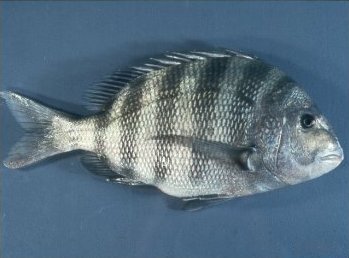 SheepsheadArchosargus probatocephalus
-
 Red Sea BreamPagrus major
-
 Salema PorgySarpa salpa
-
 White Sea BreamDiplodus sargus
-
 Red PorgyPagrus pagrus
-
 Common DentexDentex dentex
Compare
Questions and answers
What is the scientific name of the Black Musselcracker?
The scientific name of the Black Musselcracker is Cymatoceps nasutus. Written with its author, the full name is Cymatoceps nasutus (Castelnau, 1861).
Which family does the Black Musselcracker belong to?
Cymatoceps nasutus belongs to the family Sparidae, in the order Perciformes and the class Teleostei.
Where is the Black Musselcracker found?
Checklists and occurrence records place Cymatoceps nasutus in 2 countries: South Africa and Namibia.
What is the conservation status of the Black Musselcracker?
The IUCN Red List category recorded for Cymatoceps nasutus is Vulnerable (VU).
What other names does the Black Musselcracker have?
Cymatoceps nasutus is also known in English as Musselcracker and Poenskop Seabream.
Is musselcracker a fish?
Yes. Black Musselcracker is a popular sport fish in South Africa.[1]
Sources
Passages the profile rests on
- The black musselcracker is a popular sport fish in South Africa. Source passage: “The black musselcracker is a popular sport fish in South Africa.” — English Wikipedia
- Adults have a dull dark grey body with a bright white chin and belly. Source passage: “The overall colour of adults is dull dark grey with the chin and belly being bright white” — English Wikipedia
- Juveniles have dark greenish-brown bodies with irregular white mottling. Source passage: “The juveniles are dark greenish brown in colour on the body with irregular white mottling.” — English Wikipedia
- Large adults develop a fleshy projection on the snout and a hump before the eyes. Source passage: “in large adults develop a fleshy process on the snout and a hump before the eyes.” — English Wikipedia
- The body is moderately deep and laterally compressed, with standard length 2.3–2.5 times body depth. Source passage: “The body is moderately deep and compressed, its standard length being between 2.3 and 2.5 times its depth.” — English Wikipedia
- The dorsal fin has 12 spines and 10 soft rays. Source passage: “The dorsal fin is supported by 12 spines and 10 soft rays” — English Wikipedia
- The anal fin has 3 spines and 9 soft rays. Source passage: “the anal fin is supported by 3 spines and 9 soft rays.” — English Wikipedia
- The species has ctenoid scales that are larger below the lateral line than above it. Source passage: “The scales are ctenoid, larger below the lateral line than above it.” — English Wikipedia
- The maximum published total length is 150 cm. Source passage: “This species has a maximum published total length of 150 cm (59 in)” — English Wikipedia
- The maximum published body weight is 34.4 kg. Source passage: “a maximum published weight of 34.4 kg (76 lb).” — English Wikipedia
- The species occurs at depths between 1 and 80 metres. Source passage: “It is found at depths between 1 and 80 m (3 ft 3 in and 262 ft 6 in)” — English Wikipedia
- The species inhabits shallow rocky areas and rarely enters estuaries. Source passage: “and occurs in shallow rocky areas, rarely entering estuaries.” — English Wikipedia
- Adults inhabit deeper, topographically varied reefs in both inshore and offshore waters. Source passage: “The adults are found on deeper topographically varied reefs in both inshore and offshore waters.” — English Wikipedia
- Juveniles prefer shallow reefs below the low-tide mark at depths of less than 10 metres. Source passage: “The juveniles prefer shallower reefs, just below the low tide mark at depths of less than 10 m (33 ft).” — English Wikipedia
- The species is endemic to South Africa. Source passage: “It is endemic to South Africa.” — English Wikipedia
- Its South African range extends from northern KwaZulu-Natal to False Bay. Source passage: “it is found from northern KwaZulu-Natal to False Bay.” — English Wikipedia
- The species has also been reported from Maputo Bay in Mozambique. Source passage: “It has been reported from Maputo Bay in Mozambique” — English Wikipedia
- Adults prey mainly on molluscs, crustaceans and echinoderms. Source passage: “mainly molluscs, crustaceans, and echinoderms as adults.” — English Wikipedia
- Black musselcrackers are solitary fish. Source passage: “Black musselcrackers are solitary” — English Wikipedia
- Juveniles and sub-adults are very sedentary. Source passage: “Tagging studies have revealed that both juveniles and sub-adults are very sedentary” — English Wikipedia
- Available movement data suggest that larger adults move eastwards along the South African coast. Source passage: “the limited data obtained on the movements of larger adults suggests that there is an easterly movement up the South African coast.” — English Wikipedia
- The species is thought to be a protogynous hermaphrodite. Source passage: “This species is thought to be a protogynous hermaphrodite” — English Wikipedia
- Spawning occurs off the Eastern Cape between May and October. Source passage: “off the Eastern Cape, spawning occurs between May and October.” — English Wikipedia
- The smallest recorded reproductively active female had a fork length of 53 cm. Source passage: “The smallest females found which was reproductively active had a fork length of 53 cm (21 in)” — English Wikipedia
- Approximately 50% of the population is thought to reach sexual maturity at 10 years of age. Source passage: “the age at which 50% of the fish are sexually mature is thought to be 10 years old.” — English Wikipedia
- Females are thought to change sex into males at approximately 70 cm fork length and 18 years of age. Source passage: “They are thought to change sex from female to male at a fork length of 70 cm (28 in), around 18 years of age” — English Wikipedia
- All recorded fish exceeding 95 cm fork length are male. Source passage: “fish with fork lengths in excess of 95 cm (37 in) are all male.” — English Wikipedia
- The species has high to very high vulnerability, with a FishBase vulnerability score of 74 out of 100. Source passage: “High to very high vulnerability (74 of 100).” — fishbase.se
- The estimated minimum population doubling time is more than 14 years. Source passage: “Very Low, minimum population doubling time more than 14 years (K=0.05; tmax=45).” — fishbase.se
- The species grows slowly and has a long lifespan. Source passage: “Studies of the otoliths of this species show that it grows slowly and has a long life” — English Wikipedia
- Overharvesting threatens population stability because the species is highly sought after and grows slowly. Source passage: “Because it is eagerly sought after, this species experiences a lot of over harvesting, which diminishes its chances of a stable population.” — English Wikipedia
- South African fishing regulations limit each fisherman to one fish per day with a minimum permitted length of 50 cm. Source passage: “each fisherman is allowed only one fish, minimum length of 50 centimeters, per day.” — English Wikipedia
- Populations have increased in some regions of South Africa following the introduction of fishing regulations. Source passage: “in some regions of South Africa, black musselcracker populations are on the rise.” — English Wikipedia
Data
- Catalogue of Life, 2026-10-16 XR cc by
- Global Biodiversity Information Facility CC BY 4.0
- Wikidata CC0
- GeoNames CC BY 4.0
- Wikimedia Commons per image; credit shown with each image
- Within the Catalogue of Life, this name comes from World Register of Marine Species cc by
This species in other databases
- Catalogue of Life 335X5
- Wikidata Q1409436
- iNaturalist 424571
- WoRMS urn:lsid:marinespecies.org:taxname:218601
- ITIS 647933
Page built on 27 November 2026. See how the catalog is made and all sources and licences.
Cite this page
ScientificNames.org. (2026). Cymatoceps nasutus (Black Musselcracker). Retrieved November 27, 2026, from https://scientificnames.org/species/cymatoceps-nasutus
“Cymatoceps nasutus (Black Musselcracker).” ScientificNames.org, 2026, scientificnames.org/species/cymatoceps-nasutus. Accessed 27 Nov. 2026.
ScientificNames.org. “Cymatoceps nasutus (Black Musselcracker).” Accessed November 27, 2026. https://scientificnames.org/species/cymatoceps-nasutus.
@misc{scientificnames_cymatoceps_nasutus_black_musselcracker,
  author = {{ScientificNames.org}},
  title = {Cymatoceps nasutus (Black Musselcracker)},
  year = {2026},
  url = {https://scientificnames.org/species/cymatoceps-nasutus},
  note = {Accessed 2026-11-27}
}