Species · Amphibians
Mexican Burrowing Caecilian Dermophis mexicanus
The scientific name of the Mexican Burrowing Caecilian is Dermophis mexicanus. It is a species of amphibian in the family Dermophiidae (neotropical and afrotropical caecilians), order Gymnophiona. The name dates from 1841.
- Scientific name
- Dermophis mexicanus (Duméril & Bibron, 1841)
- Common name
- Mexican Burrowing Caecilian
- Genus
- Dermophis
- Family
- Dermophiidae (Neotropical and Afrotropical Caecilians)
- Order
- Gymnophiona
- Class
- Amphibia
- Red List category
- LC Least Concern
- Environment
- terrestrial
- Recorded in
- 6 countries
- Name status
- accepted in the Catalogue of Life
Overview
Dermophis mexicanus occurs in Mexico, Guatemala, El Salvador, Honduras, and Nicaragua, inhabiting damp, loose soil and several types of forests.
Written 26 November 2026 from the sources listed below. Each statement was checked against the passage it cites; statements that could not be supported were removed.
Appearance
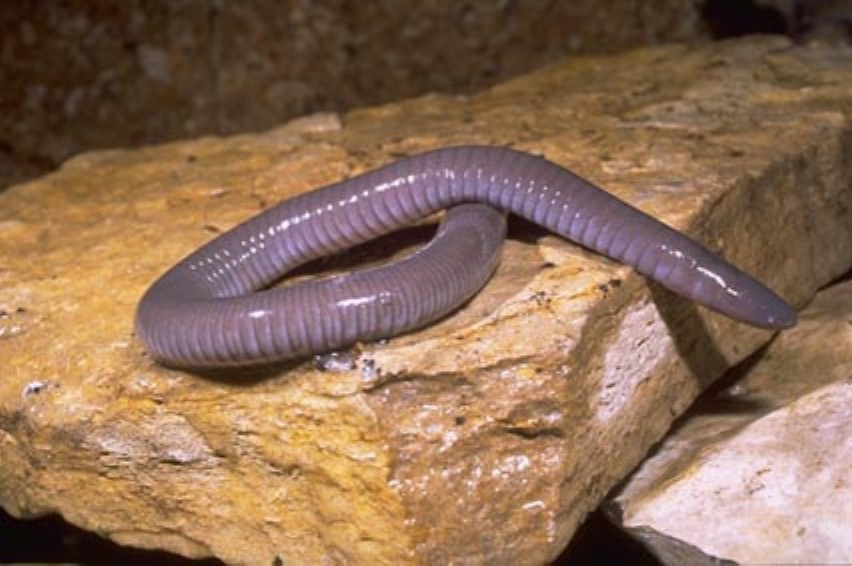
Its head has a pointed snout and one row of teeth in the lower jaw. Its two vestigial eyes are covered by skin, and a pair of protrusible tentacles is positioned between its eyes and nostrils.[1][2][3][4]
Its upper surface is dark grey, while its underside is pale grey with darker markings on the annuli. Adults reach a total length, including the tail, of 30–50 cm.[5][6]
Habitat
The Mexican burrowing caecilian inhabits damp, loose soil and spends much of its time in burrows in moist, loose soil. It lives beneath leaf litter, logs, and plant debris and is frequently found in banana and coffee plantations.[7][8][9][10]
Its natural habitats include subtropical and tropical dry forests, moist lowland forests, and moist montane forests. It also inhabits rural gardens and heavily degraded former forests.[11][12][13]
The species occurs at elevations up to 1,200 metres above sea level.[14]
Diet
The Mexican burrowing caecilian eats earthworms, termites, crickets, slugs, and snails. Larger individuals may also consume mice and small lizards.[15][16]
Behaviour
The Mexican burrowing caecilian moves using internal concertina-like movements and side-to-side body undulations.[17]
It forages on the surface, often emerging at dusk. On nights with light rainfall, it emerges onto the ground surface to catch small prey.[18][19]
Reproduction and life cycle
The Mexican burrowing caecilian is viviparous and gives birth to live young. Fertilisation occurs internally.[20][21]
Females can begin reproducing after one year, although most reproduce in their second year. Males begin spermatogenesis at one year of age but may not reproduce until their second year.[22][23]
A developing brood can contain up to 16 larvae. The larvae initially subsist on the yolks of their eggs for three months.[24][25]
After exhausting their egg yolks, larvae develop rasping teeth and consume maternal glandular secretions. They scrape the inside of the mother's oviduct to stimulate the production of these secretions.[26][27]
Gestation lasts approximately 11 months. Newborn individuals measure 10–15 cm in length and shed their larval teeth before rapidly developing adult teeth.[28][29][30]
Conservation
The Mexican burrowing caecilian is classified as Least Concern on the IUCN Red List. It has several geographically separated populations.[31][32]
The species appears to have become less common in areas where it was previously abundant. The number of locations where it is found also appears to have decreased.[33][34]
Classification of the Mexican Burrowing Caecilian
| Kingdom | Animalia |
|---|---|
| Phylum | Chordata |
| Subphylum | Vertebrata |
| Infraphylum | Gnathostomata |
| Parvphylum | Osteichthyes |
| Megaclass | Tetrapoda |
| Class | Amphibia (Amphibians) |
| Order | Gymnophiona (Caecilian) |
| Family | Dermophiidae (Neotropical and Afrotropical Caecilians) |
| Genus | Dermophis (Mexican Caecilians) |
| Species | Dermophis mexicanus (Duméril & Bibron, 1841) |
Where the Mexican Burrowing Caecilian is found
Checklists and occurrence records place Dermophis mexicanus in 6 countries across North America. GBIF holds 1,621 georeferenced records of it.
Countries
Regions and cities with the most records
- Malacatán, Guatemala 817
- San Marcos, Guatemala 634
- San Marcos, Guatemala 633
- San Pedro Sacatepéquez, Guatemala 633
- Chiapas, Mexico 324
- Cacahoatán, Mexico 200
- Tapachula de Córdova y Ordóñez, Mexico 157
- El Palmar, Guatemala 95
- Mazatenango, Guatemala 95
- San Felipe, Guatemala 95
- San Francisco Zapotitlán, Guatemala 95
- San Pablo Jocopilas, Guatemala 95
- San Sebastián, Guatemala 65
- Retalhuleu, Guatemala 64
- Colomba, Guatemala 63
- El Asintal, Guatemala 60
- Nuevo San Carlos, Guatemala 59
- Cantel, Guatemala 58
- Quetzaltenango, Guatemala 58
- Veracruz, Mexico 41
- Chicacao, Guatemala 40
- Santa Tecla, El Salvador 33
- San Salvador, El Salvador 32
- Antiguo Cuscatlán, El Salvador 31
- San Marcos, El Salvador 31
- Mejicanos, El Salvador 30
- Ayutuxtepeque, El Salvador 29
- Cuscatancingo, El Salvador 29
- Delgado, El Salvador 29
- Soyapango, El Salvador 28
- Apopa, El Salvador 27
- Ilopango, El Salvador 26
- Quezaltepeque, El Salvador 26
- San Salvador Department, El Salvador 23
- Tabasco, Mexico 22
- Oaxaca, Mexico 20
Range as the checklists state it
Middle America
A number beside a place is its count of GBIF occurrence records. A place without a number comes from a checklist alone. Records show where a species has been observed or collected, which can include escapes and vagrants.
Common names
English
- Mexican Burrowing Caecilian
- Mexican Caecilian
Names in 8 other languages
- Arabic
- ضفدع ثعباني مكسيكي
- Czech
- cecílie mexická
- French
- Dermophis mexicain
- German
- Mexikanische Leder-Ringelwühle
- Italian
- Cecilia messicana
- Korean
- 멕시코무족영원
- Russian
- Кожистая червяга
- Spanish
- Baretilla, Cecilia mexicana, Culebra de dos cabezas, Suelda con suelda, Tapalcua
Synonyms
8 other scientific names have been used for this species and are now treated as synonyms of Dermophis mexicanus.
- Amphisbaena versatilis Gray, 1850
- Dermophis eburatus Taylor, 1968
- Dermophis mexicanus clarki (Barbour, 1926)
- Dermophis mexicanus eburatus Taylor, 1968
- Dermophis mexicanus mexicanus (Duméril & Bibron, 1841)
- Dermophis septentrionalis Taylor, 1968
- Gymnophis clarkii Barbour, 1926
- Siphonops mexicanus Duméril & Bibron, 1841
Related species
-
 Slender CaecilianDermophis parviceps
- Oaxacan CaecilianDermophis oaxacae
- Atlantic Montane CaecilianDermophis costaricense
- San Isidro CaecilianDermophis glandulosus
- Chiriqui CaecilianDermophis gracilior
- Pacific Slender CaecilianDermophis occidentalis
- Gaboon CaecilianGeotrypetes seraphini
-
 São Tomé CaecilianSchistometopum thomense
Compare
Questions and answers
What is the scientific name of the Mexican Burrowing Caecilian?
The scientific name of the Mexican Burrowing Caecilian is Dermophis mexicanus. Written with its author, the full name is Dermophis mexicanus (Duméril & Bibron, 1841).
Which family does the Mexican Burrowing Caecilian belong to?
Dermophis mexicanus belongs to the family Dermophiidae, in the order Gymnophiona and the class Amphibia.
Where is the Mexican Burrowing Caecilian found?
Checklists and occurrence records place Dermophis mexicanus in 6 countries: Guatemala, Mexico, El Salvador, Honduras, Costa Rica and Nicaragua.
What is the conservation status of the Mexican Burrowing Caecilian?
The IUCN Red List category recorded for Dermophis mexicanus is Least Concern (LC).
What other names does the Mexican Burrowing Caecilian have?
Dermophis mexicanus is also known in English as Mexican Caecilian.
Sources
Passages the profile rests on
- Its head has a pointed snout. Source passage: “The head has a pointed snout” — English Wikipedia
- It has one row of teeth in its lower jaw. Source passage: “a single row of teeth in the lower jaw” — English Wikipedia
- Its two vestigial eyes are covered by skin. Source passage: “two vestigial eyes covered with skin” — English Wikipedia
- It has a pair of protrusible tentacles positioned between its eyes and nostrils. Source passage: “a pair of protrusible tentacles between the eyes and the nostrils.” — English Wikipedia
- Its upper surface is dark grey, while its underside is pale grey with darker markings on the annuli. Source passage: “The upper surface is dark grey and the under surface pale grey with darker markings on the annuli.” — English Wikipedia
- Adults reach a total length, including the tail, of 30–50 cm. Source passage: “The adult Mexican burrowing caecilian grows to a total length (tail included) of 30 to 50 cm (12 to 20 in).” — English Wikipedia
- The species inhabits damp, loose soil. Source passage: “living in damp, loose soil” — English Wikipedia
- It lives beneath leaf litter, logs, and plant debris. Source passage: “under leaf litter, logs, and plant debris” — English Wikipedia
- It is frequently found in banana and coffee plantations. Source passage: “often in banana and coffee plantations.” — English Wikipedia
- The species spends much of its time in burrows in moist, loose soil. Source passage: “Dermophis mexicanus spends much of its time in burrows in moist, loose soil” — amphibiaweb.org
- Its natural habitats include subtropical and tropical dry forests. Source passage: “subtropical or tropical dry forests” — English Wikipedia
- Its natural habitats include moist lowland forests and moist montane forests. Source passage: “moist lowland forests, moist montane forests” — English Wikipedia
- It also inhabits rural gardens and heavily degraded former forests. Source passage: “rural gardens, and heavily degraded former forests.” — English Wikipedia
- The species occurs at elevations up to 1,200 metres above sea level. Source passage: “It is found at altitudes of up to 1,200 m (3,900 ft) above sea level.” — English Wikipedia
- Its diet includes earthworms, termites, crickets, slugs, and snails. Source passage: “including earthworms, termites, crickets, slugs, and snails.” — English Wikipedia
- Larger individuals may consume mice and small lizards. Source passage: “Larger individuals may eat mice and small lizards.” — English Wikipedia
- It moves using internal concertina-like movements and side-to-side body undulations. Source passage: “It moves by internal concertina-like movements and by undulating its body from side to side.” — English Wikipedia
- The species emerges onto the ground surface on nights with light rainfall to catch small prey. Source passage: “It emerges onto the ground surface on nights with light rainfall and catches small prey that come within its reach.” — English Wikipedia
- The species also forages on the surface, often emerging at dusk. Source passage: “it also forages on the surface, often emerging at dusk if” — amphibiaweb.org
- The species is viviparous and gives birth to live young. Source passage: “This caecilian is viviparous.” — English Wikipedia
- Fertilisation occurs internally. Source passage: “Fertilisation is internal” — English Wikipedia
- Females can begin reproducing after one year, although most reproduce in their second year. Source passage: “Females can start reproducing after 1 year, but most reproduce in their second year.” — English Wikipedia
- Males begin spermatogenesis at one year of age but may not reproduce until their second year. Source passage: “Males start spermatogenesis at 1 years of age but may not reproduce until year two” — English Wikipedia
- A developing brood can contain up to 16 larvae. Source passage: “up to 16 developing larvae” — English Wikipedia
- Developing larvae initially subsist on the yolks of their eggs for three months. Source passage: “subsist on the yolks of their eggs for three months.” — English Wikipedia
- After exhausting their egg yolks, larvae develop rasping teeth and consume maternal glandular secretions. Source passage: “they develop rasping teeth and feed on maternal glandular secretions” — English Wikipedia
- Larvae scrape the inside of the mother's oviduct to stimulate the production of glandular secretions. Source passage: “scraping the inside of the oviduct to stimulate their production.” — English Wikipedia
- Gestation lasts approximately 11 months. Source passage: “after 11 months of gestation” — English Wikipedia
- Newborn individuals measure 10–15 cm in length. Source passage: “they are 10 to 15 cm (3.9 to 5.9 in) long.” — English Wikipedia
- Newborn individuals shed their larval teeth and rapidly develop adult teeth. Source passage: “They then shed their larval teeth and rapidly grow a set of adult ones.” — English Wikipedia
- The species is classified as Least Concern on the IUCN Red List. Source passage: “The Mexican burrowing caecilian is listed as least concern in the IUCN Red List of Threatened Species.” — English Wikipedia
- The species has several geographically separated populations. Source passage: “It has several disjunct populations” — English Wikipedia
- The species appears to have become less common in areas where it was previously abundant. Source passage: “in areas where it used to be abundant it now seems to be less common” — English Wikipedia
- The number of locations where the species is found appears to have decreased. Source passage: “the locations in which it is found seem to be fewer in number.” — English Wikipedia
Data
- Catalogue of Life, 2026-10-16 XR cc by
- Global Biodiversity Information Facility CC BY 4.0
- Wikidata CC0
- GeoNames CC BY 4.0
- Wikimedia Commons per image; credit shown with each image
- iNaturalist per image; credit shown with each image
- Within the Catalogue of Life, this name comes from The Integrated Taxonomic Information System cc0
References
- Duméril, A. M. C.; Bibron, G. (1841). Erpétologie Genérale ou Histoire Naturelle Complète des Reptiles. Volume 8. Paris: Librarie Enclyclopedique de Roret. where the name was published
- Flores-Villela, Oscar / McCoy, C. J., ed. (1993). Herpetofauna Mexicana: Lista anotada de las especies de anfibios y reptiles de México, cambios taxonómicos recientes, y nuevas especies. Carnegie Museum of Natural History Special Publication, No. 17.
This species in other databases
- Catalogue of Life 34XMH
- Wikidata Q1759933
- iNaturalist 28070
- WoRMS urn:lsid:marinespecies.org:taxname:1506618
Page built on 29 November 2026. See how the catalog is made and all sources and licences.
Cite this page
ScientificNames.org. (2026). Dermophis mexicanus (Mexican Burrowing Caecilian). Retrieved November 29, 2026, from https://scientificnames.org/species/dermophis-mexicanus
“Dermophis mexicanus (Mexican Burrowing Caecilian).” ScientificNames.org, 2026, scientificnames.org/species/dermophis-mexicanus. Accessed 29 Nov. 2026.
ScientificNames.org. “Dermophis mexicanus (Mexican Burrowing Caecilian).” Accessed November 29, 2026. https://scientificnames.org/species/dermophis-mexicanus.
@misc{scientificnames_dermophis_mexicanus_mexican_burrowing_caecilian,
  author = {{ScientificNames.org}},
  title = {Dermophis mexicanus (Mexican Burrowing Caecilian)},
  year = {2026},
  url = {https://scientificnames.org/species/dermophis-mexicanus},
  note = {Accessed 2026-11-29}
}