Species · Amphibians
Slender Caecilian Dermophis parviceps
The scientific name of the Slender Caecilian is Dermophis parviceps. It is a species of amphibian in the family Dermophiidae (neotropical and afrotropical caecilians), order Gymnophiona. The name dates from 1924.
- Scientific name
- Dermophis parviceps (Dunn, 1924)
- Common name
- Slender Caecilian
- Genus
- Dermophis
- Family
- Dermophiidae (Neotropical and Afrotropical Caecilians)
- Order
- Gymnophiona
- Class
- Amphibia
- Red List category
- LC Least Concern
- Recorded in
- 3 countries
- Name status
- accepted in the Catalogue of Life

Overview
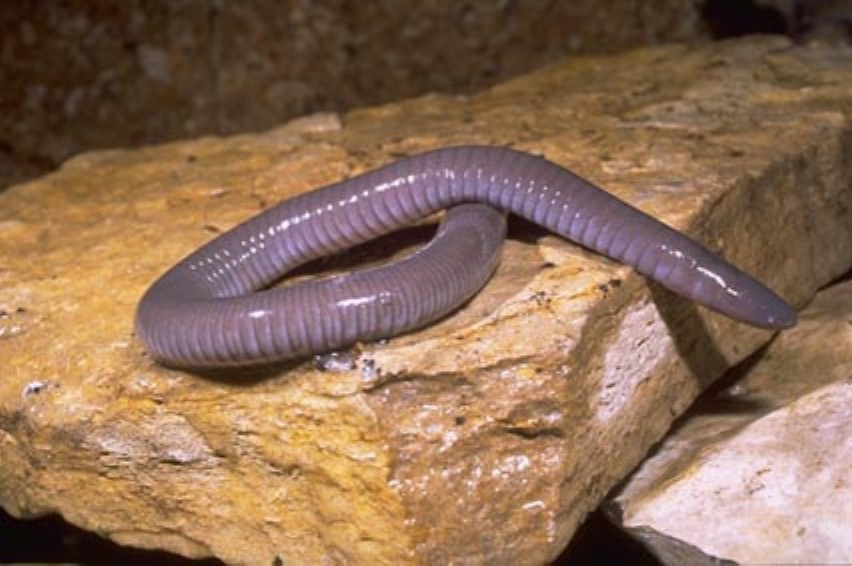
Dermophis parviceps is recorded in Costa Rica and Panama, and inhabits humid montane and lowland forests at elevations of 40–1,200 m above sea level. Its eyes are visible through its skin, and its pinkish head contrasts with its purplish-gray body.
Written 27 November 2026 from the sources listed below. Each statement was checked against the passage it cites; statements that could not be supported were removed.
Appearance
The Slender Caecilian has eyes visible through its skin. Its head is pinkish, contrasting with its purplish-gray body.[1][2]
Specimens from Costa Rica have a total length of 112–217 mm. Costa Rican specimens have 85–102 primary annuli and 11–26 secondary annuli.[3][4]
Its annular grooves lack the dark pigmentation present in Dermophis mexicanus and Dermophis oaxacae.[5]
Habitat
The Slender Caecilian inhabits humid montane and lowland forests at elevations of 40–1,200 m above sea level. It is recorded in Costa Rica and Panama, with its occurrence in Colombia depending on the source.[6][7]
It can also be found beneath logs and in leaf litter.[8]
Behaviour
The Slender Caecilian lives underground and can occur as deep as 60 cm below the soil surface.[9]
Reproduction and life cycle
The Slender Caecilian is considered probably viviparous. Its reproduction is not dependent on water.[10][11]
Conservation
The Slender Caecilian can be locally common. The extent to which deforestation threatens the species is unknown.[12][13]
The species occurs in numerous protected areas in Panama and Costa Rica.[14]
Classification of the Slender Caecilian
| Kingdom | Animalia |
|---|---|
| Phylum | Chordata |
| Subphylum | Vertebrata |
| Infraphylum | Gnathostomata |
| Parvphylum | Osteichthyes |
| Megaclass | Tetrapoda |
| Class | Amphibia (Amphibians) |
| Order | Gymnophiona (Caecilian) |
| Family | Dermophiidae (Neotropical and Afrotropical Caecilians) |
| Genus | Dermophis (Mexican Caecilians) |
| Species | Dermophis parviceps (Dunn, 1924) |
Where the Slender Caecilian is found
Checklists and occurrence records place Dermophis parviceps in 3 countries. GBIF holds 39 georeferenced records of it.
Countries
Regions and cities with the most records
- San Isidro, Costa Rica 5
- San José, Costa Rica 5
- Cartago Province, Costa Rica 4
- Puntarenas Province, Costa Rica 4
A number beside a place is its count of GBIF occurrence records. A place without a number comes from a checklist alone. Records show where a species has been observed or collected, which can include escapes and vagrants.
Common names
English
- Slender Caecilian
- Atlantic Slender Caecilian
- La Loma Caecilian
- Small-headed Caecilian
Names in 4 other languages
- Czech
- cecílie malohlavá
- Italian
- Cecilia snella testa piccola
- Russian
- Малоголовая червяга
- Spanish
- cecilido cabeza pequeña
Synonyms
2 other scientific names have been used for this species and are now treated as synonyms of Dermophis parviceps.
- Gymnopis parviceps (Dunn, 1924)
- Siphonops parviceps Dunn, 1924
Related species
-
 Mexican Burrowing CaecilianDermophis mexicanus
- Oaxacan CaecilianDermophis oaxacae
- Atlantic Montane CaecilianDermophis costaricense
- San Isidro CaecilianDermophis glandulosus
- Chiriqui CaecilianDermophis gracilior
- Pacific Slender CaecilianDermophis occidentalis
- Gaboon CaecilianGeotrypetes seraphini
-
 São Tomé CaecilianSchistometopum thomense
Compare
Questions and answers
What is the scientific name of the Slender Caecilian?
The scientific name of the Slender Caecilian is Dermophis parviceps. Written with its author, the full name is Dermophis parviceps (Dunn, 1924).
Which family does the Slender Caecilian belong to?
Dermophis parviceps belongs to the family Dermophiidae, in the order Gymnophiona and the class Amphibia.
Where is the Slender Caecilian found?
Checklists and occurrence records place Dermophis parviceps in 3 countries: Costa Rica, Panama and Nicaragua.
What is the conservation status of the Slender Caecilian?
The IUCN Red List category recorded for Dermophis parviceps is Least Concern (LC).
What other names does the Slender Caecilian have?
Dermophis parviceps is also known in English as Atlantic Slender Caecilian, La Loma Caecilian and Small-headed Caecilian.
Sources
Passages the profile rests on
- Its eyes are visible through its skin. Source passage: “The eyes can be seen through the skin.” — English Wikipedia
- Its head is pinkish, contrasting with its purplish-gray body. Source passage: “The head is pinkish, contrasting with the purplish-gray body.” — English Wikipedia
- Specimens from Costa Rica have a total length of 112–217 mm. Source passage: “Specimens from Costa Rica measure 112–217 mm (4.4–8.5 in) in total length” — English Wikipedia
- Costa Rican specimens have 85–102 primary annuli and 11–26 secondary annuli. Source passage: “85–102 primary and 11–26 secondary annuli” — English Wikipedia
- Its annular grooves lack the dark pigmentation present in Dermophis mexicanus and Dermophis oaxacae. Source passage: “the annular grooves lack dark pigment seen in Dermophis mexicanus and Dermophis oaxacae.” — English Wikipedia
- Dermophis parviceps is recorded in Costa Rica and Panama, with its occurrence in Colombia depending on the source. Source passage: “It is found in Costa Rica and Panama, and possibly in Colombia, depending on the source.” — English Wikipedia
- The species inhabits humid montane and lowland forests at elevations of 40–1,200 m above sea level. Source passage: “Dermophis parviceps occurs in humid montane and lowland forest at elevations of 40–1,200 m (130–3,940 ft) above sea level.” — English Wikipedia
- The species can also be found beneath logs and in leaf litter. Source passage: “but also under logs or in leaf litter.” — English Wikipedia
- The species lives underground and can occur as deep as 60 cm below the soil surface. Source passage: “It is a subterranean species that can be found as deep as 60 cm (2 ft) below the soil surface” — English Wikipedia
- The species is considered probably viviparous. Source passage: “It is probably viviparous” — English Wikipedia
- Its reproduction is not dependent on water. Source passage: “not dependent on water for its reproduction.” — English Wikipedia
- The species can be locally common. Source passage: “D. parviceps can be locally common.” — English Wikipedia
- The extent to which deforestation threatens the species is unknown. Source passage: “It is unknown to which degree deforestation is a threat to it.” — English Wikipedia
- The species occurs in numerous protected areas in Panama and Costa Rica. Source passage: “It is present in many protected areas in Panama and Costa Rica.” — English Wikipedia
Data
- Catalogue of Life, 2026-10-16 XR cc by
- Global Biodiversity Information Facility CC BY 4.0
- Wikidata CC0
- GeoNames CC BY 4.0
- Wikimedia Commons per image; credit shown with each image
- Within the Catalogue of Life, this name comes from The Integrated Taxonomic Information System cc0
This species in other databases
Page built on 27 November 2026. See how the catalog is made and all sources and licences.
Cite this page
ScientificNames.org. (2026). Dermophis parviceps (Slender Caecilian). Retrieved November 27, 2026, from https://scientificnames.org/species/dermophis-parviceps
“Dermophis parviceps (Slender Caecilian).” ScientificNames.org, 2026, scientificnames.org/species/dermophis-parviceps. Accessed 27 Nov. 2026.
ScientificNames.org. “Dermophis parviceps (Slender Caecilian).” Accessed November 27, 2026. https://scientificnames.org/species/dermophis-parviceps.
@misc{scientificnames_dermophis_parviceps_slender_caecilian,
  author = {{ScientificNames.org}},
  title = {Dermophis parviceps (Slender Caecilian)},
  year = {2026},
  url = {https://scientificnames.org/species/dermophis-parviceps},
  note = {Accessed 2026-11-27}
}