Species · Amphibians
Oaxacan Caecilian Dermophis oaxacae
The scientific name of the Oaxacan Caecilian is Dermophis oaxacae. It is a species of amphibian in the family Dermophiidae (neotropical and afrotropical caecilians), order Gymnophiona. The name dates from 1930.
- Scientific name
- Dermophis oaxacae (Mertens, 1930)
- Common name
- Oaxacan Caecilian
- Genus
- Dermophis
- Family
- Dermophiidae (Neotropical and Afrotropical Caecilians)
- Order
- Gymnophiona
- Class
- Amphibia
- Red List category
- LC Least Concern
- Recorded in
- 1 country
- Name status
- accepted in the Catalogue of Life
Overview
The Oaxacan Caecilian is a subterranean species. It is endemic to southwestern Mexico, occurring on the Pacific slopes and in the Balsas depression of Jalisco, Michoacán, Guerrero, Oaxaca, and Chiapas. Its unusually high annulus counts distinguish it from all other members of the genus Dermophis.
Written 27 November 2026 from the sources listed below. Each statement was checked against the passage it cites; statements that could not be supported were removed.
Appearance
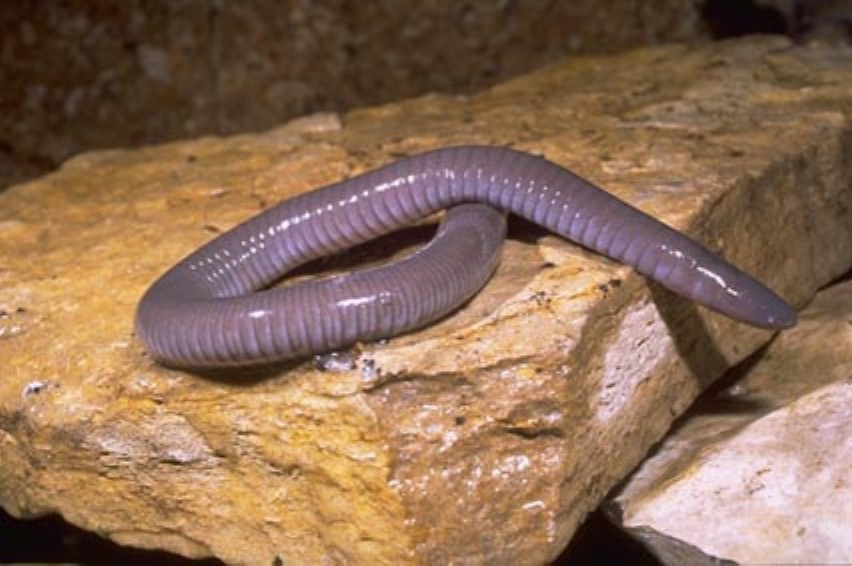
The Oaxacan Caecilian has between 119 and 139 primary annuli and between 101 and 133 secondary annuli. These unusually high counts distinguish it from all other members of the genus Dermophis.[1][2][3]
It has a somewhat robust body and a relatively large head. Its mouth is positioned subterminally, and its eyes are visible through a layer of skin.[4][5][6][7]
Living individuals have blue-black coloration. The annular grooves have dark pigmentation on their ventral surfaces, contrasting sharply with the otherwise pale underside.[8][9][10]
The maximum reported total length is 454 mm.[11]
Habitat
The Oaxacan Caecilian occurs in semi-deciduous tropical forests and is also reported to inhabit subtropical or tropical dry forests. It occurs at elevations reaching 2,100 m above sea level.[12][13][14]
Behaviour
The Oaxacan Caecilian is a subterranean species.[15]
Reproduction and life cycle
The species is considered probably viviparous.[16]
Conservation
The Oaxacan Caecilian is poorly known and has few recent observations. The degree to which deforestation threatens the species is unknown.[17][18]
Diet
The dietary habits of the Oaxacan Caecilian are inferred to resemble those of similar species.[19]
Classification of the Oaxacan Caecilian
| Kingdom | Animalia |
|---|---|
| Phylum | Chordata |
| Subphylum | Vertebrata |
| Infraphylum | Gnathostomata |
| Parvphylum | Osteichthyes |
| Megaclass | Tetrapoda |
| Class | Amphibia (Amphibians) |
| Order | Gymnophiona (Caecilian) |
| Family | Dermophiidae (Neotropical and Afrotropical Caecilians) |
| Genus | Dermophis (Mexican Caecilians) |
| Species | Dermophis oaxacae (Mertens, 1930) |
Where the Oaxacan Caecilian is found
Checklists and occurrence records place Dermophis oaxacae in 1 country across North America. GBIF holds 83 georeferenced records of it.
Countries
Regions and cities with the most records
- Oaxaca, Mexico 17
- Chiapas, Mexico 14
- Guerrero, Mexico 14
- Jalisco, Mexico 8
- Acapulco de Juárez, Mexico 5
- Tonalá, Mexico 5
- Colima, Mexico 3
- Puerto Vallarta, Mexico 3
Range as the checklists state it
Middle America
A number beside a place is its count of GBIF occurrence records. A place without a number comes from a checklist alone. Records show where a species has been observed or collected, which can include escapes and vagrants.
Common names
English
- Oaxacan Caecilian
Names in 3 other languages
- Czech
- cecílie oaxacká
- Russian
- Тихоокеанская червяга
- Spanish
- Cecilia del Pacífico, Cecilia oaxaqueña
Synonyms
3 other scientific names have been used for this species and are now treated as synonyms of Dermophis oaxacae.
- Dermophis multiplicatus oaxacae (Mertens, 1930)
- Gymnopis multiplicata oaxacae Mertens, 1930
- Gymnopis multiplicatus oaxacae Mertens, 1930
Related species
-
 Mexican Burrowing CaecilianDermophis mexicanus
-
 Slender CaecilianDermophis parviceps
- Atlantic Montane CaecilianDermophis costaricense
- San Isidro CaecilianDermophis glandulosus
- Chiriqui CaecilianDermophis gracilior
- Pacific Slender CaecilianDermophis occidentalis
- Gaboon CaecilianGeotrypetes seraphini
-
 São Tomé CaecilianSchistometopum thomense
Compare
Questions and answers
What is the scientific name of the Oaxacan Caecilian?
The scientific name of the Oaxacan Caecilian is Dermophis oaxacae. Written with its author, the full name is Dermophis oaxacae (Mertens, 1930).
Which family does the Oaxacan Caecilian belong to?
Dermophis oaxacae belongs to the family Dermophiidae, in the order Gymnophiona and the class Amphibia.
Where is the Oaxacan Caecilian found?
Checklists and occurrence records place Dermophis oaxacae in 1 country: Mexico.
What is the conservation status of the Oaxacan Caecilian?
The IUCN Red List category recorded for Dermophis oaxacae is Least Concern (LC).
Sources
Passages the profile rests on
- The species has between 119 and 139 primary annuli. Source passage: “It has 119–139 primary and 101–133 secondary annuli” — English Wikipedia
- The species has between 101 and 133 secondary annuli. Source passage: “119–139 primary and 101–133 secondary annuli” — English Wikipedia
- Its unusually high annulus counts distinguish it from all other members of the genus Dermophis. Source passage: “these high counts distinguish it from all other Dermophis.” — English Wikipedia
- Dermophis oaxacae has a somewhat robust body. Source passage: “The body is somewhat robust” — English Wikipedia
- The species has a relatively large head. Source passage: “the head is relatively large.” — English Wikipedia
- Its mouth is positioned subterminally. Source passage: “The mouth is subterminal.” — English Wikipedia
- The eyes are visible through a layer of skin. Source passage: “The eyes are visible through a layer of skin.” — English Wikipedia
- Living individuals have blue-black coloration. Source passage: “Living animals have blue-black coloration.” — English Wikipedia
- The annular grooves have dark pigmentation on their ventral surfaces. Source passage: “The annular grooves are ventrally marked with dark pigment” — English Wikipedia
- The dark pigmentation of the ventral annular grooves contrasts sharply with the otherwise pale underside. Source passage: “in sharp contrast to the otherwise pale venter.” — English Wikipedia
- Dermophis oaxacae can reach a maximum reported total length of 454 mm. Source passage: “reported maximum total length of 454 mm (17.9 in).” — English Wikipedia
- The species occurs in semi-deciduous tropical forests. Source passage: “occurs in semi-deciduous tropical forests” — English Wikipedia
- Dermophis oaxacae occurs at elevations reaching 2,100 m above sea level. Source passage: “at elevations up to 2,100 m (6,900 ft) above sea level.” — English Wikipedia
- The species is reported to inhabit subtropical or tropical dry forests. Source passage: “Its natural habitats are subtropical or tropical dry forests,” — inaturalist.org
- Dermophis oaxacae is a subterranean species. Source passage: “It is a subterranean species.” — English Wikipedia
- The species is considered probably viviparous. Source passage: “It is probably viviparous.” — English Wikipedia
- Dermophis oaxacae is poorly known and has few recent observations. Source passage: “is a poorly known species with few recent observations.” — English Wikipedia
- The degree to which deforestation threatens the species is unknown. Source passage: “It is unknown to which degree deforestation is a threat to it.” — English Wikipedia
- The dietary habits of Dermophis oaxacae are inferred to resemble those of similar species. Source passage: “Its dietary habits and other aspects of its ecology and life history are inferred to be similar ...” — amphibiaweb.org
Data
- Catalogue of Life, 2026-10-16 XR cc by
- Global Biodiversity Information Facility CC BY 4.0
- Wikidata CC0
- GeoNames CC BY 4.0
- Within the Catalogue of Life, this name comes from The Integrated Taxonomic Information System cc0
References
- Flores-Villela, Oscar / McCoy, C. J., ed. (1993). Herpetofauna Mexicana: Lista anotada de las especies de anfibios y reptiles de México, cambios taxonómicos recientes, y nuevas especies. Carnegie Museum of Natural History Special Publication, No. 17.
This species in other databases
Page built on 29 November 2026. See how the catalog is made and all sources and licences.
Cite this page
ScientificNames.org. (2026). Dermophis oaxacae (Oaxacan Caecilian). Retrieved November 29, 2026, from https://scientificnames.org/species/dermophis-oaxacae
“Dermophis oaxacae (Oaxacan Caecilian).” ScientificNames.org, 2026, scientificnames.org/species/dermophis-oaxacae. Accessed 29 Nov. 2026.
ScientificNames.org. “Dermophis oaxacae (Oaxacan Caecilian).” Accessed November 29, 2026. https://scientificnames.org/species/dermophis-oaxacae.
@misc{scientificnames_dermophis_oaxacae_oaxacan_caecilian,
  author = {{ScientificNames.org}},
  title = {Dermophis oaxacae (Oaxacan Caecilian)},
  year = {2026},
  url = {https://scientificnames.org/species/dermophis-oaxacae},
  note = {Accessed 2026-11-29}
}