Species · Amphibians
Pacific Slender Caecilian Dermophis occidentalis
The scientific name of the Pacific Slender Caecilian is Dermophis occidentalis. It is a species of amphibian in the family Dermophiidae (neotropical and afrotropical caecilians), order Gymnophiona. The name dates from 1955.
- Scientific name
- Dermophis occidentalis Taylor, 1955
- Common name
- Pacific Slender Caecilian
- Genus
- Dermophis
- Family
- Dermophiidae (Neotropical and Afrotropical Caecilians)
- Order
- Gymnophiona
- Class
- Amphibia
- Red List category
- LC Least Concern
- Name status
- accepted in the Catalogue of Life
Overview
Dermophis occidentalis inhabits lowland and submontane rainforests in southwestern Costa Rica. Adults measure 192–235 mm in total length and have a narrow, light grayish-tan head.
Written 27 November 2026 from the sources listed below. Each statement was checked against the passage it cites; statements that could not be supported were removed.
Appearance
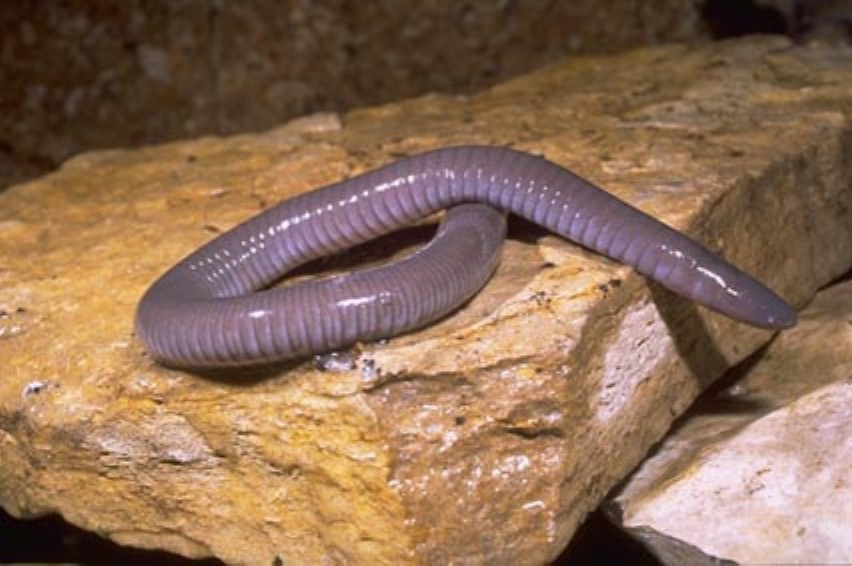
The Pacific Slender Caecilian has a narrow, light grayish-tan head. Its dorsal body coloration is lavender plumbeous and becomes lighter on the underside.[1][2]
Adults measure 192–235 mm in total length. The species has 95–112 primary annuli and 29–37 secondary annuli, with a body length approximately 30–32 times its width.[3][4][5][6]
Habitat
The species inhabits lowland and submontane rainforests at elevations of 365–970 m above sea level. It is subterranean.[7][8][9]
Individuals can be found beneath logs and in leaf litter.[10]
Conservation
The Pacific Slender Caecilian is poorly known. Deforestation is identified as a potential threat to the species.[11][12]
Its geographic range overlaps with Corcovado National Park.[13]
Classification of the Pacific Slender Caecilian
| Kingdom | Animalia |
|---|---|
| Phylum | Chordata |
| Subphylum | Vertebrata |
| Infraphylum | Gnathostomata |
| Parvphylum | Osteichthyes |
| Megaclass | Tetrapoda |
| Class | Amphibia (Amphibians) |
| Order | Gymnophiona (Caecilian) |
| Family | Dermophiidae (Neotropical and Afrotropical Caecilians) |
| Genus | Dermophis (Mexican Caecilians) |
| Species | Dermophis occidentalis Taylor, 1955 |
Common names
English
- Pacific Slender Caecilian
- San Jose Caecilian
- Western Caecilian
Names in 2 other languages
- Italian
- Cecilia costaricana occidentale
- Spanish
- cecilido del oeste
Related species
-
 Mexican Burrowing CaecilianDermophis mexicanus
-
 Slender CaecilianDermophis parviceps
- Oaxacan CaecilianDermophis oaxacae
- Atlantic Montane CaecilianDermophis costaricense
- San Isidro CaecilianDermophis glandulosus
- Chiriqui CaecilianDermophis gracilior
- Gaboon CaecilianGeotrypetes seraphini
-
 São Tomé CaecilianSchistometopum thomense
Compare
Questions and answers
What is the scientific name of the Pacific Slender Caecilian?
The scientific name of the Pacific Slender Caecilian is Dermophis occidentalis. Written with its author, the full name is Dermophis occidentalis Taylor, 1955.
Which family does the Pacific Slender Caecilian belong to?
Dermophis occidentalis belongs to the family Dermophiidae, in the order Gymnophiona and the class Amphibia.
What is the conservation status of the Pacific Slender Caecilian?
The IUCN Red List category recorded for Dermophis occidentalis is Least Concern (LC).
What other names does the Pacific Slender Caecilian have?
Dermophis occidentalis is also known in English as San Jose Caecilian and Western Caecilian.
Sources
Passages the profile rests on
- The species has a narrow, light grayish-tan head. Source passage: “The head is narrow and light grayish tan in color.” — English Wikipedia
- The dorsal body coloration is lavender plumbeous and becomes lighter on the underside. Source passage: “The body is dorsally lavender plumbeous, turning lighter ventrally.” — English Wikipedia
- Adults measure 192–235 mm in total length. Source passage: “measuring 192–235 mm (7.6–9.3 in) in total length.” — English Wikipedia
- The species has 95–112 primary annuli. Source passage: “It has 95–112 primary” — English Wikipedia
- The species has 29–37 secondary annuli. Source passage: “29–37 secondary annuli.” — English Wikipedia
- The body length is approximately 30–32 times the body width. Source passage: “with its length 30 to 32 times the body width.” — English Wikipedia
- The species inhabits lowland and submontane rainforests. Source passage: “occurs in lowland and submontane rainforests” — English Wikipedia
- The species occurs at elevations of 365–970 m above sea level. Source passage: “at elevations of 365–970 m (1,198–3,182 ft) above sea level.” — English Wikipedia
- The species is subterranean. Source passage: “It is a subterranean species” — English Wikipedia
- Individuals can be found beneath logs and in leaf litter. Source passage: “that can be found under logs and in leaf litter.” — English Wikipedia
- The species is poorly known. Source passage: “Dermophis occidentalis is a poorly known species.” — English Wikipedia
- Deforestation is identified as a potential threat to the species. Source passage: “Deforestation might be a threat to it.” — English Wikipedia
- The species' geographic range overlaps with Corcovado National Park. Source passage: “Its range overlaps with the Corcovado National Park, among others.” — English Wikipedia
Data
- Catalogue of Life, 2026-10-16 XR cc by
- Wikidata CC0
- Within the Catalogue of Life, this name comes from The Integrated Taxonomic Information System cc0
References
- Additions to the known herpetological fauna of Costa Rica with comments on other species. No. II. (1955). Kansas University Science Bulletin, 37(1), 499–575. https://bionames.org/references/ddff8e6725faf278324029f07c352648 Link where the name was published
This species in other databases
Page built on 29 November 2026. See how the catalog is made and all sources and licences.
Cite this page
ScientificNames.org. (2026). Dermophis occidentalis (Pacific Slender Caecilian). Retrieved November 29, 2026, from https://scientificnames.org/species/dermophis-occidentalis
“Dermophis occidentalis (Pacific Slender Caecilian).” ScientificNames.org, 2026, scientificnames.org/species/dermophis-occidentalis. Accessed 29 Nov. 2026.
ScientificNames.org. “Dermophis occidentalis (Pacific Slender Caecilian).” Accessed November 29, 2026. https://scientificnames.org/species/dermophis-occidentalis.
@misc{scientificnames_dermophis_occidentalis_pacific_slender_caecilian,
  author = {{ScientificNames.org}},
  title = {Dermophis occidentalis (Pacific Slender Caecilian)},
  year = {2026},
  url = {https://scientificnames.org/species/dermophis-occidentalis},
  note = {Accessed 2026-11-29}
}