Species · Birds
Red-keeled Flowerpecker Dicaeum australe
The scientific name of the Red-keeled Flowerpecker is Dicaeum australe. It is a species of bird in the family Dicaeidae (flowerpecker), order Passeriformes. The name dates from 1783.
- Scientific name
- Dicaeum australe (Hermann, 1783)
- Common name
- Red-keeled Flowerpecker
- Genus
- Dicaeum
- Family
- Dicaeidae (Flowerpecker)
- Order
- Passeriformes
- Class
- Aves
- Red List category
- LC Least Concern
- Recorded in
- 1 country
- Name status
- accepted in the Catalogue of Life

Overview
Dicaeum australe is endemic to the Philippines. It is marked by a narrow scarlet stripe down the breast and belly of males.
Written 26 November 2026 from the sources listed below. Each statement was checked against the passage it cites; statements that could not be supported were removed.
Appearance
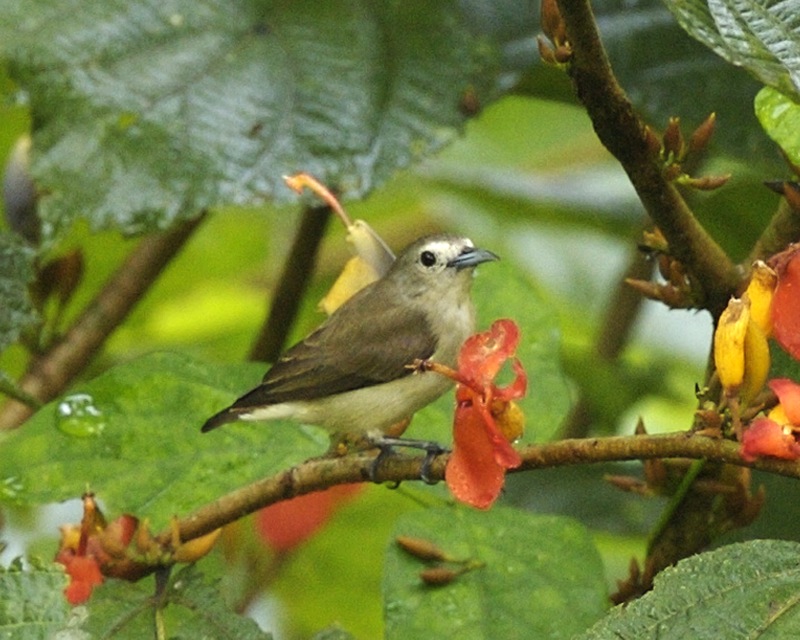
The species has a small, relatively long, curved bill of medium thickness. Its bill and legs are black, and its eyes are dark chestnut.[1][2]
Males have glossy blue-black upperparts, white chins and throat sides, gray remaining underparts, and a narrow scarlet stripe down the breast and belly. Their underwings and pectoral tufts are white.[3][4]
Females resemble males but have paler plumage. Immature birds are dark grayish-brown above and brownish olive-gray below.[5][6]
The species has black upperparts with a glossy blue sheen and white underparts washed with pale gray.[7]
Habitat
The species inhabits lowland forest, second-growth vegetation, agricultural areas, and parks. It also occurs in foothill forest and more open woodland.[8][9]
It is highly adaptable to different habitats but is not found in montane forest.[10]
Diet
The species feeds on small fruits, mistletoes, flowers, and small insects.[11]
Behaviour
The species forages mainly in the canopy and middle forest stratum.[12]
Individuals occur singly, in pairs, or in mixed-species flocks with other flowerpeckers and small birds.[13]
Reproduction and life cycle
Breeding has been observed between April and August.[14]
Conservation
The IUCN classifies the species as Least Concern. It is common throughout its wide geographic range.[15][16]
The species is among the Philippine endemic birds reported not to have a declining population because of its ability to thrive in degraded habitats.[17]
Similar species
The black-belted flowerpecker was formerly classified as a subspecies of the red-keeled flowerpecker but is now treated as a separate species.[18]
Classification of the Red-keeled Flowerpecker
| Kingdom | Animalia |
|---|---|
| Phylum | Chordata |
| Subphylum | Vertebrata |
| Infraphylum | Gnathostomata |
| Parvphylum | Osteichthyes |
| Megaclass | Tetrapoda |
| Class | Aves (Bird) |
| Order | Passeriformes (Passerine) |
| Family | Dicaeidae (Flowerpecker) |
| Genus | Dicaeum (Flowerpeckers) |
| Species | Dicaeum australe (Hermann, 1783) |
Where the Red-keeled Flowerpecker is found
Checklists and occurrence records place Dicaeum australe in 1 country. GBIF holds 14,692 georeferenced records of it.
Countries
Regions and cities with the most records
- Pateros, Philippines 3,541
- Bel Air, Philippines 3,503
- Makati City, Philippines 3,492
- Taytay, Philippines 3,414
- Upper Bicutan, Philippines 3,376
- Cainta, Philippines 3,370
- Taguig, Philippines 3,352
- Pasay, Philippines 3,319
- Baclaran, Philippines 3,285
- Antipolo, Philippines 3,221
- Angono, Philippines 3,215
- Pasig City, Philippines 3,174
- Mandaluyong City, Philippines 3,165
- Mandaluyong, Philippines 3,162
- San Juan, Philippines 3,147
- Paranaque City, Philippines 3,132
- Calumpang, Philippines 3,130
- Quezon City, Philippines 3,106
- Bagong Pagasa, Philippines 3,061
- Manila, Philippines 3,052
- Marikina City, Philippines 2,988
- Bagong Barrio, Philippines 2,923
- Commonwealth, Philippines 2,876
- Talipapa, Philippines 2,811
- Caloocan, Philippines 2,794
- Navotas, Philippines 2,499
- Valenzuela, Philippines 2,371
- Malabon, Philippines 2,317
- Tanza, Philippines 2,311
- Las Piñas, Philippines 2,161
- Bacoor, Philippines 2,103
- Imus, Philippines 2,038
- Muntinlupa, Philippines 2,012
- Poblacion, Philippines 1,941
- Tunasan, Philippines 1,936
- Kawit, Philippines 1,933
A number beside a place is its count of GBIF occurrence records. A place without a number comes from a checklist alone. Records show where a species has been observed or collected, which can include escapes and vagrants.
Common names
English
- Red-keeled Flowerpecker
- Red-striped Flowerpecker
Names in 25 other languages
- Catalan
- picaflors de les Filipines
- Chinese
- 红纹啄花鸟, 菲律賓啄花
- Croatian
- crvenotrba imelašica
- Czech
- květozob filipínský
- Danish
- Rødbuget Blomsterpikker
- Dutch
- Filipijnse Honingvogel, Filippijnse Honingvogel
- Esperanto
- ruĝventra dikeo
- Finnish
- filippiinienkukastaja
- French
- Dicée des Philippines
- German
- Rostbauch-Mistelfresser, Rostbauchmistelfresser
- Italian
- Beccafiore fasciarossa
- Japanese
- ゴシキハナドリ
- Lithuanian
- filipininis žiedsiurbys
- Norwegian
- rødkjølblomsterfugl
- Norwegian Bokmål
- rødreimblomsterfugl
- Polish
- kwiatówka zbroczona
- Portuguese
- pica-flor-de-barriga-encarnada, pica-flor-filipino
- Russian
- Филиппинский цветоед
- Slovak
- bobuliar červenobruchý
- Spanish
- Picaflores filipino
- Swedish
- rödbukig blomsterpickare
- Tagalog
- pipit
- Turkish
- Kızıl Karınlı Öksekuşu
- Ukrainian
- квіткоїд філіпінський
- Welsh
- pigwr blodau'r Philipinau
Synonyms
2 other scientific names have been used for this species and are now treated as synonyms of Dicaeum australe.
- Dicaeum australe australe Hermann, J, 1783
- Pipra australis Hermann, J, 1783
Related species
-
 MistletoebirdDicaeum hirundinaceum
-
 Cebu FlowerpeckerDicaeum quadricolor
-
 Scarlet-backed FlowerpeckerDicaeum cruentatum
-
 Fire-breasted FlowerpeckerDicaeum ignipectus
-
 Orange-bellied FlowerpeckerDicaeum trigonostigma
-
 Nilgiri FlowerpeckerDicaeum concolor
-
 Thick-billed FlowerpeckerDicaeum agile
-
 Spectacled FlowerpeckerDicaeum dayakorum
Compare
Questions and answers
What is the scientific name of the Red-keeled Flowerpecker?
The scientific name of the Red-keeled Flowerpecker is Dicaeum australe. Written with its author, the full name is Dicaeum australe (Hermann, 1783).
Which family does the Red-keeled Flowerpecker belong to?
Dicaeum australe belongs to the family Dicaeidae, in the order Passeriformes and the class Aves.
Where is the Red-keeled Flowerpecker found?
Checklists and occurrence records place Dicaeum australe in 1 country: Philippines.
What is the conservation status of the Red-keeled Flowerpecker?
The IUCN Red List category recorded for Dicaeum australe is Least Concern (LC).
What other names does the Red-keeled Flowerpecker have?
Dicaeum australe is also known in English as Red-striped Flowerpecker.
Sources
Passages the profile rests on
- The species has a small, relatively long, curved bill of medium thickness. Source passage: “Small, relatively long curved bill of medium thickness” — English Wikipedia
- The species has a black bill and legs and dark chestnut eyes. Source passage: “Bill and lags black; eye dark chestnut.” — English Wikipedia
- Male australe have glossy blue-black upperparts, white chins and throat sides, gray remaining underparts, and a narrow scarlet stripe down the breast and belly. Source passage: “australe male upperparts glossy blue black; chin and sides of throat white; rest of underparts gray with diagnostic narrow scarlet stripe down center of the breast and belly” — English Wikipedia
- The underwings and pectoral tufts are white. Source passage: “underwing and pectoral tufts white.” — English Wikipedia
- Females resemble males but have paler plumage. Source passage: “female like male but paler.” — English Wikipedia
- Immature birds are dark grayish-brown above and brownish olive-gray below. Source passage: “imm dark grayish brown above, brownish olive gray below.” — English Wikipedia
- The species has black upperparts with a glossy blue sheen and white underparts washed with pale gray. Source passage: “Black upperparts are glossed blue, while white underparts are washed with pale gray.” — ebird.org
- The species inhabits lowland forest, second-growth vegetation, agricultural areas, and parks. Source passage: “found in lowland forest, second growth, agricultural areas and parks.” — English Wikipedia
- The species occurs in lowland and foothill forest as well as more open woodland. Source passage: “A small bird of lowland and foothill forest and more open woodland.” — ebird.org
- The species is highly adaptable to different habitats but is not found in montane forest. Source passage: “This species is extremely adaptable to almost any habitat except montane forest” — English Wikipedia
- The species feeds on small fruits, mistletoes, flowers, and small insects. Source passage: “Feeds on small fruits, mistletoes, flowers and also takes small insects.” — English Wikipedia
- The species forages mainly in the canopy and middle forest stratum. Source passage: “Forages mostly in the canopy and middle stratum.” — English Wikipedia
- Individuals occur singly, in pairs, or in mixed-species flocks with other flowerpeckers and small birds. Source passage: “Found singly, in pairs or mixed species flocks with other flowerpeckers and small birds.” — English Wikipedia
- Breeding has been observed between April and August. Source passage: “Breeding has been observed from April to August” — English Wikipedia
- The IUCN classifies the species as Least Concern. Source passage: “The IUCN has classified the species as least concern” — English Wikipedia
- The species is common throughout its wide geographic range. Source passage: “as it is common throughout its wide range.” — English Wikipedia
- The species is among the Philippine endemic birds reported not to have a declining population because of its ability to thrive in degraded habitats. Source passage: “Its adaptability to be able to thrive in degraded habitat has made one of the few Philippine endemic birds that does not have a declining population.” — English Wikipedia
- The black-belted flowerpecker was formerly classified as a subspecies of the red-keeled flowerpecker but is now treated as a separate species. Source passage: “The Black-belted flowerpecker was once considered a subspecies of Red-keeled flowerpecker but has since been classified as a separate species” — English Wikipedia
Data
- Catalogue of Life, 2026-10-16 XR cc by
- Global Biodiversity Information Facility CC BY 4.0
- Wikidata CC0
- GeoNames CC BY 4.0
- Wikimedia Commons per image; credit shown with each image
- Within the Catalogue of Life, this name comes from The Integrated Taxonomic Information System cc0
References
- Gill, Frank, & and Minturn Wright. (2006). Birds of the World: Recommended English Names.
This species in other databases
Page built on 27 November 2026. See how the catalog is made and all sources and licences.
Cite this page
ScientificNames.org. (2026). Dicaeum australe (Red-keeled Flowerpecker). Retrieved November 27, 2026, from https://scientificnames.org/species/dicaeum-australe
“Dicaeum australe (Red-keeled Flowerpecker).” ScientificNames.org, 2026, scientificnames.org/species/dicaeum-australe. Accessed 27 Nov. 2026.
ScientificNames.org. “Dicaeum australe (Red-keeled Flowerpecker).” Accessed November 27, 2026. https://scientificnames.org/species/dicaeum-australe.
@misc{scientificnames_dicaeum_australe_red_keeled_flowerpecker,
  author = {{ScientificNames.org}},
  title = {Dicaeum australe (Red-keeled Flowerpecker)},
  year = {2026},
  url = {https://scientificnames.org/species/dicaeum-australe},
  note = {Accessed 2026-11-27}
}