Species · Birds
Spectacled Flowerpecker Dicaeum dayakorum
The scientific name of the Spectacled Flowerpecker is Dicaeum dayakorum. It is a species of bird in the family Dicaeidae (flowerpecker), order Passeriformes. The name dates from 2019.
- Scientific name
- Dicaeum dayakorum Saucier, Milensky, Caraballo-Ortiz et al., 2019
- Common name
- Spectacled Flowerpecker
- Genus
- Dicaeum
- Family
- Dicaeidae (Flowerpecker)
- Order
- Passeriformes
- Class
- Aves
- Red List category
- DD Data Deficient
- Recorded in
- 2 countries
- Name status
- accepted in the Catalogue of Life

Overview
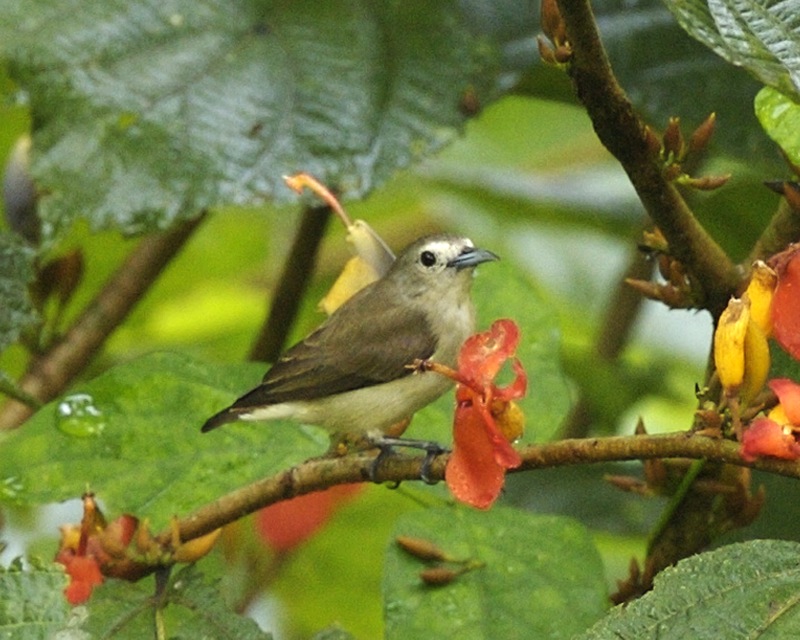
Dicaeum dayakorum is endemic to Borneo and has been observed in tropical rainforest, particularly in the high canopy of lowland forests. It is a tiny, slate-grey bird distinguished by broken white eye-rings and prominent white pectoral tufts.
Written 26 November 2026 from the sources listed below. Each statement was checked against the passage it cites; statements that could not be supported were removed.
Appearance
The Spectacled Flowerpecker has prominent white arcs above and below its eyes, creating a broken eye-ring effect. Its upperparts are slate-grey, and its throat is white, bordered by a diffuse dusky malar that merges into grey sides.[1][2][3]
A white stripe separates the grey sides from the throat to the centre of the underparts. Prominent pure-white pectoral tufts emerge from the carpal joints, while the eyes, bill and legs are dark.[4][5][6]
Some observed individuals have paler grey plumage, less prominent eye-rings and pectoral tufts, and a less distinct breast stripe. The species has a chunky body structure and a short tail typical of flowerpeckers.[7][8]
Habitat
The species is suspected to specialize in the rainforest canopy and appears to live exclusively in the high canopy of Borneo's lowland tropical forests. It rarely, if ever, visits the forest understory.[9][10][11]
Diet
The Spectacled Flowerpecker feeds on ephemeral epiphytic fruits, including mistletoe fruits. Individuals have been observed feeding in fruiting epiphytic mistletoe growing on a Koompassia excelsa tree in Sabah and on Viscum mistletoe berries in Central Kalimantan.[12][13][14]
Behaviour
The species' vocalisations include two very short, hard flight-notes. A well-marked putative male has been heard singing a series of approximately 12 high-pitched notes that rise and then fall in pitch.[15][16]
Its song is nondescript and contributes to its difficulty of detection.[17]
Reproduction and life cycle
Two observed adult individuals were suggested to represent a male and a female. The more strikingly marked bird was considered the male.[18]
Conservation
The population status of the Spectacled Flowerpecker was still unknown at the time of publication of the document. Its elusiveness suggests that it has low population densities.[19][20]
The species was assessed for the IUCN Red List in 2020.[21]
Classification of the Spectacled Flowerpecker
| Kingdom | Animalia |
|---|---|
| Phylum | Chordata |
| Subphylum | Vertebrata |
| Infraphylum | Gnathostomata |
| Parvphylum | Osteichthyes |
| Megaclass | Tetrapoda |
| Class | Aves (Bird) |
| Order | Passeriformes (Passerine) |
| Family | Dicaeidae (Flowerpecker) |
| Genus | Dicaeum (Flowerpeckers) |
| Species | Dicaeum dayakorum Saucier, Milensky, Caraballo-Ortiz et al., 2019 |
This name was added to the Catalogue of Life from a contributing dataset by automated merging and has not yet been reviewed by its editors.
Where the Spectacled Flowerpecker is found
Checklists and occurrence records place Dicaeum dayakorum in 2 countries across Asia. GBIF holds 14 georeferenced records of it.
Countries
Regions and cities with the most records
Range as the checklists state it
northeastern Borneo (Danum Valley, Sabah, Malaysia)
A number beside a place is its count of GBIF occurrence records. A place without a number comes from a checklist alone. Records show where a species has been observed or collected, which can include escapes and vagrants.
Common names
English
- Spectacled Flowerpecker
Names in 19 other languages
- Chinese
- 眼鏡啄花鳥, 眼镜啄花鸟
- Danish
- Dayak Blomsterpikker
- Dutch
- Brilhoningvogel
- Esperanto
- okulvitra dikeo
- Finnish
- Hiirikukastaja
- French
- Dicée à lunettes
- German
- Dayakmistelfresser
- Indonesian
- Cabai berkacamata
- Japanese
- メガネハナドリ
- Norwegian
- brilleblomsterfugl
- Polish
- kwiatówka szarawa
- Portuguese
- pica-flor-de-lunetas, pica-flor-de-óculos
- Russian
- Даякский цветоед, Очковый цветосос
- Serbian
- Naočarasta cvetarka
- Slovak
- bobuliar okuliarnatý
- Spanish
- Picaflores especulado
- Swedish
- dajakblomsterpickare
- Turkish
- Gözlüklü Öksekuşu
- Ukrainian
- квіткоїд сірий
Related species
-
 MistletoebirdDicaeum hirundinaceum
-
 Cebu FlowerpeckerDicaeum quadricolor
-
 Scarlet-backed FlowerpeckerDicaeum cruentatum
-
 Red-keeled FlowerpeckerDicaeum australe
-
 Fire-breasted FlowerpeckerDicaeum ignipectus
-
 Orange-bellied FlowerpeckerDicaeum trigonostigma
-
 Nilgiri FlowerpeckerDicaeum concolor
-
 Thick-billed FlowerpeckerDicaeum agile
Compare
Questions and answers
What is the scientific name of the Spectacled Flowerpecker?
The scientific name of the Spectacled Flowerpecker is Dicaeum dayakorum. Written with its author, the full name is Dicaeum dayakorum Saucier, Milensky, Caraballo-Ortiz et al., 2019.
Which family does the Spectacled Flowerpecker belong to?
Dicaeum dayakorum belongs to the family Dicaeidae, in the order Passeriformes and the class Aves.
Where is the Spectacled Flowerpecker found?
Checklists and occurrence records place Dicaeum dayakorum in 2 countries: Malaysia and Brunei.
What is the conservation status of the Spectacled Flowerpecker?
The IUCN Red List category recorded for Dicaeum dayakorum is Data Deficient (DD).
What is a flowerpecker?
The Spectacled Flowerpecker is a bird in the family Dicaeidae, order Passeriformes, and class Aves. It has a chunky body structure and a short tail typical of flowerpeckers.[8]
Sources
Passages the profile rests on
- The species has prominent white arcs above and below its eyes that create a broken eye-ring effect. Source passage: “The first bird sighted had prominent white arcs above and below the eyes, creating a broken eye-ring effect.” — English Wikipedia
- Its throat is white, bordered by a diffuse dusky malar that merges into grey sides. Source passage: “The white throat was bordered by a diffuse dusky malar, merging into grey sides” — English Wikipedia
- Its upperparts are slate-grey. Source passage: “The upperparts were slate-grey.” — English Wikipedia
- A white stripe separates the grey sides from the throat to the centre of the underparts. Source passage: “separated by a white stripe from the throat to the centre of the underparts.” — English Wikipedia
- It has prominent pure-white pectoral tufts emerging from the carpal joints. Source passage: “There were prominent, pure white pectoral tufts emerging from the carpal joints.” — English Wikipedia
- Its eyes, bill and legs are dark. Source passage: “The eyes, bill and legs were dark.” — English Wikipedia
- Some observed individuals have paler grey plumage, less prominent eye-rings and pectoral tufts, and a less distinct breast stripe. Source passage: “with paler grey plumage, less prominent eye-rings and pectoral tufts, and a less defined stripe” — English Wikipedia
- The species has a chunky body structure and a short tail typical of flowerpeckers. Source passage: “Has the chunky and short-tailed structure typical of flowerpeckers.” — ebird.org
- The species is suspected to specialize in the rainforest canopy. Source passage: “Edwards et al. (2009) speculate that the spectacled flowerpecker is a rainforest canopy specialist” — English Wikipedia
- The species appears to live exclusively in the high canopy of Borneo's lowland tropical forests. Source passage: “seems to live exclusively in the high canopy of Borneo’s lowland tropical forests.” — audubon.org
- The species rarely, if ever, visits the forest understory. Source passage: “rarely, if ever, visiting the understory of the forest” — English Wikipedia
- The species feeds on ephemeral epiphytic fruits, including mistletoe fruits. Source passage: “relying on ephemeral epiphytic fruits such as mistletoes” — English Wikipedia
- Individuals have been observed feeding in fruiting epiphytic mistletoe growing on a Koompassia excelsa tree in Sabah. Source passage: “the birds at Danum Valley In Sabah were feeding in a fruiting epiphytic mistletoe that was parasitising a large Koompassia excelsa tree.” — English Wikipedia
- Individuals have been observed feeding on Viscum mistletoe berries in Central Kalimantan. Source passage: “spectacled flowerpeckers have been observed feeding on Viscum mistletoe berries.” — English Wikipedia
- Its vocalisations include two very short, hard flight-notes. Source passage: “Vocalisations heard include two very short, hard flight-notes” — English Wikipedia
- A well-marked putative male has been heard singing a series of approximately 12 high-pitched notes that rise and then fall in pitch. Source passage: “with a series of about 12 high-pitched see notes, rising and then falling in pitch.” — English Wikipedia
- The species has a nondescript song that contributes to its difficulty of detection. Source passage: “it also has a nondescript song” — audubon.org
- Two observed adult individuals were suggested to represent a male and a female, with the more strikingly marked bird considered the male. Source passage: “Edwards et al. (2009) suggest that two adult individuals were seen, with the more strikingly marked bird the male and the less well-marked bird the female.” — English Wikipedia
- The population status of the species was still unknown at the time of the document's publication. Source passage: “For the Spectacled Flowerpecker, this is still unknown.” — audubon.org
- The species' elusiveness suggests that it has low population densities. Source passage: “its elusiveness indicates that it has low population densities.” — audubon.org
- The species was assessed for the IUCN Red List in 2020. Source passage: “Dicaeum dayakorum has most recently been assessed for The IUCN Red List of Threatened Species in 2020.” — iucnredlist.org
Data
- Catalogue of Life, 2026-10-16 XR cc by
- Global Biodiversity Information Facility CC BY 4.0
- Wikidata CC0
- GeoNames CC BY 4.0
- Wikimedia Commons per image; credit shown with each image
- Within the Catalogue of Life, this name comes from The eBird/Clements Checklist of Birds of the World cc by
References
- Saucier, Jacob R., Christopher M. Milensky, Marcos A. CaraballO-ortiz, Roslina Ragai, N. F. Dahlan & David P. Edwards. 2019. A distinctive new species of flowerpecker (Passeriformes: Dicaeidae) from Borneo. Zootaxa 4686(1): 451–464. Link where the name was published
This species in other databases
Page built on 27 November 2026. See how the catalog is made and all sources and licences.
Cite this page
ScientificNames.org. (2026). Dicaeum dayakorum (Spectacled Flowerpecker). Retrieved November 27, 2026, from https://scientificnames.org/species/dicaeum-dayakorum
“Dicaeum dayakorum (Spectacled Flowerpecker).” ScientificNames.org, 2026, scientificnames.org/species/dicaeum-dayakorum. Accessed 27 Nov. 2026.
ScientificNames.org. “Dicaeum dayakorum (Spectacled Flowerpecker).” Accessed November 27, 2026. https://scientificnames.org/species/dicaeum-dayakorum.
@misc{scientificnames_dicaeum_dayakorum_spectacled_flowerpecker,
  author = {{ScientificNames.org}},
  title = {Dicaeum dayakorum (Spectacled Flowerpecker)},
  year = {2026},
  url = {https://scientificnames.org/species/dicaeum-dayakorum},
  note = {Accessed 2026-11-27}
}