Species · Birds
Cebu Flowerpecker Dicaeum quadricolor
The scientific name of the Cebu Flowerpecker is Dicaeum quadricolor. It is a species of bird in the family Dicaeidae (flowerpecker), order Passeriformes. The name dates from 1878.
- Scientific name
- Dicaeum quadricolor (Tweeddale, 1878)
- Common name
- Cebu Flowerpecker
- Genus
- Dicaeum
- Family
- Dicaeidae (Flowerpecker)
- Order
- Passeriformes
- Class
- Aves
- Red List category
- CR Critically Endangered
- Recorded in
- 1 country
- Name status
- accepted in the Catalogue of Life

Overview
The species is endemic to Cebu Island in the Philippines. The male is distinguished by a large triangular scarlet-to-vermilion patch on its breast.
Written 26 November 2026 from the sources listed below. Each statement was checked against the passage it cites; statements that could not be supported were removed.
Appearance
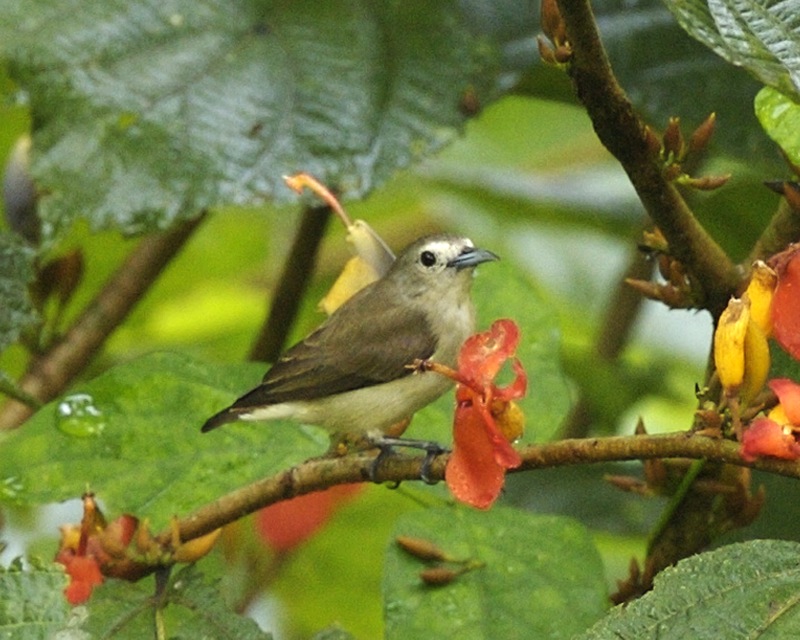
The female has a predominantly brown upper side, olive-washed wings, and an almost entirely olive-yellow rump. Its underside is white with a faint greyish olive-yellow tinge that becomes brighter toward the chest and abdomen.[1][2]
The Cebu Flowerpecker normally measures 11–12 cm in length.[3]
Habitat
The species inhabits limestone forest in the Central Cebu Protected Landscape. It is known from Tabunan Forest, Babayungan Forest in Dalaguete, and Nug-as Forest in Alcoy.[4][5]
The species commonly occupies closed forest canopies and areas near flowering or fruiting plants. Its habitat includes both the interior and outskirts of forest ranges.[6][7]
Diet
The Cebu Flowerpecker feeds on small fruits and mistletoe plants. It has been observed feeding on the endemic Cebu Mistletoe, Lepeostegeres cebuensis.[8][9]
Behaviour
The species is primarily active between 9 a.m. and 1 p.m., reportedly avoiding competition from more aggressive birds. When foraging, it flies quickly to a preferred flowering plant, feeds, and immediately flies away.[10][11]
The Cebu Flowerpecker rarely calls. Its call resembles that of the Pygmy Flowerpecker.[12][13]
Reproduction and life cycle
The Cebu Flowerpecker is classified as a critically endangered breeding bird.[14]
Similar species
The Red-Striped Flowerpecker is identified as an aggressive bird that bullies the Cebu Flowerpecker. The Red-keeled Flowerpecker is theorized to outcompete it because it is more adaptable to habitat disturbance.[15][16]
Conservation
Tabunan is the only location for which definitive evidence of the species has been reported. The species has also been reported from Nug-as Forest, Mount Lantoy, and the forests of Dalaguete.[17][18]
The estimated population of the species is between 85 and 105 individuals. Its habitat is reported to have been reduced to 1,000 hectares.[19][20]
Habitat loss is identified as the main threat to the species. Agricultural development and local resource collection contribute to deforestation in Tabunan Forest, while road development in Nug-as Forest causes severe habitat fragmentation.[21][22][23]
Hunting and infrastructure expansion are among the anthropogenic threats identified for the species. Invasive species, mining, climate change, flooding, and storms are identified as additional potential threats.[24][25]
The remaining forest cover on Cebu is reported as 0.3% of the island's area. The Tabunan Forest lies within the boundaries of Central Cebu National Park.[26][27]
The species is categorized as critically endangered on the IUCN Red List. Conservation measures include habitat restoration, biodiversity management, and protection through the Central Cebu Protected Landscape.[28][29]
A Critical Habitat has been established as part of conservation efforts.[30]
Classification of the Cebu Flowerpecker
| Kingdom | Animalia |
|---|---|
| Phylum | Chordata |
| Subphylum | Vertebrata |
| Infraphylum | Gnathostomata |
| Parvphylum | Osteichthyes |
| Megaclass | Tetrapoda |
| Class | Aves (Bird) |
| Order | Passeriformes (Passerine) |
| Family | Dicaeidae (Flowerpecker) |
| Genus | Dicaeum (Flowerpeckers) |
| Species | Dicaeum quadricolor (Tweeddale, 1878) |
Where the Cebu Flowerpecker is found
Checklists and occurrence records place Dicaeum quadricolor in 1 country. GBIF holds 37 georeferenced records of it.
Countries
Regions and cities with the most records
- Balamban, Philippines 18
- Apas, Philippines 16
- Cebu City, Philippines 16
- Mandaue City, Philippines 16
- Consolacion, Philippines 15
- Toledo, Philippines 3
A number beside a place is its count of GBIF occurrence records. A place without a number comes from a checklist alone. Records show where a species has been observed or collected, which can include escapes and vagrants.
Common names
English
- Cebu Flowerpecker
Names in 26 other languages
- Catalan
- picaflors de l'illa Cebú
- Chinese
- 四色啄花, 四色啄花鸟
- Croatian
- cebuska imelašica
- Czech
- květozob čtyřbarvý
- Danish
- Cebu Blomsterpikker
- Dutch
- Cebuhoningvogel
- Esperanto
- cebua dikeo
- Finnish
- cebunkukastaja
- French
- Dicée quadricolore
- German
- Cebu-Mistelfresser, Vierfarben-Mistelfresser, Vierfarbenmistelfresser
- Hungarian
- cebui virágjáró
- Italian
- Beccafiore di Cebu
- Japanese
- ヨイロハナドリ
- Lithuanian
- keturspalvis žiedsiurbys
- Norwegian
- cebublomsterfugl
- Persian
- گلکوب سبو
- Polish
- kwiatówka barwna
- Portuguese
- pica-flor-de-cebu
- Russian
- Четырёхцветный цветоед
- Slovak
- bobuliar štvorfarebný
- Spanish
- Picaflores de Cebú
- Swedish
- cebublomsterpickare
- Turkish
- Sebu Öksekuşu
- Ukrainian
- квіткоїд червоноспинний
- Vietnamese
- Chim sâu Cebu
- pnb
- سیبو پھل ٹھونگا
Synonyms
One other scientific name has been used for this species and is now treated as a synonym of Dicaeum quadricolor.
- Prionochilus quadricolor Tweeddale, A, 1878
Related species
-
 MistletoebirdDicaeum hirundinaceum
-
 Scarlet-backed FlowerpeckerDicaeum cruentatum
-
 Red-keeled FlowerpeckerDicaeum australe
-
 Fire-breasted FlowerpeckerDicaeum ignipectus
-
 Orange-bellied FlowerpeckerDicaeum trigonostigma
-
 Nilgiri FlowerpeckerDicaeum concolor
-
 Thick-billed FlowerpeckerDicaeum agile
-
 Spectacled FlowerpeckerDicaeum dayakorum
Compare
Questions and answers
What is the scientific name of the Cebu Flowerpecker?
The scientific name of the Cebu Flowerpecker is Dicaeum quadricolor. Written with its author, the full name is Dicaeum quadricolor (Tweeddale, 1878).
Which family does the Cebu Flowerpecker belong to?
Dicaeum quadricolor belongs to the family Dicaeidae, in the order Passeriformes and the class Aves.
Where is the Cebu Flowerpecker found?
Checklists and occurrence records place Dicaeum quadricolor in 1 country: Philippines.
What is the conservation status of the Cebu Flowerpecker?
The IUCN Red List category recorded for Dicaeum quadricolor is Critically Endangered (CR).
How many cebu flowerpeckers are left?
The estimated population is between 85 and 105 individuals.[19]
Sources
Passages the profile rests on
- The female has a predominantly brown upper side with olive-washed wings and an almost entirely olive-yellow rump. Source passage: “In the female, the top is brown. The head is slightly faded olive, the back, the wing-coverts and outer webs of secondaries are strongly washed out olive. The rump is almost entirely olive-yellow.” — English Wikipedia
- The female has a white underside with a faint greyish olive-yellow tinge that becomes brighter toward the chest and abdomen. Source passage: “The underside is white with a faint gray olive-yellow approach that is brighter towards the center of the chest and abdomen.” — English Wikipedia
- The Cebu Flowerpecker normally measures 11–12 cm in length. Source passage: “This four-colored bird normally grows to 11 or 12 centimeters (4.3 or 4.7 in).” — English Wikipedia
- The species inhabits limestone forest in the Central Cebu Protected Landscape. Source passage: “it was rediscovered in 1992 in a small patch of limestone forest in Tabunan in the Central Cebu Protected Landscape” — English Wikipedia
- The species is known from Tabunan Forest, Babayungan Forest in Dalaguete, and Nug-as Forest in Alcoy. Source passage: “The Cebu Flowerpecker is known to inhabit the Tabunan Forest, the Babayungan Forest in Dalaguete, and the Nug-as Forest in Alcoy on the island of Cebu in the Philippines.” — English Wikipedia
- The species commonly occupies closed forest canopies and areas near flowering or fruiting plants. Source passage: “The Cebu Flowerpecker is commonly found in the closed forest canopy and near flowering or fruiting plants” — English Wikipedia
- Its habitat includes both the interior and outskirts of forest ranges. Source passage: “these areas are located in the interior and outskirt ranges of the forests.” — English Wikipedia
- The Cebu Flowerpecker feeds on small fruits and mistletoe plants. Source passage: “The Cebu Flowerpecker consumes small fruits and mistletoe plants to get its energy” — English Wikipedia
- The species has been observed feeding on the endemic Cebu Mistletoe, Lepeostegeres cebuensis. Source passage: “The endemic Cebu Mistletoe, Lepeostegeres cebuensis, that it has been seen feeding on” — English Wikipedia
- The species is primarily active between 9 a.m. and 1 p.m., reportedly avoiding competition from more aggressive birds. Source passage: “it chooses to be active between 9 am to 1 pm, after the busiest time of the day, in order to avoid these more competitive species.” — English Wikipedia
- When foraging, the species flies quickly to a preferred flowering plant, feeds, and immediately flies away. Source passage: “When foraging, it tends to fly quickly to its preferred flowering plant, feed, and then promptly fly away immediately after.” — English Wikipedia
- The Cebu Flowerpecker rarely calls. Source passage: “Although the Cebu flowerpecker rarely calls” — English Wikipedia
- Its call resembles that of the Pygmy Flowerpecker. Source passage: “its sound is similar to the Pygmy flowerpecker's call.” — English Wikipedia
- The Cebu Flowerpecker is classified as a critically endangered breeding bird. Source passage: “The Cebu flowerpecker is a critically endangered breeding bird.” — English Wikipedia
- The Red-Striped Flowerpecker is identified as an aggressive bird that bullies the Cebu Flowerpecker. Source passage: “Because the species is known to be bullied by other aggressive birds such as the Red-Striped Flowerpecker” — English Wikipedia
- The Red-keeled Flowerpecker is theorized to outcompete the Cebu Flowerpecker because it is more adaptable to habitat disturbance. Source passage: “While native, the Red-keeled flowerpecker has been theorized to outcompete these birds as they are much more adaptable to habitat disturbance” — English Wikipedia
- Tabunan is the only location for which definitive evidence of the species has been reported in the document. Source passage: “However, the only definitive proof of this bird was in its original area of discovery in Tabunan” — English Wikipedia
- The species has been reported from three additional sites: Nug-as Forest, Mount Lantoy, and the forests of Dalaguete. Source passage: “namely, the Nug-as forest of Alcoy, Mount Lantoy of Argao and the forests of Dalaguete.” — English Wikipedia
- The estimated population of the species is between 85 and 105 individuals. Source passage: “The current population is estimated to be between 85 and 105.” — English Wikipedia
- The species' habitat is reported to have been reduced to 1,000 hectares. Source passage: “The habitat of the Cebu Flowerpecker has been reduced to 1000 hectares.” — English Wikipedia
- Habitat loss is identified as the main threat to the species. Source passage: “The main threat to this species is habitat loss.” — English Wikipedia
- Agricultural development and local resource collection contribute to deforestation in Tabunan Forest. Source passage: “deforestation for the purposes of agricultural development and resource collection by local villagers in the Tabunan Forest” — English Wikipedia
- Road development in Nug-as Forest causes severe habitat fragmentation. Source passage: “The next critical-level threat includes road development, in Nug-as forest in Alcoy, which leads to severe habitat fragmentation.” — English Wikipedia
- Hunting and infrastructure expansion are among the anthropogenic threats identified for the species. Source passage: “anthropogenic activities which include deforestation, hunting, and expansion of infrastructure.” — English Wikipedia
- Invasive species, mining, climate change, flooding, and storms are identified as additional potential threats. Source passage: “Other lower-level threats may include invasive species, mining, climate change (e.g. flooding, storms).” — English Wikipedia
- The Tabunan Forest lies within the boundaries of Central Cebu National Park. Source passage: “The Tabunan forest is located within the boundaries of the Central Cebu National Park” — English Wikipedia
- The remaining forest cover on Cebu is reported as 0.3% of the island's area. Source passage: “Cebu is the most deforested major island in the Philippines with only 0.3% of remaining forest cover.” — English Wikipedia
- Conservation measures include habitat restoration, biodiversity management, and protection through the Central Cebu Protected Landscape. Source passage: “Current conservation efforts include the Biodiversity Conservation Awareness, habitat restoration, biodiversity management, and protection by Central Cebu Protected Landscape” — English Wikipedia
- The species is categorized as critically endangered on the IUCN Red List. Source passage: “The Cebu Flowerpecker is currently categorized as critically endangered on the IUCN red list.” — English Wikipedia
- A Critical Habitat has been established as part of conservation efforts. Source passage: “and the establishment of the Critical Habitat.” — English Wikipedia
Data
- Catalogue of Life, 2026-10-16 XR cc by
- Global Biodiversity Information Facility CC BY 4.0
- Wikidata CC0
- GeoNames CC BY 4.0
- Wikimedia Commons per image; credit shown with each image
- Within the Catalogue of Life, this name comes from The Integrated Taxonomic Information System cc0
References
- Gill, Frank, & and Minturn Wright. (2006). Birds of the World: Recommended English Names.
This species in other databases
Page built on 26 November 2026. See how the catalog is made and all sources and licences.
Cite this page
ScientificNames.org. (2026). Dicaeum quadricolor (Cebu Flowerpecker). Retrieved November 26, 2026, from https://scientificnames.org/species/dicaeum-quadricolor
“Dicaeum quadricolor (Cebu Flowerpecker).” ScientificNames.org, 2026, scientificnames.org/species/dicaeum-quadricolor. Accessed 26 Nov. 2026.
ScientificNames.org. “Dicaeum quadricolor (Cebu Flowerpecker).” Accessed November 26, 2026. https://scientificnames.org/species/dicaeum-quadricolor.
@misc{scientificnames_dicaeum_quadricolor_cebu_flowerpecker,
  author = {{ScientificNames.org}},
  title = {Dicaeum quadricolor (Cebu Flowerpecker)},
  year = {2026},
  url = {https://scientificnames.org/species/dicaeum-quadricolor},
  note = {Accessed 2026-11-26}
}