Species · Birds
Nilgiri Flowerpecker Dicaeum concolor
The scientific name of the Nilgiri Flowerpecker is Dicaeum concolor. It is a species of bird in the family Dicaeidae (flowerpecker), order Passeriformes. The name dates from 1840.
- Scientific name
- Dicaeum concolor Jerdon, 1840
- Common name
- Nilgiri Flowerpecker
- Genus
- Dicaeum
- Family
- Dicaeidae (Flowerpecker)
- Order
- Passeriformes
- Class
- Aves
- Red List category
- LC Least Concern
- Recorded in
- 11 countries
- Name status
- accepted in the Catalogue of Life
Overview
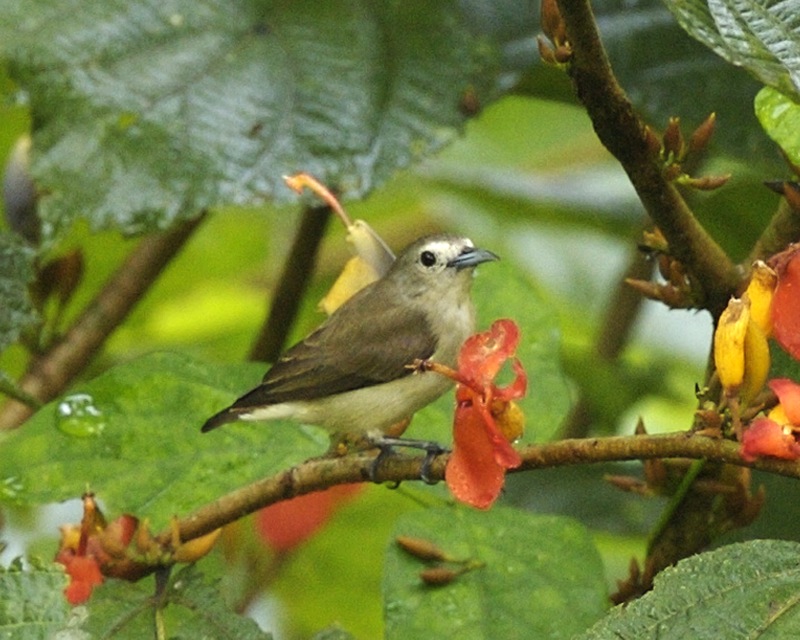
Dicaeum concolor occurs in hill forests of the Western Ghats and Nilgiri hills in southern India. It has pale brown upperparts, whitish underparts and a distinctive whitish brow in front of the eye.
Written 26 November 2026 from the sources listed below. Each statement was checked against the passage it cites; statements that could not be supported were removed.
Appearance
The Nilgiri Flowerpecker has pale brown upperparts and whitish underparts. It measures approximately 9 cm in length.[1][2]
Males and females show no marked difference in appearance. The species has a whitish brow in front of the eye that is wider than that of Dicaeum erythrorhynchos.[3][4]
Habitat
The Nilgiri Flowerpecker occurs in hill forests of the Western Ghats and Nilgiri hills in southern India. It inhabits woodland edges, cultivated areas and isolated stands of trees, particularly in hilly landscapes.[5][6]
Diet
The Nilgiri Flowerpecker feeds predominantly on nectar and fruits. It also consumes soft berries and small insects.[7][8]
Behaviour
Nilgiri Flowerpeckers forage within forest canopies and are non-migratory.[9][10]
The species produces a sharp check call or a rapid series of ticking notes. Its song is a high-pitched trill.[11][12]
The Nilgiri Flowerpecker has a feathery tongue that enables it to sip nectar.[13]
Reproduction and life cycle
In the Nilgiris, the breeding season extends from January through April, with a possible second brood in May and June. The species lays two or three eggs per clutch.[14][15]
The Nilgiri Flowerpecker builds a purse-like nest suspended from a tree or bush.[16]
Conservation
The Nilgiri Flowerpecker is an important pollinator and disperser of mistletoes in tropical forests.[17]
Similar species
The Nilgiri Flowerpecker has a whitish brow in front of the eye that is wider than that of Dicaeum erythrorhynchos.[4]
Uses
The Nilgiri Flowerpecker was formerly classified as a subspecies of the bird previously called the plain flowerpecker. Pamela Rasmussen elevated it to full species status.[18][19]
The species was assessed for the IUCN Red List of Threatened Species in 2016. BirdLife identifies it as a breeding endemic species.[20][21]
Classification of the Nilgiri Flowerpecker
| Kingdom | Animalia |
|---|---|
| Phylum | Chordata |
| Subphylum | Vertebrata |
| Infraphylum | Gnathostomata |
| Parvphylum | Osteichthyes |
| Megaclass | Tetrapoda |
| Class | Aves (Bird) |
| Order | Passeriformes (Passerine) |
| Family | Dicaeidae (Flowerpecker) |
| Genus | Dicaeum (Flowerpeckers) |
| Species | Dicaeum concolor Jerdon, 1840 |
Where the Nilgiri Flowerpecker is found
Checklists and occurrence records place Dicaeum concolor in 11 countries. GBIF holds 55,586 georeferenced records of it.
Countries
- Bangladesh 3
- China 45
- India 54,275
- Indonesia 50
- Laos 14
- Malaysia 22
- Myanmar 11
- Nepal 18
- Taiwan 1,064
- Thailand 60
- Vietnam 24
Regions and cities with the most records
- Kerala, India 20,863
- Tamil Nadu, India 13,451
- Karnataka, India 11,056
- Valparai, India 6,698
- Goa, India 6,560
- Curti, India 2,908
- Ponda, India 2,828
- Kērkandi, India 2,734
- Kalpatta, India 2,723
- Wellington, India 2,681
- Coonoor, India 2,675
- Kuttampuzha, India 2,637
- Ooty, India 2,557
- Kotagiri, India 2,427
- Chimbel, India 2,396
- Kotamangalam, India 2,366
- Penha de França, India 2,175
- Taleigao, India 2,168
- Gudalur, India 2,146
- Maharashtra, India 2,143
- Panjim, India 2,109
- Bicholim, India 2,064
- Munnar, India 1,982
- Marayur, India 1,953
- Virajpet, India 1,871
- Curchorem, India 1,773
- Mapusa, India 1,766
- Calangute, India 1,753
- Mettupalayam, India 1,596
- Vasco da Gama, India 1,588
- Mormugao, India 1,553
- Iramallūr, India 1,467
- Cumbum, India 1,461
- Sancoale, India 1,405
- Kottur, India 1,282
- Madgaon, India 1,048
A number beside a place is its count of GBIF occurrence records. A place without a number comes from a checklist alone. Records show where a species has been observed or collected, which can include escapes and vagrants.
Common names
English
- Nilgiri Flowerpecker
- Plain Flowerpecker
Names in 30 other languages
- Catalan
- picaflors del monts Nilgiri
- Chinese
- 印度纯色啄花鸟, 尼爾基里啄花, 纯色啄花鸟
- Croatian
- zapadnogatska imelašica
- Czech
- květozob ochmetový
- Danish
- Ensfarvet Blomsterpikker
- Dutch
- Nilgirihoningvogel
- Esperanto
- nilgiria dikeo
- Finnish
- harmaakukastaja, malabarinkukastaja
- French
- Dicée concolore
- German
- Einfarbmistelfresser, Nilgirimistelfresser
- Indonesian
- Cabai Polos
- Italian
- Beccafiore disadorno
- Japanese
- アオハナドリ
- Lithuanian
- vienspalvis žiedsiurbys
- Malayalam
- കരിഞ്ചുണ്ടൻ ഇത്തിക്കണ്ണിക്കുരുവി
- Norwegian
- malabarblomsterfugl
- Persian
- گلکوب نیلگیری
- Polish
- kwiatówka uboga
- Portuguese
- pica-flor-dos-nilguiri, pica-flor-liso
- Russian
- Одноцветный цветоед
- Slovak
- bobuliar fádny
- Spanish
- Picaflores de los Nilgiri, Picaflores liso
- Swedish
- ghatsblomsterpickare
- Tamil
- நீலகிரி பூக்கொத்தி
- Turkish
- Nilgiri Öksekuşu
- Ukrainian
- квіткоїд однобарвний
- Vietnamese
- Chim sâu vàng lục
- Welsh
- pigwr blodau plaen
- nav
- Dahtsʼaaʼ yiłchozhii bítááʼ łigaaígíí
- pnb
- نیلگری پھل ٹھونگا
Synonyms
5 other scientific names have been used for this species and are now treated as synonyms of Dicaeum concolor.
- Dicaeum concolor concolor Jerdon, TC, 1840
- Dicaeum concolor unicolor Koelz, WN, 1939
- Dicaeum minullum subflavum Baker, ECS, 1921
- Dicaeum tickelliae Blyth, E, 1843
- Nectarinia minima Tickell, SR, 1833
Related species
-
 MistletoebirdDicaeum hirundinaceum
-
 Cebu FlowerpeckerDicaeum quadricolor
-
 Scarlet-backed FlowerpeckerDicaeum cruentatum
-
 Red-keeled FlowerpeckerDicaeum australe
-
 Fire-breasted FlowerpeckerDicaeum ignipectus
-
 Orange-bellied FlowerpeckerDicaeum trigonostigma
-
 Thick-billed FlowerpeckerDicaeum agile
-
 Spectacled FlowerpeckerDicaeum dayakorum
Compare
Questions and answers
What is the scientific name of the Nilgiri Flowerpecker?
The scientific name of the Nilgiri Flowerpecker is Dicaeum concolor. Written with its author, the full name is Dicaeum concolor Jerdon, 1840.
Which family does the Nilgiri Flowerpecker belong to?
Dicaeum concolor belongs to the family Dicaeidae, in the order Passeriformes and the class Aves.
Where is the Nilgiri Flowerpecker found?
Checklists and occurrence records place Dicaeum concolor in 11 countries, including India, Taiwan, Thailand, Indonesia, China and Vietnam.
What is the conservation status of the Nilgiri Flowerpecker?
The IUCN Red List category recorded for Dicaeum concolor is Least Concern (LC).
What other names does the Nilgiri Flowerpecker have?
Dicaeum concolor is also known in English as Plain Flowerpecker.
Sources
Passages the profile rests on
- The Nilgiri flowerpecker has pale brown upperparts and whitish underparts. Source passage: “It is pale brown on the upperside and the underside is whitish.” — English Wikipedia
- The Nilgiri flowerpecker measures approximately 9 cm in length. Source passage: “These birds are tiny (9 cm long)” — English Wikipedia
- Male and female Nilgiri flowerpeckers show no marked difference in appearance. Source passage: “there is no marked difference between the males and females.” — English Wikipedia
- The species has a whitish brow in front of the eye that is wider than that of Dicaeum erythrorhynchos. Source passage: “The whitish brow in front of the eye is wider than in Dicaeum erythrorhynchos.” — English Wikipedia
- The Nilgiri flowerpecker occurs in hill forests of the Western Ghats and Nilgiri hills in southern India. Source passage: “It is found in hill forests of the Western Ghats and Nilgiri hills of southern India.” — English Wikipedia
- The species inhabits woodland edges, cultivated areas and isolated stands of trees, particularly in hilly landscapes. Source passage: “The Nilgiri flowerpecker is a common resident breeding bird of woodland edges, cultivation and isolated stands of trees, often in hilly country.” — English Wikipedia
- The Nilgiri flowerpecker feeds predominantly on nectar and fruits. Source passage: “Like others of the group, it feeds predominantly on nectar and fruits.” — English Wikipedia
- The species also consumes soft berries and small insects. Source passage: “they feed on soft berries as well as small insects.” — English Wikipedia
- Nilgiri flowerpeckers forage within forest canopies. Source passage: “They forage within the canopy of forests” — English Wikipedia
- The Nilgiri flowerpecker is a non-migratory species. Source passage: “They are non-migratory” — English Wikipedia
- The species produces a sharp check call or a rapid series of ticking notes. Source passage: “The call of the Nilgiri flowerpecker is a sharp check or a rapid series of ticks” — English Wikipedia
- The Nilgiri flowerpecker's song is a high-pitched trill. Source passage: “while the song is a high-pitched trill.” — English Wikipedia
- The species has a feathery tongue that enables it to sip nectar. Source passage: “Like other flowerpeckers they have a feathery tongue that allows them to sip nectar” — English Wikipedia
- The breeding season of the Nilgiri flowerpecker in the Nilgiris extends from January through April, with a possible second brood in May and June. Source passage: “The breeding season of concolor in the Nilgiris is January to April possibly with a second brood in May and June.” — English Wikipedia
- The species lays two or three eggs per clutch. Source passage: “Two or three eggs are laid” — English Wikipedia
- The Nilgiri flowerpecker builds a purse-like nest suspended from a tree or bush. Source passage: “a purse-like nest suspended from a tree or bush.” — English Wikipedia
- The Nilgiri flowerpecker is an important pollinator and disperser of mistletoes in tropical forests. Source passage: “They are important pollinators and dispersers of mistletoes in tropical forests.” — English Wikipedia
- The Nilgiri flowerpecker was formerly classified as a subspecies of the bird previously called the plain flowerpecker. Source passage: “Formerly a subspecies of what used to be termed as the plain flowerpecker” — English Wikipedia
- The Nilgiri flowerpecker was elevated to full species status by Pamela Rasmussen. Source passage: “This subspecies has been raised to full species by Pamela Rasmussen.” — English Wikipedia
- The Nilgiri flowerpecker was assessed for the IUCN Red List of Threatened Species in 2016. Source passage: “Nilgiri Flowerpecker Dicaeum concolor has most recently been assessed for The IUCN Red List of Threatened Species in 2016.” — iucnredlist.org
- BirdLife identifies the Nilgiri flowerpecker as a breeding endemic species. Source passage: “Migratory status. Breeding endemic.” — datazone.birdlife.org
Data
- Catalogue of Life, 2026-10-16 XR cc by
- Global Biodiversity Information Facility CC BY 4.0
- Wikidata CC0
- GeoNames CC BY 4.0
- Wikimedia Commons per image; credit shown with each image
- Within the Catalogue of Life, this name comes from The Integrated Taxonomic Information System cc0
References
- Gill, Frank, & and Minturn Wright. (2006). Birds of the World: Recommended English Names.
This species in other databases
Page built on 27 November 2026. See how the catalog is made and all sources and licences.
Cite this page
ScientificNames.org. (2026). Dicaeum concolor (Nilgiri Flowerpecker). Retrieved November 27, 2026, from https://scientificnames.org/species/dicaeum-concolor
“Dicaeum concolor (Nilgiri Flowerpecker).” ScientificNames.org, 2026, scientificnames.org/species/dicaeum-concolor. Accessed 27 Nov. 2026.
ScientificNames.org. “Dicaeum concolor (Nilgiri Flowerpecker).” Accessed November 27, 2026. https://scientificnames.org/species/dicaeum-concolor.
@misc{scientificnames_dicaeum_concolor_nilgiri_flowerpecker,
  author = {{ScientificNames.org}},
  title = {Dicaeum concolor (Nilgiri Flowerpecker)},
  year = {2026},
  url = {https://scientificnames.org/species/dicaeum-concolor},
  note = {Accessed 2026-11-27}
}