Species · Birds
Orange-bellied Flowerpecker Dicaeum trigonostigma
The scientific name of the Orange-bellied Flowerpecker is Dicaeum trigonostigma. It is a species of bird in the family Dicaeidae (flowerpecker), order Passeriformes. The name dates from 1786.
- Scientific name
- Dicaeum trigonostigma (Scopoli, 1786)
- Common name
- Orange-bellied Flowerpecker
- Genus
- Dicaeum
- Family
- Dicaeidae (Flowerpecker)
- Order
- Passeriformes
- Class
- Aves
- Red List category
- LC Least Concern
- Recorded in
- 9 countries
- Name status
- accepted in the Catalogue of Life

Overview
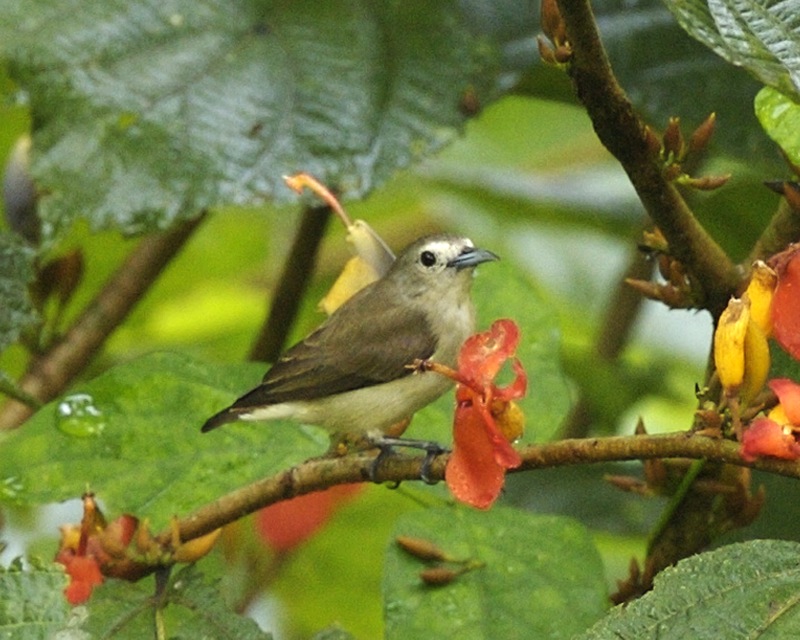
Dicaeum trigonostigma occurs in Bangladesh, Brunei, Indonesia, Malaysia, Myanmar, the Philippines, Singapore, Thailand, and India, inhabiting subtropical or tropical moist lowland, mangrove, and moist montane forests. Adult males have slaty-blue upperparts and a large triangular orange mantle patch, while females are predominantly dull olive-brown with pale-orange rumps and yellow bellies.
Written 26 November 2026 from the sources listed below. Each statement was checked against the passage it cites; statements that could not be supported were removed.
Appearance
Adult males have a slaty-blue crown, nape, wings, and tail, contrasting with a large triangular orange mantle patch. Their bills are relatively thin and short, with slightly downward-curving tips.[1][2]
Male birds have lighter greyish-blue upper breasts and throats, with fiery-orange lower breasts grading into yellow coloration at the vent.[3][4]
Females are predominantly dull olive-brown, with pale-orange rumps and yellow bellies.[5]
Habitat
The Orange-bellied Flowerpecker inhabits subtropical or tropical moist lowland forests, mangrove forests, and moist montane forests.[6][7][8]
Conservation
The species was most recently assessed for the IUCN Red List in 2024.[9]
Classification of the Orange-bellied Flowerpecker
| Kingdom | Animalia |
|---|---|
| Phylum | Chordata |
| Subphylum | Vertebrata |
| Infraphylum | Gnathostomata |
| Parvphylum | Osteichthyes |
| Megaclass | Tetrapoda |
| Class | Aves (Bird) |
| Order | Passeriformes (Passerine) |
| Family | Dicaeidae (Flowerpecker) |
| Genus | Dicaeum (Flowerpeckers) |
| Species | Dicaeum trigonostigma (Scopoli, 1786) |
Where the Orange-bellied Flowerpecker is found
Checklists and occurrence records place Dicaeum trigonostigma in 9 countries. GBIF holds 42,512 georeferenced records of it.
Countries
- Bangladesh 103
- Brunei 148
- India 5
- Indonesia 4,074
- Malaysia 17,266
- Myanmar 51
- Philippines 7,807
- Singapore 6,322
- Thailand 6,736
Regions and cities with the most records
- Sabah, Malaysia 6,747
- Yishun New Town, Singapore 6,368
- Ang Mo Kio New Town, Singapore 6,362
- Sungai Simpang, Singapore 6,362
- Yio Chu Kang, Singapore 6,362
- Sembawang Estate, Singapore 6,355
- Sengkang New Town, Singapore 6,329
- Novena, Singapore 6,312
- Matilda Estate, Singapore 6,303
- Punggol, Singapore 6,269
- MacPherson, Singapore 6,264
- Eunos, Singapore 6,263
- Kampong Pasir Ris, Singapore 6,259
- Marine Parade, Singapore 6,238
- Ulu Bedok, Singapore 6,236
- Singapore, Singapore 6,231
- Kampung Pasir Gudang Baru, Malaysia 6,217
- Bedok New Town, Singapore 6,195
- Woodlands, Singapore 6,185
- Bukit Panjang New Town, Singapore 6,169
- Choa Chu Kang New Town, Singapore 6,164
- Teck Whye, Singapore 6,164
- Yew Tee, Singapore 6,162
- Marsiling, Singapore 6,158
- Bukit Timah, Singapore 6,147
- Anak Bukit, Singapore 6,144
- Keat Hong Village, Singapore 6,140
- Jurong West, Singapore 6,139
- Jurong East, Singapore 6,135
- Jurong Town, Singapore 6,133
- Boon Lay, Singapore 6,121
- Queenstown Estate, Singapore 6,118
- Johor Bahru, Malaysia 6,065
- Pasir Gudang, Malaysia 6,052
- Masai, Malaysia 5,921
- Taman Permas Jaya, Malaysia 5,879
2 more countries have a few records outside this range
These countries hold a few records of Dicaeum trigonostigma but lie outside the range the checklists give for it. Such records are often zoo or garden specimens, museum material or vagrants, so the species is not counted as occurring there.
A number beside a place is its count of GBIF occurrence records. A place without a number comes from a checklist alone. Records show where a species has been observed or collected, which can include escapes and vagrants.
Common names
English
- Orange-bellied Flowerpecker
Names in 27 other languages
- Catalan
- picaflors de ventre carbassa
- Chinese
- 橙腹啄花, 橙腹啄花鸟
- Croatian
- zlatnotrba imelašica
- Czech
- květozob oranžovobřichý
- Danish
- Orangebuget Blomsterpikker
- Dutch
- Oranjebuikhoningvogel
- Esperanto
- oranĝventra dikeo
- Finnish
- mandariinikukastaja
- French
- Dicée à ventre orange
- German
- Orangebauch-Mistelfresser, Orangenbauchmistelfresser
- Hungarian
- narancshasú virágjáró
- Indonesian
- Cabai bunga-api
- Italian
- Beccafiore panciarancio, Beccafiori ventrearancio
- Japanese
- オレンジハナドリ
- Lithuanian
- oranžinis žiedsiurbys
- Norwegian
- ildbukblomsterfugl
- Polish
- kwiatówka trójbarwna
- Portuguese
- pica-flor-de-barriga-laranja, pica-flores-de-ventre-laranja
- Russian
- Оранжевобрюхий цветоед
- Slovak
- bobuliar pestrý
- Spanish
- Picaflores ventrinaranja
- Swedish
- orangebukig blomsterpickare
- Thai
- นกกาฝากท้องสีส้ม
- Turkish
- Turuncu Karınlı Öksekuşu
- Ukrainian
- квіткоїд трибарвний
- Vietnamese
- Chim sâu ngực xám
- Welsh
- pigwr blodau torfelyngoch
Synonyms
One other scientific name has been used for this species and is now treated as a synonym of Dicaeum trigonostigma.
- Certhia trigonostigma Scopoli, GA, 1786
Subspecies and varieties
- Dicaeum trigonostigma antioproctum subspecies
- Dicaeum trigonostigma assimile subspecies
- Dicaeum trigonostigma besti subspecies
- Dicaeum trigonostigma cinereigulare subspecies
- Dicaeum trigonostigma cnecolaemum subspecies
- Dicaeum trigonostigma dayakanum subspecies
- Dicaeum trigonostigma dorsale subspecies
- Dicaeum trigonostigma flaviclunis subspecies
- Dicaeum trigonostigma intermedium subspecies
- Dicaeum trigonostigma isidroi subspecies
- Dicaeum trigonostigma megastoma subspecies
- Dicaeum trigonostigma melanostigma subspecies
- Dicaeum trigonostigma pallidius subspecies
- Dicaeum trigonostigma rubropygium subspecies
- Dicaeum trigonostigma sibutuense subspecies
- Dicaeum trigonostigma sibuyanicum subspecies
- Dicaeum trigonostigma trigonostigma subspecies
- Dicaeum trigonostigma xanthopygium subspecies
Related species
-
 MistletoebirdDicaeum hirundinaceum
-
 Cebu FlowerpeckerDicaeum quadricolor
-
 Scarlet-backed FlowerpeckerDicaeum cruentatum
-
 Red-keeled FlowerpeckerDicaeum australe
-
 Fire-breasted FlowerpeckerDicaeum ignipectus
-
 Nilgiri FlowerpeckerDicaeum concolor
-
 Thick-billed FlowerpeckerDicaeum agile
-
 Spectacled FlowerpeckerDicaeum dayakorum
Compare
Questions and answers
What is the scientific name of the Orange-bellied Flowerpecker?
The scientific name of the Orange-bellied Flowerpecker is Dicaeum trigonostigma. Written with its author, the full name is Dicaeum trigonostigma (Scopoli, 1786).
Which family does the Orange-bellied Flowerpecker belong to?
Dicaeum trigonostigma belongs to the family Dicaeidae, in the order Passeriformes and the class Aves.
Where is the Orange-bellied Flowerpecker found?
Checklists and occurrence records place Dicaeum trigonostigma in 9 countries, including Malaysia, Philippines, Thailand, Singapore, Indonesia and Brunei.
What is the conservation status of the Orange-bellied Flowerpecker?
The IUCN Red List category recorded for Dicaeum trigonostigma is Least Concern (LC).
Sources
Passages the profile rests on
- Adult males have slaty-blue crown, nape, wings, and tail, contrasting with a large triangular orange mantle patch. Source passage: “shows slaty-blue upperparts (crown/nape/wings/tail) except for a large triangular orange patch on the mantle.” — English Wikipedia
- Male birds have a relatively thin, short bill with a slightly downward-curving tip. Source passage: “It has a fairly thin and short bill that is slightly curved downwards at the tip.” — English Wikipedia
- Male birds have lighter greyish-blue upper breasts and throats. Source passage: “Upper-breast and throat are a lighter greyish blue;” — English Wikipedia
- Male birds have fiery-orange lower breasts grading into yellow coloration at the vent. Source passage: “from the lower breast to the vent is a gradient from fiery orange (on the lower breast) to yellow (on the vent).” — English Wikipedia
- Females are predominantly dull olive-brown, with pale-orange rumps and yellow bellies. Source passage: “Female is much duller, and is mostly drab olive brown overall, except for its pale orange rump and yellow belly.” — English Wikipedia
- The species inhabits subtropical or tropical moist lowland forests. Source passage: “subtropical or tropical moist lowland forest” — English Wikipedia
- The species occurs in subtropical or tropical mangrove forests. Source passage: “subtropical or tropical mangrove forest” — English Wikipedia
- The species inhabits subtropical or tropical moist montane forests. Source passage: “subtropical or tropical moist montane forest.” — English Wikipedia
- The species was most recently assessed for the IUCN Red List in 2024. Source passage: “Orange-bellied Flowerpecker Dicaeum trigonostigma has most recently been assessed for The IUCN Red List of Threatened Species in 2024.” — iucnredlist.org
Data
- Catalogue of Life, 2026-10-16 XR cc by
- Global Biodiversity Information Facility CC BY 4.0
- Wikidata CC0
- GeoNames CC BY 4.0
- Wikimedia Commons per image; credit shown with each image
- Within the Catalogue of Life, this name comes from The Integrated Taxonomic Information System cc0
References
- Gill, Frank, & and Minturn Wright. (2006). Birds of the World: Recommended English Names.
This species in other databases
Page built on 26 November 2026. See how the catalog is made and all sources and licences.
Cite this page
ScientificNames.org. (2026). Dicaeum trigonostigma (Orange-bellied Flowerpecker). Retrieved November 26, 2026, from https://scientificnames.org/species/dicaeum-trigonostigma
“Dicaeum trigonostigma (Orange-bellied Flowerpecker).” ScientificNames.org, 2026, scientificnames.org/species/dicaeum-trigonostigma. Accessed 26 Nov. 2026.
ScientificNames.org. “Dicaeum trigonostigma (Orange-bellied Flowerpecker).” Accessed November 26, 2026. https://scientificnames.org/species/dicaeum-trigonostigma.
@misc{scientificnames_dicaeum_trigonostigma_orange_bellied_flowerpecker,
  author = {{ScientificNames.org}},
  title = {Dicaeum trigonostigma (Orange-bellied Flowerpecker)},
  year = {2026},
  url = {https://scientificnames.org/species/dicaeum-trigonostigma},
  note = {Accessed 2026-11-26}
}