Species · Birds
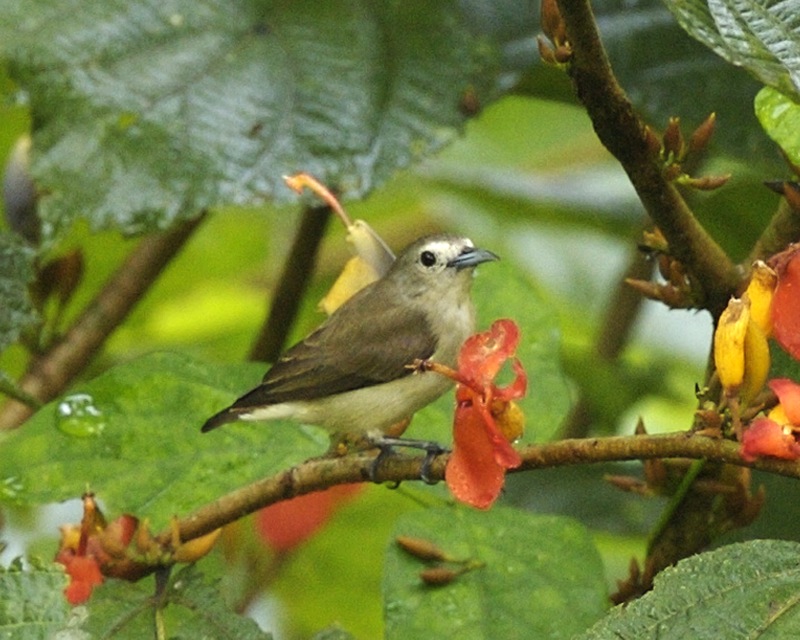
Plain Flowerpecker Dicaeum minullum
The scientific name of the Plain Flowerpecker is Dicaeum minullum. It is a species of bird in the family Dicaeidae (flowerpecker), order Passeriformes. The name dates from 1870.
- Scientific name
- Dicaeum minullum Swinhoe, 1870
- Common name
- Plain Flowerpecker
- Genus
- Dicaeum
- Family
- Dicaeidae (Flowerpecker)
- Order
- Passeriformes
- Class
- Aves
- Red List category
- LC Least Concern
- Recorded in
- 15 countries
- Name status
- accepted in the Catalogue of Life

Overview
Dicaeum minullum inhabits subtropical or tropical moist lowland forests. It has pale, olive-washed underparts.
Written 26 November 2026 from the sources listed below. Each statement was checked against the passage it cites; statements that could not be supported were removed.
Appearance
The Plain Flowerpecker measures approximately 9 cm in length. Males and females show no marked differences in appearance.[1][2]
The Plain Flowerpecker has pale, olive-washed underparts.[3]
Habitat
The Plain Flowerpecker inhabits subtropical or tropical moist lowland forests and is a lowland-dwelling songbird.[4][5]
Its distribution extends from the central Himalayas through western Indonesia to Taiwan.[6]
Diet
The Plain Flowerpecker favours mistletoe when foraging.[7]
Behaviour
The Plain Flowerpecker is commonly observed hovering around flowers or probing into them. It shows a particular preference for mistletoe.[8][9]
Classification of the Plain Flowerpecker
| Kingdom | Animalia |
|---|---|
| Phylum | Chordata |
| Subphylum | Vertebrata |
| Infraphylum | Gnathostomata |
| Parvphylum | Osteichthyes |
| Megaclass | Tetrapoda |
| Class | Aves (Bird) |
| Order | Passeriformes (Passerine) |
| Family | Dicaeidae (Flowerpecker) |
| Genus | Dicaeum (Flowerpeckers) |
| Species | Dicaeum minullum Swinhoe, 1870 |
Where the Plain Flowerpecker is found
Checklists and occurrence records place Dicaeum minullum in 15 countries. GBIF holds 23,800 georeferenced records of it.
Countries
- Bangladesh 16
- Bhutan 277
- Brunei 27
- Cambodia 733
- China 1,734
- Hong Kong 637
- India 3,979
- Indonesia 424
- Laos 346
- Malaysia 1,562
- Myanmar 214
- Nepal 426
- Taiwan 9,357
- Thailand 3,544
- Vietnam 524
Regions and cities with the most records
- Taiwan, Taiwan 5,531
- Banqiao, Taiwan 2,079
- Puli, Taiwan 2,017
- Assam, India 1,956
- Taipei, Taiwan 1,741
- Shulin, Taiwan 1,555
- Neihu, Taiwan 1,355
- New Taipei City, Taiwan 1,300
- Chiang Mai, Thailand 1,205
- Xizhi, Taiwan 1,107
- Yunnan, China 1,090
- Sanxia, Taiwan 1,008
- Lugu, Taiwan 835
- West Bengal, India 791
- Yingge, Taiwan 733
- Chiayi City, Taiwan 690
- Mondolkiri, Cambodia 680
- Taipei, Taiwan 666
- Fanling, Hong Kong 637
- Fo Tan, Hong Kong 636
- Sha Tin, Hong Kong 635
- Tai Shui Hang, Hong Kong 635
- Tai Wai, Hong Kong 635
- Wo Che, Hong Kong 635
- City One, Hong Kong 634
- Keng Hau, Hong Kong 634
- Pok Hong, Hong Kong 634
- San Tin, Hong Kong 634
- Sha Tin Wai, Hong Kong 634
- Shui Chuen O, Hong Kong 634
- Siu Lek Yuen, Hong Kong 634
- Sun Tin Wai, Hong Kong 634
- Tai Po, Hong Kong 634
- Hong Lok Yuen, Hong Kong 633
- Shuen Wan, Hong Kong 633
- Kam Ying, Hong Kong 632
A number beside a place is its count of GBIF occurrence records. A place without a number comes from a checklist alone. Records show where a species has been observed or collected, which can include escapes and vagrants.
Common names
English
- Plain Flowerpecker
Names in 26 other languages
- Chinese
- 綠啄花, 綠啄花〔純色啄花〕, 綠啄花鳥, 纯色啄花鸟
- Croatian
- dugokljuna imelašica
- Danish
- Hainan Blomsterpikker
- Dutch
- Groengrijze Honingvogel
- Esperanto
- unukolora dikeo
- Finnish
- Harmaakukastaja
- French
- Dicée olivâtre
- German
- Einfarb-Mistelfresser, Graugrüner Mistelfresser
- Indonesian
- Cabai polos
- Italian
- Beccafiori oliva
- Japanese
- ムジハナドリ
- Nepali
- समरुप पुष्पकोकिल
- Norwegian
- olivenblomsterfugl
- Persian
- گلکوب ساده
- Polish
- kwiatówka oliwkowa
- Portuguese
- pica-flor-liso, pica-flor-simples
- Russian
- Бурый цветоед
- Slovak
- bobuliar malý
- Spanish
- Picaflores sencillo
- Swedish
- enfärgad blomsterpickare
- Thai
- นกกาฝากสีเรียบ
- Turkish
- Açık Renkli Öksekuşu
- Ukrainian
- квіткоїд індокитайський
- Vietnamese
- Chim sâu bình nguyên
- nav
- Dahtsʼaaʼ yiłchozhii łibáhígíí
- pnb
- سادھ پھل ٹھونگا
Synonyms
One other scientific name has been used for this species and is now treated as a synonym of Dicaeum minullum.
- Dicaeum concolor minullum Swinhoe, R, 1870
Subspecies and varieties
- Dicaeum minullum borneanum subspecies
- Dicaeum minullum minullum subspecies
- Dicaeum minullum olivaceum subspecies
- Dicaeum minullum sollicitans subspecies
- Dicaeum minullum uchidai subspecies
Related species
-
 MistletoebirdDicaeum hirundinaceum
-
 Cebu FlowerpeckerDicaeum quadricolor
-
 Scarlet-backed FlowerpeckerDicaeum cruentatum
-
 Red-keeled FlowerpeckerDicaeum australe
-
 Fire-breasted FlowerpeckerDicaeum ignipectus
-
 Orange-bellied FlowerpeckerDicaeum trigonostigma
-
 Nilgiri FlowerpeckerDicaeum concolor
-
 Thick-billed FlowerpeckerDicaeum agile
Compare
Questions and answers
What is the scientific name of the Plain Flowerpecker?
The scientific name of the Plain Flowerpecker is Dicaeum minullum. Written with its author, the full name is Dicaeum minullum Swinhoe, 1870.
Which family does the Plain Flowerpecker belong to?
Dicaeum minullum belongs to the family Dicaeidae, in the order Passeriformes and the class Aves.
Where is the Plain Flowerpecker found?
Checklists and occurrence records place Dicaeum minullum in 15 countries, including Taiwan, India, Thailand, China, Malaysia and Cambodia.
What is the conservation status of the Plain Flowerpecker?
The IUCN Red List category recorded for Dicaeum minullum is Least Concern (LC).
Sources
Passages the profile rests on
- The Plain Flowerpecker measures approximately 9 cm in length. Source passage: “These birds are tiny (9 cm long)” — English Wikipedia
- Male and female Plain Flowerpeckers show no marked differences in appearance. Source passage: “there is no marked difference between the males and females.” — English Wikipedia
- The Plain Flowerpecker has pale, olive-washed underparts. Source passage: “pale, olive-washed underparts.” — ebird.org
- The Plain Flowerpecker inhabits subtropical or tropical moist lowland forests. Source passage: “Its natural habitat is subtropical or tropical moist lowland forests.” — English Wikipedia
- The Plain Flowerpecker is a lowland-dwelling songbird. Source passage: “Aptly named small songbird of lowlands” — ebird.org
- The Plain Flowerpecker is distributed from the central Himalayas through western Indonesia to Taiwan. Source passage: “It is found in the central Himalayas, through western Indonesia to Taiwan.” — English Wikipedia
- The Plain Flowerpecker favours mistletoe when foraging. Source passage: “Like many flowerpeckers, it favours mistletoe for foraging.” — English Wikipedia
- The Plain Flowerpecker is commonly observed hovering around flowers or probing into them. Source passage: “Usually seen hovering around or probing into flowers;” — ebird.org
- The Plain Flowerpecker shows a particular preference for mistletoe. Source passage: “especially fond of mistletoe” — ebird.org
Data
- Catalogue of Life, 2026-10-16 XR cc by
- Global Biodiversity Information Facility CC BY 4.0
- Wikidata CC0
- GeoNames CC BY 4.0
- Wikimedia Commons per image; credit shown with each image
- Within the Catalogue of Life, this name comes from The Integrated Taxonomic Information System cc0
This species in other databases
Page built on 27 November 2026. See how the catalog is made and all sources and licences.
Cite this page
ScientificNames.org. (2026). Dicaeum minullum (Plain Flowerpecker). Retrieved November 27, 2026, from https://scientificnames.org/species/dicaeum-minullum
“Dicaeum minullum (Plain Flowerpecker).” ScientificNames.org, 2026, scientificnames.org/species/dicaeum-minullum. Accessed 27 Nov. 2026.
ScientificNames.org. “Dicaeum minullum (Plain Flowerpecker).” Accessed November 27, 2026. https://scientificnames.org/species/dicaeum-minullum.
@misc{scientificnames_dicaeum_minullum_plain_flowerpecker,
  author = {{ScientificNames.org}},
  title = {Dicaeum minullum (Plain Flowerpecker)},
  year = {2026},
  url = {https://scientificnames.org/species/dicaeum-minullum},
  note = {Accessed 2026-11-27}
}