Species · Birds
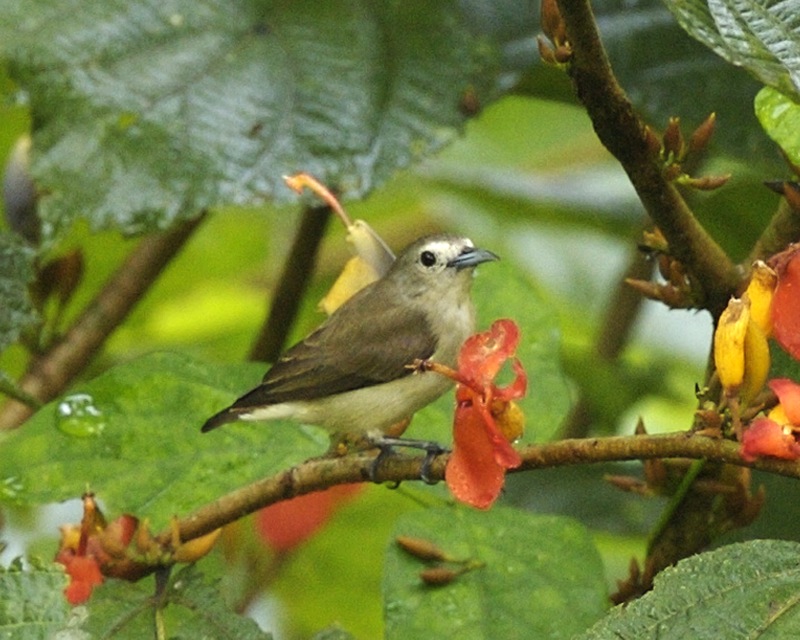
Pygmy Flowerpecker Dicaeum pygmaeum
The scientific name of the Pygmy Flowerpecker is Dicaeum pygmaeum. It is a species of bird in the family Dicaeidae (flowerpecker), order Passeriformes. The name dates from 1833.
- Scientific name
- Dicaeum pygmaeum (Kittlitz, 1833)
- Common name
- Pygmy Flowerpecker
- Genus
- Dicaeum
- Family
- Dicaeidae (Flowerpecker)
- Order
- Passeriformes
- Class
- Aves
- Red List category
- LC Least Concern
- Recorded in
- 1 country
- Name status
- accepted in the Catalogue of Life

Overview
The species is endemic to the Philippines. Five subspecies of the Pygmy Flowerpecker are recognized.
Written 26 November 2026 from the sources listed below. Each statement was checked against the passage it cites; statements that could not be supported were removed.
Habitat
The Pygmy Flowerpecker inhabits tropical moist lowland forests and tropical moist montane forests. It occurs in both primary and secondary tropical moist lowland forests.[1][2]
The species occurs at elevations reaching 2,000 meters above sea level but is mostly observed below 1,000 meters. It is considered to have a medium dependency on forest habitat.[3][4][5]
Diet
The Pygmy Flowerpecker feeds on fruit, nectar, and pollen.[6]
Behaviour
The species is often observed feeding around flowering and fruiting trees and mistletoes. It forages in the canopy or high in the understory.[7][8]
The Pygmy Flowerpecker forages alone, in small groups, or in mixed-species flocks.[9]
Reproduction and life cycle
A fledgling of this species has been observed in May. Individuals with enlarged gonads have been collected in breeding condition between February and December.[10][11]
The breeding habits of the Pygmy Flowerpecker remain poorly known.[12]
Conservation
The Pygmy Flowerpecker is classified as Least Concern on the IUCN Red List. It was most recently assessed in 2024.[13][14][15]
The species' population is reported to be decreasing. Deforestation associated with land conversion, illegal logging, and mining is reported as a threat.[16][17]
Classification of the Pygmy Flowerpecker
| Kingdom | Animalia |
|---|---|
| Phylum | Chordata |
| Subphylum | Vertebrata |
| Infraphylum | Gnathostomata |
| Parvphylum | Osteichthyes |
| Megaclass | Tetrapoda |
| Class | Aves (Bird) |
| Order | Passeriformes (Passerine) |
| Family | Dicaeidae (Flowerpecker) |
| Genus | Dicaeum (Flowerpeckers) |
| Species | Dicaeum pygmaeum (Kittlitz, 1833) |
Where the Pygmy Flowerpecker is found
Checklists and occurrence records place Dicaeum pygmaeum in 1 country. GBIF holds 5,080 georeferenced records of it.
Countries
Regions and cities with the most records
- Taytay, Philippines 848
- Cainta, Philippines 823
- Antipolo, Philippines 813
- Rodriguez, Philippines 740
- Teresa, Philippines 725
- Angono, Philippines 718
- Calumpang, Philippines 715
- Pasig City, Philippines 715
- Quezon City, Philippines 712
- Mandaluyong City, Philippines 711
- Mandaluyong, Philippines 710
- Pateros, Philippines 708
- San Juan, Philippines 707
- Marikina City, Philippines 706
- Bel Air, Philippines 700
- Bagong Pagasa, Philippines 699
- Makati City, Philippines 699
- San Mateo, Philippines 699
- Bagong Silangan, Philippines 691
- Malanday, Philippines 689
- Commonwealth, Philippines 685
- Manila, Philippines 657
- Talipapa, Philippines 646
- Bagong Barrio, Philippines 645
- Novaliches Proper, Philippines 640
- Taguig, Philippines 575
- Pasay, Philippines 565
- Upper Bicutan, Philippines 564
- Morong, Philippines 554
- Tanay, Philippines 554
- Baras, Philippines 549
- Paranaque City, Philippines 544
- Cardona, Philippines 541
- Baclaran, Philippines 528
- Caloocan, Philippines 519
- Binangonan, Philippines 516
A number beside a place is its count of GBIF occurrence records. A place without a number comes from a checklist alone. Records show where a species has been observed or collected, which can include escapes and vagrants.
Common names
English
- Pygmy Flowerpecker
Names in 24 other languages
- Catalan
- picaflors menut
- Chinese
- 小啄花, 小啄花鸟
- Croatian
- kratkorepa imelašica
- Czech
- květozob malý
- Danish
- Pygmæblomsterpikker
- Dutch
- Dwerghoningvogel
- Esperanto
- pigmea dikeo
- Finnish
- pikkukukastaja
- French
- Dicée pygmée
- German
- Zwergmistelfresser
- Italian
- Beccafiore pigmeo, Beccafiori pigmeo di Palawan
- Japanese
- パラワンハナドリ
- Lithuanian
- palavaninis žiedsiurbys
- Norwegian
- dvergblomsterfugl
- Polish
- kwiatówka malutka
- Portuguese
- pica-flor-cerúleo, pica-flor-pigmeu
- Russian
- Крошечный цветоед, Цветоед-крошка
- Serbian
- Mala cvetarka
- Slovak
- bobuliar trpasličí
- Spanish
- Picaflores pigmeo
- Swedish
- dvärgblomsterpickare
- Turkish
- Küçük Öksekuşu
- Ukrainian
- квіткоїд-крихітка
- Welsh
- pigwr blodau bach
Synonyms
One other scientific name has been used for this species and is now treated as a synonym of Dicaeum pygmaeum.
- Nectarinia pygmaea Kittlitz, FH, 1833
Subspecies and varieties
- Dicaeum pygmaeum davao (Mindanao Pygmy Flowerpecker) subspecies
- Dicaeum pygmaeum fugaense (Fuga Pygmy Flowerpecker) subspecies
- Dicaeum pygmaeum palawanorum (Palawan Pygmy Flowerpecker) subspecies
- Dicaeum pygmaeum pygmaeum subspecies
- Dicaeum pygmaeum salomonseni subspecies
Related species
-
 MistletoebirdDicaeum hirundinaceum
-
 Cebu FlowerpeckerDicaeum quadricolor
-
 Scarlet-backed FlowerpeckerDicaeum cruentatum
-
 Red-keeled FlowerpeckerDicaeum australe
-
 Fire-breasted FlowerpeckerDicaeum ignipectus
-
 Orange-bellied FlowerpeckerDicaeum trigonostigma
-
 Nilgiri FlowerpeckerDicaeum concolor
-
 Thick-billed FlowerpeckerDicaeum agile
Compare
Questions and answers
What is the scientific name of the Pygmy Flowerpecker?
The scientific name of the Pygmy Flowerpecker is Dicaeum pygmaeum. Written with its author, the full name is Dicaeum pygmaeum (Kittlitz, 1833).
Which family does the Pygmy Flowerpecker belong to?
Dicaeum pygmaeum belongs to the family Dicaeidae, in the order Passeriformes and the class Aves.
Where is the Pygmy Flowerpecker found?
Checklists and occurrence records place Dicaeum pygmaeum in 1 country: Philippines.
What is the conservation status of the Pygmy Flowerpecker?
The IUCN Red List category recorded for Dicaeum pygmaeum is Least Concern (LC).
Sources
Passages the profile rests on
- The species inhabits tropical moist lowland forests and tropical moist montane forests. Source passage: “Its natural habitats are tropical moist lowland forest and tropical moist montane forest.” — English Wikipedia
- The species occurs in primary and secondary tropical moist lowland forests. Source passage: “Its natural habitats at tropical moist lowland primary forest and secondary forest” — English Wikipedia
- The species occurs at elevations reaching 2,000 meters above sea level. Source passage: “up to 2,000 meters above sea level” — English Wikipedia
- The species is mostly observed below 1,000 meters above sea level. Source passage: “but mostly seen below 1,000 meters above sea level.” — English Wikipedia
- The species is considered to have a medium dependency on forest habitat. Source passage: “This species is considered to have a medium dependency on forest habitat” — datazone.birdlife.org
- The Pygmy Flowerpecker feeds on fruit, nectar, and pollen. Source passage: “Feeds on fruit, nectar and pollen.” — English Wikipedia
- The species is often observed feeding around flowering and fruiting trees and mistletoes. Source passage: “Often seen feeding around flowering and fruiting trees and mistletoes.” — English Wikipedia
- The species forages in the canopy or high in the understory. Source passage: “Forages in the canopy or high in the understory” — English Wikipedia
- The species forages alone, in small groups, or in mixed-species flocks. Source passage: “singly, in small groups or joins mixed-species flocks.” — English Wikipedia
- A fledgling of this species has been observed in May. Source passage: “Fledgling seen in May.” — English Wikipedia
- Individuals with enlarged gonads have been collected in breeding condition between February and December. Source passage: “Birds in breeding condition with enlarged gonads collected from February to December.” — English Wikipedia
- The breeding habits of the species remain poorly known. Source passage: “Barely anything is known about its breeding habits.” — English Wikipedia
- The species is classified as Least Concern on the IUCN Red List. Source passage: “The IUCN Red List has assessed this bird as least-concern species” — English Wikipedia
- The species was most recently assessed for the IUCN Red List in 2024. Source passage: “Pygmy Flowerpecker Dicaeum pygmaeum has most recently been assessed for The IUCN Red List of Threatened Species in 2024.” — iucnredlist.org
- The species is listed as Least Concern in the IUCN Red List. Source passage: “Dicaeum pygmaeum is listed as Least ...” — iucnredlist.org
- The species' population is reported to be decreasing. Source passage: “Its population is still said to be decreasing” — English Wikipedia
- Deforestation associated with land conversion, illegal logging, and mining is reported as a threat to the species. Source passage: “due to deforestation in the Philippines due to land conversion, illegal logging and mining.” — English Wikipedia
Data
- Catalogue of Life, 2026-10-16 XR cc by
- Global Biodiversity Information Facility CC BY 4.0
- Wikidata CC0
- GeoNames CC BY 4.0
- Wikimedia Commons per image; credit shown with each image
- Within the Catalogue of Life, this name comes from The Integrated Taxonomic Information System cc0
References
- Gill, Frank, & and Minturn Wright. (2006). Birds of the World: Recommended English Names.
This species in other databases
Page built on 27 November 2026. See how the catalog is made and all sources and licences.
Cite this page
ScientificNames.org. (2026). Dicaeum pygmaeum (Pygmy Flowerpecker). Retrieved November 27, 2026, from https://scientificnames.org/species/dicaeum-pygmaeum
“Dicaeum pygmaeum (Pygmy Flowerpecker).” ScientificNames.org, 2026, scientificnames.org/species/dicaeum-pygmaeum. Accessed 27 Nov. 2026.
ScientificNames.org. “Dicaeum pygmaeum (Pygmy Flowerpecker).” Accessed November 27, 2026. https://scientificnames.org/species/dicaeum-pygmaeum.
@misc{scientificnames_dicaeum_pygmaeum_pygmy_flowerpecker,
  author = {{ScientificNames.org}},
  title = {Dicaeum pygmaeum (Pygmy Flowerpecker)},
  year = {2026},
  url = {https://scientificnames.org/species/dicaeum-pygmaeum},
  note = {Accessed 2026-11-27}
}