Species · Birds
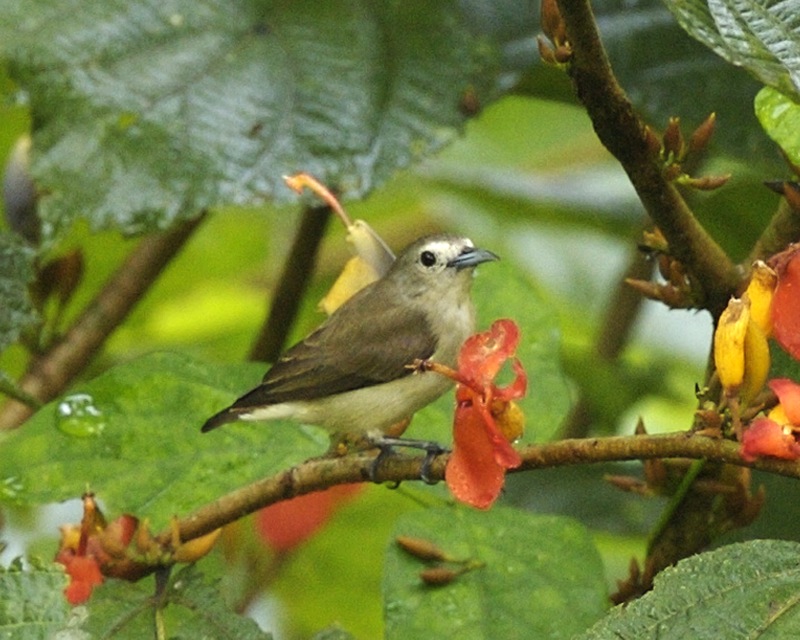
Scarlet-collared Flowerpecker Dicaeum retrocinctum
The scientific name of the Scarlet-collared Flowerpecker is Dicaeum retrocinctum. It is a species of bird in the family Dicaeidae (flowerpecker), order Passeriformes. The name dates from 1872.
- Scientific name
- Dicaeum retrocinctum Gould, 1872
- Common name
- Scarlet-collared Flowerpecker
- Genus
- Dicaeum
- Family
- Dicaeidae (Flowerpecker)
- Order
- Passeriformes
- Class
- Aves
- Red List category
- NT Near Threatened
- Recorded in
- 1 country
- Name status
- accepted in the Catalogue of Life

Overview
The Scarlet-collared Flowerpecker is a bird endemic to Mindoro Island in the Philippines. It inhabits tropical moist lowland forests at elevations below approximately 1,000 metres above sea level.
Written 26 November 2026 from the sources listed below. Each statement was checked against the passage it cites; statements that could not be supported were removed.
Appearance
The species has a black back, head and chest, with white markings on the sides of the belly, chest and vent. A red patch extends from its throat through the center of its chest to its belly and collar.[1][2]
Habitat
The species inhabits tropical moist lowland forests and occurs in forest habitats at elevations below approximately 1,000 metres above sea level. It occurs in forest canopies, along forest edges and in open country with scattered trees.[3][4][5]
It prefers primary and secondary forests but also visits cultivated areas and coconut plantations.[6]
Diet
The species feeds on flowering and fruiting trees.[7]
Behaviour
The species produces a high-pitched staccato song resembling two pebbles being struck together.[8]
Reproduction and life cycle
Individuals in breeding condition have been recorded between February and June. Nests of the species have been found in April.[9][10]
Immature individuals have been observed as late as September.[11]
Similar species
The Scarlet-collared Flowerpecker is closely related to the red-keeled flowerpecker (Dicaeum australe).[12]
Conservation
The species was reassessed as Near Threatened in 2024. Its estimated population in the 2024 assessment was 40,000 to 160,000 mature individuals.[13][14]
The species occurs in the protected areas of Mt Siburan and Mt. Iglit-Baco National Park.[15]
Establishing formally managed protected areas for remaining forest at Malpalon and Puerto Galera has been proposed as a conservation measure. Expanding Mt Iglit-Baco National Park to include remaining lowland forest areas has also been proposed.[16][17]
A biodiversity-focused forest management plan for Mt. Siburan has been proposed.[18]
Classification of the Scarlet-collared Flowerpecker
| Kingdom | Animalia |
|---|---|
| Phylum | Chordata |
| Subphylum | Vertebrata |
| Infraphylum | Gnathostomata |
| Parvphylum | Osteichthyes |
| Megaclass | Tetrapoda |
| Class | Aves (Bird) |
| Order | Passeriformes (Passerine) |
| Family | Dicaeidae (Flowerpecker) |
| Genus | Dicaeum (Flowerpeckers) |
| Species | Dicaeum retrocinctum Gould, 1872 |
Where the Scarlet-collared Flowerpecker is found
Checklists and occurrence records place Dicaeum retrocinctum in 1 country. GBIF holds 262 georeferenced records of it.
Countries
Regions and cities with the most records
- Sablayan, Philippines 112
- Victoria, Philippines 21
- Pinamalayan, Philippines 12
- Calapan, Philippines 6
- Mansalay, Philippines 3
A number beside a place is its count of GBIF occurrence records. A place without a number comes from a checklist alone. Records show where a species has been observed or collected, which can include escapes and vagrants.
Common names
English
- Scarlet-collared Flowerpecker
Names in 23 other languages
- Catalan
- picaflors de l'illa Mindoro
- Chinese
- 紅領啄花, 红领啄花鸟
- Croatian
- ogrličasta imelašica
- Czech
- květozob mindorský
- Danish
- Mindoro Blomsterpikker
- Dutch
- Mindorohoningvogel
- Esperanto
- mindora dikeo
- Finnish
- mindoronkukastaja
- French
- Dicée de Mindoro
- German
- Mindoro-Mistelfresser, Mindoromistelfresser
- Italian
- Beccafiore dal collare
- Japanese
- ミンドロハナドリ
- Lithuanian
- mindorinis žiedsiurbys
- Norwegian
- rødnakkeblomsterfugl
- Polish
- kwiatówka krawatowa
- Portuguese
- pica-flor-de-colar, pica-flor-de-mindoro
- Russian
- Миндорский цветоед
- Slovak
- bobuliar červenohrdlý
- Spanish
- Picaflores de Mindoro
- Swedish
- mindoroblomsterpickare
- Turkish
- Al Boyunlu Öksekuşu
- Ukrainian
- квіткоїд червоногорлий
- Welsh
- pigwr blodau Mindoro
Related species
-
 MistletoebirdDicaeum hirundinaceum
-
 Cebu FlowerpeckerDicaeum quadricolor
-
 Scarlet-backed FlowerpeckerDicaeum cruentatum
-
 Red-keeled FlowerpeckerDicaeum australe
-
 Fire-breasted FlowerpeckerDicaeum ignipectus
-
 Orange-bellied FlowerpeckerDicaeum trigonostigma
-
 Nilgiri FlowerpeckerDicaeum concolor
-
 Thick-billed FlowerpeckerDicaeum agile
Compare
Questions and answers
What is the scientific name of the Scarlet-collared Flowerpecker?
The scientific name of the Scarlet-collared Flowerpecker is Dicaeum retrocinctum. Written with its author, the full name is Dicaeum retrocinctum Gould, 1872.
Which family does the Scarlet-collared Flowerpecker belong to?
Dicaeum retrocinctum belongs to the family Dicaeidae, in the order Passeriformes and the class Aves.
Where is the Scarlet-collared Flowerpecker found?
Checklists and occurrence records place Dicaeum retrocinctum in 1 country: Philippines.
What is the conservation status of the Scarlet-collared Flowerpecker?
The IUCN Red List category recorded for Dicaeum retrocinctum is Near Threatened (NT).
Sources
Passages the profile rests on
- The species has a black back, head and chest, with white markings on the sides of the belly, chest and vent. Source passage: “It has a black back, head and chest with white on the sides of the belly, chest and vent.” — English Wikipedia
- The species has a red patch extending from its throat through the center of its chest to its belly and collar. Source passage: “It has a red patch on its throat, center of its chest down to the belly and collar.” — English Wikipedia
- The species inhabits tropical moist lowland forests. Source passage: “found only in the tropical moist lowland forests in Mindoro” — English Wikipedia
- The species occurs in forest habitats at elevations below approximately 1,000 metres above sea level. Source passage: “usually occurring below 1000m” — English Wikipedia
- The species occurs in forest canopies, along forest edges and in open country with scattered trees. Source passage: “in the canopy and edge of the forest and in open country with scattered trees.” — English Wikipedia
- The species prefers primary and secondary forests but also visits cultivated areas and coconut plantations. Source passage: “It prefers primary forest and secondary forest but has been known to visit cultivations and coconut plantations” — English Wikipedia
- The species feeds on flowering and fruiting trees. Source passage: “It is seen feeding on flowering and fruiting trees.” — English Wikipedia
- The species produces a high-pitched staccato song resembling two pebbles being struck together. Source passage: “Its call is described as high pitched stacatto song that sounds like two pebbles struck together.” — English Wikipedia
- Nests of the species have been found in April. Source passage: “Nests have been found in April.” — English Wikipedia
- Individuals in breeding condition have been recorded between February and June. Source passage: “Birds in breeding condition recorded from February to June.” — English Wikipedia
- Immature individuals have been observed as late as September. Source passage: “Immature birds seen as late as September.” — English Wikipedia
- The scarlet-collared flowerpecker is closely related to the red-keeled flowerpecker (Dicaeum australe). Source passage: “It is closely related to the red-keeled flowerpecker (Dicaeum australe)” — English Wikipedia
- The species was reassessed as Near Threatened in 2024. Source passage: “In 2024, it was re-assessed as a Near-threatened species” — English Wikipedia
- The estimated population in the 2024 assessment was 40,000 to 160,000 mature individuals. Source passage: “estimates of 40,000 to 160,000 mature individuals.” — English Wikipedia
- The species occurs in the protected areas of Mt Siburan and Mt. Iglit-Baco National Park. Source passage: “It occurs on a few protected areas Mt Siburan (Important Bird Area) and Mt. Iglit-baco National Park” — English Wikipedia
- Establishing formally managed protected areas for remaining forest at Malpalon and Puerto Galera has been proposed as a conservation measure. Source passage: “establish formal, managed protected areas to conserve remnant forest at Malpalon and Puerto Galera.” — English Wikipedia
- Expanding Mt Iglit-Baco National Park to include remaining lowland forest areas has been proposed as a conservation measure. Source passage: “Extend Mt Iglit-Baco National Park to encompass remaining lowland forest tracts.” — English Wikipedia
- A biodiversity-focused forest management plan for Mt. Siburan has been proposed. Source passage: “Devise and implement a management plan for the forest at Mt. Siburan with a focus on biodiversity conservation” — English Wikipedia
Data
- Catalogue of Life, 2026-10-16 XR cc by
- Global Biodiversity Information Facility CC BY 4.0
- Wikidata CC0
- GeoNames CC BY 4.0
- Wikimedia Commons per image; credit shown with each image
- Within the Catalogue of Life, this name comes from The Integrated Taxonomic Information System cc0
References
- Gill, Frank, & and Minturn Wright. (2006). Birds of the World: Recommended English Names.
This species in other databases
Page built on 27 November 2026. See how the catalog is made and all sources and licences.
Cite this page
ScientificNames.org. (2026). Dicaeum retrocinctum (Scarlet-collared Flowerpecker). Retrieved November 27, 2026, from https://scientificnames.org/species/dicaeum-retrocinctum
“Dicaeum retrocinctum (Scarlet-collared Flowerpecker).” ScientificNames.org, 2026, scientificnames.org/species/dicaeum-retrocinctum. Accessed 27 Nov. 2026.
ScientificNames.org. “Dicaeum retrocinctum (Scarlet-collared Flowerpecker).” Accessed November 27, 2026. https://scientificnames.org/species/dicaeum-retrocinctum.
@misc{scientificnames_dicaeum_retrocinctum_scarlet_collared_flowerpecker,
  author = {{ScientificNames.org}},
  title = {Dicaeum retrocinctum (Scarlet-collared Flowerpecker)},
  year = {2026},
  url = {https://scientificnames.org/species/dicaeum-retrocinctum},
  note = {Accessed 2026-11-27}
}