Species · Birds
Scarlet-headed Flowerpecker Dicaeum trochileum
The scientific name of the Scarlet-headed Flowerpecker is Dicaeum trochileum. It is a species of bird in the family Dicaeidae (flowerpecker), order Passeriformes. The name dates from 1789.
- Scientific name
- Dicaeum trochileum (Sparrman, 1789)
- Common name
- Scarlet-headed Flowerpecker
- Genus
- Dicaeum
- Family
- Dicaeidae (Flowerpecker)
- Order
- Passeriformes
- Class
- Aves
- Red List category
- LC Least Concern
- Recorded in
- 1 country
- Name status
- accepted in the Catalogue of Life

Overview
The Scarlet-headed Flowerpecker (Dicaeum trochileum) is a bird endemic to Indonesia. It mainly inhabits the Indonesian islands of Java and Bali, with smaller numbers reported on Lombok, Sumatra, and southeastern Borneo.
Written 26 November 2026 from the sources listed below. Each statement was checked against the passage it cites; statements that could not be supported were removed.
Appearance
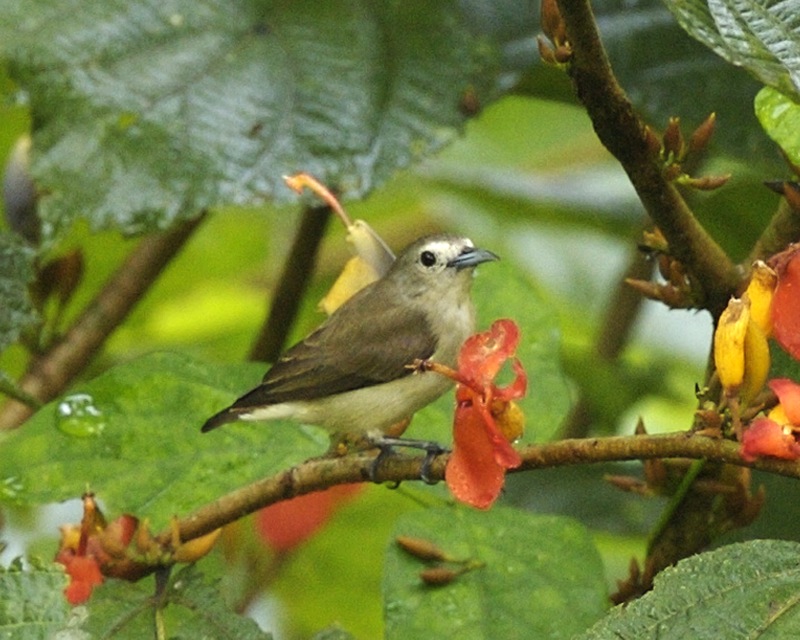
Females have light grey to brown heads and backs, with orange to red rumps. Their wings are lighter than male wings and lack blue coloration.[1][2][3]
Juveniles resemble females more closely than males. They have light grey beaks, pale brown wings, and pale grey to yellow bellies.[4][5]
Adult males also have bright red heads, breasts, and backs. The species reaches a body length of approximately 8–9 centimetres at maturity.[6][7]
Habitat
The Scarlet-headed Flowerpecker inhabits open woodlands, gardens, and mangroves. It has also been recorded along the seacoast and in the lowlands of Sumatra.[8][9]
The species occurs from sea level to approximately 600 metres in elevation.[10]
Diet
The species feeds mainly on small berries, insects, nectar, and pollen. It forages for berries in milkweed and mistletoe vegetation.[11][12]
Behaviour
The Scarlet-headed Flowerpecker forages alone or with one partner and can perch low in trees while searching for food. Its small body enables it to move through dense mistletoe branches while searching for berries.[13][14][15]
The species produces short, high-pitched calls, including sounds transcribed as "zit-zit-zit" and "seeeeep…seeeeep". Individual call pitches last approximately 2–3.5 seconds, and the most common call is a short buzzy sound.[16][17][18][19]
The species is more active in the morning when human presence and noise are reduced. Human presence and noise disturbance affect its daytime activity.[20][21]
Individuals undergo moulting throughout the year, with more individuals moulting in July. The timing of moulting is associated with the abundance and quality of available food resources.[22][23]
Reproduction and life cycle
The species builds nests measuring approximately 70–80 by 30–35 millimetres. Nest construction materials include grass and leaves, and milkweed fibres have also been recorded.[24][25][26]
The eggs are white, sometimes glossy, and bear a dark red spot at one end. They are laid in a large cavity in the middle of the nest.[27][28]
Both parents participate in caring for their chicks at the nest.[29]
In West Java, the breeding season extends from January through October. In East and Central Java, it generally occurs during April and May.[30][31]
The breeding season varies according to the island and region inhabited by individuals.[32]
Conservation
The Scarlet-headed Flowerpecker is classified as Least Concern on the IUCN Red List and has a stable population. It was assessed for the IUCN Red List in 2024.[33][34][35]
Human disturbance does not appear to affect the species' reproduction or survival.[36]
Classification of the Scarlet-headed Flowerpecker
| Kingdom | Animalia |
|---|---|
| Phylum | Chordata |
| Subphylum | Vertebrata |
| Infraphylum | Gnathostomata |
| Parvphylum | Osteichthyes |
| Megaclass | Tetrapoda |
| Class | Aves (Bird) |
| Order | Passeriformes (Passerine) |
| Family | Dicaeidae (Flowerpecker) |
| Genus | Dicaeum (Flowerpeckers) |
| Species | Dicaeum trochileum (Sparrman, 1789) |
Where the Scarlet-headed Flowerpecker is found
Checklists and occurrence records place Dicaeum trochileum in 1 country. GBIF holds 7,304 georeferenced records of it.
Countries
Regions and cities with the most records
- Bali, Indonesia 2,627
- Jakarta, Indonesia 1,753
- Ciputat, Indonesia 1,479
- Denpasar, Indonesia 1,250
- Dalung, Indonesia 1,191
- Batubulan, Indonesia 1,176
- South Tangerang, Indonesia 1,128
- Kuta, Indonesia 1,008
- Tuban, Indonesia 996
- Benoa, Indonesia 988
- Cibinong, Indonesia 880
- Utan, Indonesia 872
- Pamulang, Indonesia 830
- Sawangan, Indonesia 826
- Depok, Indonesia 759
- Bekasi, Indonesia 718
- Parung, Indonesia 702
- Tangerang, Indonesia 702
- Serpong, Indonesia 700
- Citeureup, Indonesia 645
- Teluknaga, Indonesia 593
- Banyuwangi, Indonesia 581
- Bogor, Indonesia 579
- Ciampea, Indonesia 571
- Caringin, Indonesia 538
- Tabanan, Indonesia 524
- Ubud, Indonesia 456
- Yogyakarta, Indonesia 427
- Cileungsir, Indonesia 414
- Klungkung, Indonesia 394
- Melati, Indonesia 377
- Sleman, Indonesia 377
- Depok, Indonesia 369
- Candi Prambanan, Indonesia 368
- Gamping Lor, Indonesia 347
- Sepatan, Indonesia 346
A number beside a place is its count of GBIF occurrence records. A place without a number comes from a checklist alone. Records show where a species has been observed or collected, which can include escapes and vagrants.
Common names
English
- Scarlet-headed Flowerpecker
Names in 25 other languages
- Catalan
- picaflors cap-roig
- Chinese
- 紅頭啄花鳥, 红头啄花鸟, 赤頭啄花
- Croatian
- crvenoglava imelašica
- Czech
- květozob šarlatovohlavý
- Danish
- Kardinal Blomsterpikker
- Dutch
- Roodkophoningvogel
- Esperanto
- skarlatkapa dikeo
- Finnish
- tulikukastaja
- French
- Dicée à tête écarlate
- German
- Feuerkopf-Mistelfresser, Feuerkopfmistelfresser
- Hungarian
- skarlátfejű virágjáró
- Indonesian
- Cabai jawa
- Italian
- Beccafiore testascarlatta, Beccafiori testarossa
- Japanese
- ショウジョウハナドリ
- Lithuanian
- raudongalvis žiedsiurbys
- Norwegian
- rødhodeblomsterfugl
- Polish
- kwiatówka szkarłatna
- Portuguese
- pica-flor-de-cabeça-encarnada, pica-flor-de-cabeça-vermelha
- Russian
- Огненноголовый цветоед
- Slovak
- bobuliar čiernokrídly
- Spanish
- Picaflores cabecirrojo
- Swedish
- kardinalblomsterpickare
- Turkish
- Al Başlı Öksekuşu
- Ukrainian
- квіткоїд вогнистоголовий
- Welsh
- pigwr blodau pengoch
Synonyms
One other scientific name has been used for this species and is now treated as a synonym of Dicaeum trochileum.
- Certhia trochilea Sparrman, A, 1789
Subspecies and varieties
- Dicaeum trochileum stresemanni subspecies
- Dicaeum trochileum trochileum subspecies
Related species
-
 MistletoebirdDicaeum hirundinaceum
-
 Cebu FlowerpeckerDicaeum quadricolor
-
 Scarlet-backed FlowerpeckerDicaeum cruentatum
-
 Red-keeled FlowerpeckerDicaeum australe
-
 Fire-breasted FlowerpeckerDicaeum ignipectus
-
 Orange-bellied FlowerpeckerDicaeum trigonostigma
-
 Nilgiri FlowerpeckerDicaeum concolor
-
 Thick-billed FlowerpeckerDicaeum agile
Compare
Questions and answers
What is the scientific name of the Scarlet-headed Flowerpecker?
The scientific name of the Scarlet-headed Flowerpecker is Dicaeum trochileum. Written with its author, the full name is Dicaeum trochileum (Sparrman, 1789).
Which family does the Scarlet-headed Flowerpecker belong to?
Dicaeum trochileum belongs to the family Dicaeidae, in the order Passeriformes and the class Aves.
Where is the Scarlet-headed Flowerpecker found?
Checklists and occurrence records place Dicaeum trochileum in 1 country: Indonesia.
What is the conservation status of the Scarlet-headed Flowerpecker?
The IUCN Red List category recorded for Dicaeum trochileum is Least Concern (LC).
Sources
Passages the profile rests on
- Females have light grey to brown heads and backs. Source passage: “The females have a light grey to brown head and back.” — English Wikipedia
- Females have orange to red rumps. Source passage: “Their orange to red rumps characterize the females' morphology.” — English Wikipedia
- Female wings are lighter than male wings and lack blue coloration. Source passage: “Their wings are lighter than the male's wings colour, and they are missing the blue coloration.” — English Wikipedia
- Juveniles resemble females more closely than males. Source passage: “The morphology of the juveniles resembles more that of the females than that of the males.” — English Wikipedia
- Juveniles have light grey beaks, pale brown wings, and pale grey to yellow bellies. Source passage: “They have a light grey beak with pale brown wings and a pale grey to yellow belly.” — English Wikipedia
- Adult males have bright red heads, breasts, and backs. Source passage: “Male's bright red head, breast, and back makes him unmistakable.” — ebird.org
- The species reaches a body length of approximately 8–9 centimetres at maturity. Source passage: “The scarlet-headed flowerpecker body length can reach up to eight to nine centimeters after maturity.” — English Wikipedia
- The species inhabits open woodlands, gardens, and mangroves. Source passage: “It mostly inhabits open woodlands, gardens and mangroves.” — English Wikipedia
- The species has also been recorded along the seacoast and in the lowlands of Sumatra. Source passage: “This bird's presence has also been reported on the seacoast and in the lowlands of Sumatra Island.” — English Wikipedia
- The species occurs from sea level to approximately 600 metres in elevation. Source passage: “It is found between the sea level and up to a maximum of 600 meters in altitude.” — English Wikipedia
- The species feeds mainly on small berries, insects, nectar, and pollen. Source passage: “The scarlet-headed flowerpecker feeds mostly on small berries, insects, nectar and pollen.” — English Wikipedia
- The species forages for berries in milkweed and mistletoe vegetation. Source passage: “It is often seen in milkweed and mistletoe grooves, foraging the plants' berries.” — English Wikipedia
- The species forages either alone or with one partner. Source passage: “It will forage either alone or with a partner.” — English Wikipedia
- The species can perch low in trees while foraging. Source passage: “The aggressivity of this small bird allows it to perch low in trees” — English Wikipedia
- Its small body enables it to move through dense mistletoe branches while searching for berries. Source passage: “its small size helps it to move through the dense branches of the mistletoes to find its berries.” — English Wikipedia
- The species produces short, high-pitched calls. Source passage: “It makes high and acute short notes.” — English Wikipedia
- Its vocalizations include sounds transcribed as "zit-zit-zit" and "seeeeep…seeeeep". Source passage: “Its vocals are either a "zit-zit-zit" sound or "seeeeep…seeeeep".” — English Wikipedia
- Individual call pitches last approximately 2–3.5 seconds. Source passage: “Every pitch last from two to three and a half seconds.” — English Wikipedia
- The most common call is a short buzzy sound. Source passage: “most common call is a short buzzy “bzzt”.” — ebird.org
- The species is more active in the morning when human presence and noise are reduced. Source passage: “This flowerpecker is more active in the morning when it is silent and deserted of human presence.” — English Wikipedia
- Human presence and noise disturbance affect the species' daytime activity. Source passage: “The human presence and the noise disturbance affect this bird's activity during the day.” — English Wikipedia
- Individuals of the species undergo moulting throughout the year, with more individuals moulting in July. Source passage: “There are individuals of scarlet-headed flowerpecker moulting all year round, but a higher number of individuals moult in July.” — English Wikipedia
- The timing of moulting is associated with the abundance and quality of available food resources. Source passage: “The individuals calibrate their moulting with the abundance and quality of the food resources they can find.” — English Wikipedia
- The species builds nests measuring approximately 70–80 by 30–35 millimetres. Source passage: “The nest of this species is about 70–80 × 30–35 mm” — English Wikipedia
- Nest construction materials include grass and leaves. Source passage: “made from grass and leaves.” — English Wikipedia
- Milkweed fibres have also been recorded as nest materials. Source passage: “Milkweed fibers have also been found in their nests.” — English Wikipedia
- The eggs are white, sometimes glossy, and bear a dark red spot at one end. Source passage: “Their eggs are white, sometimes glossed and they have a dark red dot at one end.” — English Wikipedia
- The species lays its eggs in a large cavity in the middle of the nest. Source passage: “This flowerpecker lays the eggs in a large hole dug in the middle of the nests.” — English Wikipedia
- Both parents participate in caring for their chicks at the nest. Source passage: “Both males and females are found in the nest, taking care of their chick together.” — English Wikipedia
- The breeding season in West Java extends from January through October. Source passage: “In West Java, the breeding season extends from January to October” — English Wikipedia
- The breeding season in East and Central Java generally occurs during April and May. Source passage: “in East and Central Java, it is generally from April to May.” — English Wikipedia
- The breeding season varies according to the island and region inhabited by individuals. Source passage: “The breeding season of this species changes depending on the island and the region each individual inhabits.” — English Wikipedia
- The species is classified as Least Concern on the IUCN Red List. Source passage: “The IUCN has classified its conservation status to Least Concern.” — English Wikipedia
- The species has a stable population. Source passage: “As of today, D. trochileum population is stable.” — English Wikipedia
- The species was assessed for the IUCN Red List in 2024. Source passage: “Scarlet-headed Flowerpecker Dicaeum trochileum has most recently been assessed for The IUCN Red List of Threatened Species in 2024.” — iucnredlist.org
- Human disturbance does not appear to affect the species' reproduction or survival. Source passage: “However, those disturbances do not affect the population's reproduction and survival” — English Wikipedia
Data
- Catalogue of Life, 2026-10-16 XR cc by
- Global Biodiversity Information Facility CC BY 4.0
- Wikidata CC0
- GeoNames CC BY 4.0
- Wikimedia Commons per image; credit shown with each image
- Within the Catalogue of Life, this name comes from The Integrated Taxonomic Information System cc0
References
- Gill, Frank, & and Minturn Wright. (2006). Birds of the World: Recommended English Names.
This species in other databases
Page built on 27 November 2026. See how the catalog is made and all sources and licences.
Cite this page
ScientificNames.org. (2026). Dicaeum trochileum (Scarlet-headed Flowerpecker). Retrieved November 27, 2026, from https://scientificnames.org/species/dicaeum-trochileum
“Dicaeum trochileum (Scarlet-headed Flowerpecker).” ScientificNames.org, 2026, scientificnames.org/species/dicaeum-trochileum. Accessed 27 Nov. 2026.
ScientificNames.org. “Dicaeum trochileum (Scarlet-headed Flowerpecker).” Accessed November 27, 2026. https://scientificnames.org/species/dicaeum-trochileum.
@misc{scientificnames_dicaeum_trochileum_scarlet_headed_flowerpecker,
  author = {{ScientificNames.org}},
  title = {Dicaeum trochileum (Scarlet-headed Flowerpecker)},
  year = {2026},
  url = {https://scientificnames.org/species/dicaeum-trochileum},
  note = {Accessed 2026-11-27}
}