Species · Mammals
Agile Kangaroo Rat Dipodomys agilis
The scientific name of the Agile Kangaroo Rat is Dipodomys agilis. It is a species of mammal in the family Heteromyidae (pocket mice), order Rodentia. The name dates from 1848.
- Scientific name
- Dipodomys agilis Gambel, 1848
- Common name
- Agile Kangaroo Rat
- Genus
- Dipodomys
- Family
- Heteromyidae (Pocket Mice)
- Order
- Rodentia
- Class
- Mammalia
- Red List category
- LC Least Concern
- Recorded in
- 2 countries
- Name status
- accepted in the Catalogue of Life

Overview
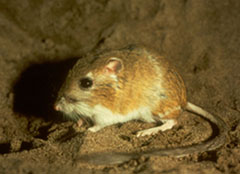
The Agile Kangaroo Rat is a mammal in the family Heteromyidae, order Rodentia, and class Mammalia. The Agile Kangaroo Rat is reported from Baja California, Mexico, and southern California. The Agile Kangaroo Rat has five toes, relatively large ears, and sexual dimorphism in body size.
Written 26 November 2026 from the sources listed below. Each statement was checked against the passage it cites; statements that could not be supported were removed.
Appearance
The Agile Kangaroo Rat has five toes and relatively large ears. It exhibits sexual dimorphism in body size, with males generally larger than females.[1][2][3]
The Agile Kangaroo Rat is intermediate in size among kangaroo rat species.[4]
Behaviour
The Agile Kangaroo Rat has been studied in relation to its sympatric relationship with Merriam's kangaroo rat.[5]
Similar species
The Dulzura kangaroo rat was formerly classified as a subspecies of the Agile Kangaroo Rat. Subsequent studies confirmed that the Dulzura kangaroo rat is a distinct species.[6][7]
The Agile Kangaroo Rat occurs in northern California's range relative to the Dulzura kangaroo rat. Genomic analysis found marked genetic differentiation between the two species and no evidence of hybridization or sympatry.[8][9][10]
The estimated divergence between the Agile Kangaroo Rat and the Dulzura kangaroo rat occurred approximately 0.5 million years ago. Their joint effective population size at divergence was estimated at approximately 100,000.[11][12]
The effective population size of the Agile Kangaroo Rat remained relatively unchanged after its separation from the Dulzura kangaroo rat. Their more recent effective population sizes converged at approximately 50,000.[13][14]
The Agile Kangaroo Rat exhibited longer runs of homozygosity and higher nucleotide diversity than the Dulzura kangaroo rat. The genomic study found no evidence that either species had experienced recent population bottlenecks.[15][16][17]
Classification of the Agile Kangaroo Rat
| Kingdom | Animalia |
|---|---|
| Phylum | Chordata |
| Subphylum | Vertebrata |
| Infraphylum | Gnathostomata |
| Parvphylum | Osteichthyes |
| Megaclass | Tetrapoda |
| Class | Mammalia (Mammal) |
| Subclass | Theria |
| Infraclass | Eutheria |
| Order | Rodentia (Rodent) |
| Suborder | Castorimorpha |
| Family | Heteromyidae (Pocket Mice) |
| Subfamily | Dipodomyinae (Kangaroo Mice) |
| Genus | Dipodomys (Kangaroo Rat) |
| Species | Dipodomys agilis Gambel, 1848 |
Where the Agile Kangaroo Rat is found
Checklists and occurrence records place Dipodomys agilis in 2 countries across North America. GBIF holds 6,742 georeferenced records of it.
Countries
Regions and cities with the most records
- California, United States 3,658
- Baja California, Mexico 621
- Colton, United States 416
- Loma Linda, United States 410
- San Bernardino, United States 378
- Highland, United States 340
- Moreno Valley, United States 340
- Rialto, United States 327
- Bloomington, United States 326
- Beaumont, United States 320
- Redlands, United States 316
- Fontana, United States 302
- Riverside, United States 246
- Yucaipa, United States 245
- San Jacinto, United States 237
- Banning, United States 236
- Rubidoux, United States 228
- Perris, United States 224
- Mead Valley, United States 222
- Glen Avon, United States 200
- Santa Clarita, United States 171
- East Hemet, United States 169
- Hemet, United States 164
- Menifee, United States 164
- Vincent, United States 163
- Burbank, United States 158
- Stevenson Ranch, United States 152
- Palmdale, United States 138
- Jurupa Valley, United States 137
- La Crescenta-Montrose, United States 137
- La Cañada Flintridge, United States 132
- Altadena, United States 131
- Glendale, United States 130
- Valencia, United States 128
- Eastvale, United States 126
- Castaic, United States 122
Range as the checklists state it
North America
A number beside a place is its count of GBIF occurrence records. A place without a number comes from a checklist alone. Records show where a species has been observed or collected, which can include escapes and vagrants.
Common names
English
- Agile Kangaroo Rat
Names in 8 other languages
- Arabic
- جرذ كنغري نشيط
- Czech
- tarbíkomyš čilá
- Dutch
- Pacifische Kangoeroegoffer
- Finnish
- bajankengurotta
- Japanese
- クロカンガルーネズミ
- Polish
- Szczuroskoczek zwinny
- Russian
- Прыткий кенгуровый прыгун
- Spanish
- Rata canguro de Baja California, Rata-canguro ágil
Subspecies and varieties
- Dipodomys agilis agilis subspecies
- Dipodomys agilis perplexus subspecies
Related species
-
 Merriam's Kangaroo RatDipodomys merriami
-
 Desert Kangaroo RatDipodomys deserti
-
 Ord's Kangaroo RatDipodomys ordii
-
 Giant Kangaroo RatDipodomys ingens
-
 Banner-tailed Kangaroo RatDipodomys spectabilis
-
 California Kangaroo RatDipodomys californicus
-
 Panamint Kangaroo RatDipodomys panamintinus
-
 Chisel-toothed Kangaroo RatDipodomys microps
Compare
Questions and answers
What is the scientific name of the Agile Kangaroo Rat?
The scientific name of the Agile Kangaroo Rat is Dipodomys agilis. Written with its author, the full name is Dipodomys agilis Gambel, 1848.
Which family does the Agile Kangaroo Rat belong to?
Dipodomys agilis belongs to the family Heteromyidae, in the order Rodentia and the class Mammalia.
Where is the Agile Kangaroo Rat found?
Checklists and occurrence records place Dipodomys agilis in 2 countries: United States and Mexico.
What is the conservation status of the Agile Kangaroo Rat?
The IUCN Red List category recorded for Dipodomys agilis is Least Concern (LC).
What is the scientific name of a kangaroo rat?
The scientific name of the Agile Kangaroo Rat is Dipodomys agilis. William Gambel proposed this name in 1848.[18]
Sources
Passages the profile rests on
- The agile kangaroo rat has five toes and relatively large ears. Source passage: “This species is intermediate in size when compared with other kangaroo rat species and has larger ears alongside five toes.” — English Wikipedia
- The agile kangaroo rat exhibits sexual dimorphism in body size. Source passage: “The agile kangaroo rat exhibits sexual dimorphism;” — English Wikipedia
- Male agile kangaroo rats are generally larger than females. Source passage: “most male agile kangaroo rat specimens are larger than their female counterparts.” — English Wikipedia
- The agile kangaroo rat is intermediate in size among kangaroo rat species. Source passage: “This species is intermediate in size when compared with other kangaroo rat species” — English Wikipedia
- The agile kangaroo rat has been studied in relation to its sympatric relationship with Merriam's kangaroo rat. Source passage: “Sympatric relationships of the kangaroo rats, Dipodomys merriami and Dipodomys agilis.” — nrm.dfg.ca.gov
- The Dulzura kangaroo rat was formerly classified as a subspecies of the agile kangaroo rat. Source passage: “The Dulzura kangaroo rat, which overlaps in range with the agile kangaroo rat, was believed to be a subspecies of the agile kangaroo rat” — English Wikipedia
- Subsequent studies confirmed that the Dulzura kangaroo rat is a distinct species. Source passage: “subsequent studies have confirmed the latter's status as a unique species.” — English Wikipedia
- The agile kangaroo rat occurs in northern California's range relative to the Dulzura kangaroo rat. Source passage: “the agile kangaroo rat (AKR, D. agilis, 2N = 62) in the north of its range in California” — pmc.ncbi.nlm.nih.gov
- Genomic analysis found marked genetic differentiation between agile and Dulzura kangaroo rats. Source passage: “The taxa showed marked genetic differentiation, with no evidence of hybridization or sympatry.” — pmc.ncbi.nlm.nih.gov
- The genomic study found no evidence of hybridization or sympatry between agile and Dulzura kangaroo rats. Source passage: “The taxa showed marked genetic differentiation, with no evidence of hybridization or sympatry.” — pmc.ncbi.nlm.nih.gov
- The estimated divergence between agile and Dulzura kangaroo rats occurred approximately 0.5 million years ago. Source passage: “and from each other ∼0.5 mya” — pmc.ncbi.nlm.nih.gov
- The joint effective population size of the agile and Dulzura kangaroo rats at their divergence was estimated at approximately 100,000. Source passage: “when their joint effective population size (Ne) was ~100,000.” — pmc.ncbi.nlm.nih.gov
- The effective population size of the agile kangaroo rat remained relatively unchanged after its separation from the Dulzura kangaroo rat. Source passage: “while AKR’s was little changed.” — pmc.ncbi.nlm.nih.gov
- The more recent effective population sizes of the agile and Dulzura kangaroo rats converged at approximately 50,000. Source passage: “More recently their Ne converged at ~50,000.” — pmc.ncbi.nlm.nih.gov
- The agile kangaroo rat exhibited longer runs of homozygosity than the Dulzura kangaroo rat. Source passage: “Runs of homozygosity were longer in AKR” — pmc.ncbi.nlm.nih.gov
- The agile kangaroo rat had higher nucleotide diversity than the Dulzura kangaroo rat. Source passage: “however, nucleotide diversity was higher in AKR” — pmc.ncbi.nlm.nih.gov
- The genomic study found no evidence that either kangaroo rat species had experienced recent population bottlenecks. Source passage: “indicating neither experienced recent bottlenecks.” — pmc.ncbi.nlm.nih.gov
- William Gambel proposed the scientific name Dipodomys agilis in 1848. Source passage: “William Gambel proposed the scientific name Dipodomys agilis for a jerboa-like animal from Los Angeles in 1848.” — English Wikipedia
Data
- Catalogue of Life, 2026-10-16 XR cc by
- Global Biodiversity Information Facility CC BY 4.0
- Wikidata CC0
- GeoNames CC BY 4.0
- Wikimedia Commons per image; credit shown with each image
- Within the Catalogue of Life, this name comes from The Integrated Taxonomic Information System cc0
References
- Proc. Acad. Nat. Sci. Philadelphia vol.4 p.77 where the name was published
- Banks, R. C., R. W. McDiarmid, and A. L. Gardner. (1987). Checklist of Vertebrates of the United States, the U.S. Territories, and Canada. Resource Publication, No. 166.
- Wilson, Don E., and DeeAnn M. Reeder, eds. (1993). Mammal Species of the World: A Taxonomic and Geographic Reference, 2nd Ed., 3rd Printing.
- Wilson, Don E., and Sue Ruff, eds. (1999). The Smithsonian Book of North American Mammals.
- Wilson, Don E., and F. Russell Cole. (2000). Common Names of Mammals of the World.
- Wilson, Don E., and DeeAnn M. Reeder, eds. (2005). Mammal Species of the World: A Taxonomic and Geographic Reference, 3rd Ed., Vols. 1 & 2.
- Hafner, M. S. / Wilson, Don E., T. E. Lacher Jr., and R. A. Mittermeier, eds. (2016). Family Heteromyidae (Pocket Mice, Kangaroo Mice and Kangaroo Rats). Handbook of the Mammals of the World. Vol. 6: Lagomorphs and Rodents I.
- Burgin, Connor J., Don E. Wilson, Russell A. Mittermeier, Anthony B. Rylands, et al. (2020). Illustrated Checklist of the Mammals of the World. Vol. 1. Monotremata to Rodentia.
This species in other databases
Page built on 27 November 2026. See how the catalog is made and all sources and licences.
Cite this page
ScientificNames.org. (2026). Dipodomys agilis (Agile Kangaroo Rat). Retrieved November 27, 2026, from https://scientificnames.org/species/dipodomys-agilis
“Dipodomys agilis (Agile Kangaroo Rat).” ScientificNames.org, 2026, scientificnames.org/species/dipodomys-agilis. Accessed 27 Nov. 2026.
ScientificNames.org. “Dipodomys agilis (Agile Kangaroo Rat).” Accessed November 27, 2026. https://scientificnames.org/species/dipodomys-agilis.
@misc{scientificnames_dipodomys_agilis_agile_kangaroo_rat,
  author = {{ScientificNames.org}},
  title = {Dipodomys agilis (Agile Kangaroo Rat)},
  year = {2026},
  url = {https://scientificnames.org/species/dipodomys-agilis},
  note = {Accessed 2026-11-27}
}