Species · Mammals
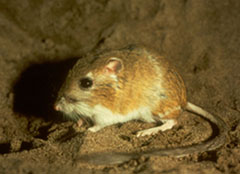
Merriam's Kangaroo Rat Dipodomys merriami
The scientific name of the Merriam's Kangaroo Rat is Dipodomys merriami. It is a species of mammal in the family Heteromyidae (pocket mice), order Rodentia. The name dates from 1890.
- Scientific name
- Dipodomys merriami Mearns, 1890
- Common name
- Merriam's Kangaroo Rat
- Genus
- Dipodomys
- Family
- Heteromyidae (Pocket Mice)
- Order
- Rodentia
- Class
- Mammalia
- Red List category
- LC Least Concern
- Recorded in
- 2 countries
- Name status
- accepted in the Catalogue of Life

Overview
The species occurs in the Upper and Lower Sonoran life zones of the southwestern United States, Baja California, and northern Mexico.
Written 26 November 2026 from the sources listed below. Each statement was checked against the passage it cites; statements that could not be supported were removed.
Appearance
Adults average 247 mm in total length, with a tail averaging 144 mm and hind feet measuring approximately 39 mm. The tail is usually more than 130% of the combined head and body length, and the hind feet have four toes and hairy soles.[1][2][3][4][5]
Habitat
The species inhabits desert scrub, alkali scrub, sagebrush steppe, pinyon-juniper woodland, and Joshua tree habitat. It occurs in sandy soils, clays, gravels, and rocky environments, commonly occupying harder and stonier soils than other kangaroo rats.[6][7][8]
In Trans-Pecos Texas, it generally inhabits clayey or stony soils rather than loose sand. On the Llano Estacado, it occurs in the southern part of the region where creosote bush is common.[9][10]
Diet
The diet consists almost entirely of plant seeds, primarily those of mesquite, creosote bush, ocotillo, purslane, and grama grass. Seeds constitute 64% of the diet in a study conducted in the Guadalupe Mountains.[11][12][13]
Green vegetation is most important in the diet during midsummer, while insects are consumed occasionally and most abundantly in winter. Individuals obtain water primarily through metabolic processes and moisture in their food rather than by drinking.[14][15][16]
Behaviour
Individuals live separately in burrow systems and establish individual territories. One adult typically occupies each burrow system, and individuals are aggressive toward members of their own species, primarily defending food resources.[17][18][19][20]
The species is predominantly nocturnal, with activity peaks around 9 PM and 3 AM. Above-ground activity decreases during periods of strong moonlight.[21][22][23]
During the day, individuals remain in cool burrows and may seal the entrances with soil. They transport collected seeds in their cheek pouches to their burrows, where they eat or store them.[24][25]
Reproduction and life cycle
Breeding begins in early February and continues at least through May. In the Big Bend region, breeding occurs throughout the year, with pregnant females recorded in all months except December through February.[26][27]
The gestation period lasts approximately 28–32 days. Females can produce up to three litters annually, with litter sizes ranging from one to six young.[28][29][30]
Newborn individuals weigh between 3 and 8 grams. Young are weaned between 24 and 33 days after birth and generally reach sexual maturity at approximately 60 days.[31][32][33]
Conservation
Merriam's Kangaroo Rat is classified as least concern by the IUCN. The species does not appear on federal or state lists of concerned species and does not appear to face major threats at present.[34][35][36]
Uses
The species contributes to seed dispersal in arid regions. Its burrowing and digging are thought to aerate and fertilize soil.[37][38]
Classification of the Merriam's Kangaroo Rat
| Kingdom | Animalia |
|---|---|
| Phylum | Chordata |
| Subphylum | Vertebrata |
| Infraphylum | Gnathostomata |
| Parvphylum | Osteichthyes |
| Megaclass | Tetrapoda |
| Class | Mammalia (Mammal) |
| Subclass | Theria |
| Infraclass | Eutheria |
| Order | Rodentia (Rodent) |
| Suborder | Castorimorpha |
| Family | Heteromyidae (Pocket Mice) |
| Subfamily | Dipodomyinae (Kangaroo Mice) |
| Genus | Dipodomys (Kangaroo Rat) |
| Species | Dipodomys merriami Mearns, 1890 |
Where the Merriam's Kangaroo Rat is found
Checklists and occurrence records place Dipodomys merriami in 2 countries across North America. GBIF holds 52,281 georeferenced records of it.
Countries
Regions and cities with the most records
- California, United States 9,447
- Arizona, United States 9,131
- New Mexico, United States 6,492
- Nevada, United States 2,765
- Texas, United States 2,376
- Baja California, Mexico 2,344
- Sahuarita, United States 2,159
- Green Valley, United States 2,130
- Durango, Mexico 1,642
- Sonora, Mexico 1,448
- Baja California Sur, Mexico 1,428
- Chihuahua, Mexico 1,046
- Utah, United States 897
- Zacatecas, Mexico 813
- Coahuila, Mexico 748
- San Luis Potosí, Mexico 651
- Desert Hot Springs, United States 620
- Palm Springs, United States 498
- Cathedral City, United States 462
- San Felipe, Mexico 440
- Rancho Mirage, United States 398
- Tucson, United States 393
- Saint George, United States 359
- Yucca Valley, United States 356
- Apple Valley, United States 352
- Palm Desert, United States 348
- Tanque Verde, United States 341
- Washington, United States 340
- Victorville, United States 314
- Drexel Heights, United States 313
- Flowing Wells, United States 313
- Fountain Hills, United States 292
- Casas Adobes, United States 285
- Catalina Foothills, United States 270
- Adelanto, United States 265
- Lerdo, Mexico 261
1 more country has a few records outside this range
These countries hold a few records of Dipodomys merriami but lie outside the range the checklists give for it. Such records are often zoo or garden specimens, museum material or vagrants, so the species is not counted as occurring there.
Range as the checklists state it
Middle America
North America
A number beside a place is its count of GBIF occurrence records. A place without a number comes from a checklist alone. Records show where a species has been observed or collected, which can include escapes and vagrants.
Common names
English
- Merriam's Kangaroo Rat
- Margarita Island Kangaroo Rat
- Merriam S Kangaroo Rat
- San Jose Island Kangaroo Rat
Names in 11 other languages
- Czech
- tarbíkomyš Margaritina, tarbíkomyš Merriamova, tarbíkomyš ostrovní
- Dutch
- Margaritakangoeroegoffer, Merrians Kangoeroegoffer, San José Kangoeroegoffer
- Finnish
- arizonankengurotta, sanjosenkengurotta, santamargaritankengurotta
- French
- Rat-kangourou de Merriam
- German
- Merriam-Kängururatte, Merriams Kängururatte
- Greek
- Γερβίλος του Merriam
- Japanese
- メリアムカンガルーネズミ
- Polish
- Szczuroskoczek zmienny
- Portuguese
- Rato-canguru-de-Merriam
- Russian
- Кенгуровый прыгун Мерриама
- Spanish
- Rata canguro de Merriam, Rata canguro de Santa Margarita, Rata canguro de la isla San José, Rata-canguro de Merriam
Subspecies and varieties
- Dipodomys merriami ambiguus subspecies
- Dipodomys merriami annulus subspecies
- Dipodomys merriami arenivagus subspecies
- Dipodomys merriami atronasus subspecies
- Dipodomys merriami brunensis subspecies
- Dipodomys merriami collinus (Earthquake Merriam's Kangaroo Rat) subspecies
- Dipodomys merriami frenatus (Virgin Merriam's Kangaroo Rat) subspecies
- Dipodomys merriami insularis (San Jose Island Kangaroo Rat) subspecies
- Dipodomys merriami margaritae (Margarita Island Kangaroo Rat) subspecies
- Dipodomys merriami mayensis subspecies
- Dipodomys merriami melanurus subspecies
- Dipodomys merriami merriami subspecies
- Dipodomys merriami mitchelli subspecies
- Dipodomys merriami olivaceus subspecies
- Dipodomys merriami parvus (San Bernardino Kangaroo Rat) subspecies
- Dipodomys merriami platycephalus subspecies
- Dipodomys merriami quintinensis subspecies
- Dipodomys merriami trinidadensis (Valle de la Trinidad Kangaroo Rat) subspecies
- Dipodomys merriami vulcani subspecies
Related species
-
 Desert Kangaroo RatDipodomys deserti
-
 Ord's Kangaroo RatDipodomys ordii
-
 Giant Kangaroo RatDipodomys ingens
-
 Banner-tailed Kangaroo RatDipodomys spectabilis
-
 California Kangaroo RatDipodomys californicus
-
 Panamint Kangaroo RatDipodomys panamintinus
-
 Agile Kangaroo RatDipodomys agilis
-
 Chisel-toothed Kangaroo RatDipodomys microps
Compare
Questions and answers
What is the scientific name of the Merriam's Kangaroo Rat?
The scientific name of the Merriam's Kangaroo Rat is Dipodomys merriami. Written with its author, the full name is Dipodomys merriami Mearns, 1890.
Which family does the Merriam's Kangaroo Rat belong to?
Dipodomys merriami belongs to the family Heteromyidae, in the order Rodentia and the class Mammalia.
Where is the Merriam's Kangaroo Rat found?
Checklists and occurrence records place Dipodomys merriami in 2 countries: United States and Mexico.
What is the conservation status of the Merriam's Kangaroo Rat?
The IUCN Red List category recorded for Dipodomys merriami is Least Concern (LC).
What other names does the Merriam's Kangaroo Rat have?
Dipodomys merriami is also known in English as Margarita Island Kangaroo Rat, Merriam S Kangaroo Rat and San Jose Island Kangaroo Rat.
What is the diet of a kangaroo rat?
Merriam's Kangaroo Rat feeds primarily on plant seeds, including seeds of mesquite, creosote bush, ocotillo, purslane, and grama grass. It occasionally consumes insects, especially during winter.[11][12][15]
Sources
Passages the profile rests on
- Adults have four toes on each hind foot. Source passage: “merriami have four toes on each hind foot” — English Wikipedia
- The species has an average total length of 247 mm and an average tail length of 144 mm. Source passage: “Merriam's kangaroo rats have an average total length of 247 mm. The tail is rather long, about 144 mm in length” — animaldiversity.org
- The tail is usually more than 130% of the combined head and body length. Source passage: “It is usually more than 130% of the the length of the head and body.” — animaldiversity.org
- The hind feet measure approximately 39 mm and have hairy soles. Source passage: “The hind feet, bearing four toes, are very large, (39 mm), with hairy soles.” — animaldiversity.org
- The species has a total length averaging 247 mm, a tail averaging 144 mm, and a hind foot averaging 39 mm. Source passage: “Averages for external measurements: total length, 247 mm; tail, 144 mm; hind foot, 39 mm.” — depts.ttu.edu
- The species inhabits desert scrub, alkali scrub, sagebrush steppe, pinyon-juniper woodland, and Joshua tree habitat. Source passage: “Merriam's kangaroo rat can be found in desert scrub, alkali scrub, sagebrush steppe, pinyon-juniper woodland, and Joshua tree habitat” — English Wikipedia
- The species inhabits sandy soils, clays, gravels, and rocky environments. Source passage: “They can live equally well in sandy soils, clays, gravels, and among rocks.” — animaldiversity.org
- Compared with other kangaroo rats, the species commonly occupies harder and stonier soils. Source passage: “Compared to other kangaroo rats, Dipodomys merriami inhabits harder, stonier soils.” — animaldiversity.org
- In Trans-Pecos Texas, the species generally inhabits clayey or stony soils rather than loose sand. Source passage: “D. ordii is found in areas of loose sands and D. merriami in areas of clayey or stony soils that are not suitable habitat for the other species.” — depts.ttu.edu
- On the Llano Estacado, the species occurs in the southern part of the region where creosote bush is common. Source passage: “On the Llano Estacado, D. merriami occurs along the southern part of the region where creosote bush is common.” — depts.ttu.edu
- The species' diet consists almost entirely of plant seeds. Source passage: “The diet of Merriam's kangaroo rat is almost exclusively plant seeds (they are granivorous).” — English Wikipedia
- The species feeds primarily on seeds of mesquite, creosote bush, ocotillo, purslane, and grama grass. Source passage: “They feed primarily on the seeds of mesquite, creosote bush, ocotillo, purslane, and grama grass.” — animaldiversity.org
- Seeds constitute 64% of the diet in a study conducted in the Guadalupe Mountains. Source passage: “A study of D. merriami in the Guadalupe Mountains showed that seeds make up 64% of the diet” — depts.ttu.edu
- Individuals obtain water primarily through metabolic processes and moisture in their food rather than by drinking. Source passage: “They rarely drink water. Rather, they obtain water through metabolic processes augmented by the moisture content of their food.” — English Wikipedia
- Insects are consumed occasionally, especially during winter. Source passage: “Insects are eaten occasionally. They are eaten in the greatest abundance in the winter months” — animaldiversity.org
- Green vegetation is most important in the diet during midsummer, while insects are consumed most abundantly in winter. Source passage: “Green vegetation is most important in midsummer, and insects are eaten in greatest abundance in winter.” — depts.ttu.edu
- Individuals live separately within burrow systems and establish individual territories. Source passage: “Merriam's kangaroo rats live individually within a maze of burrows. Males and females each establish individual territories.” — English Wikipedia
- Individuals defend their territories against other members of the same species, primarily to protect food resources. Source passage: “They defend their territories against other male and female merriami, primarily to protect often scarce food resources.” — English Wikipedia
- One adult typically occupies each burrow system. Source passage: “One adult occupies each burrow system.” — animaldiversity.org
- Individuals are aggressive toward members of their own species. Source passage: “D. merriami are aggressive amoung their own species.” — animaldiversity.org
- The species is predominantly nocturnal. Source passage: “Most kangaroo rats are exclusively nocturnal.” — English Wikipedia
- Individuals reduce their above-ground activity during periods of strong moonlight. Source passage: “The greater the amounts of moonlight the less time they spend collecting food, defending their territory, or searching for mates.” — English Wikipedia
- Individuals are active primarily at night, with activity peaks around 9 PM and 3 AM. Source passage: “They seem to have two major time periods of activity: one around 9 PM, and the other about 3 AM” — animaldiversity.org
- During the day, individuals remain in cool burrows and may seal the entrances with soil. Source passage: “During the day, they remain in their cool burrows. They often seal entrances to their burrows with soil to prevent exposure to heat.” — English Wikipedia
- Individuals transport collected seeds in their cheek pouches to their burrows, where they eat or store them. Source passage: “When their cheek pouches are full they retreat to their burrows where they disgorge the seeds they have collected.” — English Wikipedia
- Breeding begins in early February and continues at least through May. Source passage: “Breeding for the Merriam's kangaroo rat begins in early February and continues into the spring, at least through May.” — animaldiversity.org
- In the Big Bend region, breeding occurs throughout the year, with pregnant females recorded in all months except December through February. Source passage: “This kangaroo rat breeds throughout the year in the Big Bend region, with pregnant females having been taken in all months except December–February.” — depts.ttu.edu
- Females can produce up to three litters annually. Source passage: “Merriam's kangaroo rats produce up to three litters per year” — English Wikipedia
- The gestation period lasts approximately 28–32 days. Source passage: “The gestation period is approximately 28 to 32 days.” — animaldiversity.org
- Litters contain between one and six young, averaging three. Source passage: “Between one and six young are born in each litter, with an average of three.” — animaldiversity.org
- Young are weaned between 24 and 33 days after birth. Source passage: “Weaning of young occurs 24–33 days after birth.” — English Wikipedia
- Newborn individuals weigh between 3 and 8 grams. Source passage: “When young are born they weigh between 3 and 8 grams.” — animaldiversity.org
- Young generally reach sexual maturity at approximately 60 days. Source passage: “sexual maturity of young is usually attained in 60 days.” — depts.ttu.edu
- The species is classified as least concern by the IUCN. Source passage: “The IUCN lists Merriam's kangaroo rat as a species of least concern” — depts.ttu.edu
- The species does not appear on federal or state lists of concerned species. Source passage: “it does not appear on the federal or state lists of concerned species.” — depts.ttu.edu
- The species does not appear to face major threats at present. Source passage: “It does not appear to face any major threats at the present time.” — depts.ttu.edu
- The species contributes to seed dispersal in arid regions. Source passage: “Dipodomys merriami are important in dispersing seeds of plants in arid regions.” — animaldiversity.org
- Burrowing and digging by the species are thought to aerate and fertilize soil. Source passage: “Their burrowing and digging is thought to aerate and fertilize soil.” — animaldiversity.org
Data
- Catalogue of Life, 2026-10-16 XR cc by
- Global Biodiversity Information Facility CC BY 4.0
- Wikidata CC0
- GeoNames CC BY 4.0
- Wikimedia Commons per image; credit shown with each image
- Within the Catalogue of Life, this name comes from The Integrated Taxonomic Information System cc0
References
- Bull. Am. Mus. Nat. Hist. vol.2 p.290 where the name was published
- Banks, R. C., R. W. McDiarmid, and A. L. Gardner. (1987). Checklist of Vertebrates of the United States, the U.S. Territories, and Canada. Resource Publication, No. 166.
- Wilson, Don E., and DeeAnn M. Reeder, eds. (1993). Mammal Species of the World: A Taxonomic and Geographic Reference, 2nd Ed., 3rd Printing.
- Wilson, Don E., and Sue Ruff, eds. (1999). The Smithsonian Book of North American Mammals.
- Wilson, Don E., and F. Russell Cole. (2000). Common Names of Mammals of the World.
- Wilson, Don E., and DeeAnn M. Reeder, eds. (2005). Mammal Species of the World: A Taxonomic and Geographic Reference, 3rd Ed., Vols. 1 & 2.
- Álvarez-Castañeda, Sergio Ticul, William Z. Lidicker, Jr., and Evelyn Rios. (2009). Revision of the Dipodomys merriami complex in the Baja California peninsula, Mexico. Journal of Mammalogy, Vol. 90, No. 4.
- Hafner, M. S. / Wilson, Don E., T. E. Lacher Jr., and R. A. Mittermeier, eds. (2016). Family Heteromyidae (Pocket Mice, Kangaroo Mice and Kangaroo Rats). Handbook of the Mammals of the World. Vol. 6: Lagomorphs and Rodents I.
- Burgin, Connor J., Don E. Wilson, Russell A. Mittermeier, Anthony B. Rylands, et al. (2020). Illustrated Checklist of the Mammals of the World. Vol. 1. Monotremata to Rodentia.
This species in other databases
Page built on 27 November 2026. See how the catalog is made and all sources and licences.
Cite this page
ScientificNames.org. (2026). Dipodomys merriami (Merriam's Kangaroo Rat). Retrieved November 27, 2026, from https://scientificnames.org/species/dipodomys-merriami
“Dipodomys merriami (Merriam's Kangaroo Rat).” ScientificNames.org, 2026, scientificnames.org/species/dipodomys-merriami. Accessed 27 Nov. 2026.
ScientificNames.org. “Dipodomys merriami (Merriam's Kangaroo Rat).” Accessed November 27, 2026. https://scientificnames.org/species/dipodomys-merriami.
@misc{scientificnames_dipodomys_merriami_merriams_kangaroo_rat,
  author = {{ScientificNames.org}},
  title = {Dipodomys merriami (Merriam's Kangaroo Rat)},
  year = {2026},
  url = {https://scientificnames.org/species/dipodomys-merriami},
  note = {Accessed 2026-11-27}
}