Species · Mammals
California Kangaroo Rat Dipodomys californicus
The scientific name of the California Kangaroo Rat is Dipodomys californicus. It is a species of mammal in the family Heteromyidae (pocket mice), order Rodentia. The name dates from 1890.
- Scientific name
- Dipodomys californicus Merriam, 1890
- Common name
- California Kangaroo Rat
- Genus
- Dipodomys
- Family
- Heteromyidae (Pocket Mice)
- Order
- Rodentia
- Class
- Mammalia
- Red List category
- LC Least Concern
- Recorded in
- 2 countries
- Name status
- accepted in the Catalogue of Life

Overview
Dipodomys californicus occurs in California from the San Francisco Bay area northward to south-central Oregon. It has large hind feet, a long white-tipped tail with black stripes, and a dark cinnamon-tan upper body.
Written 26 November 2026 from the sources listed below. Each statement was checked against the passage it cites; statements that could not be supported were removed.
Appearance
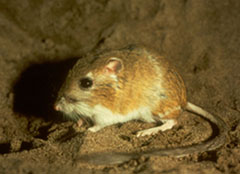
The California Kangaroo Rat has a dark cinnamon-tan upper body and darker facial markings. Its underside, feet, belly, and forelegs are almost entirely white.[1][2]
Its long, well-furred tail has black stripes on its upper and lower surfaces and a white tuft at its tip. The tail is longer than the body.[3][4][5]
The species has large hind feet, small forefeet, four toes on each foot, large eyes and ears, and silky fur. It also has external cheek pouches on both sides of its face.[6][7][8]
Adult individuals range from 260 to 340 mm in total length, and the tail measures between 152 and 217 mm. The species is estimated to weigh approximately 75 grams.[9][10][4]
Upper coloration ranges from cinnamon to nearly black, while the underside is very light. The coat becomes lighter in texture during molting between approximately July and November.[11][12]
Males tend to be slightly larger than females. Individuals from northern parts of the distribution tend to be larger than those from southern areas.[13][14]
Habitat
The California Kangaroo Rat prefers areas receiving less than 50 cm of annual precipitation. It requires well-drained soils suitable for burrowing and fine sand or soil for dust bathing.[15][16][17]
The species occurs on the floor of the Sacramento Valley and below 400 m in the foothills of the Sierra Nevada and Cascade ranges. Its documented elevation range is 60 to 400 m.[18][19]
Diet
The California Kangaroo Rat primarily eats seeds and berries. Its diet also includes tubers, green vegetation, and some insects.[20][21]
Its food includes manzanita seeds and berries, Ceanothus seeds, rabbitbrush, lupines, bur-clover, and wild oats. Manzanita berries are preferred during autumn, while green vegetation is preferred during spring.[22][23]
The species obtains water from its food and metabolic processes rather than requiring a separate freshwater source.[24]
Behaviour
Individuals communicate using scent marks and foot drumming. Hind-foot strikes against the ground produce vibrations that warn nearby kangaroo rats to leave.[25][26]
Individuals bury food in small caches near their burrows.[27]
Reproduction and life cycle
The species has separate male and female sexes. Breeding is most likely between February and September, with peak activity from February through April.[28][29]
A female may produce up to three litters annually. Each litter contains between two and four altricial young.[30][31]
Females nurse their young in protected burrows until the offspring are ready to disperse.[32]
Conservation
The California Kangaroo Rat is classified as Least Concern by the IUCN.[33]
Uses
The California Kangaroo Rat contributes to seed dispersal because it does not consume every seed it stores.[34]
Similar species
Dipodomys californicus can be distinguished from Dipodomys deserti and Dipodomys merriami by its coloration and size. It also has a broader face than both species.[35][36]
Classification of the California Kangaroo Rat
| Kingdom | Animalia |
|---|---|
| Phylum | Chordata |
| Subphylum | Vertebrata |
| Infraphylum | Gnathostomata |
| Parvphylum | Osteichthyes |
| Megaclass | Tetrapoda |
| Class | Mammalia (Mammal) |
| Subclass | Theria |
| Infraclass | Eutheria |
| Order | Rodentia (Rodent) |
| Suborder | Castorimorpha |
| Family | Heteromyidae (Pocket Mice) |
| Subfamily | Dipodomyinae (Kangaroo Mice) |
| Genus | Dipodomys (Kangaroo Rat) |
| Species | Dipodomys californicus Merriam, 1890 |
Where the California Kangaroo Rat is found
Checklists and occurrence records place Dipodomys californicus in 2 countries across North America. GBIF holds 1,509 georeferenced records of it.
Countries
Regions and cities with the most records
- California, United States 1,042
- Oregon, United States 80
- Altamont, United States 56
- Paradise, United States 51
- Chico, United States 50
- South Yuba City, United States 23
- Yuba City, United States 23
- Ukiah, United States 22
- Novato, United States 17
- San Rafael, United States 17
- Petaluma, United States 16
- Clearlake, United States 13
- Klamath Falls, United States 13
- Susanville, United States 9
- Central Point, United States 5
- Fairfield, United States 3
- Oroville, United States 3
- Suisun, United States 3
Range as the checklists state it
North America
A number beside a place is its count of GBIF occurrence records. A place without a number comes from a checklist alone. Records show where a species has been observed or collected, which can include escapes and vagrants.
Common names
English
- California Kangaroo Rat
Names in 6 other languages
- Czech
- tarbíkomyš kalifornská
- Finnish
- kaliforniankengurotta
- Japanese
- カリフォルニアカンガルーネズミ
- Polish
- Szczuroskoczek kalifornijski
- Russian
- Калифорнийский кенгуровый прыгун
- Spanish
- Rata canguro de California
Subspecies and varieties
- Dipodomys californicus californicus subspecies
- Dipodomys californicus eximius (Marysville California Kangaroo Rat) subspecies
- Dipodomys californicus saxatilis subspecies
Related species
-
 Merriam's Kangaroo RatDipodomys merriami
-
 Desert Kangaroo RatDipodomys deserti
-
 Ord's Kangaroo RatDipodomys ordii
-
 Giant Kangaroo RatDipodomys ingens
-
 Banner-tailed Kangaroo RatDipodomys spectabilis
-
 Panamint Kangaroo RatDipodomys panamintinus
-
 Agile Kangaroo RatDipodomys agilis
-
 Chisel-toothed Kangaroo RatDipodomys microps
Compare
Questions and answers
What is the scientific name of the California Kangaroo Rat?
The scientific name of the California Kangaroo Rat is Dipodomys californicus. Written with its author, the full name is Dipodomys californicus Merriam, 1890.
Which family does the California Kangaroo Rat belong to?
Dipodomys californicus belongs to the family Heteromyidae, in the order Rodentia and the class Mammalia.
Where is the California Kangaroo Rat found?
Checklists and occurrence records place Dipodomys californicus in 2 countries: United States and Mexico.
What is the conservation status of the California Kangaroo Rat?
The IUCN Red List category recorded for Dipodomys californicus is Least Concern (LC).
What is the diet of a kangaroo rat?
The California Kangaroo Rat primarily eats seeds and berries. Its diet also includes tubers, green vegetation, and some insects.[20][21]
What habitat does a kangaroo rat live in?
The California Kangaroo Rat prefers areas receiving less than 50 cm of annual precipitation. It requires well-drained soils suitable for burrowing and fine sand or soil for dust bathing.[15][16][17]
Is a kangaroo rat a carnivore, herbivore, or omnivore?
The California Kangaroo Rat eats seeds, berries, tubers, and green vegetation, as well as some insects.[20][21]
Where do kangaroo rats live in California?
The California Kangaroo Rat occurs in California from the San Francisco Bay area northward to south-central Oregon. In California, it occurs on the floor of the Sacramento Valley and below 400 m in the foothills of the Sierra Nevada and Cascade ranges.[37][18]
Sources
Passages the profile rests on
- The underside, feet, belly, and forelegs are almost entirely white. Source passage: “has an almost all-white underside, including its feet, belly, and forelegs” — English Wikipedia
- The animal has a dark cinnamon-tan upper body and darker facial markings. Source passage: “The upper surface of the body tends to be a dark cinnamon-tan shade, extending everywhere but the face, which features darker facial markings.” — English Wikipedia
- The species has a white-tipped tail with black stripes on its upper and lower surfaces. Source passage: “their unique tail coloration which features a white tip with black stripes on the top and bottom.” — English Wikipedia
- The tail measures between 152 and 217 mm and is longer than the body. Source passage: “The tail is longer than the body at 152 to 217 mm in length.” — animaldiversity.org
- The long, well-furred tail has a white tuft at its tip. Source passage: “Their long, well furred tail is tufted with white at the tip.” — animaldiversity.org
- The species has large hind feet, small forefeet, and four toes on each foot. Source passage: “Like all kangaroo rats, these animals have large hind feet and small forefeet. Each of their feet has four toes.” — animaldiversity.org
- The species has large eyes and ears and silky fur. Source passage: “They have large eyes and ears and silky fur.” — animaldiversity.org
- The species has external cheek pouches on both sides of its face. Source passage: “They have external cheekpouches on each side of their face.” — animaldiversity.org
- The species is estimated to weigh approximately 75 grams. Source passage: “experts conclude the weight of the species to be around 75 grams” — English Wikipedia
- Adults range from 260 to 340 mm in total length. Source passage: “Dipodomys californicus ranges from 260 to 340 mm in total length.” — animaldiversity.org
- The coat becomes lighter in texture during molting between approximately July and November. Source passage: “During the molting season for the kangaroo rat (around July through November), the active shedding of the previous year's fur will result in a lighter-textured coat growing anew” — English Wikipedia
- The upper coloration ranges from cinnamon to nearly black, while the underside is very light. Source passage: “They are dark colored on top, ranging from cinnamon to nearly black, and are very light underneath.” — animaldiversity.org
- Individuals from northern parts of the distribution tend to be larger than those from southern areas. Source passage: “The species generally tends to be larger in the northern areas of its distribution (near Modoc County)” — English Wikipedia
- Males tend to be slightly larger than females. Source passage: “Males and females are similar although males tend to be slightly larger.” — animaldiversity.org
- The species prefers areas receiving less than 50 cm of annual precipitation. Source passage: “It prefers areas that get less than 50 cm of precipitation per year” — animaldiversity.org
- The species requires well-drained soils suitable for burrowing. Source passage: “and requires well drained soils that are suitable for burrowing.” — animaldiversity.org
- The species requires fine sand or soil for dust bathing. Source passage: “This species requires fine sand or soil for dust bathing.” — animaldiversity.org
- The species occurs on the floor of the Sacramento Valley and below 400 m in the foothills of the Sierra Nevada and Cascade ranges. Source passage: “This species occurs on the floor of the Sacramento Valley and below 400 m in the foothills of the Sierra Nevada and Cascade mountain ranges.” — animaldiversity.org
- The documented elevation range is 60 to 400 m. Source passage: “It is found from elevations of 60 to 400 m” — animaldiversity.org
- The species primarily eats seeds and berries. Source passage: “Dipodomys californicus eats mostly seeds and berries.” — animaldiversity.org
- Its diet also includes tubers, green vegetation, and some insects. Source passage: “It also consumes some tubers, green vegetation, and may eat a few insects.” — animaldiversity.org
- The species consumes manzanita seeds and berries, Ceanothus seeds, rabbitbrush, lupines, bur-clover, wild oats, tubers, green vegetation, and insects. Source passage: “Foods eaten include: manzanita seeds and berries, Ceanothus seeds, rabbitbrush, lupines, bur-clover, insects, wild oats, small tubers and green vegetation.” — animaldiversity.org
- Manzanita berries are preferred during autumn, while green vegetation is preferred during spring. Source passage: “Dipodomys californicus seems to prefer manzanita berries in the fall and green vegetation in the spring.” — animaldiversity.org
- The species obtains water from its food and metabolic processes rather than requiring a separate freshwater source. Source passage: “They don't need a source a fesh water as they get water from their diet and through metabolic processes.” — animaldiversity.org
- Individuals communicate using scent marks and foot drumming. Source passage: “Individuals of this species use scent marks and foot drumming to communicate with conspecifics.” — animaldiversity.org
- Individuals use hind-foot strikes against the ground to produce vibrations that warn nearby kangaroo rats to leave. Source passage: “they hit their hind feet on the ground to create vibrations that signal to the other kangaroo rat to go away.” — animaldiversity.org
- Individuals bury food in small caches near their burrows. Source passage: “Individuals of this species make small food caches by burying food in an area near their burrow.” — animaldiversity.org
- Breeding is most likely between February and September, with peak activity from February through April. Source passage: “but is most likely to occur between February and September, peaking from February to April.” — animaldiversity.org
- The species has separate male and female sexes. Source passage: “gonochoric/gonochoristic/dioecious (sexes separate)” — animaldiversity.org
- A female may produce up to three litters annually. Source passage: “A female may produce as many as 3 litters per year.” — animaldiversity.org
- Each litter contains between two and four altricial young. Source passage: “There are 2 to 4 altricial young per litter.” — animaldiversity.org
- Females nurse their young in protected burrows until the offspring are ready to disperse. Source passage: “Females nurse the young in a protected burrow until they are ready to disperse.” — animaldiversity.org
- The California kangaroo rat is classified as Least Concern by the IUCN. Source passage: “It is an IUCN listed Least Concern species” — English Wikipedia
- The species contributes to seed dispersal because it does not consume every seed it stores. Source passage: “They do aid in the dispersal of seeds as they don't eat every seed they stash.” — animaldiversity.org
- Dipodomys californicus can be distinguished from Dipodomys deserti and Dipodomys merriami by its coloration and size. Source passage: “The species can be differentiated from similar species such as Dipodomys deserti and Dipodomys merriami by their coloration and size.” — animaldiversity.org
- Dipodomys californicus has a broader face than Dipodomys deserti and Dipodomys merriami. Source passage: “Dipodomys californicus also has a broader face than either of these two species.” — animaldiversity.org
- The species occurs in California from the San Francisco Bay area northward to south-central Oregon. Source passage: “Dipodomys californicus is found in California as far south as San Francisco Bay and north to south-central Oregon.” — animaldiversity.org
Data
- Catalogue of Life, 2026-10-16 XR cc by
- Global Biodiversity Information Facility CC BY 4.0
- Wikidata CC0
- GeoNames CC BY 4.0
- Wikimedia Commons per image; credit shown with each image
- Within the Catalogue of Life, this name comes from The Integrated Taxonomic Information System cc0
References
- N. Am. Fauna vol.4 p.49 where the name was published
- Banks, R. C., R. W. McDiarmid, and A. L. Gardner. (1987). Checklist of Vertebrates of the United States, the U.S. Territories, and Canada. Resource Publication, No. 166.
- Wilson, Don E., and DeeAnn M. Reeder, eds. (1993). Mammal Species of the World: A Taxonomic and Geographic Reference, 2nd Ed., 3rd Printing.
- Wilson, Don E., and Sue Ruff, eds. (1999). The Smithsonian Book of North American Mammals.
- Wilson, Don E., and F. Russell Cole. (2000). Common Names of Mammals of the World.
- Wilson, Don E., and DeeAnn M. Reeder, eds. (2005). Mammal Species of the World: A Taxonomic and Geographic Reference, 3rd Ed., Vols. 1 & 2.
- Hafner, M. S. / Wilson, Don E., T. E. Lacher Jr., and R. A. Mittermeier, eds. (2016). Family Heteromyidae (Pocket Mice, Kangaroo Mice and Kangaroo Rats). Handbook of the Mammals of the World. Vol. 6: Lagomorphs and Rodents I.
- Burgin, Connor J., Don E. Wilson, Russell A. Mittermeier, Anthony B. Rylands, et al. (2020). Illustrated Checklist of the Mammals of the World. Vol. 1. Monotremata to Rodentia.
This species in other databases
Page built on 29 November 2026. See how the catalog is made and all sources and licences.
Cite this page
ScientificNames.org. (2026). Dipodomys californicus (California Kangaroo Rat). Retrieved November 29, 2026, from https://scientificnames.org/species/dipodomys-californicus
“Dipodomys californicus (California Kangaroo Rat).” ScientificNames.org, 2026, scientificnames.org/species/dipodomys-californicus. Accessed 29 Nov. 2026.
ScientificNames.org. “Dipodomys californicus (California Kangaroo Rat).” Accessed November 29, 2026. https://scientificnames.org/species/dipodomys-californicus.
@misc{scientificnames_dipodomys_californicus_california_kangaroo_rat,
  author = {{ScientificNames.org}},
  title = {Dipodomys californicus (California Kangaroo Rat)},
  year = {2026},
  url = {https://scientificnames.org/species/dipodomys-californicus},
  note = {Accessed 2026-11-29}
}