Species · Mammals
Panamint Kangaroo Rat Dipodomys panamintinus
The scientific name of the Panamint Kangaroo Rat is Dipodomys panamintinus. It is a species of mammal in the family Heteromyidae (pocket mice), order Rodentia. The name dates from 1894.
- Scientific name
- Dipodomys panamintinus (Merriam, 1894)
- Common name
- Panamint Kangaroo Rat
- Genus
- Dipodomys
- Family
- Heteromyidae (Pocket Mice)
- Order
- Rodentia
- Class
- Mammalia
- Red List category
- LC Least Concern
- Recorded in
- 1 country
- Name status
- accepted in the Catalogue of Life

Overview
The Panamint Kangaroo Rat (Dipodomys panamintinus) is a mammal in the family Heteromyidae, order Rodentia, and class Mammalia. It inhabits Great Basin bush desert in western Nevada and areas east of the Sierra Nevada in California. It has a long tail averaging 140% of its body length, pale clay-colored fur, and fur-lined cheek pouches.
Written 26 November 2026 from the sources listed below. Each statement was checked against the passage it cites; statements that could not be supported were removed.
Appearance
The Panamint Kangaroo Rat has pale clay-colored fur with blackish patches around its face. Its long tail averages 140% of its body length and has a white stripe and a heavy terminal hair tuft.[1][2]
The species has five toes on each hind foot and is medium-sized relative to other members of its genus. Males tend to have larger body sizes than females.[3][4][5]
The species has fur-lined cheek pouches that allow it to carry large quantities of food.[6]
Habitat
The Panamint Kangaroo Rat inhabits Great Basin bush desert in western Nevada and areas east of the Sierra Nevada in California. It occurs at elevations between 1,200 and 1,950 meters.[7][8]
The species occupies holes in small sand mounds accumulated around clumps of brush. In the Panamint Mountains, an individual may occupy a burrow containing at least 12 tunnels.[9][10]
The entrances of some burrows are connected by clearly defined surface runways.[11]
Diet
The species also eats green grass shoots, insects, and mesquite. It collects seeds in its fur-lined cheek pouches.[12][13]
The species uses both scatter hoarding and larder hoarding to store seeds.[14]
Behaviour
The Panamint Kangaroo Rat is nocturnal and does not hibernate. It remains active throughout the year except when snow cover restricts its activity.[15][16]
The species is solitary except during estrus. When frightened, it uses erratic bipedal leaps to avoid predators.[17][18]
The species can swim effectively, using its large hind feet for agility in water. When environmental temperatures exceed 35 °C, it uses its burrows to maintain body temperature.[19][20]
The species produces highly concentrated urine to conserve water. When deprived of water, it produces a small drop of urine every one to two hours.[21][22]
Reproduction and life cycle
The main breeding season of the Panamint Kangaroo Rat occurs during February and March. Females typically produce litters of three to four young.[23][24]
Males expand their home ranges during spring in connection with mating. Successful breeding involves males and females living separately before briefly coming together to mate.[25][26]
Classification of the Panamint Kangaroo Rat
| Kingdom | Animalia |
|---|---|
| Phylum | Chordata |
| Subphylum | Vertebrata |
| Infraphylum | Gnathostomata |
| Parvphylum | Osteichthyes |
| Megaclass | Tetrapoda |
| Class | Mammalia (Mammal) |
| Subclass | Theria |
| Infraclass | Eutheria |
| Order | Rodentia (Rodent) |
| Suborder | Castorimorpha |
| Family | Heteromyidae (Pocket Mice) |
| Subfamily | Dipodomyinae (Kangaroo Mice) |
| Genus | Dipodomys (Kangaroo Rat) |
| Species | Dipodomys panamintinus (Merriam, 1894) |
Where the Panamint Kangaroo Rat is found
Checklists and occurrence records place Dipodomys panamintinus in 1 country across North America. GBIF holds 4,712 georeferenced records of it.
Countries
Regions and cities with the most records
- California, United States 3,808
- Hesperia, United States 319
- Ridgecrest, United States 246
- Victorville, United States 217
- Apple Valley, United States 216
- Nevada, United States 195
- Vincent, United States 170
- Palmdale, United States 162
- Adelanto, United States 151
- Sparks, United States 70
- Reno, United States 69
- Lancaster, United States 65
- Spanish Springs, United States 60
- Sun Valley, United States 60
- Rosamond, United States 57
- Carson City, United States 19
- Barstow, United States 7
- Barstow Heights, United States 6
Range as the checklists state it
North America
A number beside a place is its count of GBIF occurrence records. A place without a number comes from a checklist alone. Records show where a species has been observed or collected, which can include escapes and vagrants.
Common names
English
- Panamint Kangaroo Rat
Names in 5 other languages
- Finnish
- aavikkokengurotta
- Japanese
- パナミントカンガルーネズミ
- Polish
- Szczuroskoczek jałowcowy
- Russian
- Панаминтский кенгуровый прыгун
- Spanish
- Rata canguro del valle de Panamint
Synonyms
One other scientific name has been used for this species and is now treated as a synonym of Dipodomys panamintinus.
- Perodipus panamintinus Merriam, 1894
Subspecies and varieties
- Dipodomys panamintinus argusensis (Argus Mountains Kangaroo Rat) subspecies
- Dipodomys panamintinus caudatus subspecies
- Dipodomys panamintinus leucogenys subspecies
- Dipodomys panamintinus mohavensis subspecies
- Dipodomys panamintinus panamintinus (Panamint Kangaroo Rat) subspecies
Related species
-
 Merriam's Kangaroo RatDipodomys merriami
-
 Desert Kangaroo RatDipodomys deserti
-
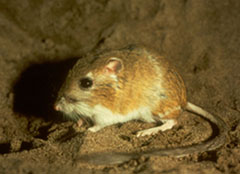 Ord's Kangaroo RatDipodomys ordii
-
 Giant Kangaroo RatDipodomys ingens
-
 Banner-tailed Kangaroo RatDipodomys spectabilis
-
 California Kangaroo RatDipodomys californicus
-
 Agile Kangaroo RatDipodomys agilis
-
 Chisel-toothed Kangaroo RatDipodomys microps
Compare
Questions and answers
What is the scientific name of the Panamint Kangaroo Rat?
The scientific name of the Panamint Kangaroo Rat is Dipodomys panamintinus. Written with its author, the full name is Dipodomys panamintinus (Merriam, 1894).
Which family does the Panamint Kangaroo Rat belong to?
Dipodomys panamintinus belongs to the family Heteromyidae, in the order Rodentia and the class Mammalia.
Where is the Panamint Kangaroo Rat found?
Checklists and occurrence records place Dipodomys panamintinus in 1 country: United States.
What is the conservation status of the Panamint Kangaroo Rat?
The IUCN Red List category recorded for Dipodomys panamintinus is Least Concern (LC).
Do kangaroo rats still exist?
The Panamint Kangaroo Rat is a species with a distribution in eastern California and western Nevada, United States.[27]
Why do they call it a kangaroo rat?
The common name kangaroo rat derives from the species' bipedal form.[28]
Sources
Passages the profile rests on
- The Panamint kangaroo rat has pale clay-colored fur with blackish patches around its face. Source passage: “It is pale clay-colored with blackish patches around the face.” — English Wikipedia
- The species has a long tail averaging 140% of its body length, with a white stripe and a heavy terminal hair tuft. Source passage: “The tail is extremely long, on average 140% of its body length and contains a white stripe with a heavy tuft of hair at the end.” — English Wikipedia
- The Panamint kangaroo rat has five toes on each hind foot. Source passage: “the hind feet have five toes” — English Wikipedia
- Males tend to have larger body sizes than females. Source passage: “males tend to be larger than females in body size.” — English Wikipedia
- The Panamint kangaroo rat is medium-sized relative to other members of its genus. Source passage: “The Panamint kangaroo rat is considered medium-sized for its genus.” — English Wikipedia
- The species has fur-lined cheek pouches that allow it to carry large quantities of food. Source passage: “A notable characteristic of the Panamint kangaroo rat is the fur lined cheek pouches that it uses to obtain large quantities of food.” — English Wikipedia
- The species inhabits Great Basin bush desert in western Nevada and areas east of the Sierra Nevada in California. Source passage: “It is centered in Great Basin bush desert in western Nevada and east of the Sierra Nevada mountains in California” — English Wikipedia
- The species occurs at elevations between 1,200 and 1,950 meters. Source passage: “They tend to live at higher elevations between 1,200 and 1,950 meters (3,940 and 6,400 ft).” — English Wikipedia
- Panamint kangaroo rats occupy holes in small sand mounds accumulated around clumps of brush. Source passage: “Panamint kangaroo rats occupy holes in small mounds of sand that have accumulated around clumps of brush.” — English Wikipedia
- In the Panamint Mountains, an individual may occupy a burrow containing at least 12 tunnels. Source passage: “In the Panamint Mountains, one animal may occupy a burrow that has 12 or more tunnels” — English Wikipedia
- The entrances of some burrows are connected by clearly defined surface runways. Source passage: “the mouths of which are connected on the surface by well-defined runways.” — English Wikipedia
- The species eats green grass shoots, insects, and mesquite. Source passage: “green shoots of grass, insects, and mesquite.” — English Wikipedia
- The species collects seeds in fur-lined cheek pouches. Source passage: “It gathers large bunches of seeds and packs them into fur-lined cheek pouches.” — English Wikipedia
- The Panamint kangaroo rat uses both scatter hoarding and larder hoarding to store seeds. Source passage: “They tend to partake in both scatter hoarding (single or small clusters of seeds buried in the ground surface) and larder hoarding (deposition of seeds in burrows and chambers).” — English Wikipedia
- The Panamint kangaroo rat is nocturnal and does not hibernate. Source passage: “The Panamint kangaroo rat is nocturnal and does not hibernate.” — English Wikipedia
- The species remains active throughout the year except when snow cover restricts its activity. Source passage: “It tends to be active throughout the year except when limited by snow cover.” — English Wikipedia
- The species is solitary except during estrus. Source passage: “The species is solitary and separate except during estrus.” — English Wikipedia
- When frightened, the species uses erratic bipedal leaps to avoid predators. Source passage: “when frightened, the hopping changes into erratic bipedal leaps in order to avoid predators.” — English Wikipedia
- The species can swim effectively, using its large hind feet for agility in water. Source passage: “Panamint kangaroo rats are excellent swimmers, their large hind feet give them considerable agility in the water.” — English Wikipedia
- The species uses its burrows to maintain body temperature when environmental temperatures exceed 35 °C. Source passage: “Above 35 °C the Panamint kangaroo rat utilizes their burrows to help maintain homeothermy.” — English Wikipedia
- The species produces highly concentrated urine to conserve water. Source passage: “These kangaroo rats are able to excrete urine that is extremely concentrated as a means to retain water.” — English Wikipedia
- When deprived of water, the species produces a small drop of urine every one to two hours. Source passage: “When deprived of water, it only produces a small drop of urine every 1–2 hours.” — English Wikipedia
- The main breeding season of the Panamint kangaroo rat occurs during February and March. Source passage: “The height of breeding season is between February and March.” — English Wikipedia
- Females typically produce litters of three to four young. Source passage: “Litter size ranges between 3 and 4 young.” — English Wikipedia
- Males expand their home ranges during spring in connection with mating. Source passage: “Males home ranges will become broader during spring for mating.” — English Wikipedia
- Successful breeding involves males and females living separately before briefly coming together to mate. Source passage: “successful breeding demands that both sexes dwell separately, coming together for mating with only a brief paring interval.” — English Wikipedia
- The Panamint kangaroo rat is endemic to the Mojave Desert in eastern California and western Nevada, United States. Source passage: “It is endemic to the Mojave Desert in eastern California and western Nevada, in the United States.” — English Wikipedia
- The common name kangaroo rat derives from the species' bipedal form. Source passage: “Their common name derives from their bipedal form.” — English Wikipedia
Data
- Catalogue of Life, 2026-10-16 XR cc by
- Global Biodiversity Information Facility CC BY 4.0
- Wikidata CC0
- GeoNames CC BY 4.0
- Wikimedia Commons per image; credit shown with each image
- Within the Catalogue of Life, this name comes from The Integrated Taxonomic Information System cc0
References
- Proc. Biol. Soc. Wash. vol.9 p.114 where the name was published
- Banks, R. C., R. W. McDiarmid, and A. L. Gardner. (1987). Checklist of Vertebrates of the United States, the U.S. Territories, and Canada. Resource Publication, No. 166.
- Wilson, Don E., and DeeAnn M. Reeder, eds. (1993). Mammal Species of the World: A Taxonomic and Geographic Reference, 2nd Ed., 3rd Printing.
- Wilson, Don E., and Sue Ruff, eds. (1999). The Smithsonian Book of North American Mammals.
- Wilson, Don E., and F. Russell Cole. (2000). Common Names of Mammals of the World.
- Wilson, Don E., and DeeAnn M. Reeder, eds. (2005). Mammal Species of the World: A Taxonomic and Geographic Reference, 3rd Ed., Vols. 1 & 2.
- Hafner, M. S. / Wilson, Don E., T. E. Lacher Jr., and R. A. Mittermeier, eds. (2016). Family Heteromyidae (Pocket Mice, Kangaroo Mice and Kangaroo Rats). Handbook of the Mammals of the World. Vol. 6: Lagomorphs and Rodents I.
- Burgin, Connor J., Don E. Wilson, Russell A. Mittermeier, Anthony B. Rylands, et al. (2020). Illustrated Checklist of the Mammals of the World. Vol. 1. Monotremata to Rodentia.
This species in other databases
Page built on 27 November 2026. See how the catalog is made and all sources and licences.
Cite this page
ScientificNames.org. (2026). Dipodomys panamintinus (Panamint Kangaroo Rat). Retrieved November 27, 2026, from https://scientificnames.org/species/dipodomys-panamintinus
“Dipodomys panamintinus (Panamint Kangaroo Rat).” ScientificNames.org, 2026, scientificnames.org/species/dipodomys-panamintinus. Accessed 27 Nov. 2026.
ScientificNames.org. “Dipodomys panamintinus (Panamint Kangaroo Rat).” Accessed November 27, 2026. https://scientificnames.org/species/dipodomys-panamintinus.
@misc{scientificnames_dipodomys_panamintinus_panamint_kangaroo_rat,
  author = {{ScientificNames.org}},
  title = {Dipodomys panamintinus (Panamint Kangaroo Rat)},
  year = {2026},
  url = {https://scientificnames.org/species/dipodomys-panamintinus},
  note = {Accessed 2026-11-27}
}