Species · Mammals
Desert Kangaroo Rat Dipodomys deserti
The scientific name of the Desert Kangaroo Rat is Dipodomys deserti. It is a species of mammal in the family Heteromyidae (pocket mice), order Rodentia. The name dates from 1887.
- Scientific name
- Dipodomys deserti Stephens, 1887
- Common name
- Desert Kangaroo Rat
- Genus
- Dipodomys
- Family
- Heteromyidae (Pocket Mice)
- Order
- Rodentia
- Class
- Mammalia
- Red List category
- LC Least Concern
- Recorded in
- 2 countries
- Name status
- accepted in the Catalogue of Life

Overview
The Desert Kangaroo Rat (Dipodomys deserti Stephens, 1887) is a mammal in the family Heteromyidae, order Rodentia, and class Mammalia. It inhabits arid parts of southwestern North America, primarily occupying sand dunes and areas with substantial accumulations of wind-driven sand.
Written 26 November 2026 from the sources listed below. Each statement was checked against the passage it cites; statements that could not be supported were removed.
Appearance
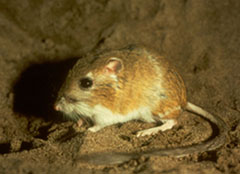
The upper body is pale brown to grayish, while the underside is white. All feet are covered with long hairs, and the hind feet have four toes each.[1][2]
The species has the thickest hair among members of its genus. Its tail has long guard hairs with white tips along its upper surface.[3][4]
Habitat
The species primarily inhabits sand dunes in highly arid regions of southwestern North America. It is associated with areas containing substantial accumulations of wind-driven sand.[5][6]
Although primarily associated with sandy terrain, it has also been recorded at a locality in central Arizona with gravelly soil. It uses mainly unvegetated mounds as burrow sites.[7][8]
Underground burrow chambers contain multiple storerooms and a central nest. Burrow colonies may contain clusters of six to twelve widely spaced large burrows.[9][10]
The species occurs at elevations from 60 meters below sea level in Death Valley, California, to 1,710 meters in Huntoon Valley, Nevada. Its distribution includes Death Valley, the Great Basin, the Mojave Desert, and portions of the Sonoran Desert.[11][12]
Diet
Seeds are the dominant component of the species' diet. It prefers dried plant matter from the previous year, particularly sage leaves and creosote bush seeds.[13][14]
The species stores large quantities of mesquite pods and other plant seeds in underground chambers. It selects seeds with relatively high carbohydrate content and does not consume green vegetation.[15][16][17]
Behaviour
The species is highly solitary, with burrows generally occupied by only one individual except when a female has a litter. Individuals aggressively defend their territories against other members of their species.[18][19]
The species is principally nocturnal but sometimes emerges from its burrow during daylight. Individuals may forage within a radius of up to 100 m during a single night.[20][21]
Individuals frequently modify their burrows by plugging entrances, opening new ones, and digging tunnels. The species dust-bathes in sand to keep its fur clean and free of grease.[22][23]
The species does not hibernate. Individuals move faster and travel farther on full-moon nights than on new-moon nights.[24][25]
Males are more exploratory than females. Individuals with lower body-condition scores spend more time exploring, while those with longer feet travel farther during exploratory activity.[26][27][28]
Reproduction and life cycle
Reproductive activity occurs from early January through early July. The gestation period lasts between 29 and 32 days, and females produce one or two litters annually.[29][30][31]
Litters contain between one and six embryos. Females may enter estrus 10 to 15 days after giving birth.[32][33]
Young are born with a mass between 2.2 and 4.6 g. Newborns are approximately 52 mm long and initially lack fur.[34][35]
Young develop complete pigmentation and fur by weaning at approximately 21 days of age. Sexual maturity probably occurs at approximately two months of age.[36][37]
Classification of the Desert Kangaroo Rat
| Kingdom | Animalia |
|---|---|
| Phylum | Chordata |
| Subphylum | Vertebrata |
| Infraphylum | Gnathostomata |
| Parvphylum | Osteichthyes |
| Megaclass | Tetrapoda |
| Class | Mammalia (Mammal) |
| Subclass | Theria |
| Infraclass | Eutheria |
| Order | Rodentia (Rodent) |
| Suborder | Castorimorpha |
| Family | Heteromyidae (Pocket Mice) |
| Subfamily | Dipodomyinae (Kangaroo Mice) |
| Genus | Dipodomys (Kangaroo Rat) |
| Species | Dipodomys deserti Stephens, 1887 |
Where the Desert Kangaroo Rat is found
Checklists and occurrence records place Dipodomys deserti in 2 countries across North America. GBIF holds 4,400 georeferenced records of it.
Countries
Regions and cities with the most records
- California, United States 1,765
- Arizona, United States 549
- Nevada, United States 510
- Sonora, Mexico 275
- Baja California, Mexico 167
- Puerto Peñasco, Mexico 103
- Somerton, United States 99
- Scottsdale, United States 91
- Yuma, United States 82
- San Luis Río Colorado, Mexico 80
- San Felipe, Mexico 79
- San Luis, United States 67
- Coachella, United States 56
- Fountain Hills, United States 55
- Palm Springs, United States 53
- Cathedral City, United States 52
- Desert Hot Springs, United States 49
- Rancho Mirage, United States 49
- Eloy, United States 44
- Palm Desert, United States 43
- Chandler, United States 35
- Barstow, United States 34
- Barstow Heights, United States 34
- Mesa, United States 33
- Tempe, United States 33
- Tempe Junction, United States 33
- Gilbert, United States 30
- Phoenix, United States 28
- Fortuna Foothills, United States 27
- La Quinta, United States 25
- Utah, United States 25
- Casa Grande, United States 21
- Mesquite, United States 21
- Apple Valley, United States 20
- Blythe, United States 19
- Indio, United States 18
Range as the checklists state it
Middle America
North America
A number beside a place is its count of GBIF occurrence records. A place without a number comes from a checklist alone. Records show where a species has been observed or collected, which can include escapes and vagrants.
Common names
English
- Desert Kangaroo Rat
Names in 9 other languages
- Czech
- tarbíkomyš pouštní
- Dutch
- Woestijnkangoeroegoffer
- Finnish
- sonorankengurotta
- Greek
- Διποδόμυς της ερήμου
- Japanese
- サバクカンガルーネズミ
- Polish
- Szczuroskoczek pustynny
- Portuguese
- Rato-canguru-do-deserto
- Russian
- Пустынный кенгуровый прыгун
- Spanish
- Rata canguro de Sonora, Rata-canguro desértica
Subspecies and varieties
- Dipodomys deserti aquilus subspecies
- Dipodomys deserti arizonae subspecies
- Dipodomys deserti deserti subspecies
- Dipodomys deserti sonoriensis subspecies
Related species
-
 Merriam's Kangaroo RatDipodomys merriami
-
 Ord's Kangaroo RatDipodomys ordii
-
 Giant Kangaroo RatDipodomys ingens
-
 Banner-tailed Kangaroo RatDipodomys spectabilis
-
 California Kangaroo RatDipodomys californicus
-
 Panamint Kangaroo RatDipodomys panamintinus
-
 Agile Kangaroo RatDipodomys agilis
-
 Chisel-toothed Kangaroo RatDipodomys microps
Compare
Questions and answers
What is the scientific name of the Desert Kangaroo Rat?
The scientific name of the Desert Kangaroo Rat is Dipodomys deserti. Written with its author, the full name is Dipodomys deserti Stephens, 1887.
Which family does the Desert Kangaroo Rat belong to?
Dipodomys deserti belongs to the family Heteromyidae, in the order Rodentia and the class Mammalia.
Where is the Desert Kangaroo Rat found?
Checklists and occurrence records place Dipodomys deserti in 2 countries: United States and Mexico.
What is the conservation status of the Desert Kangaroo Rat?
The IUCN Red List category recorded for Dipodomys deserti is Least Concern (LC).
What is the scientific name of a kangaroo rat?
The scientific name of the Desert Kangaroo Rat is Dipodomys deserti Stephens, 1887.[38]
Do kangaroo rats still exist?
The Desert Kangaroo Rat is a mammal occurring in arid parts of southwestern North America.[12]
Why can't kangaroo rats drink water?
The Desert Kangaroo Rat meets most of its water requirements through metabolic processes rather than drinking environmental water. It can survive prolonged periods without drinking water.[39][40]
Sources
Passages the profile rests on
- The upper body is pale brown to grayish, while the underside is white. Source passage: “The upper parts of the body are pale brown to grayish (depending on the subspecies), and the underside is white.” — animaldiversity.org
- The hind feet have four toes each and all feet are covered with long hairs. Source passage: “D. deserti has four toes on each hind foot, and all of the feet are covered with long hairs.” — animaldiversity.org
- The species has the thickest hair among members of its genus. Source passage: “D deserti has the thickest hair in their genus.” — animaldiversity.org
- The tail has long guard hairs with white tips along its upper surface. Source passage: “In both sexes, the tail has long, white-tipped guard hairs along the top.” — animaldiversity.org
- The species primarily inhabits sand dunes in highly arid regions of southwestern North America. Source passage: “Desert kangaroo rats inhabit dunes in the most arid regions of southwestern North America.” — animaldiversity.org
- The species is associated with areas containing substantial accumulations of wind-driven sand. Source passage: “D. deserti is associated with areas that have substantial accumulations of wind driven sand.” — animaldiversity.org
- Although primarily associated with sandy terrain, the species has also been recorded at a locality in central Arizona with gravelly soil. Source passage: “and are also known to occur at one locality in central Arizona where the soil is gravelly (Best et al., 1989).” — animaldiversity.org
- The species uses mainly unvegetated mounds as burrow sites. Source passage: “D. deserti uses mainly un-vegetated mounds for burrow sites.” — animaldiversity.org
- Underground burrow chambers contain multiple storerooms and a central nest. Source passage: “Underground chambers consist of multiple storerooms and a central nest.” — animaldiversity.org
- Burrow colonies may contain clusters of six to twelve widely spaced large burrows. Source passage: “Desert kangaroo rats may form widely spaced colonies with clusters of 6-12 large burrows in each colony.” — animaldiversity.org
- The species occurs at elevations from 60 meters below sea level in Death Valley, California, to 1,710 meters in Huntoon Valley, Nevada. Source passage: “They occur at elevations ranging from 60 meters below sea level in Death Valley, California, to 1,710 meters in Huntoon Valley, Nevada” — animaldiversity.org
- The species occurs in arid parts of southwestern North America, including Death Valley, the Great Basin, the Mojave Desert, and portions of the Sonoran Desert. Source passage: “including Death Valley, the Great Basin, the Mojave Desert, and portions of the Sonoran Desert.” — English Wikipedia
- Seeds are the dominant component of the species' diet. Source passage: “Seeds are the dominant component of the diet of desert kangaroo rats.” — English Wikipedia
- The species prefers dried plant matter from the previous year, particularly sage leaves and creosote bush seeds. Source passage: “They prefer a diet of dried plant matter from the previous year, particularly leaves of sage, and seeds of the creosote bush” — animaldiversity.org
- The species stores large quantities of mesquite pods and other plant seeds in underground chambers. Source passage: “Within these chambers, D. deserti stores large amounts of mesquite pods and other plant seeds.” — animaldiversity.org
- The species selects seeds with relatively high carbohydrate content. Source passage: “with this species choosing seeds with high carbohydrate content.” — English Wikipedia
- The species does not consume green vegetation. Source passage: “Although some kangaroo rats will consume green vegetation, desert kangaroo rats do not.” — English Wikipedia
- The species is highly solitary, with burrows generally occupied by only one individual except when a female has a litter. Source passage: “Desert kangaroo rats are extremely solitary, and except when a female has a litter, no burrow has more that one occupant.” — animaldiversity.org
- Individuals aggressively defend their territories against other members of their species. Source passage: “Individuals are highly aggressive and actively drive conspecifics out of their territory (Best, 1999).” — animaldiversity.org
- The species is principally nocturnal but sometimes emerges from its burrow during daylight. Source passage: “Although principally nocturnal, D. deserti often ventures out of the burrow during daylight.” — animaldiversity.org
- Individuals may forage within a radius of up to 100 m during a single night. Source passage: “In a single night, an individual may forage in a radius of up to 100 m.” — animaldiversity.org
- Individuals frequently modify their burrows by plugging entrances, opening new ones, and digging tunnels. Source passage: “Much of this time is spent modifying burrows: plugging entrances, opening new entrances and digging new tunnels.” — animaldiversity.org
- The species dust-bathes in sand to keep its fur clean and free of grease. Source passage: “D. deserti also dust bathe in the sand to keep their pelage clean and free from grease.” — animaldiversity.org
- The species does not hibernate. Source passage: “Desert kangaroo rats are excellent swimmers and, like all other kangaroo rats, do not hibernate (Best et al., 1989).” — animaldiversity.org
- Individuals move faster and travel farther on full-moon nights than on new-moon nights. Source passage: “individuals moved faster and farther on full moon nights compared to new moon nights” — pmc.ncbi.nlm.nih.gov
- Males are more exploratory than females. Source passage: “males were more exploratory than females” — pmc.ncbi.nlm.nih.gov
- Individuals with lower body-condition scores spend more time exploring. Source passage: “individuals with lower body condition scores spent more time exploring” — pmc.ncbi.nlm.nih.gov
- Individuals with longer feet travel farther during exploratory activity. Source passage: “individuals with longer feet – a proxy for skeletal size – traveled further.” — pmc.ncbi.nlm.nih.gov
- Reproductive activity occurs from early January through early July. Source passage: “Reproductive activity begins early in January and continues through early July.” — animaldiversity.org
- The gestation period lasts between 29 and 32 days. Source passage: “The gestation period ranges from 29-32 days” — animaldiversity.org
- Females produce one or two litters annually. Source passage: “One or two litters are produced annually.” — animaldiversity.org
- Litters contain between one and six embryos. Source passage: “the number of embryos ranges from 1-6.” — animaldiversity.org
- Females may enter estrus 10 to 15 days after giving birth. Source passage: “Adult females will come into estrus 10-15 days post-partum” — animaldiversity.org
- Young are born with a mass between 2.2 and 4.6 g. Source passage: “The mass of D. deserti at birth ranges between 2.2 and 4.6 g.” — animaldiversity.org
- Newborns are approximately 52 mm long and initially lack fur. Source passage: “The neonate is approximately 52 mm in length, and is naked” — animaldiversity.org
- Young develop complete pigmentation and fur by weaning at approximately 21 days of age. Source passage: “Complete pigmentation and furring appear by weaning, around 21 days of age” — animaldiversity.org
- Sexual maturity probably occurs at approximately two months of age. Source passage: “Sexual maturity probably occurs around 2 months of age” — animaldiversity.org
- Adult males average 342 mm in total length, while adult females average 331 mm. Source passage: “Males average 342 mm in length and females average 331 mm in total length.” — animaldiversity.org
- Most of the species' water requirements are met through metabolic processes rather than drinking environmental water. Source passage: “the vast majority of their water requirements are met from byproducts of metabolic processes.” — English Wikipedia
- The species can survive prolonged periods without drinking water. Source passage: “D. deserti will drink water when it is available, but can survive long periods” — animaldiversity.org
Data
- Catalogue of Life, 2026-10-16 XR cc by
- Global Biodiversity Information Facility CC BY 4.0
- Wikidata CC0
- GeoNames CC BY 4.0
- Wikimedia Commons per image; credit shown with each image
- Within the Catalogue of Life, this name comes from The Integrated Taxonomic Information System cc0
References
- Am. Nat. vol.21 p.42 where the name was published
- Banks, R. C., R. W. McDiarmid, and A. L. Gardner. (1987). Checklist of Vertebrates of the United States, the U.S. Territories, and Canada. Resource Publication, No. 166.
- Wilson, Don E., and DeeAnn M. Reeder, eds. (1993). Mammal Species of the World: A Taxonomic and Geographic Reference, 2nd Ed., 3rd Printing.
- Wilson, Don E., and Sue Ruff, eds. (1999). The Smithsonian Book of North American Mammals.
- Wilson, Don E., and F. Russell Cole. (2000). Common Names of Mammals of the World.
- Wilson, Don E., and DeeAnn M. Reeder, eds. (2005). Mammal Species of the World: A Taxonomic and Geographic Reference, 3rd Ed., Vols. 1 & 2.
- Hafner, M. S. / Wilson, Don E., T. E. Lacher Jr., and R. A. Mittermeier, eds. (2016). Family Heteromyidae (Pocket Mice, Kangaroo Mice and Kangaroo Rats). Handbook of the Mammals of the World. Vol. 6: Lagomorphs and Rodents I.
- Burgin, Connor J., Don E. Wilson, Russell A. Mittermeier, Anthony B. Rylands, et al. (2020). Illustrated Checklist of the Mammals of the World. Vol. 1. Monotremata to Rodentia.
This species in other databases
Page built on 27 November 2026. See how the catalog is made and all sources and licences.
Cite this page
ScientificNames.org. (2026). Dipodomys deserti (Desert Kangaroo Rat). Retrieved November 27, 2026, from https://scientificnames.org/species/dipodomys-deserti
“Dipodomys deserti (Desert Kangaroo Rat).” ScientificNames.org, 2026, scientificnames.org/species/dipodomys-deserti. Accessed 27 Nov. 2026.
ScientificNames.org. “Dipodomys deserti (Desert Kangaroo Rat).” Accessed November 27, 2026. https://scientificnames.org/species/dipodomys-deserti.
@misc{scientificnames_dipodomys_deserti_desert_kangaroo_rat,
  author = {{ScientificNames.org}},
  title = {Dipodomys deserti (Desert Kangaroo Rat)},
  year = {2026},
  url = {https://scientificnames.org/species/dipodomys-deserti},
  note = {Accessed 2026-11-27}
}