Overview
Drysdalia mastersii is endemic to Australia, ranging from near Esperance in Western Australia into coastal and subcoastal South Australia, south-eastern South Australia and western Victoria. Its upper body ranges from light brown to dark grey, with a pale band across the nape and a white stripe extending from the upper lip to the neck.
Written 26 November 2026 from the sources listed below. Each statement was checked against the passage it cites; statements that could not be supported were removed.
Appearance
Adults reach an average total length, including the tail, of approximately 40 cm.[1]
The upper body ranges in colour from light brown to dark grey. A pale band crosses the nape, and a white stripe extends from the upper lip to the neck.[2][3][4]
Habitat
Masters' Snake inhabits heathland, grassland and mallee. Its preferred habitats occur on sandy and limestone soils.[5][6]
Diet
Lizards constitute the predominant prey of Masters' Snake.[7]
Reproduction and life cycle
Masters' Snake is viviparous. The average litter size is three offspring.[8][9]
Conservation
Masters' Snake is classified as Least Concern on the IUCN Red List.[10]
Classification of the Masters' Snake
| Kingdom | Animalia |
|---|---|
| Phylum | Chordata |
| Subphylum | Vertebrata |
| Infraphylum | Gnathostomata |
| Parvphylum | Osteichthyes |
| Megaclass | Tetrapoda |
| Class | Reptilia (Reptile) |
| Order | Squamata (Snakes) |
| Suborder | Serpentes (Snakes) |
| Infraorder | Alethinophidia |
| Family | Elapidae (Cobras) |
| Subfamily | Hydrophiinae |
| Genus | Drysdalia (Southeastern Grass Snakes) |
| Species | Drysdalia mastersii (Krefft, 1866) |
Where the Masters' Snake is found
Checklists and occurrence records place Drysdalia mastersii in 1 country across Oceania. GBIF holds 420 georeferenced records of it.
Countries
Regions and cities with the most records
- South Australia, Australia 250
- Victoria, Australia 54
- Western Australia, Australia 41
- New South Wales, Australia 3
Range as the checklists state it
Australia (South Australia, Victoria, Western Australia)
A number beside a place is its count of GBIF occurrence records. A place without a number comes from a checklist alone. Records show where a species has been observed or collected, which can include escapes and vagrants.
Common names
English
- Masters' Snake
- Master's Snake
Names in 1 other language
- Italian
- Serpente di Masters
Synonyms
3 other scientific names have been used for this species and are now treated as synonyms of Drysdalia mastersii.
- Hoplocephalus mastersii Krefft, 1866
- Notechis mastersii (Krefft, 1866)
- Denisonia coronoides Boulenger, 1896 ambiguous synonym
Related species
-
 White-lipped SnakeDrysdalia coronoides
- Mustard-bellied SnakeDrysdalia rhodogaster
-
 King CobraOphiophagus hannah
-
 Inland TaipanOxyuranus microlepidotus
-
 Black MambaDendroaspis polylepis
-
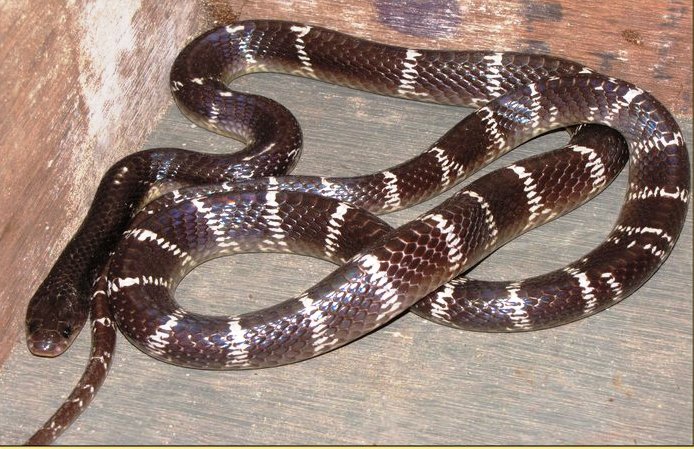 Common KraitBungarus caeruleus
-
 Eastern Brown SnakePseudonaja textilis
-
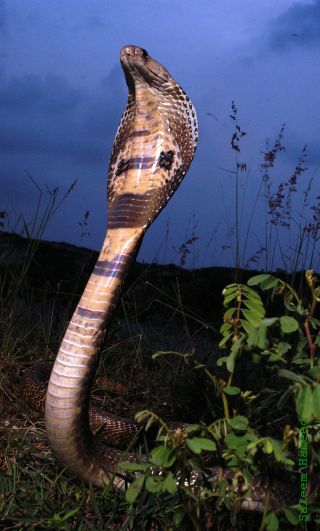 Indian CobraNaja naja
Compare
Questions and answers
What is the scientific name of the Masters' Snake?
The scientific name of the Masters' Snake is Drysdalia mastersii. Written with its author, the full name is Drysdalia mastersii (Krefft, 1866).
Which family does the Masters' Snake belong to?
Drysdalia mastersii belongs to the family Elapidae, in the order Squamata and the class Reptilia.
Where is the Masters' Snake found?
Checklists and occurrence records place Drysdalia mastersii in 1 country: Australia.
What is the conservation status of the Masters' Snake?
The IUCN Red List category recorded for Drysdalia mastersii is Least Concern (LC).
What other names does the Masters' Snake have?
Drysdalia mastersii is also known in English as Master's Snake.
Sources
Passages the profile rests on
- Adults reach an average total length, including the tail, of approximately 40 cm. Source passage: “Drysdalia mastersii grows to an average total length (tail included) of about 40 cm (16 in).” — English Wikipedia
- The upper body ranges in colour from light brown to dark grey. Source passage: “The upper body is light brown to dark grey” — English Wikipedia
- The species has a pale band across the nape. Source passage: “with a pale band over the nape” — English Wikipedia
- A white stripe extends from the upper lip to the neck. Source passage: “a white stripe extending from the upper lip to the neck.” — English Wikipedia
- The species inhabits heathland, grassland and mallee. Source passage: “The preferred natural habitats of Drysdalia mastersii are heathland, grassland, and mallee” — English Wikipedia
- Its preferred habitats occur on sandy and limestone soils. Source passage: “on sandy and limestone soils.” — English Wikipedia
- Lizards constitute the predominant prey of this species. Source passage: “Drysdalia mastersii preys predominately upon lizards.” — English Wikipedia
- The species is viviparous. Source passage: “Drysdalia mastersii is viviparous” — English Wikipedia
- The average litter size is three offspring. Source passage: “with an average litter size of three.” — English Wikipedia
- The species is classified as Least Concern on the IUCN Red List. Source passage: “Drysdalia mastersii is listed as Least Concern.” — iucnredlist.org
Data
- Catalogue of Life, 2026-10-16 XR cc by
- Global Biodiversity Information Facility CC BY 4.0
- Wikidata CC0
- GeoNames CC BY 4.0
- Within the Catalogue of Life, this name comes from The Reptile Database cc by
References
- Krefft, G. (1866). Descriptions of three species of snakes of the genus Hoplocephalus. Proc. Zool. Soc. London 1866: 370-371.
- Boulenger, G. A. (1896). Catalogue of the snakes in the British Museum, Vol. 3. London (Taylor & Francis), Xiv + 727 Pp.
- Worrell, E. (1961). Herpetological Name Changes. Western Australian Naturalist 8: 18—27.
- Coventry, A. J., & Rawlinson, P. A. (1980). Taxonomic revision of the elapid snake genus Drysdalia Worrell, 1961. Mem. Natl. Mus. Vict. 41: 65-78.
- Shine, R. (1981). Venomous snakes in cold climates: ecology of the Australian genus Drysdalia (Serpentes : Elapidae). Copeia 1981 (1): 14-25.
- Cogger, H. G. (2000). Reptiles and Amphibians of Australia, 6th ed. Ralph Curtis Publishing, Sanibel Island, 808 Pp.
- Bush, B., & Maryan, B. (2006). Snakes and Snake-like Reptiles of Southern Western Australia. Snakes Harmful & Harmless, Stoneville, Perth, Western Australia, 40 Pp.
- Dubey, Sylvain; J. Scott Keogh, Richard Shine. (2010). Plio-pleistocene diversification and connectivity between mainland and Tasmanian populations of Australian snakes (Drysdalia, Elapidae, Serpentes). Molecular Phylogenetics and Evolution 56 (3): 1119-1125.
- Wilson, S., & Swan, G. (2010). A complete guide to reptiles of Australia, 3rd ed. Chatswood: New Holland, 558 Pp.
- Beolens, B., & Michael Watkins, a. M. G. (2011). The Eponym Dictionary of Reptiles. Johns Hopkins University Press, Baltimore, USA.
- Cogger, H. G. (2014). Reptiles and Amphibians of Australia, 7th ed. CSIRO Publishing, Xxx + 1033 Pp.
- Wallach, Van; Kenneth L. Williams, Jeff Boundy. (2014). Snakes of the World: A Catalogue of Living and Extinct Species. [type catalogue]. Taylor and Francis, CRC Press, 1237 Pp.
- Eipper T, & Eipper S. (2024). SNAKES OF AUSTRALIA. Princeton University Press, Princeton and Oxford, 368 Pp.
This species in other databases
Page built on 27 November 2026. See how the catalog is made and all sources and licences.
Cite this page
ScientificNames.org. (2026). Drysdalia mastersii (Masters' Snake). Retrieved November 27, 2026, from https://scientificnames.org/species/drysdalia-mastersii
“Drysdalia mastersii (Masters' Snake).” ScientificNames.org, 2026, scientificnames.org/species/drysdalia-mastersii. Accessed 27 Nov. 2026.
ScientificNames.org. “Drysdalia mastersii (Masters' Snake).” Accessed November 27, 2026. https://scientificnames.org/species/drysdalia-mastersii.
@misc{scientificnames_drysdalia_mastersii_masters_snake,
  author = {{ScientificNames.org}},
  title = {Drysdalia mastersii (Masters' Snake)},
  year = {2026},
  url = {https://scientificnames.org/species/drysdalia-mastersii},
  note = {Accessed 2026-11-27}
}