Species · Reptiles
Turtlehead Sea Snake Emydocephalus ijimae
The scientific name of the Turtlehead Sea Snake is Emydocephalus ijimae. It is a species of reptile in the family Elapidae (cobras), order Squamata. The name dates from 1898.
- Scientific name
- Emydocephalus ijimae Stejneger, 1898
- Common name
- Turtlehead Sea Snake
- Genus
- Emydocephalus
- Family
- Elapidae (Cobras)
- Order
- Squamata
- Class
- Reptilia
- Red List category
- LC Least Concern
- Environment
- marine
- Recorded in
- 3 countries
- Name status
- accepted in the Catalogue of Life

Overview
Ijima's Turtle-headed Sea Snake is a reptile in the family Elapidae, order Squamata, and class Reptilia. It inhabits shallow coastal waters of the north-western Pacific Ocean and occurs off the coasts of China, Japan and Taiwan, including around the Ryukyu Islands of Japan. It feeds exclusively on the eggs of coral reef fishes and is considered an important predator in maintaining healthy coral reef ecosystems.
Written 26 November 2026 from the sources listed below. Each statement was checked against the passage it cites; statements that could not be supported were removed.
Appearance
Ijima's Turtle-headed Sea Snake belongs to the snake family Elapidae.[1]
Habitat
The species inhabits shallow coastal waters of the north-western Pacific Ocean. It occurs off the coasts of China, Japan and Taiwan, including around the Ryukyu Islands of Japan.[2][3][4]
Diet
The species feeds exclusively on the eggs of coral reef fishes.[5]
It is considered an important predator in maintaining healthy coral reef ecosystems.[6]
Behaviour
Adult male body weight typically increases between early spring and late summer. Females sometimes experience a rapid decrease in body weight between late autumn and early spring, followed by gradual weight recovery.[7][8]
Reproduction and life cycle
The species is viviparous. Newborn individuals begin reproductive activity during their second or third summer and their third spring after birth.[9][10]
The species has been suggested to be an income breeder that relies on energy acquired over time to produce offspring.[11]
Classification of the Turtlehead Sea Snake
| Kingdom | Animalia |
|---|---|
| Phylum | Chordata |
| Subphylum | Vertebrata |
| Infraphylum | Gnathostomata |
| Parvphylum | Osteichthyes |
| Megaclass | Tetrapoda |
| Class | Reptilia (Reptile) |
| Order | Squamata (Snakes) |
| Suborder | Serpentes (Snakes) |
| Infraorder | Alethinophidia |
| Family | Elapidae (Cobras) |
| Subfamily | Hydrophiinae |
| Genus | Emydocephalus (Turtlehead Sea Snakes) |
| Species | Emydocephalus ijimae Stejneger, 1898 |
Where the Turtlehead Sea Snake is found
Checklists and occurrence records place Emydocephalus ijimae in 3 countries across Asia. GBIF holds 248 georeferenced records of it.
Countries
Regions and cities with the most records
- Ishikawa, Japan 81
- Uruma, Japan 74
- Gushikawa, Japan 71
- Katsuren-haebaru, Japan 63
- Yomitan, Japan 63
- Nago, Japan 61
- Okinawa, Japan 59
- Okinawa, Japan 42
- Kishaba, Japan 37
- Chatan, Japan 36
- Ginowan, Japan 30
- Nishihara, Japan 29
- Urasoe, Japan 29
- Kanegusuku, Japan 28
- Naha, Japan 28
- Nakagusuku, Japan 27
- Yonabaru, Japan 27
- Tomigusuku, Japan 24
- Ishigaki, Japan 17
- Tsuha, Japan 12
- Taiwan, Taiwan 8
- Nanjō, Japan 7
- Itoman, Japan 6
- Yaese, Japan 5
Range as the checklists state it
SE Asian Sea (China, Taiwan, Japan, Ryukyu Island)
A number beside a place is its count of GBIF occurrence records. A place without a number comes from a checklist alone. Records show where a species has been observed or collected, which can include escapes and vagrants.
Common names
English
- Turtlehead Sea Snake
- Ijima's Turtle-headed Sea Snake
- Ijima's Sea Snake
Names in 6 other languages
- Chinese
- 飯島氏海蛇, 飯島氏龜頭海蛇, 龟头海蛇
- Italian
- Serpente di mare di Ijima, Serpente di mare testa di tartaruga di Ijima
- Japanese
- イイジマウミヘビ
- Portuguese
- Serpente-marinha-japonesa
- Russian
- Азиатский черепахоголов
- Spanish
- Serpiente de mar de Ijima
Synonyms
One other scientific name has been used for this species and is now treated as a synonym of Emydocephalus ijimae.
- Aipysurus annulatus Boulenger, 1899
Related species
-
 Turtle-headed SeasnakeEmydocephalus annulatus
- Western Turtle-headed Sea SnakeEmydocephalus orarius
-
 King CobraOphiophagus hannah
-
 Inland TaipanOxyuranus microlepidotus
-
 Black MambaDendroaspis polylepis
-
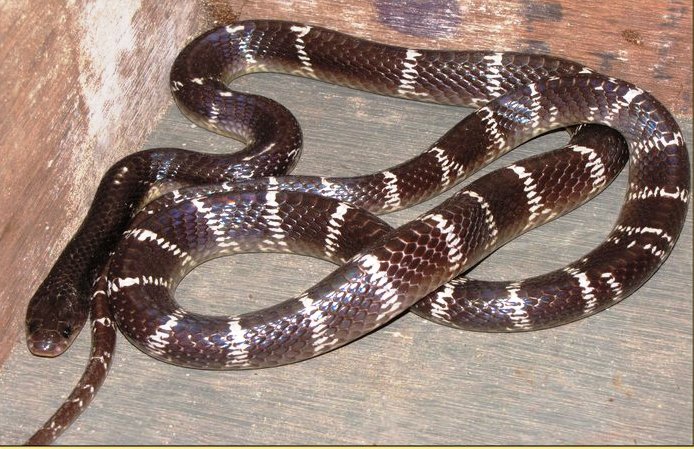 Common KraitBungarus caeruleus
-
 Eastern Brown SnakePseudonaja textilis
-
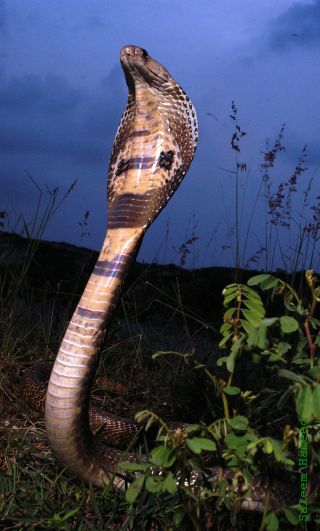 Indian CobraNaja naja
Compare
Questions and answers
What is the scientific name of the Turtlehead Sea Snake?
The scientific name of the Turtlehead Sea Snake is Emydocephalus ijimae. Written with its author, the full name is Emydocephalus ijimae Stejneger, 1898.
Which family does the Turtlehead Sea Snake belong to?
Emydocephalus ijimae belongs to the family Elapidae, in the order Squamata and the class Reptilia.
Where is the Turtlehead Sea Snake found?
Checklists and occurrence records place Emydocephalus ijimae in 3 countries: Japan, Taiwan and China.
What is the conservation status of the Turtlehead Sea Snake?
The IUCN Red List category recorded for Emydocephalus ijimae is Least Concern (LC).
What other names does the Turtlehead Sea Snake have?
Emydocephalus ijimae is also known in English as Ijima's Turtle-headed Sea Snake and Ijima's Sea Snake.
What do sea snakes eat?
Ijima's Turtle-headed Sea Snake feeds exclusively on the eggs of coral reef fishes.[5]
Sources
Passages the profile rests on
- The species belongs to the snake family Elapidae. Source passage: “is a species of snake in the family Elapidae.” — English Wikipedia
- The species inhabits shallow coastal waters of the north-western Pacific Ocean. Source passage: “in the shallow coastal waters of the north-western Pacific Ocean.” — English Wikipedia
- The species occurs off the coasts of China, Japan and Taiwan. Source passage: “E. ijimae is found off the coasts of China, Japan (including the Ryukyu Islands), and Taiwan.” — English Wikipedia
- The species occurs around the Ryukyu Islands of Japan. Source passage: “Japan (including the Ryukyu Islands)” — English Wikipedia
- The species feeds exclusively on the eggs of coral reef fishes. Source passage: “E. ijimae feeds exclusively on the eggs of coral reef fishes” — English Wikipedia
- The species is considered an important predator in maintaining healthy coral reef ecosystems. Source passage: “which makes it an important predator for maintaining a healthy coral reef ecosystem.” — English Wikipedia
- Adult male body weight typically increases between early spring and late summer. Source passage: “Adult males typically see an increase in BW from early spring to late summer” — English Wikipedia
- Females sometimes experience a rapid decrease in body weight between late autumn and early spring, followed by gradual weight recovery. Source passage: “females occasionally undergo a rapid BW decrease from late autumn to early spring followed by a steady weight regain.” — English Wikipedia
- The species is viviparous. Source passage: “E. ijimae is viviparous.” — English Wikipedia
- Newborn individuals begin reproductive activity during their second or third summer and their third spring after birth. Source passage: “Neonates begin reproductive activity in the second or third summer and third spring after birth.” — English Wikipedia
- The species has been suggested to be an income breeder that relies on energy acquired over time to produce offspring. Source passage: “Studies have suggested that E. ijimae is an income breeder that relies on temporal energy intake to produce offspring.” — English Wikipedia
Data
- Catalogue of Life, 2026-10-16 XR cc by
- Global Biodiversity Information Facility CC BY 4.0
- Wikidata CC0
- GeoNames CC BY 4.0
- Wikimedia Commons per image; credit shown with each image
- Within the Catalogue of Life, this name comes from The Reptile Database cc by
References
- Stejneger, L. (1898). On a collection of batrachians and reptiles from Formosa and Adjacent Islands. J. Coll. Sci. Univ. Tokyo. 12: 215-225. where the name was published
- Stejneger, L. (1898). On a collection of batrachians and reptiles from Formosa and Adjacent Islands. J. Coll. Sci. Univ. Tokyo 12: 215-225.
- Boulenger, G. A. (1899). Reptilia and Batrachia. Zoological Record, 36:1-31.
- Stejneger, LEONHARD H. (1907). Herpetology of Japan and adjacent territory. Bull. US Natl. Mus. 58: Xx, 1-577.
- Wall, F. (1909). Monograph on the Sea Snakes. Mem. Asiatic Soc. Bengal 2 (8): 169-251.
- Stejneger, L. (1910). The batrachians and reptiles of Formosa. Proc. US Natl. Mus. 38: 91-114.
- Maki, M. (1931). Monograph of the Snakes of Japan. Dai-Ichi Shobo, Tokyo. (1), 7, 240 Pages (Expanded Edition 1933).
- Zhao, E., & Adler, K. (1993). Herpetology of China. SSAR, Oxford/Ohio, 1-522.
- Masunaga, G., & Ota, H. (1994). Natural history of the sea snake, Emydocephalus ijimae in the central Ryukys. Japanese Journal of Herpetology 15 (4): 144.
- Huang W S. (1996). Sexual size dimorphism of sea snakes in Taiwan. Bulletin of the National Museum of Natural Science (Taichung) 7: 113-120.
- Zhao, E. M. (2006). The snakes of China [in Chinese]. Hefei, China, Anhui Sience & Technology Publ. House, Vol. I, 372 Pp., Vol. II (Color Plates), 280 Pp.
- Kharin, V. E. (2008). Biota of the Russian Waters of the Sea of Japan Vol. 7 - Reptilians [in English and Russian]. Vladivostok, Dalnauka, 170 Pp.
- Kharin, V. E. (2009). Redescription of a Russian Finding of the Erabu Sea Krait Pseudolaticauda semifasciata (Reinwardt in Schlegel, 1837), with Remarks about Species Composition of Sea Snakes (Serpentes: Laticaudidae, Hydrophiidae) in Russian and Adjacent Waters. Russian Journal of Marine Biology 35 (1): 8–14.
- Beolens, B., & Michael Watkins, a. M. G. (2011). The Eponym Dictionary of Reptiles. Johns Hopkins University Press, Baltimore, USA.
- Wallach, Van; Kenneth L. Williams, Jeff Boundy. (2014). Snakes of the World: A Catalogue of Living and Extinct Species. [type catalogue]. Taylor and Francis, CRC Press, 1237 Pp.
- NANKIVELL, JAMES H.; CLAIRE GOIRAN, MATHEW HOURSTON, RICHARD SHINE, ARNE R. RASMUSSEN, VICKI A. THOMSON, KATE L. SANDERS. (2020). A new species of turtle-headed sea Snake (Emydocephalus: Elapidae) endemic to Western Australia. Zootaxa 4758 (1): 141–156. Link
- Wang, Kai; Jinlong Ren, Hongman Chen, Zhitong Lyu, Xianguang Guo Ke Jiang, Jinmin Chen, Jiatang Li, Peng Guo, Yingyong Wang, Jing Che. (2020). The updated checklists of amphibians and reptiles of China. Biodiversity Science 28 (2): 189-218.
- SASAI, TAKAHIDE; TAISHI OKAZAWA, MINORI HASEGAWA & KEI YAMAZAKI. (2022). The first record of sea anemone Stichodactyla gigantea consuming a sea snake Emydocephalus ijimae. The Herpetological Bulletin (161).
This species in other databases
- Catalogue of Life 6F8FR
- Wikidata Q3010090
- iNaturalist 35255
- WoRMS urn:lsid:marinespecies.org:taxname:344037
- ITIS 700504
Page built on 26 November 2026. See how the catalog is made and all sources and licences.
Cite this page
ScientificNames.org. (2026). Emydocephalus ijimae (Turtlehead Sea Snake). Retrieved November 26, 2026, from https://scientificnames.org/species/emydocephalus-ijimae
“Emydocephalus ijimae (Turtlehead Sea Snake).” ScientificNames.org, 2026, scientificnames.org/species/emydocephalus-ijimae. Accessed 26 Nov. 2026.
ScientificNames.org. “Emydocephalus ijimae (Turtlehead Sea Snake).” Accessed November 26, 2026. https://scientificnames.org/species/emydocephalus-ijimae.
@misc{scientificnames_emydocephalus_ijimae_turtlehead_sea_snake,
  author = {{ScientificNames.org}},
  title = {Emydocephalus ijimae (Turtlehead Sea Snake)},
  year = {2026},
  url = {https://scientificnames.org/species/emydocephalus-ijimae},
  note = {Accessed 2026-11-26}
}