Species · Conifers and allies
White Shrubby Horsetail Ephedra alata
The scientific name of the White Shrubby Horsetail is Ephedra alata. It is a species of gymnosperm in the family Ephedraceae (jointfir family), order Ephedrales.
- Scientific name
- Ephedra alata Decne.
- Common name
- White Shrubby Horsetail
- Genus
- Ephedra
- Family
- Ephedraceae (Jointfir Family)
- Order
- Ephedrales
- Class
- Pinopsida
- Red List category
- LC Least Concern
- Recorded in
- 12 countries
- Name status
- accepted in the Catalogue of Life

Overview
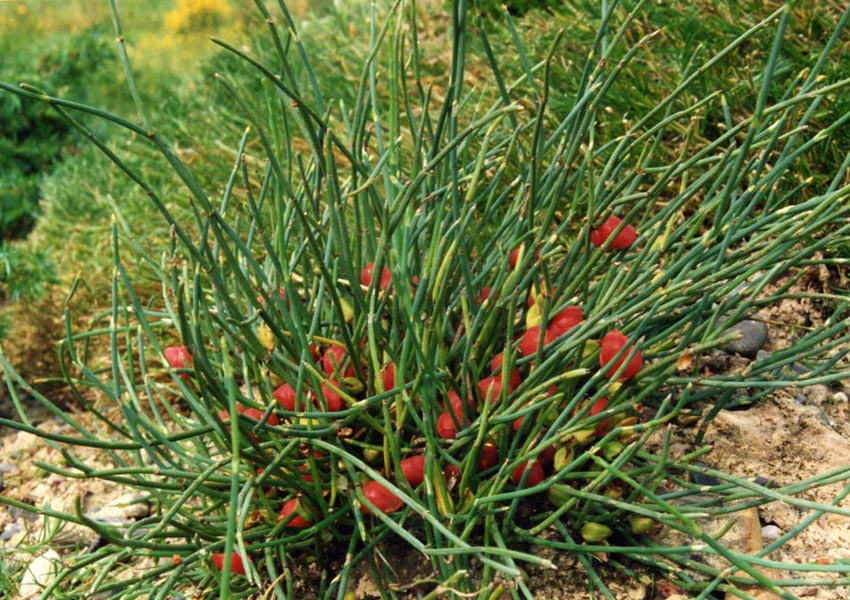
White Shrubby Horsetail (Ephedra alata Decne.) is a small terrestrial shrub in the family Ephedraceae, order Ephedrales and class Pinopsida. It primarily inhabits dry desert environments, growing on sandy calcareous, rocky and clay soils. It is distinguished by rigid branched stems, short scale leaves and yellow-green reproductive cones.
Written 26 November 2026 from the sources listed below. Each statement was checked against the passage it cites; statements that could not be supported were removed.
Appearance
White Shrubby Horsetail is a small terrestrial shrub with rigid, branched stems. It has no spines and is non-succulent.[1][2]
Its short, thick scale leaves grow in opposite pairs at the stem nodes and form sheaths near the plant base. The leaves measure approximately 3–6 mm in length.[3][4]
Its reproductive structures are organized into yellow-green cones. Male cones are oval and occur in dense clusters, while female cones are oval with overlapping yellow bracts surrounding two ovules.[5][6][7]
Male cones measure approximately 3–8 mm in length, and female cones reach up to 10 mm. The seeds are oval and acuminate.[8][9][10]
Habitat
White Shrubby Horsetail primarily inhabits dry desert environments. It grows in dense clumps on sandy calcareous, rocky and clay soils.[11][12]
It is frequently found near wadis and arid sand dunes where water is scarce. It occurs at elevations between 50 and 1,200 metres and tolerates saline soils.[13][14][15]
Reproduction and life cycle
White Shrubby Horsetail is dioecious, with separate male and female reproductive structures. It flowers and fruits between March and May.[16][17]
Its male cones contain three to six stalked microsporangia. Female cones contain two ovules surrounded by four to five pairs of overlapping bracts.[18][19]
Behaviour
The species' diaspores are dispersed by strong winds.[20]
Conservation
White Shrubby Horsetail is described as not currently raising conservation concerns because it is widespread and commonly found in its natural habitats.[21]
Seeds of the species have been stored for the Millennium Seed Bank Project because the sustainability of its populations is uncertain.[22]
Uses
The species is used medicinally as a source of ephedrine for treating asthma and other respiratory ailments. Medicinal preparations are also used for circulatory, kidney, digestive system and eye disorders.[23][24]
Its fibrous stems and roots are used to make string, cords and twine. They are also sources of tannins for dyeing and tanning materials.[25][26]
The plant is used to produce dye by boiling ground plant material with the material being dyed for one to three days.[27]
The species is consumed by camelids, bovines and caprines.[28]
Classification of the White Shrubby Horsetail
| Kingdom | Plantae |
|---|---|
| Subkingdom | Pteridobiotina |
| Phylum | Tracheophyta |
| Class | Pinopsida (Conifer) |
| Subclass | Gnetidae |
| Order | Ephedrales |
| Family | Ephedraceae (Jointfir Family) |
| Genus | Ephedra (Ephedras) |
| Species | Ephedra alata Decne. |
Where the White Shrubby Horsetail is found
Checklists and occurrence records place Ephedra alata in 12 countries. GBIF holds 459 georeferenced records of it.
Countries
- Algeria 99
- China 3
- Egypt 121
- Iraq 77
- Israel 59
- Jordan 10
- Libya 13
- Mauritania 10
- Morocco 26
- Saudi Arabia 27
- Tunisia 8
- Turkmenistan 6
Regions and cities with the most records
- Southern District, Israel 55
- Tiris Zemmour, Mauritania 10
- El Bayadh, Algeria 9
- Ouargla, Algeria 7
- Dhi Qar, Iraq 6
- El Oued, Algeria 5
- Illizi, Algeria 5
- Karbala, Iraq 5
- Brezina, Algeria 4
- Suez, Egypt 4
- Al Madīnah, Iraq 3
- Al Ḩammām, Egypt 3
- Alexandria, Egypt 3
- Aţ Ţafīlah, Jordan 3
- Basra, Iraq 3
- Burj al ‘Arab, Egypt 3
- Burj al ‘Arab al Jadīdah, Egypt 3
- Béchar, Algeria 3
- Djelfa, Algeria 3
- El Idrissia, Algeria 3
- Ghardaia, Algeria 3
- Ma’an, Jordan 3
- Nefta, Tunisia 3
- Riyadh Region, Saudi Arabia 3
- Tamanrasset, Algeria 3
- Tozeur Governorate, Tunisia 3
A number beside a place is its count of GBIF occurrence records. A place without a number comes from a checklist alone. Records show where a species has been observed or collected, which can include escapes and vagrants.
Common names
English
- White Shrubby Horsetail
Names in 3 other languages
- Arabic
- علندى مجنحة, فدر مجنح, قعود مجنح
- Czech
- chvojník křídlatý
- Hebrew
- שרביטן מכונף
Synonyms
3 other scientific names have been used for this species and are now treated as synonyms of Ephedra alata.
- Ephedra alata subsp. decaisnei (Stapf) Maire
- Ephedra alata subsp. decaisnei Decne.
- Ephedra alata var. decaisnei Stapf
Subspecies and varieties
- Ephedra alata subsp. alata subspecies
- Ephedra alata subsp. alenda subspecies
- Ephedra alata subsp. monjauzeana subspecies
Related species
-
 Chinese EphedraEphedra sinica
-
 Green Mormon TeaEphedra viridis
-
 European EphedraEphedra distachya
-
 Nevada EphedraEphedra nevadensis
-
 Joint PineEphedra fragilis
-
 California EphedraEphedra californica
-
 Dwarf Joint FirEphedra monosperma
-
 Death Valley JointfirEphedra funerea
Compare
Questions and answers
What is the scientific name of the White Shrubby Horsetail?
The scientific name of the White Shrubby Horsetail is Ephedra alata. Written with its author, the full name is Ephedra alata Decne..
Which family does the White Shrubby Horsetail belong to?
Ephedra alata belongs to the family Ephedraceae, in the order Ephedrales and the class Pinopsida.
Where is the White Shrubby Horsetail found?
Checklists and occurrence records place Ephedra alata in 12 countries, including Egypt, Algeria, Iraq, Israel, Saudi Arabia and Morocco.
What is the conservation status of the White Shrubby Horsetail?
The IUCN Red List category recorded for Ephedra alata is Least Concern (LC).
Sources
Passages the profile rests on
- Ephedra alata is a small terrestrial shrub with rigid, branched stems. Source passage: “This shrub has rigid and branched stems.” — English Wikipedia
- The species has no spines and is non-succulent. Source passage: “This desert plant species does not possess spines and is non-succulent.” — English Wikipedia
- Its short, thick scale leaves occur in opposite pairs at the stem nodes and form sheaths near the plant base. Source passage: “The leaves are very short (about 3-6mm) and are united toward the base of the plant, forming leaf sheaths. The leafs are in opposite pairs at the nodes.” — English Wikipedia
- Its leaves measure approximately 3–6 mm in length. Source passage: “The leaves are very short (about 3-6mm)” — English Wikipedia
- Its reproductive structures are organized into yellow-green cones. Source passage: “the reproductive portions of this species are organized in yellow-green cones.” — English Wikipedia
- Its male cones are oval and occur in dense clusters. Source passage: “The male, staminate cones are oval, 3-8mm long, organized in dense clusters” — English Wikipedia
- Its female cones are oval and have overlapping yellow bracts surrounding two ovules. Source passage: “The ovulate cones are oval, up to 10mm long, with 4-5 pairs of overlapping yellow bracts surrounding two ovules.” — English Wikipedia
- The seeds are oval and acuminate. Source passage: “The seeds present in the ovulate cones are oval and acuminate in shape.” — English Wikipedia
- Male cones measure approximately 3–8 mm in length. Source passage: “The male, staminate cones are oval, 3-8mm long” — English Wikipedia
- Female cones reach up to 10 mm in length. Source passage: “The ovulate cones are oval, up to 10mm long” — English Wikipedia
- The species primarily inhabits dry desert environments. Source passage: “It is found primarily in dry desert environments.” — English Wikipedia
- It grows in dense clumps on sandy calcareous, rocky and clay soils. Source passage: “This shrub grows in dense clumps, on sandy calcareous, rocky and clay soils.” — English Wikipedia
- It is frequently found near wadis and arid sand dunes where water is scarce. Source passage: “This species is often found near Wadis or other arid sand dunes, with minimal water.” — English Wikipedia
- The species occurs at elevations between 50 and 1,200 metres. Source passage: “This species grows between the elevations of 50 meters to 1200 meters.” — English Wikipedia
- The species tolerates saline soils. Source passage: “are tolerant to saline soils.” — English Wikipedia
- Ephedra alata is dioecious, with separate male and female reproductive structures. Source passage: “It is a dioecious shrub” — English Wikipedia
- The species flowers and fruits between March and May. Source passage: “This plant species flowing/fruiting season is between March and May.” — English Wikipedia
- Its male cones contain three to six stalked microsporangia. Source passage: “with 3-6 stipitate microsporangia.” — English Wikipedia
- Its female cones contain two ovules surrounded by four to five pairs of overlapping bracts. Source passage: “with 4-5 pairs of overlapping yellow bracts surrounding two ovules.” — English Wikipedia
- The species' diaspores are dispersed by strong winds. Source passage: “The plants diaspores are dispersed by strong winds.” — English Wikipedia
- The species is described as not currently raising conservation concerns because it is widespread and commonly found in its natural habitats. Source passage: “This species is not considered for conservation concerns as it is wide-ranging across the globe and commonly found in its natural environments.” — English Wikipedia
- Seeds of the species have been stored for the Millennium Seed Bank Project because the sustainability of its populations is uncertain. Source passage: “Seeds from this species have been obtained and stored for the Millennium Seed Bank Project because it is unclear if this species population is sustainable with its wide range of uses.” — English Wikipedia
- The species is used medicinally as a source of ephedrine for treating asthma and other respiratory ailments. Source passage: “The stem of this plant contain alkaloid ephedrine which is a medicine used for the treatment of asthma and other respiratory ailments.” — English Wikipedia
- Medicinal preparations from the plant are also used for circulatory, kidney, digestive system and eye disorders. Source passage: “These medicines are used to treat circulatory disorders, kidney disorders, digestive system disorders and eye disorders.” — English Wikipedia
- The fibrous stems and roots are used to make string, cords and twine. Source passage: “The stems and roots of this species is also used for it fibrous characteristic to make string, cords and twine.” — English Wikipedia
- The plant's stems and roots are used as sources of tannins for dyeing and tanning materials. Source passage: “These portions may also be used for tannins, used in the process of dying or tanning materials.” — English Wikipedia
- The plant is used to produce dye by boiling ground plant material with the material being dyed for one to three days. Source passage: “placing the ground plant portions, with the desired dyed material in boiling water for 1–3 days.” — English Wikipedia
- The species is consumed by camelids, bovines and caprines. Source passage: “These plants are also used for consumption by animals such as camelidae, bovines and caprines.” — English Wikipedia
Data
- Catalogue of Life, 2026-10-16 XR cc by
- Global Biodiversity Information Facility CC BY 4.0
- Wikidata CC0
- GeoNames CC BY 4.0
- Wikimedia Commons per image; credit shown with each image
- Within the Catalogue of Life, this name comes from Pinopsida from WFO cc0
References
- Ann. Sci. Nat. (Paris) 2: 239 (1824) where the name was published
- POWO record for urn:lsid:ipni.org:names:383343-1 Link
This species in other databases
- Catalogue of Life 6FNCZ
- Wikidata Q2920618
- iNaturalist 135464
- World Flora Online wfo-0000794281-2026-06
- GRIN 15213
Page built on 27 November 2026. See how the catalog is made and all sources and licences.
Cite this page
ScientificNames.org. (2026). Ephedra alata (White Shrubby Horsetail). Retrieved November 27, 2026, from https://scientificnames.org/species/ephedra-alata
“Ephedra alata (White Shrubby Horsetail).” ScientificNames.org, 2026, scientificnames.org/species/ephedra-alata. Accessed 27 Nov. 2026.
ScientificNames.org. “Ephedra alata (White Shrubby Horsetail).” Accessed November 27, 2026. https://scientificnames.org/species/ephedra-alata.
@misc{scientificnames_ephedra_alata_white_shrubby_horsetail,
  author = {{ScientificNames.org}},
  title = {Ephedra alata (White Shrubby Horsetail)},
  year = {2026},
  url = {https://scientificnames.org/species/ephedra-alata},
  note = {Accessed 2026-11-27}
}