Species · Conifers and allies
Green Mormon Tea Ephedra viridis
The scientific name of the Green Mormon Tea is Ephedra viridis. It is a species of gymnosperm in the family Ephedraceae (jointfir family), order Ephedrales.
- Scientific name
- Ephedra viridis Coville
- Common name
- Green Mormon Tea
- Genus
- Ephedra
- Family
- Ephedraceae (Jointfir Family)
- Order
- Ephedrales
- Class
- Pinopsida
- Red List category
- LC Least Concern
- Recorded in
- 2 countries
- Name status
- accepted in the Catalogue of Life

Overview
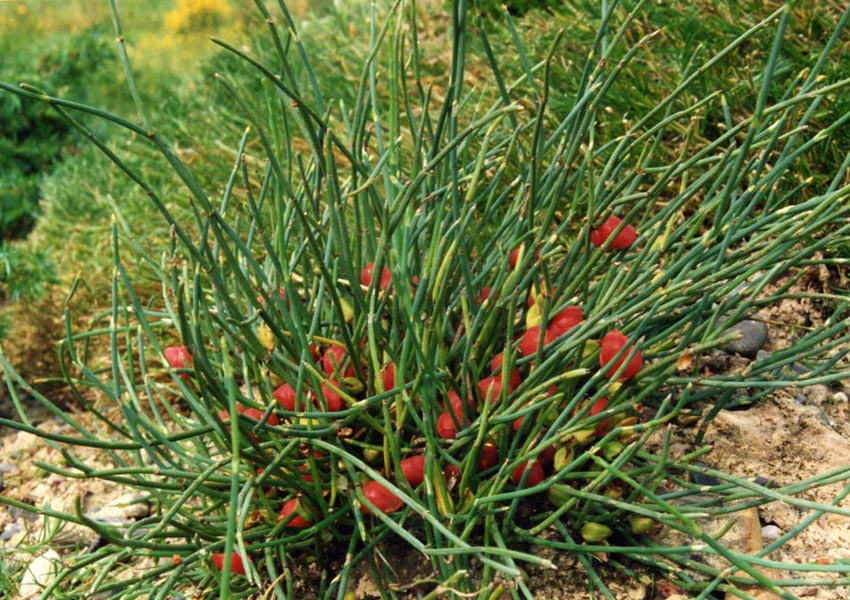
Green Mormon Tea is a shrub classified as a conifer or ally in the family Ephedraceae, order Ephedrales, and class Pinopsida. It occurs in scrub, woodland, desert, and open habitats at elevations between 900 and 2,300 meters. It has dense clusters of bright green, jointed stems and produces pollen cones or seed cones depending on the sex of the plant.
Written 26 November 2026 from the sources listed below. Each statement was checked against the passage it cites; statements that could not be supported were removed.
Appearance
The shrub has a woody base topped with dense clusters of erect, bright green twigs. Its stems are jointed, finely grooved, and lack leaves, and they perform photosynthesis.[1][2][3]
The twigs may become somewhat yellow as they age. Their nodes bear tiny pairs of vestigial leaves that initially appear reddish before drying to brown or black.[4][5]
Male plants produce pollen cones at the stem nodes. These cones are less than one centimeter long and have protruding yellowish sporangiophores.[6][7]
Female plants produce seed cones that are slightly larger than the pollen cones and contain two seeds each. The cones and seeds appear in spring and resemble small yellow flowers.[8][9]
The plant can grow to a height of four feet. It is not a true flowering plant.[10][11]
Reproduction and life cycle
Male plants produce pollen cones, while female plants produce seed cones. Each female seed cone contains two seeds.[12][13]
Cones and seeds appear during spring.[14]
Habitat
Green Mormon Tea occurs in scrub, woodland, desert, and open habitats. It grows at elevations between 900 and 2,300 meters.[15][16]
Uses
The plant's stems can be boiled to prepare tea. The Shoshone and Paiute have prepared tea by boiling the stems together with the bark of Purshia tridentata.[17][18]
Early settlers in the desert Southwest boiled the plant's young stems into tea as a remedy for colds and coughs. The Navajo have used the plant to make a dye that produces a yellowish-green color on woolen rugs.[19][20]
Native American peoples and early Chinese medicinal traditions have used Ephedra species to treat various ailments. The plant has also been used in modern medicine for sinus conditions including hay fever, common colds, and sinusitis, and as an appetite suppressant.[21][22][23]
The plant should not be ingested without a doctor's recommendation because it is toxic.[24]
Similar species
Ephedra sinica is identified as an Asian relative of Ephedra viridis.[25]
Classification of the Green Mormon Tea
| Kingdom | Plantae |
|---|---|
| Subkingdom | Pteridobiotina |
| Phylum | Tracheophyta |
| Class | Pinopsida (Conifer) |
| Subclass | Gnetidae |
| Order | Ephedrales |
| Family | Ephedraceae (Jointfir Family) |
| Genus | Ephedra (Ephedras) |
| Species | Ephedra viridis Coville |
Where the Green Mormon Tea is found
Checklists and occurrence records place Ephedra viridis in 2 countries. GBIF holds 8,517 georeferenced records of it.
Countries
Regions and cities with the most records
- California, United States 1,858
- Nevada, United States 1,616
- Utah, United States 1,379
- Arizona, United States 717
- Colorado, United States 574
- Reno, United States 385
- Sparks, United States 382
- Sun Valley, United States 361
- Spanish Springs, United States 240
- New Mexico, United States 217
- Grand Junction, United States 199
- Summerlin South, United States 155
- Carson City, United States 142
- Clifton, United States 89
- Washington, United States 65
- Hurricane, United States 52
- Spring Valley, United States 51
- Oregon, United States 45
- Saint George, United States 44
- Alamogordo, United States 40
- Enterprise, United States 34
- Farmington, United States 28
- Eagle Mountain, United States 21
- Flagstaff, United States 20
- Cedar City, United States 19
- Vincent, United States 19
- Palmdale, United States 18
- Hesperia, United States 15
- Montrose, United States 13
- Provo, United States 13
- Spanish Fork, United States 13
- Springville, United States 13
- Victorville, United States 13
- Enchanted Hills, United States 12
- Palm Desert, United States 12
- Rancho Mirage, United States 12
A number beside a place is its count of GBIF occurrence records. A place without a number comes from a checklist alone. Records show where a species has been observed or collected, which can include escapes and vagrants.
Common names
English
- Green Mormon Tea
- Brigham Tea
- Green Ephedra
- Jointfir
- Mormon Tea
Names in 9 other languages
- Chinese
- 綠麻黃, 長葉麻黃
- Dutch
- Groene Zeedruif
- French
- Éphédra vert
- Polish
- przęśl zielona
- Russian
- Хвойник зелёный, Эфедра зелёная
- Slovak
- chvojník zelený
- Swedish
- mormonefedra
- Ukrainian
- Ефедра зелена
- mte
- toyatuduba
Synonyms
4 other scientific names have been used for this species and are now treated as synonyms of Ephedra viridis.
- Ephedra nevadensis subsp. pluribraceata S.Watson
- Ephedra nevadensis subsp. viridis S.Watson
- Ephedra nevadensis subvar. pluribracteata Stapf
- Ephedra nevadensis var. viridis (Coville) M.E.Jones
Related species
-
 Chinese EphedraEphedra sinica
-
 European EphedraEphedra distachya
-
 Nevada EphedraEphedra nevadensis
-
 Joint PineEphedra fragilis
-
 California EphedraEphedra californica
-
 Dwarf Joint FirEphedra monosperma
-
 Death Valley JointfirEphedra funerea
-
 White Shrubby HorsetailEphedra alata
Compare
Questions and answers
What is the scientific name of the Green Mormon Tea?
The scientific name of the Green Mormon Tea is Ephedra viridis. Written with its author, the full name is Ephedra viridis Coville.
Which family does the Green Mormon Tea belong to?
Ephedra viridis belongs to the family Ephedraceae, in the order Ephedrales and the class Pinopsida.
Where is the Green Mormon Tea found?
Checklists and occurrence records place Ephedra viridis in 2 countries: United States and Mexico.
What is the conservation status of the Green Mormon Tea?
The IUCN Red List category recorded for Ephedra viridis is Least Concern (LC).
What other names does the Green Mormon Tea have?
Ephedra viridis is also known in English as Brigham Tea, Green Ephedra, Jointfir and Mormon Tea.
What is the common name for ephedra?
Green Mormon Tea is one of the English names recorded for Ephedra viridis.[1]
Is Mormon tea the same as ephedra?
Mormon Tea is an English name recorded for Ephedra viridis, also known as Green Mormon Tea.[1]
Where does Ephedra plant grow?
Ephedra viridis occurs in scrub, woodland, desert, and open habitats at elevations between 900 and 2,300 meters. It is indigenous to the western United States, with a range extending from California to Colorado, north to Oregon, and south to New Mexico and Arizona. It occurs throughout Colorado National Monument.[15][16][26][27][28]
What is a natural ephedrine?
A gas chromatograph analysis found no measurable ephedrine, pseudoephedrine, norephedrine, or norpseudoephedrine in tested samples of the plant.[29]
Sources
Passages the profile rests on
- The shrub has a woody base topped with dense clusters of erect, bright green twigs. Source passage: “woody below, topped with many dense clusters of erect bright green twigs.” — English Wikipedia
- Its green stems perform photosynthesis. Source passage: “The stems are green and photosynthetic.” — English Wikipedia
- Its stems are jointed, green, finely grooved, and lack leaves. Source passage: “Jointed stems, which may distantly resemble bamboo stems, are green and finely-grooved with no leaves.” — nps.gov
- The twigs may become somewhat yellow as they age. Source passage: “They may yellow somewhat with age.” — English Wikipedia
- The nodes of its twigs bear tiny pairs of vestigial leaves that initially appear reddish before drying to brown or black. Source passage: “Nodes along the twigs are marked by the tiny pairs of vestigial leaves, which start out reddish but soon dry to brown or black.” — English Wikipedia
- Male plants produce pollen cones at the stem nodes. Source passage: “Male plants produce pollen cones at the nodes” — English Wikipedia
- The pollen cones are less than one centimeter long and have protruding yellowish sporangiophores. Source passage: “each under a centimeter long with protruding yellowish sporangiophores.” — English Wikipedia
- Female plants produce seed cones that are slightly larger than the pollen cones and contain two seeds each. Source passage: “Female plants produce seed cones which are slightly larger and contain two seeds each.” — English Wikipedia
- Its cones and seeds appear in spring and resemble small yellow flowers. Source passage: “Cones and seeds appear in the spring and look like small yellow flowers.” — nps.gov
- The plant can grow to a height of four feet. Source passage: “may grow up to 4 ft tall.” — nps.gov
- The plant is not a true flowering plant. Source passage: “Note that this is not a true flowering plant.” — nps.gov
- Male plants produce pollen cones, while female plants produce seed cones. Source passage: “Male plants produce pollen cones at the nodes, each under a centimeter long with protruding yellowish sporangiophores. Female plants produce seed cones” — English Wikipedia
- Each female seed cone contains two seeds. Source passage: “contain two seeds each.” — English Wikipedia
- Cones and seeds appear during spring. Source passage: “Cones and seeds appear in the spring” — nps.gov
- The species occurs in scrub, woodland, desert, and open habitats. Source passage: “where it is a member of varied scrub, woodland, desert, and open habitats.” — English Wikipedia
- The species grows at elevations between 900 and 2,300 meters. Source passage: “It grows at 900–2,300 metres (3,000–7,500 ft) elevations.” — English Wikipedia
- The plant's stems can be boiled to prepare tea. Source passage: “A tea can be made by boiling the stems” — English Wikipedia
- The Shoshone and Paiute have prepared tea by boiling the stems together with the bark of Purshia tridentata. Source passage: “the Shoshone and Paiute boil tea using the stem of the plant and combined it with the bark of Purshia tridentata” — English Wikipedia
- The Navajo have used the plant to make a dye that produces a yellowish-green color on woolen rugs. Source passage: “The Navajo have used the plant as a dye solution to produce a yellowish-green color on woolen rugs” — English Wikipedia
- Early settlers in the desert Southwest boiled the plant's young stems into tea as a remedy for colds and coughs. Source passage: “early settlers of this region boiled the young stems of this plant into tea as a remedy for cold and cough.” — nps.gov
- Native American peoples and early Chinese medicinal traditions have used Ephedra species to treat various ailments. Source passage: “The plant is used medicinally by both Native Americans and the ancient Chinese (using their own local species of the genus) to treat various afflictions” — English Wikipedia
- The plant has been used in modern medicine for sinus conditions including hay fever, common colds, and sinusitis. Source passage: “In modern medicine, the plant is used to treat sinus illnesses such as hay fever, common colds, and sinusitis.” — English Wikipedia
- The plant has been used as an appetite suppressant. Source passage: “Because the plant can be used as an appetite suppressant” — English Wikipedia
- The plant should not be ingested without a doctor's recommendation because it is toxic. Source passage: “Because it is toxic, the plant should not be ingested without a doctor’s recommendation.” — English Wikipedia
- Ephedra sinica is identified as an Asian relative of Ephedra viridis. Source passage: “An asian relative of E. viridis known as Ephedra sinica” — nps.gov
- The species is indigenous to the western United States. Source passage: “It is indigenous to the Western United States” — English Wikipedia
- Its range extends from California to Colorado, north to Oregon, and south to New Mexico and Arizona. Source passage: “occurs throughout the western United States from California to Colorado, north to Oregon, and south to New Mexico and Arizona.” — nps.gov
- The species occurs throughout Colorado National Monument. Source passage: “It can be found throughout Colorado National Monument.” — nps.gov
- A gas chromatograph analysis found no measurable ephedrine, pseudoephedrine, norephedrine, or norpseudoephedrine in tested samples. Source passage: “found no measurable amount of ephedrine, pseudoephedrine, norephedrine, or norpseudoephedrine.” — English Wikipedia
Data
- Catalogue of Life, 2026-10-16 XR cc by
- Global Biodiversity Information Facility CC BY 4.0
- Wikidata CC0
- GeoNames CC BY 4.0
- Wikimedia Commons per image; credit shown with each image
- Within the Catalogue of Life, this name comes from Pinopsida from WFO cc0
References
- Contr. U.S. Natl. Herb. 4: 220. 1893 Link where the name was published
- POWO record for urn:lsid:ipni.org:names:91144-2 Link
This species in other databases
- Catalogue of Life 6FPD4
- Wikidata Q5382151
- iNaturalist 57891
- World Flora Online wfo-0000794501-2026-06
- GRIN 316663
Page built on 28 November 2026. See how the catalog is made and all sources and licences.
Cite this page
ScientificNames.org. (2026). Ephedra viridis (Green Mormon Tea). Retrieved November 28, 2026, from https://scientificnames.org/species/ephedra-viridis
“Ephedra viridis (Green Mormon Tea).” ScientificNames.org, 2026, scientificnames.org/species/ephedra-viridis. Accessed 28 Nov. 2026.
ScientificNames.org. “Ephedra viridis (Green Mormon Tea).” Accessed November 28, 2026. https://scientificnames.org/species/ephedra-viridis.
@misc{scientificnames_ephedra_viridis_green_mormon_tea,
  author = {{ScientificNames.org}},
  title = {Ephedra viridis (Green Mormon Tea)},
  year = {2026},
  url = {https://scientificnames.org/species/ephedra-viridis},
  note = {Accessed 2026-11-28}
}