Species · Conifers and allies
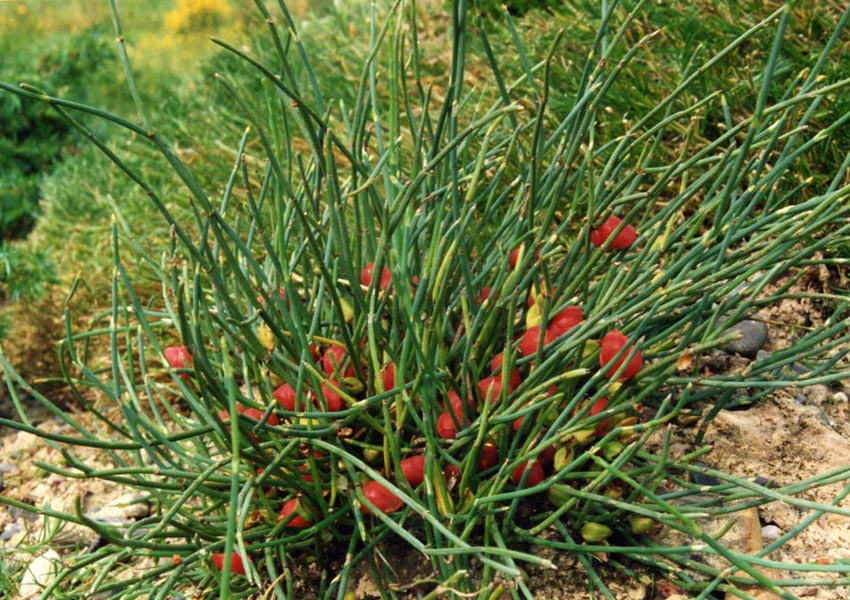
European Ephedra Ephedra distachya
The scientific name of the European Ephedra is Ephedra distachya. It is a species of gymnosperm in the family Ephedraceae (jointfir family), order Ephedrales.
- Scientific name
- Ephedra distachya L.
- Common name
- European Ephedra
- Genus
- Ephedra
- Family
- Ephedraceae (Jointfir Family)
- Order
- Ephedrales
- Class
- Pinopsida
- Red List category
- LC Least Concern
- Recorded in
- 36 countries
- Name status
- accepted in the Catalogue of Life

Overview
The species grows on fixed and stable grey sand dunes covered by continuous vegetation. All parts of the plant contain up to 3% ephedrine.
Written 26 November 2026 from the sources listed below. Each statement was checked against the passage it cites; statements that could not be supported were removed.
Appearance
European Ephedra is a shrub with tiny, scale-like leaves. It typically reaches a height of approximately 25 to 50 cm.[1][2]
Habitat
European Ephedra grows on fixed and stable grey sand dunes covered by continuous vegetation. It occurs in southern and central Europe and western and central Asia.[3][4]
Uses
The species has been used to relieve acute muscular and rheumatic pain. It has also been used as a stimulant and in Ayurvedic cardio tonics.[5][6]
Ephedrine is extracted from the dried branches and used as a stimulant, often for asthma control.[7]
Classification of the European Ephedra
| Kingdom | Plantae |
|---|---|
| Subkingdom | Pteridobiotina |
| Phylum | Tracheophyta |
| Class | Pinopsida (Conifer) |
| Subclass | Gnetidae |
| Order | Ephedrales |
| Family | Ephedraceae (Jointfir Family) |
| Genus | Ephedra (Ephedras) |
| Species | Ephedra distachya L. |
Where the European Ephedra is found
Checklists and occurrence records place Ephedra distachya in 36 countries. GBIF holds 16,071 georeferenced records of it.
Countries
- Albania 4
- Armenia 3
- Austria 14
- Azerbaijan 39
- Bulgaria 45
- China 234
- Croatia 37
- France 6,333
- Georgia 8
- Germany 18
- Greece 117
- Hungary 281
- India 9
- Iran 5
- Italy 295
- Japan 5
- Kazakhstan 463
- Kyrgyzstan 3
- Moldova 18
- Mongolia 3
- Montenegro 8
- North Macedonia 3
- Poland 12
- Portugal 5
- Romania 125
- Russia 2,470
- Slovakia 18
- Spain 1,631
- Sweden 6
- Switzerland 1,690
- The Netherlands 4
- Turkey 54
- Turkmenistan 3
- Ukraine 2,099
- United Kingdom 4
- Uzbekistan 5
Regions and cities with the most records
- Occitanie, France 2,046
- Valais, Switzerland 1,466
- Sitten, Switzerland 1,307
- Sierre, Switzerland 1,213
- Pays de la Loire, France 1,069
- Perpignan, France 1,004
- Mauguio, France 648
- Provence-Alpes-Côte d'Azur, France 639
- Lattes, France 624
- Castelnau-le-Lez, France 600
- Montpellier, France 586
- Marseille 16, France 568
- Marseille 14, France 549
- Marseille 07, France 546
- Marseille, France 545
- Marseille 02, France 545
- Marseille 03, France 545
- Allauch, France 544
- Marseille 11, France 541
- Marseille 12, France 541
- Marseille 15, France 533
- Marignane, France 531
- Les Pennes-Mirabeau, France 530
- Crimea, Ukraine 524
- Marseille 09, France 516
- Marseille 10, France 516
- Marseille 01, France 498
- Marseille 04, France 498
- Marseille 06, France 498
- Marseille 13, France 498
- Marseille 05, France 497
- Marseille 08, France 497
- Lunel, France 492
- Kherson, Ukraine 402
- Krasnodar Krai, Russia 402
- Catalonia, Spain 395
4 more countries have a few records outside this range
These countries hold a few records of Ephedra distachya but lie outside the range the checklists give for it. Such records are often zoo or garden specimens, museum material or vagrants, so the species is not counted as occurring there.
A number beside a place is its count of GBIF occurrence records. A place without a number comes from a checklist alone. Records show where a species has been observed or collected, which can include escapes and vagrants.
Common names
English
- European Ephedra
- Little Sea Grape
- Sea Grape
- Sea-grape
Names in 20 other languages
- Bulgarian
- Обикновена ефедра
- Chinese
- Shuang Sui Ma Huang, 双穗麻黃
- Czech
- chvojník dvouklasý
- Danish
- Toraklet ledris
- Dutch
- Zeedruif
- French
- Petit Éphédra, Raisin de mer, Éphédra à chatons opposés
- German
- Gewöhnliches Meerträubel
- Greek
- Εφέδρα, Κομπόχορτο
- Hungarian
- közönséges csikófark
- Italian
- Uva marina, efedra distachia
- Polish
- przęśl dwukłosowa
- Portuguese
- Éfedra
- Romanian
- Cârcel
- Russian
- Кузьмичева трава, Хвойник двухколосковый, Эфедра двухколосковая
- Slovak
- chvojník dvojklasý
- Spanish
- Uva de mar
- Swedish
- russinefedra
- Turkish
- Deniz Üzümü, Çalı Atkuyruğu
- Ukrainian
- Ефедра звичайна
- srd
- Ua de mare
Synonyms
3 other scientific names have been used for this species and are now treated as synonyms of Ephedra distachya.
- Chaetocladus distachys (L.) J.Nelson
- Ephedra distachya subvar. linnaei Stapf
- Ephedra equisetiformis subsp. distachya (L.) Bonnier & Layens
Subspecies and varieties
- Ephedra distachya subsp. distachya (Sea-grape) subspecies
- Ephedra distachya subsp. helvetica subspecies
Related species
-
 Chinese EphedraEphedra sinica
-
 Green Mormon TeaEphedra viridis
-
 Nevada EphedraEphedra nevadensis
-
 Joint PineEphedra fragilis
-
 California EphedraEphedra californica
-
 Dwarf Joint FirEphedra monosperma
-
 Death Valley JointfirEphedra funerea
-
 White Shrubby HorsetailEphedra alata
Compare
Questions and answers
What is the scientific name of the European Ephedra?
The scientific name of the European Ephedra is Ephedra distachya. Written with its author, the full name is Ephedra distachya L..
Which family does the European Ephedra belong to?
Ephedra distachya belongs to the family Ephedraceae, in the order Ephedrales and the class Pinopsida.
Where is the European Ephedra found?
Checklists and occurrence records place Ephedra distachya in 36 countries, including France, Russia, Ukraine, Switzerland, Spain and Kazakhstan.
What is the conservation status of the European Ephedra?
The IUCN Red List category recorded for Ephedra distachya is Least Concern (LC).
What other names does the European Ephedra have?
Ephedra distachya is also known in English as Little Sea Grape, Sea Grape and Sea-grape.
Where do Ephedra plants grow?
European Ephedra occurs in southern and central Europe and western and central Asia. It grows on fixed and stable grey sand dunes covered by continuous vegetation.[3][4]
What plant contains the most ephedrine?
All parts of European Ephedra contain up to 3% ephedrine.[8]
Sources
Passages the profile rests on
- Ephedra distachya is a shrub with tiny, scale-like leaves. Source passage: “The leaves of Ephedra are tiny and scale-like.” — English Wikipedia
- The shrub typically reaches a height of approximately 25 to 50 cm. Source passage: “Ephedra distachya is a shrub in the family Ephedraceae that stands about 25 cm to 50 cm high.” — English Wikipedia
- The species grows on fixed and stable grey sand dunes covered by continuous vegetation. Source passage: “Ephedra distachya lives on grey dunes which are fixed and stable sand dunes that are covered in continuous vegetation.” — English Wikipedia
- The species occurs in southern and central Europe and western and central Asia. Source passage: “The shrub grows in many parts of the world, including southern and central Europe and western and central Asia.” — English Wikipedia
- The species has been used to relieve acute muscular and rheumatic pain. Source passage: “Ephedra distachya is used to relieve acute muscular and rheumatic pains” — English Wikipedia
- The species has been used as a stimulant and in Ayurvedic cardio tonics. Source passage: “as a stimulant, and in the cardio tonics in Ayurveda.” — English Wikipedia
- Ephedrine is extracted from the dried branches of the species and used as a stimulant, often for asthma control. Source passage: “Ephedrine, an alkaloid, is obtained from its dried branches and is used as a stimulant, often to control asthma.” — English Wikipedia
- All parts of the plant contain up to 3% ephedrine. Source passage: “All parts of the plant contain up to 3% ephedrine.” — English Wikipedia
Data
- Catalogue of Life, 2026-10-16 XR cc by
- Global Biodiversity Information Facility CC BY 4.0
- Wikidata CC0
- GeoNames CC BY 4.0
- Wikimedia Commons per image; credit shown with each image
- Within the Catalogue of Life, this name comes from Pinopsida from WFO cc0
References
- Sp. Pl. : 1040 (1753) where the name was published
- POWO record for urn:lsid:ipni.org:names:383381-1 Link
This species in other databases
- Catalogue of Life 6FNF9
- Wikidata Q162784
- iNaturalist 340431
- World Flora Online wfo-0000794343-2026-06
- GRIN 15219
Page built on 28 November 2026. See how the catalog is made and all sources and licences.
Cite this page
ScientificNames.org. (2026). Ephedra distachya (European Ephedra). Retrieved November 28, 2026, from https://scientificnames.org/species/ephedra-distachya
“Ephedra distachya (European Ephedra).” ScientificNames.org, 2026, scientificnames.org/species/ephedra-distachya. Accessed 28 Nov. 2026.
ScientificNames.org. “Ephedra distachya (European Ephedra).” Accessed November 28, 2026. https://scientificnames.org/species/ephedra-distachya.
@misc{scientificnames_ephedra_distachya_european_ephedra,
  author = {{ScientificNames.org}},
  title = {Ephedra distachya (European Ephedra)},
  year = {2026},
  url = {https://scientificnames.org/species/ephedra-distachya},
  note = {Accessed 2026-11-28}
}