Species · Conifers and allies
Dwarf Joint Fir Ephedra monosperma
The scientific name of the Dwarf Joint Fir is Ephedra monosperma. It is a species of gymnosperm in the family Ephedraceae (jointfir family), order Ephedrales.
- Scientific name
- Ephedra monosperma J.G.Gmel. ex C.A.Mey.
- Common name
- Dwarf Joint Fir
- Genus
- Ephedra
- Family
- Ephedraceae (Jointfir Family)
- Order
- Ephedrales
- Class
- Pinopsida
- Red List category
- LC Least Concern
- Recorded in
- 4 countries
- Name status
- accepted in the Catalogue of Life
Overview
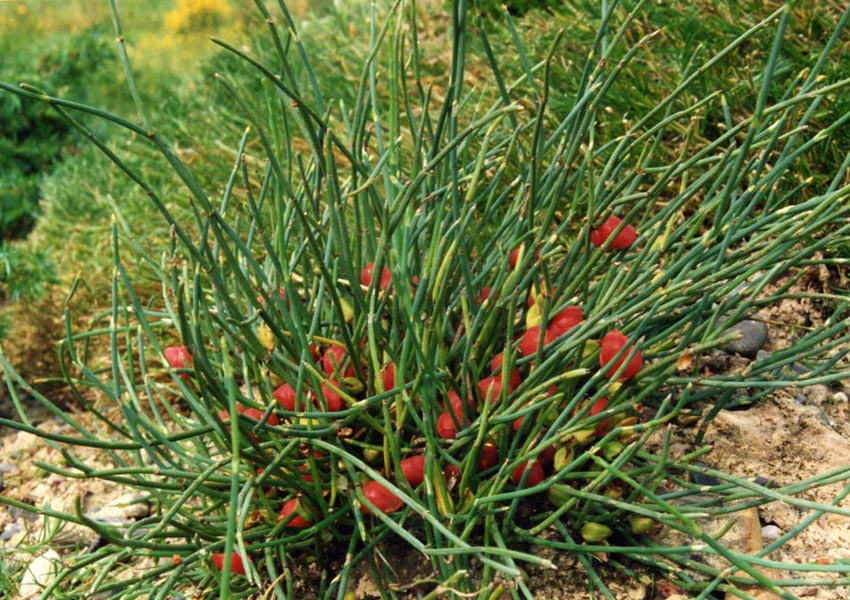
The dwarf joint fir (Ephedra monosperma J.G.Gmel. ex C.A.Mey.) is a small perennial shrub in the family Ephedraceae, order Ephedrales, class Pinopsida. It occurs in Afghanistan, China, Tibet, Kazakhstan, Mongolia, Pakistan, and Russia. It commonly develops creeping runners and produces fleshy, red mature cones.
Written 26 November 2026 from the sources listed below. Each statement was checked against the passage it cites; statements that could not be supported were removed.
Appearance
The dwarf joint fir is a small perennial shrub that commonly develops creeping runners. Its woody stems are highly branched, short, and have knotted nodes.[1][2][3]
Its slender branchlets spread outward and usually have a slight curve. Its leaves are opposite and connate basally for one-third to two-thirds of their length.[4][5]
Each cone contains one ovule enclosed by two pairs of cone bracts. Pollen cones are oblong-spherical and occur at nodes, either sessile or subsessile.[6][7]
Mature seed cones are solitary or opposite at nodes, sessile, and ovoid. They are fleshy and red.[8][9]
The shrub typically reaches a height of 5–15 cm, and its woody stems measure 1–5 cm in length. Branchlet internodes are 1–3 cm long and 1 mm in diameter, while mature cones measure 6–9 mm in length and 5–8 mm in width.[10][11][12][13]
Habitat
The dwarf joint fir grows in limestone crevices, on cliffs, and on rocky slopes. It sometimes grows on rocks along river-valley slopes.[14][15]
It occurs in habitats with sparse Juniperus and shrub vegetation. It is also found in dry pine forests.[16][17]
Reproduction and life cycle
The species flowers from May and pollinates in June. Its seeds mature in August.[18][19][20]
Its pollen cones consist of three or four pairs of decussate scales with broad margins. The pollen-cone bracts occur in two to four pairs and are connate for half their length.[21][22]
Conservation
Ephedrine products have been banned in the United States since 1994 because of serious adverse effects.[23]
Uses
The dwarf joint fir has been included in traditional Chinese and Japanese medicine. Extracted ephedrine from Ephedra herbs has been used as an oral medicine for asthma.[24][25]
Dried mature seed cones of the species are used to prepare Mongolian tea. The tea is sometimes mixed with white tea or herbs and consumed with or without cream and milk.[26]
Classification of the Dwarf Joint Fir
| Kingdom | Plantae |
|---|---|
| Subkingdom | Pteridobiotina |
| Phylum | Tracheophyta |
| Class | Pinopsida (Conifer) |
| Subclass | Gnetidae |
| Order | Ephedrales |
| Family | Ephedraceae (Jointfir Family) |
| Genus | Ephedra (Ephedras) |
| Species | Ephedra monosperma J.G.Gmel. ex C.A.Mey. |
Where the Dwarf Joint Fir is found
Checklists and occurrence records place Ephedra monosperma in 4 countries. GBIF holds 1,706 georeferenced records of it.
Countries
Regions and cities with the most records
- Irkutsk Oblast, Russia 425
- Buryatiya Republic, Russia 205
- Sakha, Russia 105
- Qinghai, China 86
- Krasnoyarsk Krai, Russia 62
- Gansu, China 48
- Tibet, China 23
- Kyzyl, Russia 18
- Krasnoyarsk, Russia 17
- Ulan-Ude, Russia 14
- Sichuan, China 13
- Hebei, China 12
- Angarsk, Russia 10
- Dongchuan, China 9
- Haomen, China 9
- Qingshizui, China 9
- Quankou, China 9
- Slyudyanka, Russia 9
- East Kazakhstan, Kazakhstan 8
- Hovd, Mongolia 7
- Nerchinsk, Russia 7
- Maqin County, China 6
- Nima, China 6
- Primorye, Russia 6
- Gusinoozyorsk, Russia 5
- Hentiy, Mongolia 5
- Irkutsk, Russia 5
- Labuleng, China 5
- Markova, Russia 5
- Novosibirsk Oblast, Russia 5
- Shanxi, China 5
- Shelekhov, Russia 5
- Yakutsk, Russia 5
- Berëzovka, Russia 4
- Gur’yevsk, Russia 4
- Hejing, China 4
1 more country has a few records outside this range
These countries hold a few records of Ephedra monosperma but lie outside the range the checklists give for it. Such records are often zoo or garden specimens, museum material or vagrants, so the species is not counted as occurring there.
A number beside a place is its count of GBIF occurrence records. A place without a number comes from a checklist alone. Records show where a species has been observed or collected, which can include escapes and vagrants.
Common names
English
- Dwarf Joint Fir
Names in 5 other languages
- Chinese
- Dan Zi Ma Huang, 單子麻黃
- Japanese
- エフェドラ・モノスペルマ
- Mongolian
- Ганц үрт зээргэнэ
- Russian
- Хвойник односемянный
- Slovak
- chvojník jednosemenný
Synonyms
3 other scientific names have been used for this species and are now treated as synonyms of Ephedra monosperma.
- Ephedra minima K.S.Hao
- Ephedra monostachya Turcz. ambiguous synonym
- Ephedra polygonoides Siev. ambiguous synonym
Related species
-
 Chinese EphedraEphedra sinica
-
 Green Mormon TeaEphedra viridis
-
 European EphedraEphedra distachya
-
 Nevada EphedraEphedra nevadensis
-
 Joint PineEphedra fragilis
-
 California EphedraEphedra californica
-
 Death Valley JointfirEphedra funerea
-
 White Shrubby HorsetailEphedra alata
Compare
Questions and answers
What is the scientific name of the Dwarf Joint Fir?
The scientific name of the Dwarf Joint Fir is Ephedra monosperma. Written with its author, the full name is Ephedra monosperma J.G.Gmel. ex C.A.Mey..
Which family does the Dwarf Joint Fir belong to?
Ephedra monosperma belongs to the family Ephedraceae, in the order Ephedrales and the class Pinopsida.
Where is the Dwarf Joint Fir found?
Checklists and occurrence records place Ephedra monosperma in 4 countries: Russia, China, Mongolia and Kazakhstan.
What is the conservation status of the Dwarf Joint Fir?
The IUCN Red List category recorded for Ephedra monosperma is Least Concern (LC).
Is the ephedra plant illegal in the US?
Ephedrine products have been banned in the United States since 1994 because of serious adverse effects. This does not establish whether the plant itself is illegal.[23]
What is the scientific name of ephedra?
The scientific name of the dwarf joint fir is Ephedra monosperma J.G.Gmel. ex C.A.Mey.[1]
Sources
Passages the profile rests on
- Ephedra monosperma is a small perennial shrub. Source passage: “Ephedra monosperma is perennial small shrub” — English Wikipedia
- The species commonly develops creeping runners. Source passage: “often with creeping runners.” — English Wikipedia
- Its woody stems are highly branched, short, and have knotted nodes. Source passage: “The woody stems are much branched and short, 1–5 cm, and have knotted nodes.” — English Wikipedia
- Its branchlets spread outward and are slender, usually with a slight curve. Source passage: “Branchlets are spreading and slim usually with slight curved shape.” — English Wikipedia
- Its leaves are opposite and connate basally for one-third to two-thirds of their length. Source passage: “The leaves are opposite, basal 1/3–2/3 connate their length.” — English Wikipedia
- Each cone contains one ovule enclosed by two pairs of cone bracts. Source passage: “There is one ovule in each cone that is enclosed by two pairs of cone bracts.” — English Wikipedia
- Its pollen cones are oblong-spherical and occur at nodes, either sessile or subsessile. Source passage: “Pollen cones, consist of three or four pairs of decussate scales with broad margin, are oblong-spherical shaped, sessile or subsessile at nodes” — English Wikipedia
- Its mature seed cones are solitary or opposite at nodes, sessile, and ovoid. Source passage: “Seed cones are solitary or opposite at nodes, sessile, and ovoid at maturity.” — English Wikipedia
- Its mature cones are fleshy and red. Source passage: “The mature cones are fleshy, red, and glucose” — English Wikipedia
- The shrub typically reaches a height of 5–15 cm. Source passage: “ranges 5 cm to 15 cm high” — English Wikipedia
- Its woody stems measure 1–5 cm in length. Source passage: “The woody stems are much branched and short, 1–5 cm” — English Wikipedia
- Its branchlet internodes are 1–3 cm long and 1 mm in diameter. Source passage: “Internodes of branchlets are 1–3 cm long, 1 mm in diameter.” — English Wikipedia
- Its mature cones measure 6–9 mm in length and 5–8 mm in width. Source passage: “6–9 mm long, 5–8 mm across.” — English Wikipedia
- The species grows in limestone crevices, on cliffs, and on rocky slopes. Source passage: “found growing in crevices of limestone, cliffs, and rocky slopes” — English Wikipedia
- It sometimes grows on rocks along river-valley slopes. Source passage: “sometimes on the rocks on slope of river valleys” — English Wikipedia
- It occurs in habitats with sparse Juniperus and shrub vegetation. Source passage: “often with sparse Juniperus and shrub vegetation.” — English Wikipedia
- The species is also found in dry pine forests. Source passage: “It is also often found in dry pine forests.” — English Wikipedia
- The species flowers from May. Source passage: “and flowers from May.” — English Wikipedia
- Ephedra monosperma pollinates in June. Source passage: “It pollinates in June” — English Wikipedia
- Its seeds mature in August. Source passage: “has matured seeds in August” — English Wikipedia
- Its pollen cones consist of three or four pairs of decussate scales with broad margins. Source passage: “Pollen cones, consist of three or four pairs of decussate scales with broad margin” — English Wikipedia
- Its pollen-cone bracts occur in two to four pairs and are connate for half their length. Source passage: “Bracts of pollen cones are in two to four pairs, 1/2 connate their length.” — English Wikipedia
- Ephedrine products have been banned in the United States since 1994 because of serious adverse effects. Source passage: “Ephedrine products are banned in U.S.A since 1994 for causing various and serious adverse effects” — English Wikipedia
- Ephedra monosperma has been included in traditional Chinese and Japanese medicine. Source passage: “Ephedrae herbs which includes Ephedra monosperma has been used in Chinese and Japanese medicine for several thousand years.” — English Wikipedia
- Extracted ephedrine from Ephedra herbs has been used as an oral medicine for asthma. Source passage: “The pure alkaloid ephedrine from the Ephedra herbs is popular for effective medicine for asthma, especially because it can be given by mouth unlike adrenaline.” — English Wikipedia
- Dried mature seed cones of this species are used to prepare Mongolian tea, sometimes mixed with white tea or herbs and consumed with or without cream and milk. Source passage: “To make Mongolia tea, dried mature seed-cones of Ephedra monosperma are mixed with white tea or herbs, taken with or without cream and milk.” — English Wikipedia
- The species belongs to the family Ephedraceae. Source passage: “is small shrub in the family of Ephedraceae.” — inaturalist.org
Data
- Catalogue of Life, 2026-10-16 XR cc by
- Global Biodiversity Information Facility CC BY 4.0
- Wikidata CC0
- GeoNames CC BY 4.0
- Wikimedia Commons per image; credit shown with each image
- Within the Catalogue of Life, this name comes from Pinopsida from WFO cc0
References
- Bull. Cl. Phys.-Math. Acad. Imp. Sci. Saint-Pétersbourg 5: 35. 1845 [& in Mem. Sci. Nat. St. Petersburg. 5: 89 (1846)] Link where the name was published
- POWO record for urn:lsid:ipni.org:names:1008173-1 Link
This species in other databases
Page built on 27 November 2026. See how the catalog is made and all sources and licences.
Cite this page
ScientificNames.org. (2026). Ephedra monosperma (Dwarf Joint Fir). Retrieved November 27, 2026, from https://scientificnames.org/species/ephedra-monosperma
“Ephedra monosperma (Dwarf Joint Fir).” ScientificNames.org, 2026, scientificnames.org/species/ephedra-monosperma. Accessed 27 Nov. 2026.
ScientificNames.org. “Ephedra monosperma (Dwarf Joint Fir).” Accessed November 27, 2026. https://scientificnames.org/species/ephedra-monosperma.
@misc{scientificnames_ephedra_monosperma_dwarf_joint_fir,
  author = {{ScientificNames.org}},
  title = {Ephedra monosperma (Dwarf Joint Fir)},
  year = {2026},
  url = {https://scientificnames.org/species/ephedra-monosperma},
  note = {Accessed 2026-11-27}
}