Species · Conifers and allies
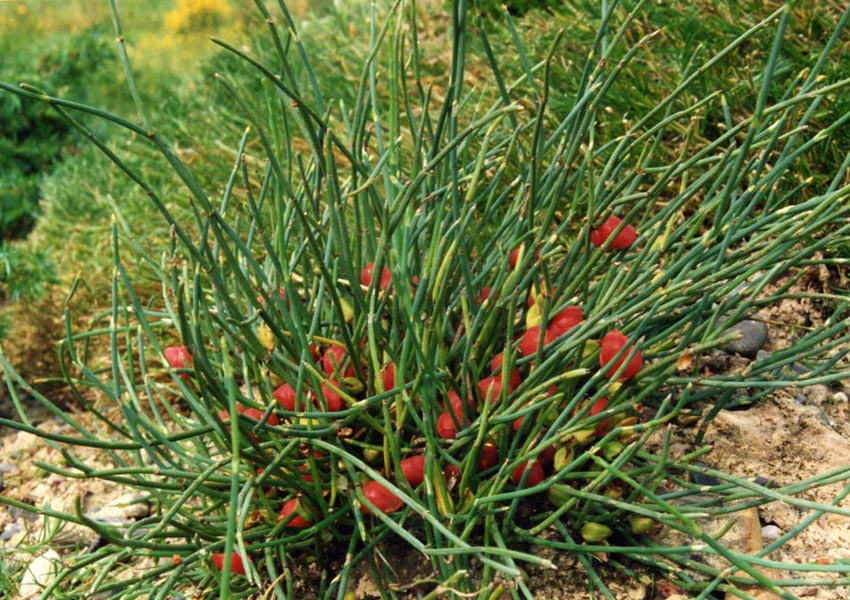
Chinese Ephedra Ephedra sinica
The scientific name of the Chinese Ephedra is Ephedra sinica. It is a species of gymnosperm in the family Ephedraceae (jointfir family), order Ephedrales.
- Scientific name
- Ephedra sinica Stapf
- Common name
- Chinese Ephedra
- Genus
- Ephedra
- Family
- Ephedraceae (Jointfir Family)
- Order
- Ephedrales
- Class
- Pinopsida
- Red List category
- LC Least Concern
- Recorded in
- 3 countries
- Name status
- accepted in the Catalogue of Life

Overview
Chinese Ephedra is a perennial, dioecious plant. It is native to Mongolia, northern China, and Russia. It contains alkaloids including ephedrine.
Written 26 November 2026 from the sources listed below. Each statement was checked against the passage it cites; statements that could not be supported were removed.
Habitat
Chinese Ephedra occurs on arid highland slopes, dry river beds, steppes, fields, and mountain sides. It also grows in shrublands and forests.[1][2]
It grows at elevations between 400 and 1,600 metres.[3]
Reproduction and life cycle
Chinese Ephedra is a perennial, dioecious plant.[4]
Appearance
The plant has a strong pine odor and an astringent taste.[5]
Uses
Chinese Ephedra has been used as a stimulant and antiasthmatic in China for more than 5,000 years. Its stems and leaves are collected and dried for medicinal use, while its roots are used in Chinese traditional medicine.[6][7][8]
In traditional medicine, the plant is used to treat colds, minor respiratory ailments, fever, and headaches. It is also used in Ephedra preparations and extracts internationally.[9][10]
Chinese Ephedra has been used as a dietary supplement for athletic performance and weight loss.[11]
The plant contains alkaloids including ephedrine. Ephedrine has sympathomimetic properties.[12][13]
Conservation
Chinese Ephedra is listed as least concern on the IUCN Red List and has a stable population. Wild harvesting is identified as a significant threat to the species.[14][15][16]
Classification of the Chinese Ephedra
| Kingdom | Plantae |
|---|---|
| Subkingdom | Pteridobiotina |
| Phylum | Tracheophyta |
| Class | Pinopsida (Conifer) |
| Subclass | Gnetidae |
| Order | Ephedrales |
| Family | Ephedraceae (Jointfir Family) |
| Genus | Ephedra (Ephedras) |
| Species | Ephedra sinica Stapf |
Where the Chinese Ephedra is found
Checklists and occurrence records place Ephedra sinica in 3 countries. GBIF holds 567 georeferenced records of it.
Countries
Regions and cities with the most records
- Shaanxi, China 50
- Hebei, China 45
- Shanxi, China 36
- Qinhuangdao, China 26
- Beijing, China 14
- Huayin, China 14
- Xilin Hot, China 11
- Xilinhot, China 11
- Ömnögovĭ, Mongolia 11
- Qinghai, China 9
- Dalandzadgad, Mongolia 8
- Gansu, China 8
- Hegang, China 7
- Heilongjiang, China 7
- Dzabkhan, Mongolia 6
- Sichuan, China 6
- Uvs Province, Mongolia 6
- Xuanhua, China 6
- Övörhangay, Mongolia 5
- Tongren, China 4
- Ulaanbaatar, Mongolia 4
- Dalain Hob, China 3
- Hovd, Mongolia 3
- Jilin, China 3
- Kaitong, China 3
- Shanhaiguan, China 3
- Sühbaatar, Mongolia 3
- Ulan Bator, Mongolia 3
2 more countries have a few records outside this range
These countries hold a few records of Ephedra sinica but lie outside the range the checklists give for it. Such records are often zoo or garden specimens, museum material or vagrants, so the species is not counted as occurring there.
A number beside a place is its count of GBIF occurrence records. A place without a number comes from a checklist alone. Records show where a species has been observed or collected, which can include escapes and vagrants.
Common names
English
- Chinese Ephedra
- Chinese Joint-fir
Names in 13 other languages
- Chinese
- Cao Ma Huang, Ma-huang, ma huang, 草麻黃, 草麻黄, 青龍、龍沙、卑相, 麻黃
- Czech
- chvojník čínský
- Dutch
- Chinese Zeedruif
- Finnish
- Kiinanefedra
- French
- Éphédra chinois
- German
- Chinesisches Meerträubel
- Japanese
- シナマオウ
- Korean
- 초마황
- Polish
- przęśl chińska
- Russian
- Хвойник китайский
- Slovak
- chvojník čínsky
- Swedish
- kinesisk efedra
- Vietnamese
- Thảo Ma Hoàng
Synonyms
3 other scientific names have been used for this species and are now treated as synonyms of Ephedra sinica.
- Ephedra flava F.P.Sm.
- Ephedra ma-huang Tang S.Liu
- Ephedra sinica var. pumila Florin
Related species
-
 Green Mormon TeaEphedra viridis
-
 European EphedraEphedra distachya
-
 Nevada EphedraEphedra nevadensis
-
 Joint PineEphedra fragilis
-
 California EphedraEphedra californica
-
 Dwarf Joint FirEphedra monosperma
-
 Death Valley JointfirEphedra funerea
-
 White Shrubby HorsetailEphedra alata
Compare
Questions and answers
What is the scientific name of the Chinese Ephedra?
The scientific name of the Chinese Ephedra is Ephedra sinica. Written with its author, the full name is Ephedra sinica Stapf.
Which family does the Chinese Ephedra belong to?
Ephedra sinica belongs to the family Ephedraceae, in the order Ephedrales and the class Pinopsida.
Where is the Chinese Ephedra found?
Checklists and occurrence records place Ephedra sinica in 3 countries: China, Mongolia and Japan.
What is the conservation status of the Chinese Ephedra?
The IUCN Red List category recorded for Ephedra sinica is Least Concern (LC).
What other names does the Chinese Ephedra have?
Ephedra sinica is also known in English as Chinese Joint-fir.
Sources
Passages the profile rests on
- The species occurs on arid highland slopes, dry river beds, steppes, fields, and mountain sides. Source passage: “it is a shrub found on arid highland slopes, dry river beds, steppes, fields or mountain sides.” — English Wikipedia
- The species grows in shrublands, forests, and mountainsides. Source passage: “The plant grows on shrublands, forests, and mountainsides” — English Wikipedia
- Ephedra sinica grows at elevations between 400 and 1,600 metres. Source passage: “The plant grows on shrublands, forests, and mountainsides between elevations of 400–1,600 m (1,300–5,200 ft).” — English Wikipedia
- Ephedra sinica is a perennial, dioecious plant. Source passage: “They are perennial and dioecious” — pmc.ncbi.nlm.nih.gov
- The plant has a strong pine odor and an astringent taste. Source passage: “E. sinica has a strong pine odor and its taste is astringent” — English Wikipedia
- Ephedra sinica has been used as a stimulant and antiasthmatic in China for more than 5,000 years. Source passage: “E. sinica Stapf is the primary species that has been used as a stimulant and as an antiasthmatic in China for more than 5,000 years” — pmc.ncbi.nlm.nih.gov
- The stems and leaves of Ephedra sinica are collected and dried for medicinal use. Source passage: “The stems and leaves are collected and dried for use” — English Wikipedia
- The roots of Ephedra sinica are used in Chinese traditional medicine. Source passage: “whereas the roots, known as "ma huang gen", are used in Chinese traditional medicine.” — English Wikipedia
- Ephedra sinica is used in Ephedra preparations and extracts internationally. Source passage: “and is still used in Ephedra preparations and extracts all around the world.” — pmc.ncbi.nlm.nih.gov
- Ephedra sinica is used in traditional medicine to treat colds, minor respiratory ailments, fever, and headaches. Source passage: “In traditional medicine, ephedra is intended to treat colds and other minor respiratory ailments, fever, and headaches.” — English Wikipedia
- Ephedra sinica has been used as a dietary supplement for athletic performance and weight loss. Source passage: “As a dietary supplement, it has been used to aid athletic performance and to lose weight.” — English Wikipedia
- Ephedra sinica contains alkaloids including ephedrine. Source passage: “E. sinica contains alkaloids, including ephedrine” — English Wikipedia
- Ephedrine, an alkaloid found in Ephedra sinica, has sympathomimetic properties. Source passage: “Ephedrine has sympathomimetic properties.” — English Wikipedia
- Ephedra sinica is listed as least concern on the IUCN Red List. Source passage: “listed as least concern on the IUCN Red List of Threatened Species.” — English Wikipedia
- The species has a stable population. Source passage: “E. sinica is a common plant in a stable population” — English Wikipedia
- Wild harvesting is identified as a significant threat to the species. Source passage: “the status of wild harvesting is unknown and a significant threat.” — English Wikipedia
Data
- Catalogue of Life, 2026-10-16 XR cc by
- Global Biodiversity Information Facility CC BY 4.0
- Wikidata CC0
- GeoNames CC BY 4.0
- Wikimedia Commons per image; credit shown with each image
- Within the Catalogue of Life, this name comes from Pinopsida from WFO cc0
References
- Bull. Misc. Inform. Kew 1927(3): 133. [12 Apr 1927] ; Read & Liu in Journ. Am. Pharm. Assoc. xvii 341 (1928), descr. ampl. Link where the name was published
- POWO record for urn:lsid:ipni.org:names:383460-1 Link
This species in other databases
- Catalogue of Life 6FPBK
- Wikidata Q2602813
- iNaturalist 135489
- World Flora Online wfo-0000794481-2026-06
- GRIN 15236
Page built on 27 November 2026. See how the catalog is made and all sources and licences.
Cite this page
ScientificNames.org. (2026). Ephedra sinica (Chinese Ephedra). Retrieved November 27, 2026, from https://scientificnames.org/species/ephedra-sinica
“Ephedra sinica (Chinese Ephedra).” ScientificNames.org, 2026, scientificnames.org/species/ephedra-sinica. Accessed 27 Nov. 2026.
ScientificNames.org. “Ephedra sinica (Chinese Ephedra).” Accessed November 27, 2026. https://scientificnames.org/species/ephedra-sinica.
@misc{scientificnames_ephedra_sinica_chinese_ephedra,
  author = {{ScientificNames.org}},
  title = {Ephedra sinica (Chinese Ephedra)},
  year = {2026},
  url = {https://scientificnames.org/species/ephedra-sinica},
  note = {Accessed 2026-11-27}
}