Species · Conifers and allies
Ephedra aurea
Ephedra aurea has no English name on record in the checklists used here. It is a species of gymnosperm in the family Ephedraceae (jointfir family), order Ephedrales.
- Scientific name
- Ephedra aurea Brullo, C.Brullo, Cambria, Ilardi, Siracusa & Giusso
- Genus
- Ephedra
- Family
- Ephedraceae (Jointfir Family)
- Order
- Ephedrales
- Class
- Pinopsida
- Recorded in
- 1 country
- Name status
- accepted in the Catalogue of Life
Classification of Ephedra aurea
| Kingdom | Plantae |
|---|---|
| Subkingdom | Pteridobiotina |
| Phylum | Tracheophyta |
| Class | Pinopsida (Conifer) |
| Subclass | Gnetidae |
| Order | Ephedrales |
| Family | Ephedraceae (Jointfir Family) |
| Genus | Ephedra (Ephedras) |
| Species | Ephedra aurea Brullo, C.Brullo, Cambria, Ilardi, Siracusa & Giusso |
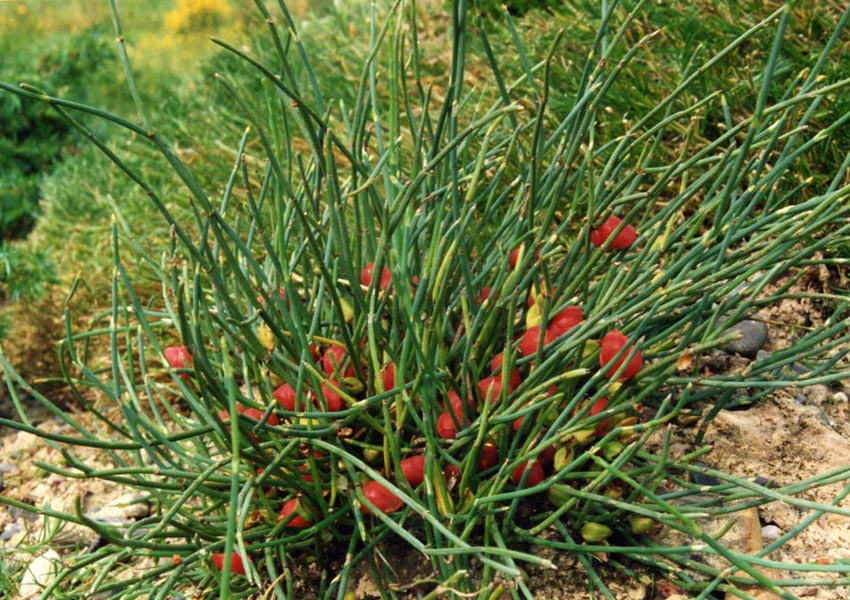
Origin of the name. Etymology: - The specific epithet means golden and refers to the colour of the ripe bracts in female cones. Phenology: - It is a dioecius plant flowering in April and producing seeds from June to July. Seed micro-morphology: - In order to verify if there are significant differences regarding the micro-sculptures of the seed testa of Ephedra aurea compared to E. nebrodensis, a SEM investigation was carried out on these species. On the basis of this research, remarkable morphological differences were found when comparing the two species. In particular, the seed coat of Ephedra aurea is characterized by longitudinally rectangular cells, rugose, 170 - 250 × 28 - 35 μm, bordered by a prominent reticulum. The anticlinal walls are quite raised, while the periclinal ones are flat (Fig. 5 A). The populations of E. nebrodensis show a seed testa characterized by shorter fusiform cells, slightly scabrous, 90 - 180 × 17 - 21 μm, delimitated by slight furrows. The anticlinal walls are furrowed, while the periclinal ones are flat or slightly convex, irregularly covered by minute papillae (Fig. 5 B). These ornamentations are very similar to those of the seeds of this species coming from Morocco investigated by Ickert-Bond & Rydin (2011, Fig. 2 D, H, L,) and identified by them as Ephedra major. FIGURE. SEM micrographs of pollen grain of Ephedra aurea (A) from type material (CAT!) and E. nebrodensis (B) from Monte Cuccio, Sicily (CAT!):. Equatorial view (x 2500) .. Polar view (x 3000). Pollen morphology: - According to literature (Iversen & Troels-Smith 1950; Welten 1957; Steeves & Barghoom 1959; Zavada & Gabarayeva 1991; Ickert-Bond et al. 2003; Punt 2007; Norback Ivarsson 2014; Bolinder et al. 2016; Bolinder 2017; Khan et al. 2018), all Ephedraceae, as well as Welwitschia, are characterized by a type of pollen grain which differs from that of the rest of the Gymnosperms and for this reason is known as ephedroid pollen. In particular, it is classified as polyplicate, with an equatorial view perprolate, rarely prolate, while the polar shape is interlobate. The ornamentations of the surface are verrucate with sculpturing rugulate. This pollen grain shows more than meridional ridges (plicae) separate by deep furrows, which can be either branched or unbranched and are called pseudosulci (Huynh 1975, Bolinder et al. 2015), since they look very similar to sulci. Indeed, the pollen of Ephedra is usually treated as inaperturate, as the exine is much thinner than over the ridges and neither the tectum nor the infratectum occur (Steeves & Barghoorn 1959; Kedves 1987; El-Ghazaly et al. 1998; Bolinder et a. 2015). According to Bolinder et al. (2016, Fig. 1) three different types of pollen can be distinguished, such as: A) pollen with unbranched pseudosulci, having a significantly higher number of plicae, usually 10 - 18, with a smaller size; B) pollen with pseudosulci with first order branched, having a lower number of plicae (4 - 8, rarely 10) showing a size slightly larger; C) similar to type B, but with pseudosulci with first and second order branching. Current knowledge based on paleopalynogical records regarding the morphological diversity of Ephedra (Ickert-Bond et al., 2009; Rydin et al., 2010; Bolinder et al., 2015, 2016) emphasized that the type A pollen is more ancestral than types B and C ones, noting an intrinsic relationship between the pollen form and pollination syndromes. In fact, pollen with unbranched pseudosulci is linked to insect-pollination, which represents the more ancestral reproductive strategy in Ephedra, but does also occur in some presumably wind-pollinated species (Bolinder et al. 2016). Pollen grains of types B and C occur are far as known always associated with anemophilous pollination (Bolinder et al. 2016). The polyplicate pollen grains of Ephedra are very similar to those of Welwitschia, but the latter differ in being monosulcate with a single and broad sulcus, whereas Ephedra pollen is inaperturate with psedosulci. According to Doyle & Donoghue (1986), aperturate monosulcate pollen is considered ancestral in the Gnetales, while polyplicate inaperturate pollen is interpreted as derived. Micromorphological investigations carried out on pollen grains of Ephedra aurea and on those of the closely related E. nebrodensis emphasized that they are very different in size and shape. In particular, E. aurea shows pollen of type A, characterized by 11 - 12 plicae, very compact and acute on the back, ca. 4 μm high ,, with unbranched and linear line in the groves (corresponding to pseudosulci), the absolute size (equatorial lenght and diameter) is 43 - 48 × 17 - 20 μm (Fig. 6 A). As regards to the pollen of the Sicilian populations of E. nebrodensis, it is quite similar to that already known of other Mediterranean populations of this species previously analyzed by other authors (Welten 1957; Steeves & Barghoorn 1959; Norback Ivarsson 2014). The pollen of this species is of type C, with 5 - 7 plicae, quite spaced and rounded on the back, 6 - 6.5 μm high, rather smooth on the surface, with first and second order branches on the pseudosulci, which are very irregular, the absolute size is 46 - 50 × 20 μm (Fig. 6 B). Therefore, these two species, basing on the pollen peculiarities, are completely differentiated not only morphologically, but also from an evolutionary point of view. In fact, as already highlighted, E. aurea has an ancestral type of pollen that may involve insect-pollination, while in E. nebrodensis the pollen represents a derived type which is linked to wind-pollination.
Where Ephedra aurea is found
Checklists and occurrence records place Ephedra aurea in 1 country across Europe. GBIF holds 10 georeferenced records of it.
Countries
Regions and cities with the most records
1 more country has a few records outside this range
These countries hold a few records of Ephedra aurea but lie outside the range the checklists give for it. Such records are often zoo or garden specimens, museum material or vagrants, so the species is not counted as occurring there.
Range as the checklists state it
Sicily
A number beside a place is its count of GBIF occurrence records. A place without a number comes from a checklist alone. Records show where a species has been observed or collected, which can include escapes and vagrants.
Synonyms
One other scientific name has been used for this species and is now treated as a synonym of Ephedra aurea.
- Ephedra fragilis var. aurea (Brullo, C.Brullo, Cambria, Ilardi, Siracusa & Giusso) El Mokni, Barone, Freitag & Domina
Related species
-
 Chinese EphedraEphedra sinica
-
 JointfirEphedra viridis
-
 Sea GrapeEphedra distachya
-
 Mormon TeaEphedra nevadensis
-
 Joint PineEphedra fragilis
-
 Desert TeaEphedra californica
-
 Dwarf Joint FirEphedra monosperma
-
 Death Valley Mormon TeaEphedra funerea
Compare
Sources
Data
- Catalogue of Life, 2026-10-16 XR cc by
- Global Biodiversity Information Facility CC BY 4.0
- GeoNames CC BY 4.0
- Within the Catalogue of Life, this name comes from Pinopsida from WFO cc0
References
- BRULLO, S., BRULLO, C., CAMBRIA, S., ILARDI, V., SIRACUSA, G., & GIUSSO DEL GALDO, G. (2022). Ephedra aurea (Ephedraceae), a new species from Sicily. Phytotaxa, 530(1), 1–20. https://doi.org/10.11646/phytotaxa.530.1.1 Link where the name was published
- POWO record for urn:lsid:ipni.org:names:77235189-1 Link
This species in other databases
Page built on 26 November 2026. See how the catalog is made and all sources and licences.
Cite this page
ScientificNames.org. (2026). Ephedra aurea. Retrieved November 26, 2026, from https://scientificnames.org/species/ephedra-aurea
“Ephedra aurea.” ScientificNames.org, 2026, scientificnames.org/species/ephedra-aurea. Accessed 26 Nov. 2026.
ScientificNames.org. “Ephedra aurea.” Accessed November 26, 2026. https://scientificnames.org/species/ephedra-aurea.
@misc{scientificnames_ephedra_aurea,
  author = {{ScientificNames.org}},
  title = {Ephedra aurea},
  year = {2026},
  url = {https://scientificnames.org/species/ephedra-aurea},
  note = {Accessed 2026-11-26}
}