Species · Conifers and allies
Navajo Ephedra Ephedra cutleri
The scientific name of the Navajo Ephedra is Ephedra cutleri. It is a species of gymnosperm in the family Ephedraceae (jointfir family), order Ephedrales.
- Scientific name
- Ephedra cutleri Peebles
- Common name
- Navajo Ephedra
- Genus
- Ephedra
- Family
- Ephedraceae (Jointfir Family)
- Order
- Ephedrales
- Class
- Pinopsida
- Red List category
- LC Least Concern
- Recorded in
- 1 country
- Name status
- accepted in the Catalogue of Life

Overview
Navajo Ephedra (Ephedra cutleri Peebles) is a rhizomatous shrub in the family Ephedraceae, order Ephedrales, and class Pinopsida. It is native to the southwestern United States, with a recorded distribution in Arizona, New Mexico, Utah, Colorado, Nevada, and Wyoming. It has sticky, olive-green photosynthetic stems and strong rhizomes that form coppice dunes.
Written 27 November 2026 from the sources listed below. Each statement was checked against the passage it cites; statements that could not be supported were removed.
Appearance
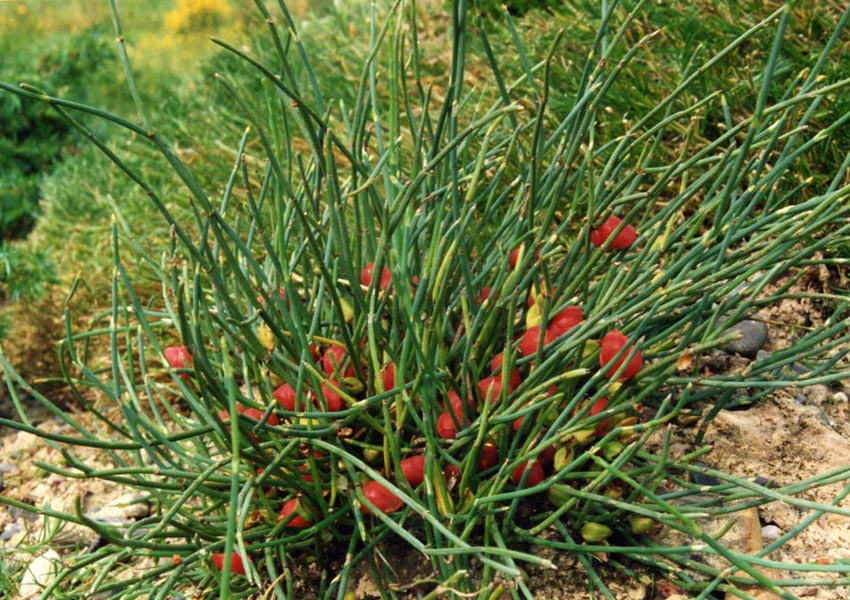
Navajo Ephedra grows as a rhizomatous shrub forming erect clumps. Its stems are sticky, viscid, and olive-green, and perform photosynthesis because its leaves are too small to do so.[1][2][3]
Its colonies often reach diameters of ten to fifteen feet.[4]
Habitat
Navajo Ephedra grows on flat, dry sandy areas and occasionally on rocky slopes. In northeastern Arizona, it occurs in areas dominated by dry, loamy, fine sand surface layers of Sheppard series soils.[5][6][7]
It prefers stabilized dunes at higher elevations.[8]
Diet
Navajo Ephedra provides a food source for animals.[9]
Behaviour
Navajo Ephedra commonly occurs in dense colonies near other colonies. Small mammals are its usual dispersal agents.[10][11]
Reproduction and life cycle
Navajo Ephedra is rhizomatous, with strong rhizomes contributing to the formation of coppice dunes.[12][13]
Uses
The species has been used to produce light tan or reddish dyes and to tan animal hides.[14][15]
Similar species
Navajo Ephedra has leaves and bracts arranged in pairs, a feature it shares with Ephedra viridis and Ephedra nevadensis.[16]
Several floras classify Ephedra cutleri as Ephedra viridis var. viscida.[17]
Classification of the Navajo Ephedra
| Kingdom | Plantae |
|---|---|
| Subkingdom | Pteridobiotina |
| Phylum | Tracheophyta |
| Class | Pinopsida (Conifer) |
| Subclass | Gnetidae |
| Order | Ephedrales |
| Family | Ephedraceae (Jointfir Family) |
| Genus | Ephedra (Ephedras) |
| Species | Ephedra cutleri Peebles |
Where the Navajo Ephedra is found
Checklists and occurrence records place Ephedra cutleri in 1 country. GBIF holds 527 georeferenced records of it.
Countries
Regions and cities with the most records
- Utah, United States 84
- Arizona, United States 82
- New Mexico, United States 45
- Colorado, United States 20
- Farmington, United States 11
- Nevada, United States 4
A number beside a place is its count of GBIF occurrence records. A place without a number comes from a checklist alone. Records show where a species has been observed or collected, which can include escapes and vagrants.
Common names
English
- Navajo Ephedra
- Cutler Morning-tea
- Cutler's Ephedra
- Cutler's Jointfir
- Three-forked Ephedra
Names in 2 other languages
- Chinese
- 摩門茶, 納瓦霍麻黃
- Dutch
- Cutler's Zeedruif
Synonyms
4 other scientific names have been used for this species and are now treated as synonyms of Ephedra cutleri.
- Ephedra coryi subsp. viscida E.L.Reed
- Ephedra coryi var. viscida H.C.Cutler
- Ephedra viridis subsp. viscida Colville
- Ephedra viridis var. viscida (H.C.Cutler) L.D.Benson
Related species
-
 Chinese EphedraEphedra sinica
-
 Green Mormon TeaEphedra viridis
-
 European EphedraEphedra distachya
-
 Nevada EphedraEphedra nevadensis
-
 Joint PineEphedra fragilis
-
 California EphedraEphedra californica
-
 Dwarf Joint FirEphedra monosperma
-
 Death Valley JointfirEphedra funerea
Compare
Questions and answers
What is the scientific name of the Navajo Ephedra?
The scientific name of the Navajo Ephedra is Ephedra cutleri. Written with its author, the full name is Ephedra cutleri Peebles.
Which family does the Navajo Ephedra belong to?
Ephedra cutleri belongs to the family Ephedraceae, in the order Ephedrales and the class Pinopsida.
Where is the Navajo Ephedra found?
Checklists and occurrence records place Ephedra cutleri in 1 country: United States.
What is the conservation status of the Navajo Ephedra?
The IUCN Red List category recorded for Ephedra cutleri is Least Concern (LC).
What other names does the Navajo Ephedra have?
Ephedra cutleri is also known in English as Cutler Morning-tea, Cutler's Ephedra, Cutler's Jointfir and Three-forked Ephedra.
Sources
Passages the profile rests on
- The species grows as a rhizomatous shrub forming erect clumps. Source passage: “The rhizomatous shrubs form erect clumps” — English Wikipedia
- Its stems are sticky and perform photosynthesis because its leaves are too small to do so. Source passage: “Because the leaves are too small to perform photosynthesis, it is conducted in the sticky stems of the plant.” — English Wikipedia
- Ephedra cutleri has viscid, olive-green stems. Source passage: “Ephedra cutleri has viscid, olive green stems” — uvu.edu
- Its colonies often reach diameters of ten to fifteen feet. Source passage: “often ten to fifteen feet in diameter” — uvu.edu
- The species grows on flat, dry sandy areas. Source passage: “It grows on flat and dry sandy areas” — English Wikipedia
- It occasionally grows on rocky slopes. Source passage: “and occasionally on rocky slopes.” — English Wikipedia
- In northeastern Arizona, it occurs in areas dominated by dry, loamy, fine sand surface layers of Sheppard series soils. Source passage: “dry, loamy, fine sand surfaced layers of Sheppard series soils dominate” — English Wikipedia
- Stabilized dunes are preferred by the species at higher elevations. Source passage: “Stabilized dunes are preferred at higher elevations.” — English Wikipedia
- The species provides a food source for animals. Source passage: “A food source for animals” — English Wikipedia
- Small mammals are identified as the species' usual dispersal agents. Source passage: “Dispersal method is normally small mammals.” — English Wikipedia
- The species commonly occurs in dense colonies near other colonies. Source passage: “with many other dense colonies nearby.” — uvu.edu
- It forms coppice dunes through the action of its strong rhizomes. Source passage: “form coppice dunes due their strong rhizomes.” — English Wikipedia
- The species is rhizomatous, with strong rhizomes contributing to the formation of coppice dunes. Source passage: “form coppice dunes due their strong rhizomes.” — English Wikipedia
- The species has been used to produce light tan or reddish dyes. Source passage: “used for making light tan or reddish dyes” — English Wikipedia
- The species has been used in tanning animal hides. Source passage: “as well as used in the process of tanning animal hides.” — English Wikipedia
- Ephedra cutleri has leaves and bracts arranged in pairs, a feature it shares with Ephedra viridis and Ephedra nevadensis. Source passage: “Ephedra virdis, E. cutleri, and E. nevadensis have leaves and bracts in twos” — uvu.edu
- Several floras classify Ephedra cutleri as Ephedra viridis var. viscida. Source passage: “Several floras consider E. cutleri to be E. viridis var. viscida” — uvu.edu
- The species is native to the southwestern United States. Source passage: “is a species of Ephedra that is native to the Southwestern United States” — English Wikipedia
- Its recorded native distribution includes Arizona, New Mexico, Utah, Colorado, Nevada, and Wyoming. Source passage: “Arizona, New Mexico, Utah, Colorado, Nevada, Wyoming” — English Wikipedia
Data
- Catalogue of Life, 2026-10-16 XR cc by
- Global Biodiversity Information Facility CC BY 4.0
- Wikidata CC0
- GeoNames CC BY 4.0
- Wikimedia Commons per image; credit shown with each image
- Within the Catalogue of Life, this name comes from Pinopsida from WFO cc0
References
- J. Wash. Acad. Sci. 30: 473. 1940 Link where the name was published
- POWO record for urn:lsid:ipni.org:names:91128-2 Link
This species in other databases
Page built on 28 November 2026. See how the catalog is made and all sources and licences.
Cite this page
ScientificNames.org. (2026). Ephedra cutleri (Navajo Ephedra). Retrieved November 28, 2026, from https://scientificnames.org/species/ephedra-cutleri
“Ephedra cutleri (Navajo Ephedra).” ScientificNames.org, 2026, scientificnames.org/species/ephedra-cutleri. Accessed 28 Nov. 2026.
ScientificNames.org. “Ephedra cutleri (Navajo Ephedra).” Accessed November 28, 2026. https://scientificnames.org/species/ephedra-cutleri.
@misc{scientificnames_ephedra_cutleri_navajo_ephedra,
  author = {{ScientificNames.org}},
  title = {Ephedra cutleri (Navajo Ephedra)},
  year = {2026},
  url = {https://scientificnames.org/species/ephedra-cutleri},
  note = {Accessed 2026-11-28}
}